Parameter-free deformation variables of the proxy-SU(3) symmetry in even-even atomic nuclei with Z=28-82, N=28-126
Pith reviewed 2026-05-10 15:34 UTC · model grok-4.3
The pith
Proxy-SU(3) symmetry predicts nuclear deformation variables beta and gamma parameter-free for even-even nuclei with Z=28-82 and N=28-126.
A machine-rendered reading of the paper's core claim, the machinery that carries it, and where it could break.
Core claim
The proxy-SU(3) approximation predicts the collective deformation variables beta and gamma of even-even atomic nuclei in a parameter-free way, based on the most symmetric irreducible representation of SU(3) allowed by the Pauli principle and the short-range nature of the nucleon-nucleon interaction, which in group theoretical language is the highest weight irrep. In the few cases in which the hw irrep turns out to be completely symmetric and able to accommodate only the ground state band, the next hw irrep becomes indispensable. Complete tables of the hw and nhw irreps are given for all nuclei from Z=28, N=28 to Z=82, N=126, along with the corresponding parameter-free predictions for beta, 2
What carries the argument
The highest-weight (hw) irreducible representation of SU(3) under the proxy-SU(3) mapping, which selects the most symmetric allowed state to fix the ground-state deformation variables beta and gamma.
If this is right
- The tabulated hw and nhw irreps directly yield beta and gamma values that can be compared to measured deformations throughout the given nuclear range.
- When the hw irrep is fully symmetric, switching to the nhw irrep supplies the additional states needed for collective bands.
- The assignments provide a group-theoretical explanation for the onset and variation of deformation in different mass regions.
- The same parameter-free procedure applies uniformly from the lightest to the heaviest nuclei in the stated window.
Where Pith is reading between the lines
- If the predictions hold, the dominant contribution to ground-state nuclear shapes in this range arises from symmetry selection rules rather than from details of the residual interaction.
- The tables could be used as a starting point for calculations that later add configuration mixing to refine energies or transition rates.
- Similar proxy mappings might be constructed for nuclei outside the stated Z and N limits provided the underlying harmonic-oscillator shell structure remains valid.
Load-bearing premise
The proxy-SU(3) mapping together with automatic choice of the highest-weight or next-highest-weight irrep is enough to fix ground-state beta and gamma accurately across the full range without corrections from the complete shell-model Hamiltonian or configuration mixing.
What would settle it
A precise experimental measurement of beta for any even-even nucleus in the Z=28-82, N=28-126 range that differs substantially from the tabulated prediction based on its hw or nhw irrep.
Figures


read the original abstract
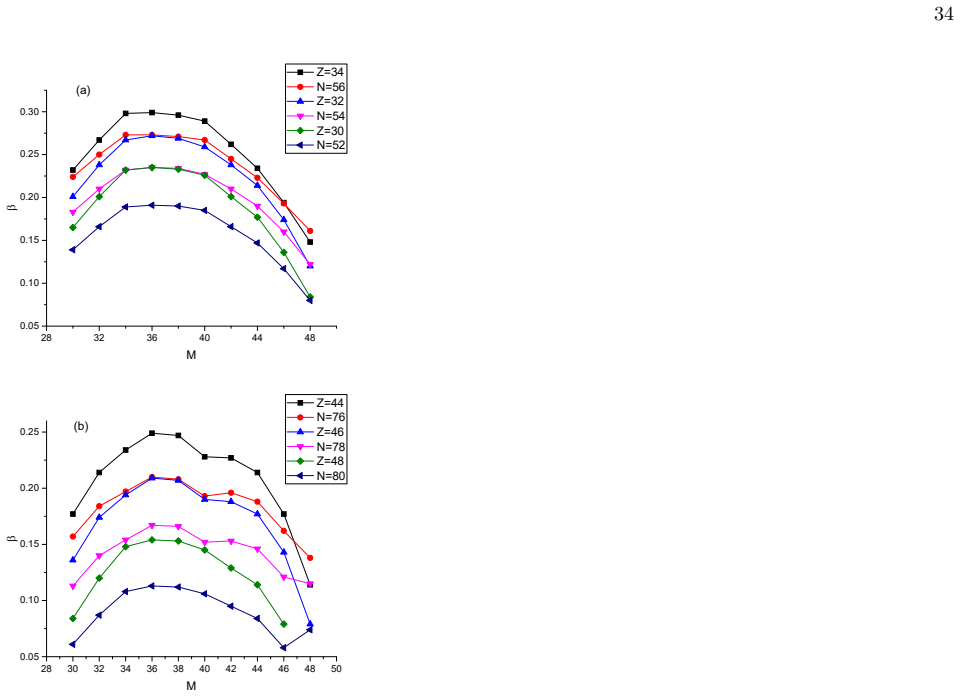
The proxy-SU(3) approximation to the shell model, which restores the SU(3) symmetry of the 3-dimensional harmonic oscillator beyond the sd shell, predicts the collective deformation variables beta and gamma of even-even atomic nuclei in a parameter-free way, based on the most symmetric irreducible representation (irrep) of SU(3) allowed by the Pauli principle and the short-range nature of the nucleon-nucleon interaction, which in group theoretical language is the highest weight (hw) irrep. In the few cases in which the hw irrep turns out to be completely symmetric, thus being able to accommodate only the ground state band, the next hw (nhw) irrep becomes indispensable. In the present article complete tables of the hw and nhw irreps are given for all atomic nuclei ranging from Z=28, N=28 to Z=82, N=126, along with the corresponding parameter-free predictions for the deformation variables beta and gamma. A few examples using the tabulated results for providing microscopic insight for specific effects in various regions of the nuclear chart are also given.
Editorial analysis
A structured set of objections, weighed in public.
Referee Report
Summary. The manuscript tabulates the highest-weight (hw) and next-highest-weight (nhw) SU(3) irreducible representations for all even-even nuclei with 28 ≤ Z ≤ 82 and 28 ≤ N ≤ 126 within the proxy-SU(3) approximation to the shell model. These irreps are selected by the Pauli principle and the short-range character of the nucleon-nucleon interaction; the corresponding (λ, μ) labels are then converted to parameter-free predictions for the collective deformation variables β and γ. A small number of illustrative examples are given to show how the tabulated values can furnish microscopic insight into specific nuclear phenomena.
Significance. If the central mapping holds, the work supplies a fully parameter-free, symmetry-based route to nuclear deformations over a wide swath of the chart, together with exhaustive tables that can be used directly by the community. The explicit construction from group labels and the absence of fitted parameters constitute a clear methodological strength, especially for regions where large-scale shell-model diagonalizations remain prohibitive.
major comments (2)
- [§4] §4 (examples): the claim that the hw/nhw irrep furnishes the ground-state β and γ rests on the assumption that configuration mixing and non-SU(3) terms in the realistic Hamiltonian do not shift the ground state away from this irrep. No quantitative comparison of the predicted β, γ values to experimental data or to full shell-model results is presented for any of the illustrated cases, leaving the size of the approximation error untested.
- [Tables 1–10] Tables 1–10 (hw/nhw tabulations): the conversion from (λ, μ) to β and γ is performed with a fixed, parameter-free formula, but the manuscript does not state the explicit expression used (or its reference) nor provide uncertainty estimates arising from the proxy-orbital mapping itself. This omission makes it impossible to judge how sensitive the tabulated deformations are to the details of the proxy construction.
minor comments (2)
- The notation for the deformation variables (β, γ) is introduced without a brief reminder of the standard Bohr-Mottelson definitions; a single sentence would improve readability for readers outside nuclear structure.
- A few table entries list the same (λ, μ) for both hw and nhw; a footnote clarifying when this occurs (completely symmetric irreps) would prevent confusion.
Simulated Author's Rebuttal
We thank the referee for the positive assessment of the significance of our work and for the constructive comments. We respond point by point to the major comments below, indicating where revisions will be incorporated.
read point-by-point responses
-
Referee: [§4] §4 (examples): the claim that the hw/nhw irrep furnishes the ground-state β and γ rests on the assumption that configuration mixing and non-SU(3) terms in the realistic Hamiltonian do not shift the ground state away from this irrep. No quantitative comparison of the predicted β, γ values to experimental data or to full shell-model results is presented for any of the illustrated cases, leaving the size of the approximation error untested.
Authors: We acknowledge that the manuscript presents no quantitative comparisons of the predicted β and γ values to experimental data or full shell-model results in §4. The examples are intended to illustrate how the tabulated hw/nhw irreps can furnish microscopic insight into specific nuclear phenomena, rather than to serve as a systematic validation of the approximation. The underlying assumption—that the hw (or nhw) irrep dominates the ground state—is inherent to the proxy-SU(3) framework, which selects the most symmetric allowed irrep on the basis of the Pauli principle and the short-range character of the nucleon-nucleon interaction. We agree that an explicit discussion of the possible effects of configuration mixing and non-SU(3) terms would strengthen the presentation. In the revised manuscript we will expand the introductory paragraph of §4 to state these assumptions clearly and to note that the size of the approximation error is left for future quantitative studies, while emphasizing that the current work focuses on delivering the complete, parameter-free tabulation. revision: partial
-
Referee: [Tables 1–10] Tables 1–10 (hw/nhw tabulations): the conversion from (λ, μ) to β and γ is performed with a fixed, parameter-free formula, but the manuscript does not state the explicit expression used (or its reference) nor provide uncertainty estimates arising from the proxy-orbital mapping itself. This omission makes it impossible to judge how sensitive the tabulated deformations are to the details of the proxy construction.
Authors: We thank the referee for identifying this omission. The conversion from the SU(3) labels (λ, μ) to the deformation parameters β and γ employs the standard, parameter-free relations derived from the quadratic Casimir operator of SU(3) and the mapping to the collective quadrupole deformation (as introduced in the original proxy-SU(3) papers). We will add the explicit expressions together with the appropriate references in the revised manuscript, most naturally in the paragraph preceding the tables. With regard to uncertainty estimates, the proxy-orbital mapping is fixed by construction to restore the SU(3) symmetry of the harmonic oscillator as accurately as possible within each major shell; the scheme is therefore parameter-free by design. We will nevertheless insert a concise discussion of the robustness of the proxy construction, referencing earlier works that examined its accuracy, so that readers can assess the sensitivity of the tabulated values to the details of the mapping. revision: yes
Circularity Check
No circularity: beta/gamma predictions follow directly from hw/nhw irrep selection via fixed SU(3) mapping
full rationale
The derivation selects the highest-weight (or next-highest-weight) SU(3) irrep for each nucleus using the Pauli principle plus the short-range NN interaction rule, then converts the resulting (lambda, mu) labels to beta and gamma through the standard, parameter-free SU(3) deformation formulas. No step fits parameters to data or renames a fitted quantity as a prediction; the output is not equivalent to the input by construction. Self-citations to prior proxy-SU(3) papers exist but are not load-bearing for the central mapping, which remains independent and externally falsifiable against measured deformations.
Axiom & Free-Parameter Ledger
axioms (2)
- domain assumption Proxy-SU(3) restores an effective SU(3) symmetry of the 3D harmonic oscillator beyond the sd shell
- domain assumption The Pauli principle together with the short-range attractive nucleon-nucleon interaction selects the highest-weight irrep
Reference graph
Works this paper leans on
-
[1]
On the Consequences of the Symmetry of the Nuclear Hamiltonian on the Spectroscopy of Nuclei
Wigner, E. On the Consequences of the Symmetry of the Nuclear Hamiltonian on the Spectroscopy of Nuclei. Phys. Rev.1937,51, 106
work page 1937
-
[2]
Nobel Foundation.Nobel Lectures, Physics 1963-1970; Elsevier: Amsterdam, The Netherlands, 1972
work page 1963
-
[3]
Mayer, M. G. On Closed Shells in Nuclei.Phys. Rev. 1948,74, 235
work page 1948
-
[4]
Mayer, M. G. On Closed Shells in Nuclei. II.Phys. Rev. 1949,75, 1969
work page 1949
-
[5]
Haxel, O.; Jensen, J. H. D.; Suess, H. E. On the ”Magic Numbers” in Nuclear Structure.Phys. Rev.1949,75, 1766
work page 1949
-
[6]
Mayer, M. G.; Jensen, J. H. D.Elementary Theory of Nuclear Shell Structure; Wiley: New York, 1955
work page 1955
-
[7]
Heyde, K. L. G.The Nuclear Shell Model; Springer: Berlin, 1990
work page 1990
-
[8]
Talmi, I.Simple Models of Complex Nuclei: The Shell Model and the Interacting Boson Model; Harwood: Chur, 1993
work page 1993
-
[9]
G.Classical Groups for Physicists; Wi- ley: New York, NY, USA, 1974
Wybourne, B. G.Classical Groups for Physicists; Wi- ley: New York, NY, USA, 1974
work page 1974
-
[10]
F.The Harmonic Oscil- lator in Modern Physics; Harwood: Amsterdam, 1996
Moshinsky, M.; Smirnov, Yu. F.The Harmonic Oscil- lator in Modern Physics; Harwood: Amsterdam, 1996
work page 1996
-
[11]
Iachello, F.Lie Algebras and Applications; Springer: Berlin, 2006
work page 2006
-
[12]
Exact boson mappings for nuclear neutron (proton) shell-model algebras having SU(3) subalgebras.Ann
Bonatsos, D.; Klein, A. Exact boson mappings for nuclear neutron (proton) shell-model algebras having SU(3) subalgebras.Ann. Phys. (NY)1986,169, 61
work page 1986
-
[13]
Elliott, J. P. Collective motion in the nuclear shell model. I. Classification schemes for states of mixed con- figurations.Proc. Roy. Soc. A Ser. A1958,245, 128
-
[14]
Elliott, J. P. Collective motion in the nuclear shell model II. The introduction of intrinsic wave-functions.Proc. Roy. Soc. A Ser. A1958,245, 562
-
[15]
Elliott, J. P.; Harvey, M. Collective motion in the nu- clear shell model III. The calculation of spectra.Proc. Roy. Soc. A Ser. A1963,272, 557
-
[16]
Elliott , J. P.; Wilsdon, C. E. Collective motion in the nuclear shell model IV. Odd-mass nuclei in the sd shell. Proc. Roy. Soc. A Ser. A1968,302, 509
-
[17]
Harvey, M. The nuclear SU 3 model.Adv. Nucl. Phys. 1968,1, 67; M. Baranger, M., Vogt, E., Eds.; Plenum: New York
work page 1968
-
[18]
The coupling of nuclear surface oscillations to the motion of individual nucleons
Bohr, A. The coupling of nuclear surface oscillations to the motion of individual nucleons. Dan. Mat. Fys. Medd.1952, 26, no. 14
work page 1952
-
[19]
Bohr, A.; Mottelson, B. R. Collective and individual- particle aspects of nuclear structure.Dan. Mat. Fys. Medd.1953,27, no. 16
work page 1953
-
[20]
Bohr, A.; Mottelson, B. R.Nuclear Structure Vol. I: Single-Particle Motion; World Scientific: Singapore, 1998
work page 1998
-
[21]
Bohr, A.; Mottelson, B. R.Nuclear Structure Vol. II: Nuclear Deformations; World Scientific: Singapore, 1998
work page 1998
-
[22]
Kota, V. K. B.SU(3) symmetry in atomic nuclei; Springer Nature: Singapore, 2020
work page 2020
-
[23]
Pseudo LS coupling and pseudo SU3 coupling schemes.Phys
Arima, A.; Harvey, M.; Shimizu, K. Pseudo LS coupling and pseudo SU3 coupling schemes.Phys. Lett. B1969, 30, 517
-
[24]
Hecht, K. T.; Adler, A. Generalized seniority for fa- voredJ̸= 0 pairs in mixed configurations.Nucl. Phys. A1969,137, 129
-
[25]
Ratna Raju, R. D.; Draayer, J. P.; Hecht, K. T. Search 24 for a coupling scheme in heavy deformed nuclei: The pseudo SU(3) model.Nucl. Phys. A1973,202, 433
-
[26]
Draayer, J. P.; Weeks, K. J.; Hecht, K. T. Strength of theQ π ·Q ν interaction and the strong-coupled pseudo- SU(3) limit.Nucl. Phys. A1982,381, 1
-
[27]
Draayer, J. P.; Weeks, K. J. Shell-Model Description of the Low-Energy Structure of Strongly Deformed Nuclei. Phys. Rev. Lett.1983,51, 1422
work page 1983
-
[28]
Draayer, J. P.; Weeks, K. J. Towards a shell model de- scription of the low-energy structure of deformed nuclei I. Even-even systems.Ann. Phys. (NY)1984,156, 41
work page 1984
-
[29]
Bahri, C.; Draayer, J. P.; Moszkowski, S. A. Pseudospin symmetry in nuclear physics.Phys. Rev. Lett.1992,68, 2133
work page 1992
-
[30]
Ginocchio, J. N. Pseudospin as a Relativistic Symmetry. Phys. Rev. Lett.1997,78, 436
work page 1997
-
[31]
P.; Retamosa, J.; Poves, A.; Caurier, E
Zuker, A. P.; Retamosa, J.; Poves, A.; Caurier, E. Spherical shell model description of rotational motion. Phys. Rev. C1995,52, R1741(R)
-
[32]
P.; Poves, A.; Nowacki, F.; Lenzi, S
Zuker, A. P.; Poves, A.; Nowacki, F.; Lenzi, S. M. Nilsson-SU3 self-consistency in heavy N=Z nuclei.Phys. Rev. C2015,92, 024320
-
[33]
E.; Minkov, N.; Martinou, A.; Cakirli, R
Bonatsos, D.; Assimakis, I. E.; Minkov, N.; Martinou, A.; Cakirli, R. B.; Casten, R. F.; Blaum, K. Proxy- SU(3) symmetry in heavy deformed nuclei.Phys. Rev. C2017,95, 064325
-
[34]
E.; Minkov, N.; Martinou, A.; Sarantopoulou, S.; Cakirli, R
Bonatsos, D.; Assimakis, I. E.; Minkov, N.; Martinou, A.; Sarantopoulou, S.; Cakirli, R. B.; Casten, R. F.; Blaum, K. Analytic predictions for nuclear shapes, pro- late dominance, and the prolate-oblate shape transi- tion in the proxy-SU(3) model.Phys. Rev. C2017,95, 064326
-
[35]
Bonatsos, D.; Martinou, A.; Peroulis, S. K.; Mertz- imekis, T. J.; Minkov, N. The Proxy-SU(3) Symmetry in Atomic Nuclei.Symmetry2023,15, 169
-
[36]
Dytrych, T.; Sviratcheva, K. D.; Draayer, J. P.; Bahri, C.; Vary, J. P. Ab initio symplectic no-core shell model. J. Phys. G: Nucl. Part. Phys.2008,35, 123101
work page 2008
-
[37]
Launey, K. D.; Draayer, J. P.; Dytrych, T.; Sun, G.-H.; Dong, S.-H. Approximate symmetries in atomic nuclei from a large-scale shell-model perspective.Int. J. Mod. Phys. E2015,24, 1530005
-
[38]
Launey, K. D.; Dytrych, T.; Draayer, J. P. Symmetry- guided large-scale shell-model theory.Prog. Part. Nucl. Phys.2016,89, 101
work page 2016
-
[39]
Launey, K. D.; Dytrych, T.; Sargsyan, G. H.; Baker, R. B.; Draayer, J. P. Emergent symplectic symmetry in atomic nuclei: Ab initio symmetry-adapted no-core shell model.Eur. Phys. J. Special Topics2020,229, 2429
-
[40]
Launey, K. D.; Mercenne, A.; Dytrych, T. Nuclear Dynamics and Reactions in the Ab Initio Symmetry- Adapted Framework.Annu. Rev. Nucl. Part. Sci.2021, 71, 253
work page 2021
-
[41]
Rosensteel, G.; Rowe, D. J. Nuclear Sp(3,R) Model. Phys. Rev. Lett.1977,38, 10
work page 1977
-
[42]
J.; On the algebraic formula- tion of collective models III
Rosensteel, G.; Rowe, D. J.; On the algebraic formula- tion of collective models III. The symplectic shell model of collective motion.Ann. Phys. (NY)1980,126, 343
work page 1980
-
[43]
Rowe, D. J. Microscopic theory of the nuclear collective model.Rep. Prog. Phys.1985,48, 1419
work page 1985
-
[44]
Navr´ atil, P.; Vary, J. P.; Barrett, B. R. Properties of 12C in the Ab Initio Nuclear Shell Model.Phys. Rev. Lett.2000,84, 5728
work page 2000
-
[45]
Navr´ atil, P.; Vary, J. P.; Barrett, B. R. Large-basis ab initio no-core shell model and its application to 12C. Phys. Rev. C2000,62, 054311
-
[46]
Honma, M.; Mizusaki, T.; Otsuka, T. Diagonaliza- tion of Hamiltonians for Many-Body Systems by Auxil- iary Field Quantum Monte Carlo Technique.Phys. Rev. Lett.1995,75, 1284
work page 1995
-
[47]
Nuclear Shell Model by the Quantum Monte Carlo Diagonalization Method.Phys
Honma, M.; Mizusaki, T.; Otsuka, T. Nuclear Shell Model by the Quantum Monte Carlo Diagonalization Method.Phys. Rev. Lett.1996,77, 3315
work page 1996
-
[48]
Quantum Monte Carlo diagonalization with angular momentum projec- tion.Phys
Mizusaki, T.; Honma, M.; Otsuka, T. Quantum Monte Carlo diagonalization with angular momentum projec- tion.Phys. Rev. C1996,53, 2786
-
[49]
Struc- ture of the N=Z=28 Closed Shell Studied by Monte Carlo Shell Model Calculation.Phys
Otsuka, T.; Michio Honma, M.; Mizusaki, T. Struc- ture of the N=Z=28 Closed Shell Studied by Monte Carlo Shell Model Calculation.Phys. Rev. Lett.1998, 81, 1588
work page 1998
-
[50]
Monte Carlo shell model for atomic nuclei
Otsuka, T.; Honma, M.; Mizusaki, T.; Shimizu, N.; Ut- suno, Y. Monte Carlo shell model for atomic nuclei. Prog. Part. Nucl. Phys.2001,47, 319
work page 2001
-
[51]
Transition from Spherical to Deformed Shapes of Nu- clei in the Monte Carlo Shell Model.Phys
Shimizu, N.; Otsuka, T.; Mizusaki, T.; Honma, M. Transition from Spherical to Deformed Shapes of Nu- clei in the Monte Carlo Shell Model.Phys. Rev. Lett. 2001,86, 1171
work page 2001
-
[52]
Emerging concepts in nuclear structure based on the shell model.Physics2022,4, 258
Otsuka, T. Emerging concepts in nuclear structure based on the shell model.Physics2022,4, 258
-
[53]
Prevailing triaxial shapes in atomic nuclei and a quantum theory of rotation of composite objects
Otsuka, T.; Tsunoda, Y.; Shimizu, N.; Utsuno, Y.; Abe, T.; Ueno, H. Prevailing triaxial shapes in atomic nuclei and a quantum theory of rotation of composite objects. Eur. Phys. J. A2025,61, 126
-
[54]
Collective Nuclear States as Rep- resentations of a SU(6) GroupPhys
Arima, A.; Iachello, F. Collective Nuclear States as Rep- resentations of a SU(6) GroupPhys. Rev. Lett.1975, 35, 1069
work page 1975
-
[55]
Interacting boson model of col- lective states I
Arima, A.;Iachello, F. Interacting boson model of col- lective states I. The vibrational limit.Ann. Phys. (NY) 1976,99, 253
work page 1976
-
[56]
Interacting boson model of col- lective nuclear states II
Arima, A.; Iachello, F. Interacting boson model of col- lective nuclear states II. The rotational limit.Ann. Phys. (NY)1978,111, 201
work page 1978
-
[57]
Interacting boson model of col- lective nuclear states IV
Arima, A.; Iachello, F. Interacting boson model of col- lective nuclear states IV. The O(6) limit.Ann. Phys. (NY)1979,123, 468
work page 1979
-
[58]
Iachello, F.; Arima, A.The Interacting Boson Model; Cambridge U. Press: Cambridge, 1987
work page 1987
-
[59]
Casten, R. F.; Warner, D.D. The interacting boson ap- proximation.Rev. Mod. Phys.1988,60, 389
work page 1988
-
[60]
Iachello, F.; Van Isacker, P.The Interacting Boson- Fermion Model; Cambridge U. Press: Cambridge, 1991
work page 1991
-
[61]
Casten, R. F., ed.,Algebraic Approaches to Nuclear Structure: Interacting Boson and Fermion Models; Har- wood: Chur, 1993
work page 1993
-
[62]
Frank, A.; Van Isacker, P.Symmetry Methods in Molecules and Nuclei; S y G Editores: Mexico, D.F., 2005
work page 2005
-
[63]
The program package PHINT for IBA cal- culations
Scholten, O. The program package PHINT for IBA cal- culations. InComputational Nuclear Physics 1: Nuclear structure; Langanke, K.; Maruhn, J. A.; Koonin, S. E., Eds.; Springer: Berlin, 1991; p. 88
work page 1991
-
[64]
User’s Manual of the Pro- gram NPBOS.Japan Atomic Energy Research Institute, JAERI-M 85-094
Otsuka, T.; Yoshida, N. User’s Manual of the Pro- gram NPBOS.Japan Atomic Energy Research Institute, JAERI-M 85-094
-
[65]
Casperson, R. J. IBAR: Interacting boson model calcu- lations for large system sizes.Comput. Phys. Commun. 2012,183, 1029. 25
work page 2012
-
[66]
Interacting bo- son model of collective nuclear states III
Scholten, O.; Iachello, F.; Arima, A. Interacting bo- son model of collective nuclear states III. The transition from SU(5) to SU(3).Ann. Phys. (NY)1978;115, 325
work page 1978
-
[67]
Feng, D. H.; Gilmore, R.; Deans, S. R. Phase transitions and the geometric properties of the interacting boson model.Phys. Rev. C1981,23, 1254
-
[68]
Iachello, F.; Zamfir, N. V.; Casten, R. F. Phase Coexis- tence in Transitional Nuclei and the Interacting-Boson Model.Phys. Rev. Lett.1998,81, 1191
work page 1998
-
[69]
F.; von Brentano, P.; Werner, V
Jolie, J.; Casten, R. F.; von Brentano, P.; Werner, V. Quantum Phase Transition forγ-Soft Nuclei.Phys. Rev. Lett.2001,87, 162501
work page 2001
-
[70]
F.; Heinze, S.; Linne- mann, A.; Werner, V
Jolie, J.; Cejnar, P.; Casten, R. F.; Heinze, S.; Linne- mann, A.; Werner, V. Triple Point of Nuclear Deforma- tions.Phys. Rev. Lett.2002,89, 182502
work page 2002
-
[71]
A triple point in nuclei.Nature2002,420, 614
Warner, D. A triple point in nuclei.Nature2002,420, 614
-
[72]
Bonatsos, D.; Martinou, A.; Peroulis, S. K.; Mertz- imekis, T. J.; Minkov, N. Prolate-oblate shape tran- sitions and O(6) symmetry in even–even nuclei: a the- oretical overviewPhys. Scr.2024,99, 062003
work page 2024
-
[73]
Dynamic Symmetries at the Critical Point
Iachello, F. Dynamic Symmetries at the Critical Point. Phys. Rev. Lett.2000,85, 3580
work page 2000
-
[74]
Iachello, F. Analytic Description of Critical Point Nu- clei in a Spherical-Axially Deformed Shape Phase Tran- sition.Phys. Rev. Lett.2001,87, 052502
work page 2001
-
[75]
Casten, R. F. Shape phase transitions and critical-point phenomena in atomic nuclei.Nature Phys.2006,2, 811
work page 2006
-
[76]
Casten, R. F.; McCutchan, E. A. Quantum phase tran- sitions and structural evolution in nuclei.J. Phys. G: Nucl. Part. Phys.2007,34, R285
work page 2007
-
[77]
Casten, R. F. Quantum phase transitions and structural evolution in nuclei.Prog. Part. Nucl. Phys.2009,62, 183
work page 2009
-
[78]
Quantum phase transitions in the interacting boson model.Prog
Cejnar, P.; Jolie, J. Quantum phase transitions in the interacting boson model.Prog. Part. Nucl. Phys.2009, 62, 210
work page 2009
-
[79]
Cejnar, P.; Jolie, J.; Casten, R. F. Quantum phase tran- sitions in the shapes of atomic nuclei.Rev. Mod. Phys. 2010,82, 2155
work page 2010
-
[80]
Nilsson, S. G. Binding states of individual nucleons in strongly deformed nuclei.Dan. Mat. Fys. Medd.1955, 29, no. 16
work page 1955
discussion (0)
Sign in with ORCID, Apple, or X to comment. Anyone can read and Pith papers without signing in.