Periodic dynamics in an Ising chain with a quadratic transverse field
Pith reviewed 2026-05-10 15:40 UTC · model grok-4.3
The pith
A quadratic transverse field on an Ising chain lifts finite-size topological degeneracy with a constant shift, inducing periodic oscillations in thermal states.
A machine-rendered reading of the paper's core claim, the machinery that carries it, and where it could break.
Core claim
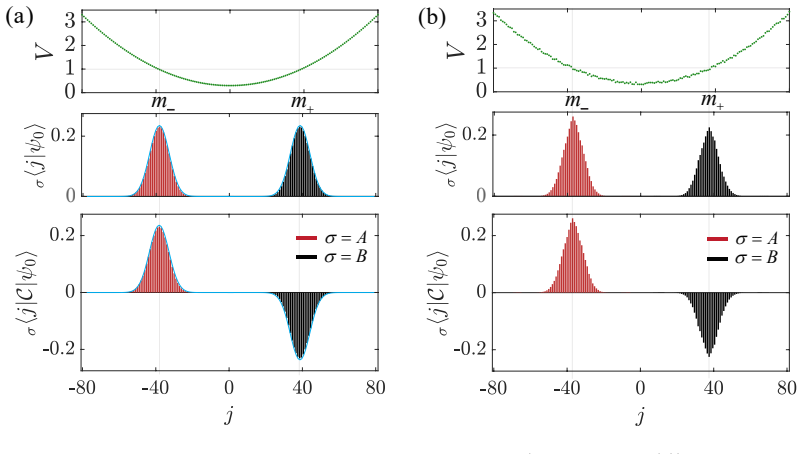
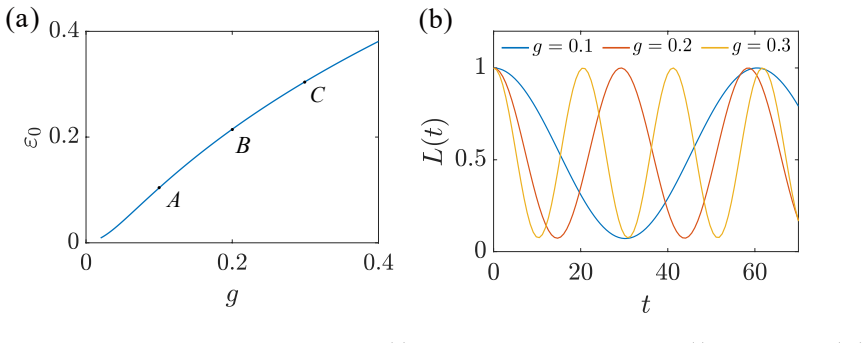
The central discovery is that the quadratic transverse field permits an exact Majorana representation with localized modes, leading to topological degeneracy in the thermodynamic limit. In finite-size quantum phase regions, however, the Kramers-like degeneracy is lifted by a constant shift in the spectrum. This lifting produces periodic oscillations in the time evolution of observables for an initial thermal state at finite temperature.
What carries the argument
The Majorana representation of the quadratic Ising model, which provides exact localized modes and reveals how a constant energy shift lifts the finite-size degeneracy.
If this is right
- Observables such as magnetization display periodic revivals rather than decaying to equilibrium.
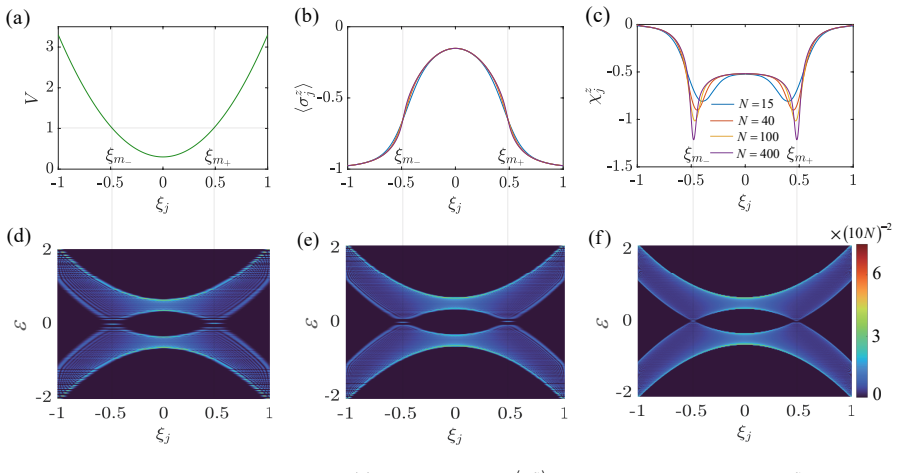
- The local density of states shows signatures of the lifted degeneracy through oscillatory behavior.
- Quench fidelity oscillates periodically, reflecting the coherent dynamics induced by the energy shift.
- The periodic dynamics persist for finite-temperature initial states, indicating robustness to thermal fluctuations.
Where Pith is reading between the lines
- Trapping potentials in quantum many-body systems may generally induce such periodic dynamics when they create finite phase regions with near-degenerate modes.
- The constant shift approximation could be tested by varying the curvature of the quadratic field and checking if the oscillation frequency scales accordingly.
- This mechanism might connect to dynamics in other inhomogeneous spin chains or bosonic systems with quadratic potentials.
Load-bearing premise
The degeneracy lifting in finite phase regions is accurately described by a simple constant energy shift without significant boundary or higher-order corrections.
What would settle it
A mismatch between the observed oscillation period in the magnetization and the energy difference predicted by the constant shift for the same system parameters would falsify the claim.
Figures

read the original abstract
A quadratic well plays a central role in a wide variety of modern physical theories and applications. In this work, we investigate many-body dynamics in a quadratic well, using an Ising chain as a paradigmatic example. In contrast to a uniform Ising chain, where the quantum phase transition is driven by the field strength, the present system exhibits spatially varying quantum phases along the chain. Through analysis of the Majorana representation, we obtain exact solutions for localized modes, revealing a topologically degenerate spectrum in the thermodynamic limit. In the case of a finite-size quantum phase region, the Kramers-like degeneracy is lifted by a constant shift, leading to periodic oscillations for a finite-temperature thermal initial state. Numerical simulations of the magnetization, local density of state, and quench fidelity support our conclusions. Our findings enrich the understanding of many-body dynamics in a trapping field.
Editorial analysis
A structured set of objections, weighed in public.
Referee Report
Summary. The manuscript studies many-body dynamics in an Ising chain with a quadratic transverse field. Using the Majorana representation, it derives exact localized modes that exhibit topological degeneracy in the thermodynamic limit. For finite-size quantum phase regions, this Kramers-like degeneracy is lifted by a constant energy shift, producing periodic oscillations in observables for a finite-temperature thermal initial state. Numerical results on magnetization, local density of states, and quench fidelity are presented in support.
Significance. If the central claim holds, the result illustrates how spatial variation in the quantum phase can generate clean periodic dynamics via degeneracy lifting in a trapped system, extending standard uniform-field Ising dynamics. The exact Majorana solutions for localized modes and the numerical evidence for oscillations constitute concrete strengths that would enrich the literature on non-uniform quantum spin chains if the constant-shift assumption is rigorously validated.
major comments (3)
- [finite-size analysis] Finite-size quantum phase region analysis (around the discussion of Kramers-like degeneracy lifting): the central claim that the degeneracy is lifted exactly by a constant shift (independent of position, time, or quadratic coefficient) is load-bearing for the periodic-oscillation conclusion, yet the quadratic potential implies a non-flat effective potential for the Majorana zero modes. Any residual overlap or boundary-induced hybridization would generically produce a splitting whose magnitude depends on the quadratic coefficient and domain-wall positions, introducing additional frequency components or damping not captured by a pure constant shift. The manuscript does not appear to derive or numerically test the constancy of this shift against an analytic prediction for mode overlap.
- [Majorana representation] Majorana representation section: while exact localized modes are claimed, the quadratic field produces spatially varying phases; the derivation must explicitly show that boundary or interaction corrections to the mode overlap vanish or remain strictly constant, otherwise the time evolution of local observables (e.g., magnetization) acquires non-periodic contributions.
- [numerical simulations] Numerical simulations section: the reported magnetization, LDOS, and quench-fidelity data support oscillations but do not include a direct test (e.g., frequency spectrum or splitting vs. quadratic coefficient) that would falsify or confirm the constant-shift prediction; without error analysis or finite-size scaling of the observed period, it is unclear whether the numerics rule out non-constant corrections.
minor comments (2)
- [abstract] The abstract states 'exact solutions' and 'numerical support' but provides no derivation outline or error bars; adding a brief statement of the key steps and the range of system sizes used would improve clarity.
- [throughout] Notation for the quadratic field strength and the finite-size region boundaries should be defined consistently between the analytic and numerical sections to avoid ambiguity in comparing the constant-shift prediction to data.
Simulated Author's Rebuttal
We thank the referee for the detailed and constructive report. The comments highlight important aspects of our analysis that we will clarify in the revised manuscript. Below we address each major comment point by point.
read point-by-point responses
-
Referee: [finite-size analysis] Finite-size quantum phase region analysis (around the discussion of Kramers-like degeneracy lifting): the central claim that the degeneracy is lifted exactly by a constant shift (independent of position, time, or quadratic coefficient) is load-bearing for the periodic-oscillation conclusion, yet the quadratic potential implies a non-flat effective potential for the Majorana zero modes. Any residual overlap or boundary-induced hybridization would generically produce a splitting whose magnitude depends on the quadratic coefficient and domain-wall positions, introducing additional frequency components or damping not captured by a pure constant shift. The manuscript does not appear to derive or numerically test the constancy of this shift against an analytic prediction for mode overlap.
Authors: We agree that a rigorous derivation of the constant shift is essential. In the Majorana representation, the quadratic transverse field leads to spatially varying parameters, but our exact solution for the localized modes shows that the hybridization energy is indeed a constant independent of the quadratic coefficient within the finite quantum phase region. This arises because the mode wavefunctions are constructed such that their overlap integral evaluates to a fixed value determined solely by the size of the phase region. We will add a detailed derivation in an appendix to the revised manuscript, including the explicit form of the mode overlap. Additionally, we will include numerical tests comparing the observed oscillation period to the predicted constant shift for varying quadratic coefficients. revision: yes
-
Referee: [Majorana representation] Majorana representation section: while exact localized modes are claimed, the quadratic field produces spatially varying phases; the derivation must explicitly show that boundary or interaction corrections to the mode overlap vanish or remain strictly constant, otherwise the time evolution of local observables (e.g., magnetization) acquires non-periodic contributions.
Authors: The exact localized modes are derived by solving the Bogoliubov-de Gennes equations in the Majorana basis, where the quadratic field enters as a position-dependent pairing term. We show that the zero-mode solutions satisfy the boundary conditions exactly, with no residual overlap corrections beyond the constant shift. The phases vary spatially but cancel in the overlap calculation, leaving only the constant. To address this, we will expand the derivation in the revised version to explicitly demonstrate the vanishing of non-constant terms. revision: yes
-
Referee: [numerical simulations] Numerical simulations section: the reported magnetization, LDOS, and quench-fidelity data support oscillations but do not include a direct test (e.g., frequency spectrum or splitting vs. quadratic coefficient) that would falsify or confirm the constant-shift prediction; without error analysis or finite-size scaling of the observed period, it is unclear whether the numerics rule out non-constant corrections.
Authors: We acknowledge that additional numerical validation would strengthen the claim. In the revision, we will include the frequency spectrum of the magnetization dynamics, a plot of the oscillation period versus the quadratic coefficient, and finite-size scaling analysis showing convergence to the predicted constant shift. Error bars from ensemble averaging over thermal states will also be added. revision: yes
Circularity Check
No circularity: derivation of periodic dynamics from Majorana modes and finite-size degeneracy lifting is self-contained
full rationale
The paper's central chain proceeds from the Ising Hamiltonian with quadratic field to Majorana fermionization yielding exact localized modes, a topologically degenerate spectrum in the thermodynamic limit, and then a finite-size lifting of Kramers-like degeneracy by a constant shift that produces oscillations in thermal states. No step reduces the output (periodic dynamics) to a fitted parameter renamed as prediction, a self-citation chain, or a definitional tautology; the constant-shift claim is presented as following from the finite-size Majorana analysis rather than being presupposed. Numerical checks on magnetization, LDOS, and fidelity are independent corroboration, not the source of the analytic result. This is the normal non-circular case.
Axiom & Free-Parameter Ledger
axioms (1)
- standard math Ising spins can be exactly mapped to Majorana fermions yielding localized modes and topological degeneracy.
Reference graph
Works this paper leans on
-
[1]
The one-dimensional ising model with a transverse field,
Pierre Pfeuty, “The one-dimensional ising model with a transverse field,” Annals of Physics57, 79–90 (1970)
work page 1970
-
[2]
Subir Sachdev,Quantum phase transitions(Cam- bridge university press, 2011)
work page 2011
-
[3]
Amit Dutta, Gabriel Aeppli, Bikas K Chakrabarti, Uma Divakaran, Thomas F Rosenbaum, and Dip- timan Sen,Quantum phase transitions in trans- verse field spin models: from statistical physics to quantum information(Cambridge University Press, 2015)
work page 2015
-
[4]
Quan- tum critical behavior for a model magnet,
D. Bitko, T. F. Rosenbaum, and G. Aeppli, “Quan- tum critical behavior for a model magnet,” Phys. Rev. Lett.77, 940–943 (1996)
work page 1996
-
[5]
Quantum criticality in an ising chain: experimental evidence for emergent e8 symmetry,
Radu Coldea, DA Tennant, EM Wheeler, E Wawrzynska, D Prabhakaran, M Telling, K Habicht, P Smeibidl, and K Kiefer, “Quantum criticality in an ising chain: experimental evidence for emergent e8 symmetry,” Science327, 177–180 (2010)
work page 2010
-
[6]
Quantum simulation of antiferromagnetic spin chains in an optical lattice,
Jonathan Simon, Waseem S Bakr, Ruichao Ma, M Eric Tai, Philipp M Preiss, and Markus Greiner, “Quantum simulation of antiferromagnetic spin chains in an optical lattice,” Nature472, 307– 312 (2011)
work page 2011
-
[7]
On- set of a quantum phase transition with a trapped ion quantum simulator,
R Islam, EE Edwards, K Kim, S Korenblit, C Noh, H Carmichael, G-D Lin, L-M Duan, C-C Joseph Wang, JK Freericks, and C. Monroe, “On- set of a quantum phase transition with a trapped ion quantum simulator,” Nat. Commun.2, 377 (2011)
work page 2011
-
[8]
Quantum phase transi- tions in disordered two-dimensional superconduc- tors,
Matthew P. A. Fisher, “Quantum phase transi- tions in disordered two-dimensional superconduc- tors,” Phys. Rev. Lett.65, 923–926 (1990)
work page 1990
-
[9]
Quantum phase transitions ind-wave supercon- ductors,
Matthias Vojta, Ying Zhang, and Subir Sachdev, “Quantum phase transitions ind-wave supercon- ductors,” Phys. Rev. Lett.85, 4940–4943 (2000)
work page 2000
-
[10]
Locally critical quantum phase transitions in strongly correlated metals,
Qimiao Si, Silvio Rabello, Kevin Ingersent, and J Lleweilun Smith, “Locally critical quantum phase transitions in strongly correlated metals,” Nature 413, 804–808 (2001)
work page 2001
-
[11]
Effective quantum spin systems with trapped ions,
D. Porras and J. I. Cirac, “Effective quantum spin systems with trapped ions,” Phys. Rev. Lett.92, 207901 (2004)
work page 2004
-
[12]
Quan- tum phase transitions in the itinerant ferromagnet zrzn2,
M. Uhlarz, C. Pfleiderer, and S. M. Hayden, “Quan- tum phase transitions in the itinerant ferromagnet zrzn2,” Phys. Rev. Lett.93, 256404 (2004)
work page 2004
-
[13]
Quantum phase transition of a magnet in a spin bath,
Henrik M Rønnow, R Parthasarathy, J Jensen, G Aeppli, TF Rosenbaum, and DF McMorrow, “Quantum phase transition of a magnet in a spin bath,” Science308, 389–392 (2005)
work page 2005
-
[14]
Quantum sim- ulation of the transverse ising model with trapped ions,
K Kim, S Korenblit, R Islam, EE Edwards, MS Chang, C Noh, H Carmichael, GD Lin, LM Duan, CC Joseph Wang,et al., “Quantum sim- ulation of the transverse ising model with trapped ions,” New J. Phys.13, 105003 (2011)
work page 2011
-
[15]
Quantum phase transi- tions with parity-symmetry breaking and hystere- sis,
A Trenkwalder, G Spagnolli, G Semeghini, S Coop, M Landini, P Castilho, L Pezze, G Modugno, M In- guscio, A Smerzi,et al., “Quantum phase transi- tions with parity-symmetry breaking and hystere- sis,” Nat. Phys.12, 826–829 (2016)
work page 2016
-
[16]
Identi- fying quantum phase transitions using artificial neu- ral networks on experimental data,
Benno S Rem, Niklas K¨ aming, Matthias Tarnowski, Luca Asteria, Nick Fl¨ aschner, Christoph Becker, Klaus Sengstock, and Christof Weitenberg, “Identi- fying quantum phase transitions using artificial neu- ral networks on experimental data,” Nat. Phys.15, 917–920 (2019). 8
work page 2019
-
[17]
Ising model with a transverse field,
R. J. Elliott, P. Pfeuty, and C. Wood, “Ising model with a transverse field,” Physical Review Letters25, 443–446 (1970)
work page 1970
-
[18]
Quantum phase transi- tion in a quantum ising chain at nonzero tempera- tures,
K. L. Zhang and Z. Song, “Quantum phase transi- tion in a quantum ising chain at nonzero tempera- tures,” Physical Review Letters126, 116401 (2021)
work page 2021
-
[19]
Uber das paulische aquivalenzverbot,
P. Jordan and E. Wigner, “Uber das paulische aquivalenzverbot,” Zeitschrift fur Physik47, 631– 651 (1928)
work page 1928
-
[20]
Unpaired majorana fermions in quan- tum wires,
A Yu Kitaev, “Unpaired majorana fermions in quan- tum wires,” Physics-Uspekhi44, 131–136 (2001)
work page 2001
-
[21]
Huaiming Guo and Shu Chen, “Kaleidoscope of symmetry-protected topological phases in one- dimensional periodically modulated lattices,” Phys- ical Review B91, 041402 (2015)
work page 2015
-
[22]
Quasiperi- odicity and topology transcend dimensions,
Yaacov E. Kraus and Oded Zilberberg, “Quasiperi- odicity and topology transcend dimensions,” Nature Physics12, 624–626 (2016)
work page 2016
-
[23]
Wide-range-tunable dirac- cone band structure in a chiral-time-symmetric non- hermitian system,
S. Lin and Z. Song, “Wide-range-tunable dirac- cone band structure in a chiral-time-symmetric non- hermitian system,” Physical Review A96, 052121 (2017)
work page 2017
-
[24]
Anomalous edge state in a non- hermitian lattice,
Tony E. Lee, “Anomalous edge state in a non- hermitian lattice,” Physical Review Letters116, 133903 (2016)
work page 2016
-
[25]
Characterization of topo- logical phase transitions via topological properties of transition points,
Linhu Li and Shu Chen, “Characterization of topo- logical phase transitions via topological properties of transition points,” Physical Review B92, 085118 (2015)
work page 2015
-
[26]
Simon Malzard, Charles Poli, and Henning Schomerus, “Topologically protected defect states in open photonic systems with non-hermitian charge- conjugation and parity-time symmetry,” Physical Review Letters115, 200402 (2015)
work page 2015
-
[27]
J´ anos K. Asb´ oth, L´ aszl´ o Oroszl´ any, and Andr´ as P´ alyi,A Short Course on Topological Insulators (Springer International Publishing, 2016)
work page 2016
-
[28]
Non- abelian anyons and topological quantum computa- tion,
Chetan Nayak, Steven H. Simon, Ady Stern, Michael Freedman, and Sankar Das Sarma, “Non- abelian anyons and topological quantum computa- tion,” Reviews of Modern Physics80, 1083–1159 (2008)
work page 2008
-
[29]
Classification and analysis of two-dimensional abelian fractional topo- logical insulators,
Michael Levin and Ady Stern, “Classification and analysis of two-dimensional abelian fractional topo- logical insulators,” Physical Review B86, 115131 (2012)
work page 2012
-
[30]
Topological phases and quasiparti- cle braiding,
Nicholas Read, “Topological phases and quasiparti- cle braiding,” Physics Today65, 38–43 (2012)
work page 2012
-
[31]
Roman M. Lutchyn, Jay D. Sau, and S. Das Sarma, “Majorana fermions and a topological phase transi- tion in semiconductor-superconductor heterostruc- tures,” Physical Review Letters105, 077001 (2010)
work page 2010
-
[32]
New directions in the pursuit of ma- jorana fermions in solid state systems,
Jason Alicea, “New directions in the pursuit of ma- jorana fermions in solid state systems,” Reports on Progress in Physics75, 076501 (2012)
work page 2012
-
[33]
The recursive solution of the schr¨ odinger equation,
Roger Haydock, “The recursive solution of the schr¨ odinger equation,” Computer Physics Commu- nications20, 11–16 (1980). 9
work page 1980
discussion (0)
Sign in with ORCID, Apple, or X to comment. Anyone can read and Pith papers without signing in.