EEG-Based Multimodal Learning via Hyperbolic Mixture-of-Curvature Experts
Pith reviewed 2026-05-12 00:51 UTC · model grok-4.3
The pith
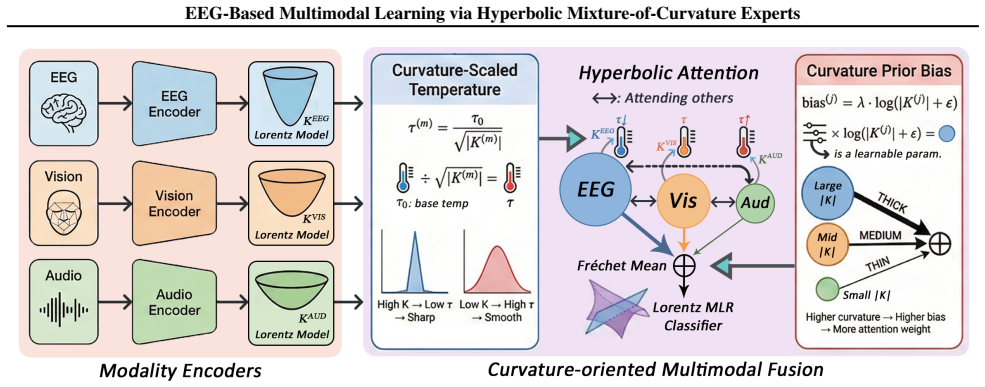
EEG-MoCE assigns each modality to its own learnable-curvature hyperbolic expert and fuses them with curvature-aware weighting to capture hierarchical structures in brain signals.
A machine-rendered reading of the paper's core claim, the machinery that carries it, and where it could break.
Core claim
EEG-MoCE places each input modality into a dedicated expert inside a hyperbolic space whose curvature is learned independently, thereby adapting the geometry to the modality's intrinsic hierarchy. Curvature-aware fusion then combines the expert outputs by dynamically emphasizing those modalities whose learned curvature indicates greater hierarchical content. Experiments on benchmark datasets establish state-of-the-art results across emotion recognition, sleep staging, and cognitive assessment tasks.
What carries the argument
The mixture-of-curvature experts operating in hyperbolic space, where each expert learns its own curvature and the fusion weights are derived from those curvatures to highlight modalities carrying richer hierarchical information.
If this is right
- Multimodal EEG systems achieve higher accuracy on emotion classification than Euclidean baselines.
- Sleep staging benefits from dynamic emphasis on modalities whose geometry encodes stronger hierarchy.
- Cognitive assessment tasks obtain improved performance when curvature-aware weighting is applied.
- The same adaptive-geometry principle extends to other EEG-based mental-state pipelines.
Where Pith is reading between the lines
- Curvature values learned for different modalities might later be inspected to quantify how much hierarchy each contributes.
- If the curvature-learning step remains stable across patient populations, the framework could support real-time neurotechnology devices.
- The approach supplies a concrete testbed for checking whether hyperbolic geometry systematically outperforms Euclidean geometry on hierarchical neuroscience data.
Load-bearing premise
That EEG and the other modalities possess hierarchical structures best captured by hyperbolic geometry when each modality is allowed its own independently learned curvature.
What would settle it
An ablation experiment that replaces the learnable per-modality curvatures with a single shared curvature or switches to Euclidean space while keeping all other components fixed, and finds no accuracy gain on the same emotion-recognition, sleep-staging, or cognitive-assessment benchmarks.
Figures


read the original abstract
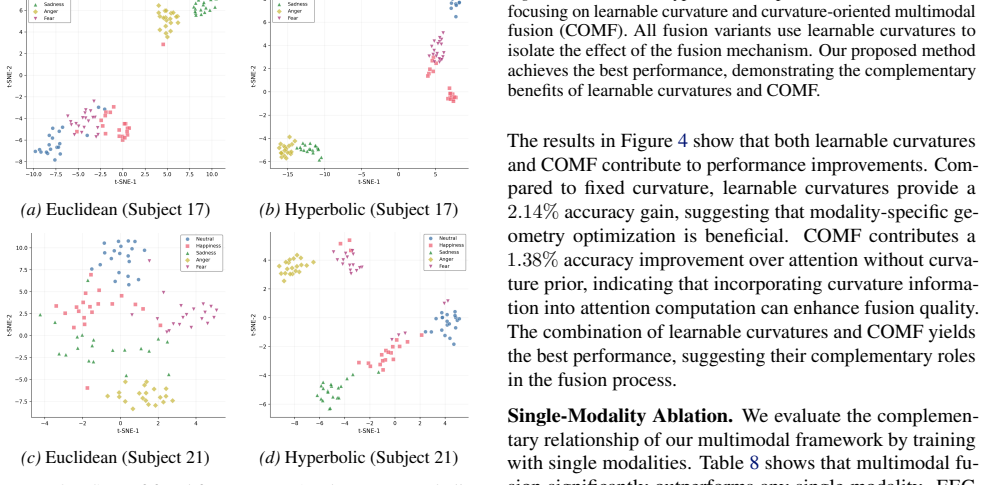
Electroencephalography (EEG)-based multimodal learning integrates brain signals with complementary modalities to improve mental state assessment, providing great clinical potential. The effectiveness of such paradigms largely depends on the representation learning on heterogeneous modalities. For EEG-based paradigms, one promising approach is to leverage their hierarchical structures, as recent studies have shown that both EEG and associated modalities (e.g., facial expressions) exhibit hierarchical structures reflecting complex cognitive processes. However, Euclidean embeddings struggle to represent these hierarchical structures due to their flat geometry, while hyperbolic spaces, with their exponential growth property, are naturally suited for them. In this work, we propose EEG-MoCE, a novel hyperbolic mixture-of-curvature experts framework designed for multimodal neurotechnology. EEG-MoCE assigns each modality to an expert in a learnable-curvature hyperbolic space, enabling adaptive modeling of its intrinsic geometry. A curvature-aware fusion strategy then dynamically weights experts, emphasizing modalities with richer hierarchical information. Extensive experiments on benchmark datasets demonstrate that EEG-MoCE achieves state-of-the-art performance, including emotion recognition, sleep staging, and cognitive assessment. Code is available at https://github.com/zhourunhe/EEG-MoCE.
Editorial analysis
A structured set of objections, weighed in public.
Referee Report
Summary. The manuscript proposes EEG-MoCE, a hyperbolic mixture-of-curvature experts framework for EEG-based multimodal learning. Each modality is assigned to an expert operating in its own learnable-curvature hyperbolic space, followed by a curvature-aware fusion mechanism that dynamically weights the experts according to the richness of hierarchical structure in each modality. The authors claim that this architecture yields state-of-the-art performance on benchmark datasets for emotion recognition, sleep staging, and cognitive assessment.
Significance. If the performance claims are rigorously substantiated, the work would add a concrete demonstration that per-modality learnable curvatures and curvature-aware fusion can exploit the exponential volume growth of hyperbolic geometry for heterogeneous neurophysiological signals. This would be of interest to the intersection of geometric deep learning and multimodal brain-computer interfaces, provided the gains are shown to arise from the geometric inductive bias rather than capacity alone.
major comments (2)
- [Abstract] Abstract: the claim that EEG-MoCE 'achieves state-of-the-art performance' is unsupported by any numerical results, baseline tables, statistical tests, or ablation studies. Without these data it is impossible to determine whether the reported improvements are attributable to the learnable-curvature experts or to other modeling choices.
- [Method / Experiments] Method and Experiments sections: the central modeling assumption—that independently learnable curvatures per modality plus curvature-aware fusion reliably capture richer hierarchical information—lacks any ablation that isolates these components against (i) a fixed-curvature hyperbolic MoE of equal capacity and (ii) a Euclidean MoE baseline. In the absence of such controls, the SOTA claim cannot be distinguished from a simple increase in model flexibility.
Simulated Author's Rebuttal
We thank the referee for the constructive feedback. The comments highlight opportunities to make the performance claims more transparent and to provide stronger evidence isolating the contributions of the proposed components. We address each point below and have revised the manuscript accordingly.
read point-by-point responses
-
Referee: [Abstract] Abstract: the claim that EEG-MoCE 'achieves state-of-the-art performance' is unsupported by any numerical results, baseline tables, statistical tests, or ablation studies. Without these data it is impossible to determine whether the reported improvements are attributable to the learnable-curvature experts or to other modeling choices.
Authors: We agree that the abstract, as a concise summary, did not include concrete numerical support. The full manuscript contains extensive experimental results, including baseline comparisons, tables, and statistical tests on emotion recognition, sleep staging, and cognitive assessment benchmarks. In the revised version we have updated the abstract to report key quantitative improvements (e.g., accuracy and F1 gains relative to prior SOTA) together with explicit references to the experimental tables and statistical analyses. This makes the SOTA claim directly verifiable from the abstract while preserving its brevity. revision: yes
-
Referee: [Method / Experiments] Method and Experiments sections: the central modeling assumption—that independently learnable curvatures per modality plus curvature-aware fusion reliably capture richer hierarchical information—lacks any ablation that isolates these components against (i) a fixed-curvature hyperbolic MoE of equal capacity and (ii) a Euclidean MoE baseline. In the absence of such controls, the SOTA claim cannot be distinguished from a simple increase in model flexibility.
Authors: This observation is correct and points to a genuine gap in the original submission. To isolate the effect of learnable per-modality curvatures and curvature-aware fusion from mere capacity increases, we have added two controlled ablation studies in the revised Experiments section: (i) a fixed-curvature hyperbolic mixture-of-experts model with identical expert count and parameter budget, and (ii) a Euclidean mixture-of-experts baseline matched in capacity. The new results show that the learnable-curvature variant consistently outperforms both controls, indicating that the performance gains arise from the geometric inductive bias rather than flexibility alone. Corresponding tables and analysis have been inserted. revision: yes
Circularity Check
No significant circularity detected in derivation chain
full rationale
The paper introduces EEG-MoCE as a novel framework that assigns modalities to experts in learnable-curvature hyperbolic spaces and applies curvature-aware fusion, motivated by the exponential growth property of hyperbolic geometry for hierarchical structures in EEG and related modalities. This motivation is drawn from general properties of hyperbolic spaces and cited recent studies on hierarchical structures, without any reduction of the proposed method or its performance claims to fitted parameters by construction, self-referential uniqueness theorems, or ansatz smuggled via self-citation. The central results are empirical SOTA performance on external benchmarks (emotion recognition, sleep staging, cognitive assessment), which are independent of the model definition itself. No load-bearing steps in the abstract or described method equate outputs to inputs via self-definition or statistical forcing. The derivation remains self-contained against external benchmarks.
Axiom & Free-Parameter Ledger
free parameters (2)
- learnable curvatures
- curvature-aware fusion weights
axioms (1)
- domain assumption Hyperbolic spaces are naturally suited for representing hierarchical structures due to their exponential growth property.
Lean theorems connected to this paper
-
IndisputableMonolith/CostJcost definition and CostAlphaLog echoes?
echoesECHOES: this paper passage has the same mathematical shape or conceptual pattern as the Recognition theorem, but is not a direct formal dependency.
hyperbolic spaces, with their exponential growth property, are naturally suited for them... per-modality experts with learnable curvatures... curvature magnitude serves as a learned geometric indicator of hierarchical complexity... τ(m)=τ0/√|K(m)|... λ·ϕ(K(j)) curvature prior
-
IndisputableMonolith/Foundation/AlexanderDualityalexander_duality_circle_linking and SphereAdmitsCircleLinking echoes?
echoesECHOES: this paper passage has the same mathematical shape or conceptual pattern as the Recognition theorem, but is not a direct formal dependency.
δ-hyperbolicity... lower δrel indicates stronger hierarchical structure... Lorentz model... expK and logK maps... weighted Fréchet mean
What do these tags mean?
- matches
- The paper's claim is directly supported by a theorem in the formal canon.
- supports
- The theorem supports part of the paper's argument, but the paper may add assumptions or extra steps.
- extends
- The paper goes beyond the formal theorem; the theorem is a base layer rather than the whole result.
- uses
- The paper appears to rely on the theorem as machinery.
- contradicts
- The paper's claim conflicts with a theorem or certificate in the canon.
- unclear
- Pith found a possible connection, but the passage is too broad, indirect, or ambiguous to say the theorem truly supports the claim.
discussion (0)
Sign in with ORCID, Apple, or X to comment. Anyone can read and Pith papers without signing in.