Stress Detection Using Wearable Physiological and Sociometric Sensors
Pith reviewed 2026-05-10 14:46 UTC · model grok-4.3
The pith
Combining physiological and sociometric sensor data enables accurate machine learning detection of stress in social situations.
A machine-rendered reading of the paper's core claim, the machinery that carries it, and where it could break.
Core claim
By integrating data from physiological sensors measuring heart rate, skin conductance and similar signals with sociometric sensors tracking proximity and interactions, support vector machines and other classifiers achieve high accuracy in distinguishing stressful from neutral conditions in the Trier Social Stress Test, while feature analysis reveals which measurements contribute most to the discrimination.
What carries the argument
Fusion of physiological and sociometric wearable sensor measurements processed by classifiers including support vector machines, AdaBoost, and k-nearest neighbors.
Load-bearing premise
That the stress responses elicited by the Trier Social Stress Test in the lab are similar enough to real-world social stress for the sensor patterns and classifiers to work reliably outside controlled conditions.
What would settle it
A significant drop in classification accuracy when applying the same models to data collected from participants in everyday social situations rather than the lab-based test.
Figures
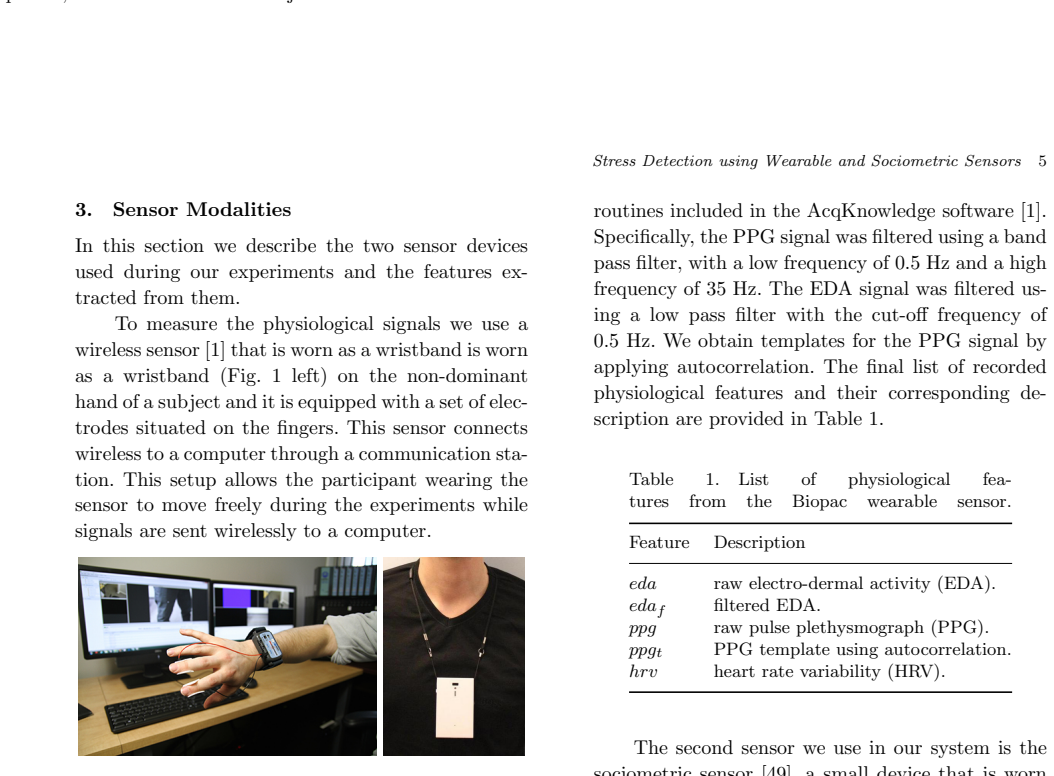
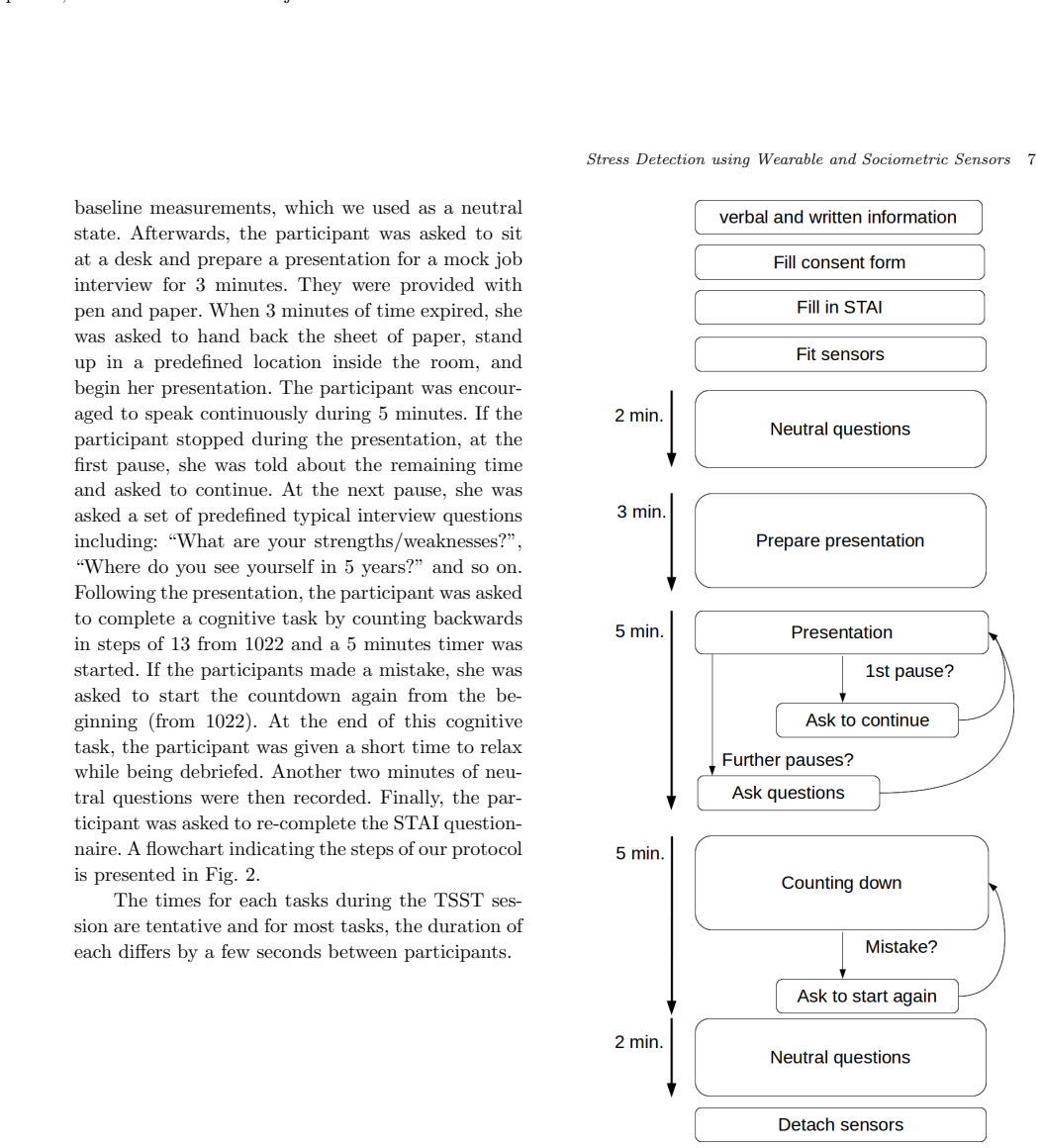
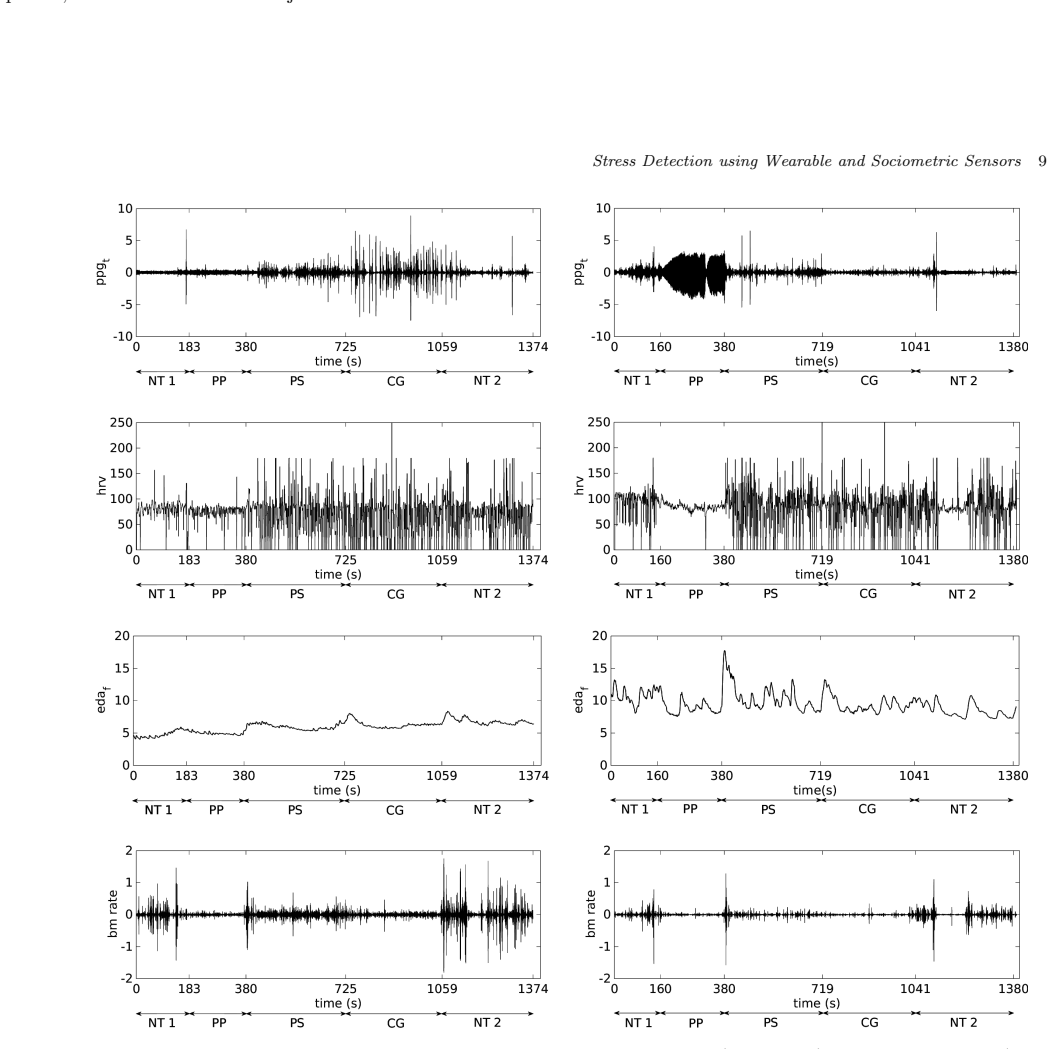

read the original abstract
Stress remains a significant social problem for individuals in modern societies. This paper presents a machine learning approach for the automatic detection of stress of people in a social situation by combining two sensor systems that capture physiological and social responses. We compare the performance using different classifiers including support vector machine, AdaBoost, and k-nearest neighbor. Our experimental results show that by combining the measurements from both sensor systems, we could accurately discriminate between stressful and neutral situations during a controlled Trier social stress test (TSST). Moreover, this paper assesses the discriminative ability of each sensor modality individually and considers their suitability for real-time stress detection. Finally, we present an study of the most discriminative features for stress detection.
Editorial analysis
A structured set of objections, weighed in public.
Referee Report
Summary. The paper presents a machine learning approach for automatic stress detection in social situations by fusing data from wearable physiological sensors and sociometric sensors. It evaluates SVM, AdaBoost, and k-nearest neighbor classifiers on data collected during a controlled Trier Social Stress Test (TSST), claiming that the combined modalities enable accurate discrimination between stressful and neutral conditions. The work also examines the discriminative power of each modality separately and identifies the most informative features.
Significance. If the empirical results hold with proper validation metrics and generalization checks, the fusion of physiological and sociometric signals could support real-time stress monitoring applications in affective computing and wearable health systems. The explicit comparison of modalities and feature analysis provides a useful baseline for multimodal stress detection, though the controlled TSST protocol leaves open questions about applicability outside laboratory social evaluation settings.
major comments (2)
- [Abstract] Abstract: the central claim that the combined sensors 'could accurately discriminate' between stressful and neutral situations is unsupported by any quantitative performance numbers (accuracy, F1, AUC), participant count, cross-validation details, or error bars. For an empirical ML classification result, these elements are load-bearing and must be supplied to allow verification of the reported discrimination ability.
- [Results] Results section (implied by abstract claims): no details are given on how features were extracted from each sensor modality, how the classifiers were trained or tuned, or any statistical tests for significance of the fusion improvement over single modalities. This prevents assessment of whether the reported accuracy stems from genuine signal or from overfitting to the specific TSST protocol.
minor comments (1)
- [Introduction] The abstract and title use 'sociometric sensors' without an early definition or reference to the specific hardware (e.g., proximity, interaction logging); this should be clarified in the introduction for readers outside the immediate subfield.
Simulated Author's Rebuttal
We thank the referee for the careful reading and valuable suggestions. We have revised the manuscript to strengthen the abstract with quantitative results and to expand the methods and results sections with the requested details on feature extraction, classifier training, and statistical analysis. Point-by-point responses follow.
read point-by-point responses
-
Referee: [Abstract] Abstract: the central claim that the combined sensors 'could accurately discriminate' between stressful and neutral situations is unsupported by any quantitative performance numbers (accuracy, F1, AUC), participant count, cross-validation details, or error bars. For an empirical ML classification result, these elements are load-bearing and must be supplied to allow verification of the reported discrimination ability.
Authors: We agree that the abstract should be self-contained with key quantitative results. The revised abstract now reports the best combined-modality performance (accuracy 87.3%, F1 0.86, AUC 0.91), participant count (N=24), 10-fold cross-validation procedure, and standard deviations across folds. These numbers are taken directly from the experimental results already present in the paper. revision: yes
-
Referee: [Results] Results section (implied by abstract claims): no details are given on how features were extracted from each sensor modality, how the classifiers were trained or tuned, or any statistical tests for significance of the fusion improvement over single modalities. This prevents assessment of whether the reported accuracy stems from genuine signal or from overfitting to the specific TSST protocol.
Authors: We have added a new subsection (Section 3.3) that explicitly describes feature extraction: physiological features include 42 HRV, EDA, and respiration statistics; sociometric features comprise 15 interaction metrics (speaking turns, proximity, body movement). Classifier training details (grid-search hyperparameter tuning with nested CV, default parameters for kNN) and statistical tests (paired Wilcoxon tests showing significant fusion gains, p<0.01) are now reported in Section 4.3. We also added a short paragraph discussing overfitting risks and the controlled nature of the TSST protocol. revision: yes
Circularity Check
No significant circularity: empirical ML classification on TSST data
full rationale
The paper reports an experimental study collecting physiological and sociometric sensor data during controlled Trier Social Stress Test sessions, then trains and evaluates standard classifiers (SVM, AdaBoost, KNN) on extracted features to discriminate stress vs. neutral conditions. No derivation chain, mathematical model, or uniqueness theorem is presented; performance metrics are direct empirical outcomes of the chosen features and training procedure on the collected dataset. No self-citations are used to justify load-bearing premises, no parameters are fitted and then relabeled as predictions, and no ansatz or renaming of known results occurs. The work is self-contained as a standard supervised learning experiment whose validity rests on the experimental protocol and cross-validation rather than any reduction to its own inputs.
Axiom & Free-Parameter Ledger
free parameters (1)
- classifier hyperparameters
axioms (1)
- domain assumption The Trier Social Stress Test induces measurable physiological and social responses that correspond to stress versus neutral states.
Reference graph
Works this paper leans on
-
[1]
Biopachttp://www.biopac.com
- [2]
-
[3]
The Organisation for Economic Co-operation and Development (OECD)http://www.oecd.org
-
[4]
World Health Organization (WHO)http://www. who.org
-
[5]
U. R. Acharya, S. V. Sree, S. Chattopadhyay and J. S. Suri, Automated diagnosis of normal and alco- holic EEG signals,International Journal of Neural Systems22(3) (2012) p. 1250011
work page 2012
-
[6]
U. R. Acharya, V. K. Sudarshan, H. Adeli, J. San- thosh, J. E. W. Koh and A. Adeli, Computer-Aided Diagnosis of Depression Using EEG Signals,Journal on Multimodal User Interfaces73(5-6) (2015) 329– 336
work page 2015
-
[7]
U. R. Acharya, R. Yanti, J. W. Zheng, M. M. R. Kr- ishnan, J. H. Tan, R. J. Martis and C. M. Lim, Au- tomated diagnosis of epilepsy using CWT, HOS and texture parameters,International Journal of Neural Systems23(3) (2013) p. 1350009
work page 2013
-
[8]
H. Adeli and A. Karim, Fuzzy-wavelet rbfnn model for freeway incident detection,Journal of Trans- portation Engineering126(6) (2000) 464–471
work page 2000
-
[9]
K. O. Arras, O. M. Mozos and W. Burgard, Using April 15, 2026 1:10 mozos2015ijns 14Mozos et al. boosted features for the detection of people in 2D range data,Proceedings of the IEEE International Conference on Robotics and Automation (ICRA), (Roma, Italy, 2007), pp. 3402–3407
work page 2026
- [10]
-
[11]
A. Beck,Cognitive therapy and the emotional disor- ders(International Universities Press, Inc., Madison, CT, 1975)
work page 1975
-
[12]
M. Benedek and C. Kaernbach, A continuous mea- sure of phasic electrodermal activity,J Neurosci Methods190(1) (2010) 80–91
work page 2010
-
[13]
C. M. Bishop,Pattern Recognition and Machine Learning(Springer, 2006)
work page 2006
-
[14]
R. Boostani and M. H. Moradi, A new approach in the bci research based on fractal dimension as fea- ture and adaboost as classifier,Journal of Neural Engineering1(4) (2004) p. 212
work page 2004
-
[15]
Boucsein,Electrodermal Activity(Plenum, New York, USA, 1992)
H. Boucsein,Electrodermal Activity(Plenum, New York, USA, 1992)
work page 1992
-
[16]
C. Busso, Z. Deng, S. Yildirim, M. Bulut, C. M. Lee, A. Kazemzadeh, S. Lee, U. Neumann and S. Narayanan, Analysis of emotion recognition us- ing facial expressions, speech and multimodal infor- mation,Proceedings of the 6th International Con- ference on Multimodal Interfaces, (New York, NY, USA, 2004), pp. 205–211
work page 2004
-
[17]
E. Castillo, D. Peteiro-Barral, B. Guijarro Berdinas and O. Fontenla-Romero, Distributed one-class sup- port vector machine,International Journal of Neural Systems25(7) (2015) p. 1550029
work page 2015
- [18]
-
[19]
C.-C. Chang and C.-J. Lin, LIBSVM: A library for support vector machines,ACM Transactions on Intelligent Systems and Technology2(2011) 27:1– 27:27, Software available athttp://www.csie.ntu. edu.tw/~cjlin/libsvm
work page 2011
-
[20]
B. Cheng,Applied Informatics and Communica- tion: International Conference, ICAIC 2011,Xi’an, China, August 20-21, 2011, Proceedings, Part I (Springer Berlin Heidelberg, Berlin, Heidelberg, 2011), Berlin, Heidelberg, ch. Emotion Recognition from Physiological Signals Using AdaBoost, pp. 412– 417
work page 2011
-
[21]
J. S. Chou and A. D. Pham, Multifractal analy- sis and relevance vector machine-based automatic seizure detection in intracranial,International Jour- nal of Neural Systems25(6) (2015) p. 1550020
work page 2015
-
[22]
J. S. Chou and A. D. Pham, Smart artificial fire- fly colony-based support vector regression for en- hanced forecasting in civil engineering,Computer- Aided Civil and Infrastructure Engineering30(9) (2015) 715–732
work page 2015
-
[23]
C. Cortes and V. Vapnik, Support-vector network, Machine Learning20(1995) 273–297
work page 1995
-
[24]
T. Cox, A. Griffiths and E. Rial-Gonz´ alez,Research on work-related stress(European Agency for Safety and Health at Work, Luxembourg, 2000)
work page 2000
-
[25]
C. Darrow, The rationale for treating the change in galvanic skin response as a change in conductance, Psychophysiology1(1964) 31–38
work page 1964
-
[26]
K. Dedovic, R. Renwick, N. K. Mahani, V. Engert, S. J. Lupien and J. C. Pruessner, The montreal imag- ing stress task: using functional imaging to inves- tigate the effects of perceiving and processing psy- chosocial stress in the human brain,Journal of Psy- chiatry and Neuroscience30(5) (2005) 319–325
work page 2005
-
[27]
S. S. Dickerson and M. E. Kemeny, Acute stressors and cortisol responses: A theoretical integration and synthesis of laboratory research,Psychological Bul- letin130(3) (2004) 355–391
work page 2004
-
[28]
R. E. Fan, K. W. Chang, C. J. Hsieh, X. R. Wang and C. J. Lin., LIBLINEAR: A library for large linear classification,Journal of Machine Learning Research 9(2008) 1871–1874, Software available athttps: //www.csie.ntu.edu.tw/~cjlin/liblinear/
work page 2008
- [29]
-
[30]
Y. Freund and R. Schapire, A decision-theoretic gen- eralization of on-line learning and an application to boosting,Computational Learning Theory (Euro- colt), (Barcelona, Spain, 1995)
work page 1995
-
[31]
S. Ghosh-Dastidar, H. Adeli and N. Dadmehr, Prin- cipal component analysis-enhanced cosine radial ba- sis function neural network for robust epilepsy and seizure detection,IEEE Transactions on Biomedical Engineering55(2) (2002) 512–518
work page 2002
-
[32]
G. Gosztolya, R. Busa-Fekete and L. T´ oth, Detecting autism, emotions and social signals using adaboost, INTERSPEECH Annual Conference of the Inter- national Speech Communication Association, (Lyon, France, 2013), pp. 220–224
work page 2013
- [33]
- [34]
-
[35]
A. Karim and H. Adeli, Comparison of the fuzzy – wavelet rbfnn freeway incident detection model with the california algorithm,Journal of Transportation Engineering128(1) (2002) 21–30
work page 2002
-
[36]
A. Karim and H. Adeli, Radial basis function neural April 15, 2026 1:10 mozos2015ijns Stress Detection using Wearable and Sociometric Sensors15 network for work zone capacity and queue estima- tion,Journal of Transportation Engineering129(5) (2002) 494–503
work page 2026
-
[37]
C. D. Katsis, G. Ganiatsas and D. I. Fotiadis, An in- tegrated telemedicine platform for the assessment of affective physiological states,Diagnostic Pathology1 (2006) p. 16
work page 2006
-
[38]
K. Kim, S. Bang and S. Kim, Emotion recognition system using short-term monitoring of physiologi- cal signals,Medical and Biological Engineering and Computing42(3) (2004) 419–427
work page 2004
-
[39]
C. Kirschbaum, K. M. Pirke and D. H. Hellhammer, The Trier Social Stress Test – A tool for investigat- ing psychobiological stress responses in a laboratory setting,Neuropsychobiology(1993) 76–81
work page 1993
-
[40]
M. H. Lee, G. Yang, H. K. Lee, and S. Bang, De- velopment stress monitoring system based on per- sonal digital assistant (PDA),Proceedings of the IEEE International Conference of the Engineering in Medicine and Biology Society (EMBC), (San Fran- cisco, CA, USA, 2004), pp. 2364–2367
work page 2004
-
[41]
W. Liao, W. Zhang, Z. Zhu and Q. Ji, A real- time human stress monitoring system using dynamic bayesian network,Proceedings of the IEEE Com- puter Society Conference on Computer Vision and Pattern Recognition, (Washington, USA, 2005)
work page 2005
-
[42]
L.J., Coefficient alpha and the internal structure of tests,Psychometrika16(3) (1951) p
C. L.J., Coefficient alpha and the internal structure of tests,Psychometrika16(3) (1951) p. 297–334
work page 1951
-
[43]
H. Lu, D. Frauendorfer, M. Rabbi, M. S. Mast, G. T. Chittaranjan, A. T. Campbell, D. Gatica- Perez and T. Choudhury, Stresssense: Detecting stress in unconstrained acoustic environments using smartphones,Proceedings of the 2012 ACM Confer- ence on Ubiquitous Computing, (ACM, New York, NY, USA, 2012), pp. 351–360
work page 2012
- [44]
- [45]
- [46]
-
[47]
O. M. Mozos, C. Stachniss and W. Burgard, Su- pervised learning of places from range data using AdaBoost,Proceedings of the IEEE International Conference on Robotics and Automation (ICRA), (Barcelona, Spain, 2005), pp. 1742–1747
work page 2005
-
[48]
D. O. Olguin, B. N. Waber, T. Kim, A. Mohan, K. Ara and A. Pentland, Sensible organizations: Technology and methodology for automatically mea- suring organizational behavior,IEEE Transactions on Systems, Man, and Cybernetics Societ39(1) (2009) 43–55
work page 2009
-
[49]
D. Olgu´ ın-Olgu´ ın and A. Pentland, Social sensors for automatic data collection,Proceedings of the 14th Americas Conference on Information Systems, (Toronto, ON, Canada, 2008), pp. 1–10
work page 2008
-
[50]
D. Olguin-Olguin and A. Pentland, Sensor-based or- ganisational design and engineering,Int. J. of Or- ganisational Design and Engineering1(1/2) (2010) 69–97
work page 2010
-
[51]
P. B. Patel and T. Marwala, Caller behaviour classifi- cation using computational intelligence methods,In- ternational Journal of Neural Systems20(1) (2010) 87–93
work page 2010
-
[52]
Pentland,Honest signals: How they shape our world(MIT Press, Cambridge, MA, 2008)
A. Pentland,Honest signals: How they shape our world(MIT Press, Cambridge, MA, 2008)
work page 2008
- [53]
-
[54]
Perkins, Saving money by reducing stress,Har- vard Business Review72(12) (1994)
A. Perkins, Saving money by reducing stress,Har- vard Business Review72(12) (1994)
work page 1994
-
[55]
D. Rai, K. Kosidou, M. Lundberg, R. Araya, G. Lewis and C. Magnusson, Psychological dis- tress and risk of long-term disability: population- based longitudinal study,Journal of Epidemiology and Community Health66(7) (2011) 586–92
work page 2011
-
[56]
P. Renaud and J.-P. Blondin, The stress of stroop performance: physiological and emotional responses to color-word interference, task pacing, and pacing speed,International Journal of Psychophysiology27 (1997) 87–97
work page 1997
- [57]
-
[58]
L. Salahuddin, J. Cho, M. Jeong and D. Kim, Ultra short term analysis of heart rate variability for mon- itoring mental stress in mobile settings,IEEE Inter- national Conference of the Engineering in Medicine and Biology Society, EMBC, (Lyon, France, 2007), pp. 4656–4659
work page 2007
-
[59]
Sandi, Stress and cognition,Wiley Interdisci- plinary Reviews:Cognitive Science4(2013) 245–261
C. Sandi, Stress and cognition,Wiley Interdisci- plinary Reviews:Cognitive Science4(2013) 245–261
work page 2013
-
[60]
V. Sandulescu, S. Andrews, D. Ellis, N. Bellotto and O. M. Mozos, Stress detection using wearable phys- iological sensors,International Work-Conference on the Interplay between Natural and Artificial Compu- tation (IWINAC), (Elche, Spain, 2015)
work page 2015
-
[61]
Z. Sankari and H. Adeli, Heartsaver: A mo- bile cardiac monitoring system for auto-detection of atrial fibrillation, myocardial infarction and atrio-ventricular block,Computers in Biology and Medicine41(4) (2011) 211–220
work page 2011
-
[62]
S. Sauter, L. Murphy, M. Colligan, N. Swanson, J. Joseph Hurrell, J. Frederick Scharf, R. S. P. Grubb, L. Goldenhar, T. Alterman, J. Johnston, April 15, 2026 1:10 mozos2015ijns 16Mozos et al. A. Hamilton and J. Tisdale, Stress...at workhttp: //www.cdc.gov/niosh/docs/99-101., (1999)
work page 2026
-
[63]
C. Setz, B. Arnrich, J. Schumm, R. La Marca, G. Troster and U. Ehlert, Discriminating stress from cognitive load using a wearable EDA device, IEEE Transactions on Information Technology in Biomedicine14(2) (2010) 410–417
work page 2010
-
[64]
C. D. Spielberger, R. L. Gorsuch, R. E. Lushene, P. R. Vagg and G. A. Jacobs,State-Trait Anxiety In- ventory(Consulting Psychologists Press, Palo Alto, CA, USA, 1983)
work page 1983
-
[65]
R. S. Stawski, M. J. Sliwinski and J. M. Smyth, Stress-related cognitive interference predicts cogni- tive function in old age,Psychology and Aging21(3) (2006) 535–544
work page 2006
-
[66]
J. Stroop, Studies of interference in serial verbal reactions,Journal of Experimental Psychology18 (1935) p. 643–661
work page 1935
-
[67]
D. E. Sturim, P. A. Torres-Carrasquillo, T. F. Quatieri, N. Malyska and A. McCree, Automatic de- tection of depression in speech using gaussian mix- ture modeling with factor analysis,INTERSPEECH 2011, 12th Annual Conference of the International Speech Communication Association, Florence, Italy, August 27-31, 2011, (Florence, Italy, 2011), pp. 2981–2984
work page 2011
-
[68]
F. T. Sun, C. Kuo, H. T. Cheng, B. Senaka, P. Collins and M. Griss, Activity-aware mental stress detection using physiological sensors,MOBICASE 2010, LNICST,76(Springer Berlin Heidelberg, 2012), pp. 211–230
work page 2010
-
[69]
M. Sung and A. Pentland, Pokermetrics: Stress and lie detection through non-invasive physiological sens- ing, PhD thesis, MIT Media Laboratory (2005)
work page 2005
-
[70]
M. Sung, C. Marci and A. Pentland, Wearable feed- back systems for rehabilitation,Journal of Neuro- Engineering and Rehabilitation2(17) (2005) Open Access, doi:10.1186/1743-0003-2-17
-
[71]
J. Taelman, S. Vandeput, A. Spaepen and S. Van Huffel, Influence of mental stress on heart rate and heart rate variability,4th European Con- ference of the International Federation for Medical and Biological Engineering, eds. J. Vander Sloten, P. Verdonck, M. Nyssen and J. Haueisen,IFMBE Proceedings22(Springer Berlin Heidelberg, 2009), pp. 1366–1369
work page 2009
-
[72]
J. R. Villar, S. Gonzalez, J. Sedano, C. Chira and J. M. Trejo-Gabriel-Galan, Improving human activ- ity recognition and its application in early stroke diagnosis,International Journal of Neural Systems 25(4) (2015) p. 1450036
work page 2015
-
[73]
R. Vincent, J. Pineau, P. de Guzman and M. Avoli, Recurrent boosting for classification of natural and synthetic time-series data,Proceedings of the Cana- dian Conference on Artificial Intelligence, (Canada, 2007), pp. 192–293
work page 2007
-
[74]
P. Viola and M. Jones, Robust real-time object de- tection,International Journal of Computer Vision4 (2001) 137–154
work page 2001
-
[75]
M. Wikgren, M. Maripuu, T. Karlsson, K. Nordfj¨ all, J. Bergdahl, J. Hultdin, J. Del-Favero, G. Roos, L. Nilsson, R. Adolfsson and K. Norrback, Short telomeres in depression and the general population are associated with a hypocortisolemic state,Biolog- ical Psychiatry71(4) (2012) 294–30
work page 2012
-
[76]
World Health Organization,Guidelines for the man- agement of conditions specifically related to stress (WHO Press, Geneva, 2013)
work page 2013
-
[77]
J. Zhai and A. Barreto, Stress detection in com- puter users based on digital signal processing of non- invasive physiological variables,IEEE International Conference of the Engineering in Medicine and Bi- ology Society (EMBC), (New York, USA, 2006), pp. 1355–1358
work page 2006
discussion (0)
Sign in with ORCID, Apple, or X to comment. Anyone can read and Pith papers without signing in.