Recognition: unknown
Mobile Communications in Intelligent Rail Transit: From LCX to PASS
Pith reviewed 2026-05-10 15:48 UTC · model grok-4.3
The pith
Pinching-antenna systems provide reconfigurable radiation points along waveguides for rail transit wireless coverage.
A machine-rendered reading of the paper's core claim, the machinery that carries it, and where it could break.
Core claim
The paper claims that pinching-antenna systems, described as flexible waveguide-based architectures, enable reconfigurable radiation points with low deployment overhead and a natural fit to predominantly straight track geometries. These systems are offered as an alternative to leaky coaxial cables that improves energy and spectrum efficiency for high-capacity rail services, backed by performance comparisons in representative simulations and a deep-learning channel-estimation framework that handles mobility-induced dynamics.
What carries the argument
Pinching-antenna systems (PASS): flexible waveguide-based architectures that place reconfigurable radiation points at chosen locations along the waveguide.
If this is right
- PASS can deliver higher performance than leaky coaxial cables in simulated high-frequency rail scenarios.
- The deep-learning channel estimator maintains accuracy despite rapid channel changes from train motion.
- Low deployment overhead allows PASS to scale along extended straight tracks without proportional cost increase.
- Reconfigurable radiation points support dynamic adjustment to varying traffic or blockage patterns.
Where Pith is reading between the lines
- The same waveguide-plus-pinching approach could extend to other long linear paths such as road tunnels or airport runways.
- Reconfigurability might enable real-time power focusing toward specific train cars without extra hardware.
- Energy savings could compound over hundreds of kilometers of track if radiation points activate only near active trains.
- Integration with existing rail sensors could turn the waveguides into a shared infrastructure for both communication and monitoring.
Load-bearing premise
Representative simulations capture real rail propagation conditions including penetration loss, blockages, and large-scale fading, and the deep-learning channel estimator generalizes to actual mobility without extra validation.
What would settle it
A side-by-side field measurement of data rate, coverage reliability, and energy use for a deployed pinching-antenna system versus a leaky coaxial cable installation under real train movement, blockages, and penetration losses.
Figures


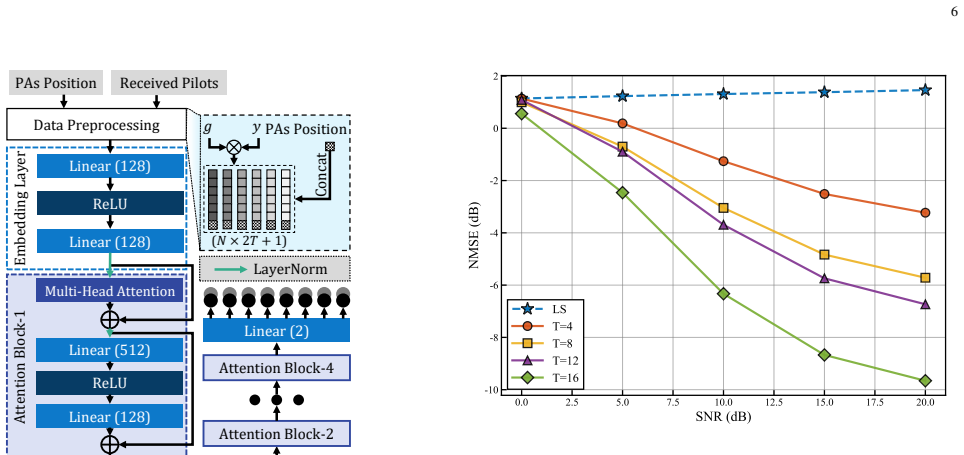
read the original abstract
Wireless communications in intelligent rail transit face harsh propagation conditions, including severe penetration loss, frequent blockages, and amplified large-scale fading. Existing leaky coaxial cables (LCX) provide wired-to-wireless conversion and stable coverage, but can be energy- and spectrum-inefficient, particularly at high carrier frequencies. Motivated by the growing demand for high-capacity and high-reliability rail services, this article introduces pinching-antenna systems (PASS), which are flexible waveguide-based architectures that enable reconfigurable radiation points with low deployment overhead and a natural fit to predominantly straight track geometries. We discuss the key benefits and deployment flexibility of PASS, evaluate their performance relative to LCX via representative simulations, and present a deep learning (DL)-enabled channel-estimation framework to cope with mobility-induced channel dynamics. Finally, we summarize the major open challenges for practical deployment and outline promising research directions.
Editorial analysis
A structured set of objections, weighed in public.
Referee Report
Summary. The manuscript introduces pinching-antenna systems (PASS) as flexible waveguide-based architectures for mobile communications in intelligent rail transit. It contrasts PASS with leaky coaxial cables (LCX), highlighting benefits such as reconfigurable radiation points, low deployment overhead, and suitability for straight track geometries. The paper evaluates PASS performance relative to LCX through representative simulations, presents a deep learning framework for channel estimation under mobility-induced dynamics, and outlines open challenges and research directions.
Significance. If the simulation-based performance gains and the DL channel estimator prove robust, PASS could enable more efficient, reconfigurable coverage for high-capacity rail services at mmWave and higher frequencies, reducing the energy and spectrum inefficiencies noted for LCX. The architecture's alignment with linear track geometries and the DL approach for dynamic channels represent potentially useful contributions to rail-specific wireless system design.
major comments (2)
- The performance evaluation section relies on 'representative simulations' to claim advantages of PASS over LCX in capacity and reliability, but provides no explicit propagation model parameters, validation against measured rail data for penetration loss, blockage statistics, or large-scale fading, nor error bars or sensitivity analysis. This makes the relative gains unverified and load-bearing for the central claim.
- The deep learning channel-estimation framework is introduced to handle mobility dynamics, yet the manuscript supplies no details on training dataset composition (e.g., coverage of train speeds, track curvatures, or frequency bands), network architecture, loss function, or cross-validation against real mobility traces. Without these, generalization claims cannot be assessed.
minor comments (2)
- The abstract would be strengthened by including one or two quantitative highlights from the simulations (e.g., capacity improvement factors or estimation error reductions).
- Notation for waveguide parameters and radiation point reconfigurability should be defined consistently in the first section where PASS is formalized.
Simulated Author's Rebuttal
We thank the referee for the constructive and detailed comments. We have addressed the concerns by clarifying the simulation setup and DL framework details. Where the manuscript was insufficiently explicit, we will expand the text and add supporting material in the revision. Our point-by-point responses follow.
read point-by-point responses
-
Referee: The performance evaluation section relies on 'representative simulations' to claim advantages of PASS over LCX in capacity and reliability, but provides no explicit propagation model parameters, validation against measured rail data for penetration loss, blockage statistics, or large-scale fading, nor error bars or sensitivity analysis. This makes the relative gains unverified and load-bearing for the central claim.
Authors: We agree that greater transparency is required. The simulations employed standard rail-adapted propagation models (path-loss exponents, log-normal shadowing, and blockage probabilities drawn from prior LCX literature at the considered frequencies). In the revised manuscript we will tabulate every parameter, report error bars obtained from Monte-Carlo runs, and include a sensitivity study on penetration loss and blockage rate. Because the study is simulation-based, we do not possess new measured rail data; we will explicitly state this limitation and the modeling assumptions used for both PASS and LCX, thereby preserving the validity of the relative comparison under consistent conditions. revision: partial
-
Referee: The deep learning channel-estimation framework is introduced to handle mobility dynamics, yet the manuscript supplies no details on training dataset composition (e.g., coverage of train speeds, track curvatures, or frequency bands), network architecture, loss function, or cross-validation against real mobility traces. Without these, generalization claims cannot be assessed.
Authors: We accept the need for these implementation details. The framework was trained on synthetically generated channels covering train speeds 100–350 km/h, straight-track geometries, and mmWave bands; the network is a multi-layer perceptron, the loss is mean-squared error, and performance was assessed via hold-out validation on the synthetic set. The revised manuscript will add the full dataset description, network diagram, hyper-parameters, loss function, and training procedure. We will also clarify that evaluation used synthetic rather than real mobility traces and will list real-trace validation as an open direction. revision: yes
- Empirical validation of the propagation models and DL estimator against actual measured rail-transit data for penetration loss, blockage statistics, and large-scale fading.
Circularity Check
No circularity: conceptual proposal with external simulation evaluation
full rationale
The paper introduces PASS as a new waveguide architecture for rail transit, discusses its benefits and flexibility relative to LCX, reports performance via representative simulations, and outlines a DL channel-estimation approach. No mathematical derivations, fitted parameters renamed as predictions, or self-citation chains appear in the load-bearing claims. The simulation results and DL framework are presented as evaluation tools rather than self-referential constructions, and the text remains self-contained against external benchmarks without reducing any central result to its own inputs by definition.
Axiom & Free-Parameter Ledger
invented entities (1)
-
pinching-antenna systems (PASS)
no independent evidence
Reference graph
Works this paper leans on
-
[1]
Off-network communications for future railway mobile communication systems: Challenges and opportunities,
J. Hu, G. Liu, Y . Li, Z. Ma, W. Wang, C. Liang, F. R. Yu, and P. Fan, “Off-network communications for future railway mobile communication systems: Challenges and opportunities,”IEEE Commun. Mag., vol. 60, no. 10, pp. 64–70, Oct. 2022
2022
-
[2]
New signal and algorithms for 5G/6G high precision train positioning in tunnel with leaky coaxial cable,
L. Yin, T. Song, Q. Ni, Q. Xiao, Y . Sun, and W. Guo, “New signal and algorithms for 5G/6G high precision train positioning in tunnel with leaky coaxial cable,”IEEE J. Sel. Areas Commun, vol. 42, no. 1, pp. 223–238, Jan. 2024
2024
-
[3]
Pinching antenna: Using a dielectric waveguide as an antenna,
H. O. Y . Suzuki and K. Kawai, “Pinching antenna: Using a dielectric waveguide as an antenna,”NTT DOCOMO Tech. J., vol. 23, no. 3, pp. 5–12, 2022
2022
-
[4]
Capacity evaluation of MIMO channel with one leaky coaxial cable used as two antennas over linear-cell environments,
Y . Hou, S. Tsukamoto, S. Li, T. Higashino, K. Kobayashi, and M. Okada, “Capacity evaluation of MIMO channel with one leaky coaxial cable used as two antennas over linear-cell environments,”IEEE Trans. Veh. Technol., vol. 66, no. 6, pp. 4636–4646, Jun. 2017
2017
-
[5]
Wireless sensing via pinching-antenna systems,
Z. Wang, C. Ouyang, Y . Liu, and A. Nallanathan, “Wireless sensing via pinching-antenna systems,”IEEE Wireless Commun. Lett., vol. 14, no. 11, pp. 3475–3479, Nov. 2025
2025
-
[6]
Integrated sensing and communications for pinching-antenna systems (PASS),
Z. Zhang, Z. Wang, X. Mu, B. He, J. Chen, and Y . Liu, “Integrated sensing and communications for pinching-antenna systems (PASS),” IEEE Commun. Lett., vol. 29, no. 12, pp. 2929–2933, Dec. 2025. 8
2025
-
[7]
Antenna activation for NOMA as- sisted pinching-antenna systems,
K. Wang, Z. Ding, and R. Schober, “Antenna activation for NOMA as- sisted pinching-antenna systems,”IEEE Wireless Commun. Lett., vol. 14, no. 5, pp. 1526–1530, May 2025
2025
-
[8]
Theory and analysis of leaky coaxial cables with periodic slots,
J. H. Wang and K. Mei, “Theory and analysis of leaky coaxial cables with periodic slots,”IEEE Transactions on Antennas and Propagation, vol. 49, no. 12, pp. 1723–1732, Dec. 2001
2001
-
[9]
Leaky coaxial cable MIMO performance in an indoor office environment,
J. Medbo and A. Nilsson, “Leaky coaxial cable MIMO performance in an indoor office environment,” inProc. IEEE PIMRC, Sept. 2012, pp. 2061–2066
2012
-
[10]
Channel estimation for pinching-antenna systems (PASS),
J. Xiao, J. Wang, and Y . Liu, “Channel estimation for pinching-antenna systems (PASS),”IEEE Commun. Lett., vol. 29, no. 8, pp. 1789–1793, Aug. 2025
2025
-
[11]
Channel estimation for mmWave pinching-antenna systems,
G. Zhou, V . K. Papanikolaou, Z. Ding, and R. Schober, “Channel estimation for mmWave pinching-antenna systems,” inProc. IEEE SPAWC, Jul. 2025, pp. 1–5
2025
-
[12]
Modeling and beamforming optimization for pinching-antenna systems,
Z. Wang, C. Ouyang, X. Mu, Y . Liu, and Z. Ding, “Modeling and beamforming optimization for pinching-antenna systems,”IEEE Trans. Commun., vol. 73, no. 12, pp. 13 904–13 919, Dec. 2025
2025
-
[13]
Pinching- antenna systems: Architecture designs, opportunities, and outlook,
Y . Liu, Z. Wang, X. Mu, C. Ouyang, X. Xu, and Z. Ding, “Pinching- antenna systems: Architecture designs, opportunities, and outlook,” IEEE Commun. Mag., vol. 64, no. 1, pp. 190–196, 2025
2025
-
[14]
Accurate channel prediction based on transformer: Making mobility negligible,
H. Jiang, M. Cui, D. W. K. Ng, and L. Dai, “Accurate channel prediction based on transformer: Making mobility negligible,”IEEE J. Sel. Areas Commun., vol. 40, no. 9, pp. 2717–2732, Sep. 2022
2022
-
[15]
Beamforming for pinching antenna systems (PASS): KKT-guided large model learning,
X. Xu, Y . Liu, X. Mu, D. Gan, and A. Nallanathan, “Beamforming for pinching antenna systems (PASS): KKT-guided large model learning,” inProc. IEEE/CIC ICCC, Aug. 2025, pp. 1–6
2025
discussion (0)
Sign in with ORCID, Apple, or X to comment. Anyone can read and Pith papers without signing in.