Quantum computing for effective nuclear lattice model
Pith reviewed 2026-05-10 13:44 UTC · model grok-4.3
The pith
Quantum variational eigensolver on nuclear lattice models produces ground-state energies that approach experimental binding energies as lattice size increases.
A machine-rendered reading of the paper's core claim, the machinery that carries it, and where it could break.
Core claim
A variational quantum eigensolver framework is constructed for the three-dimensional nuclear lattice model. For the nuclei ²H, ³H, and ⁴He on finite lattices, the computed ground-state energies exhibit a clear approach toward the experimental binding energies as the lattice size increases. Gray code encoding combined with symmetry reduction is found to give a substantially more compact qubit representation than the Jordan-Wigner encoding for these systems.
What carries the argument
Variational quantum eigensolver applied to the nuclear lattice Hamiltonian, using Gray code encoding with symmetry reduction to map the model onto fewer qubits.
If this is right
- The quantum framework can be extended to systems with more complex interactions where classical diagonalization becomes prohibitive.
- Results on finite lattices can be extrapolated to the infinite-volume limit to recover physical binding energies.
- Symmetry reduction in the Gray code encoding lowers the qubit count required for nuclear lattice simulations.
- The same variational approach supplies a route to quantum simulation of nuclear reactions and heavier nuclei.
Where Pith is reading between the lines
- If the method scales without loss of accuracy, quantum computers could eventually compute binding energies for medium-mass nuclei that remain inaccessible to classical lattice calculations.
- The encoding comparison may guide efficient qubit mappings in other lattice field theories outside nuclear physics.
- Future extensions could incorporate electromagnetic or weak interactions to compute additional nuclear observables on the same platform.
Load-bearing premise
The lattice effective field theory interactions and finite-volume extrapolations accurately represent the physical nuclear binding energies for the systems studied.
What would settle it
A calculation on successively larger lattices in which the ground-state energies stop approaching or systematically deviate from the experimental binding energies.
Figures


read the original abstract
Nuclear lattice effective field theory has become an important framework for quantum many-body calculations in nuclear physics, yet its classical implementation remains increasingly challenging for more general interactions and larger systems. In this work, we develop a quantum-computing framework for a three-dimensional nuclear lattice model. We construct a variational quantum eigensolver framework and systematically compare the Jordan-Wigner and Gray code encodings. Our analysis shows that for the few-body systems considered here, Gray code combined with symmetry reduction yields a substantially more compact qubit representation. Based on this framework, we perform numerical studies for $^{2}\mathrm{H}$, $^{3}\mathrm{H}$, and $^{4}\mathrm{He}$ on finite lattices. The calculated ground-state energies exhibit a clear approach toward the corresponding experimental binding energies as the lattice size increases. These results provide a proof-of-principle foundation for future quantum simulations of nuclear many-body problems.
Editorial analysis
A structured set of objections, weighed in public.
Referee Report
Summary. The manuscript develops a variational quantum eigensolver (VQE) framework for three-dimensional nuclear lattice effective field theory. It systematically compares Jordan-Wigner and Gray-code encodings (finding the latter more compact when combined with symmetry reduction), maps the lattice Hamiltonian to qubits, and reports VQE computations of ground-state energies for ²H, ³H, and ⁴He on finite lattices. The central numerical result is that these energies exhibit a clear approach toward the corresponding experimental binding energies as lattice size increases, presented as a proof-of-principle for quantum simulation of nuclear many-body systems.
Significance. If the numerical trend is robust, the work supplies a concrete demonstration that current quantum algorithms can be applied to lattice EFT models in nuclear physics, with the encoding comparison offering practical guidance for qubit-efficient implementations. It correctly positions few-body systems as an accessible starting point before scaling to larger nuclei where classical methods become prohibitive.
major comments (2)
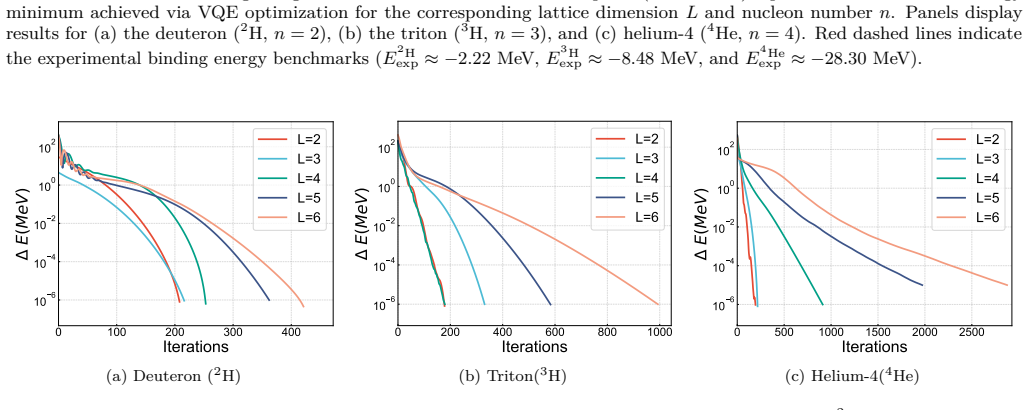
- [Results section] Results section: the claim that ground-state energies 'exhibit a clear approach' toward experimental binding energies is load-bearing for the central result, yet the manuscript supplies neither the specific lattice sizes studied, the numerical energy values (with statistical or systematic uncertainties), nor convergence diagnostics (e.g., VQE energy versus iteration count or ansatz depth). Without these data the trend cannot be quantitatively verified.
- [Hamiltonian construction and encoding section] Hamiltonian construction and encoding section: the mapping from lattice EFT interactions to the qubit Hamiltonian via Gray code plus symmetry reduction is described at a high level, but the precise form of the interactions (chiral EFT orders, fitting procedure, or parameter-free status) and the explicit symmetry-reduction protocol are not given in sufficient detail to allow independent reproduction or assessment of possible artifacts.
minor comments (2)
- Figure captions and axis labels should explicitly state the lattice sizes, the observable plotted, and whether error bars are statistical or systematic.
- The abstract would be clearer if it briefly indicated the range of lattice sizes over which the convergence trend is observed.
Simulated Author's Rebuttal
We thank the referee for the careful and constructive review of our manuscript. We address each major comment in detail below and have revised the manuscript to incorporate the requested clarifications and data.
read point-by-point responses
-
Referee: [Results section] Results section: the claim that ground-state energies 'exhibit a clear approach' toward experimental binding energies is load-bearing for the central result, yet the manuscript supplies neither the specific lattice sizes studied, the numerical energy values (with statistical or systematic uncertainties), nor convergence diagnostics (e.g., VQE energy versus iteration count or ansatz depth). Without these data the trend cannot be quantitatively verified.
Authors: We agree that explicit numerical values and diagnostics are needed for quantitative verification. In the revised manuscript we have added a table in the Results section listing the lattice sizes (2^3 through 6^3), the VQE ground-state energies for ²H, ³H, and ⁴He with statistical uncertainties obtained from repeated optimizations, and references to new supplementary figures showing VQE convergence versus iteration count and ansatz depth. These additions make the approach to experimental binding energies directly verifiable. revision: yes
-
Referee: [Hamiltonian construction and encoding section] Hamiltonian construction and encoding section: the mapping from lattice EFT interactions to the qubit Hamiltonian via Gray code plus symmetry reduction is described at a high level, but the precise form of the interactions (chiral EFT orders, fitting procedure, or parameter-free status) and the explicit symmetry-reduction protocol are not given in sufficient detail to allow independent reproduction or assessment of possible artifacts.
Authors: We accept that additional detail is required for reproducibility. The revised Hamiltonian section now specifies that leading-order chiral EFT is used with low-energy constants fitted to nucleon-nucleon phase shifts and the deuteron binding energy (the fitting procedure and resulting parameter values are provided). The symmetry-reduction protocol is described explicitly, including the projection onto definite parity and isospin sectors that reduces the qubit count by a factor of four while preserving the spectrum; the resulting qubit Hamiltonian matrices are given for the smallest lattices to allow direct verification. revision: yes
Circularity Check
No significant circularity detected
full rationale
The paper constructs a VQE framework for a 3D nuclear lattice EFT model, compares Jordan-Wigner and Gray-code encodings (with symmetry reduction), and reports numerical ground-state energies for ²H, ³H, and ⁴He on finite lattices. These energies are compared directly to independent external experimental binding energies, showing convergence with increasing lattice size. No equations reduce the reported energies or the convergence trend to fitted parameters by construction, no self-citation chains bear the central claim, and no ansatz or uniqueness result is smuggled in from prior author work. The derivation relies on standard lattice EFT Hamiltonians and variational methods that remain externally falsifiable.
Axiom & Free-Parameter Ledger
axioms (1)
- domain assumption Nuclear lattice effective field theory on a discrete grid with chosen interactions reproduces low-energy nuclear physics.
Reference graph
Works this paper leans on
-
[1]
Jordan–Wigner Transformation Among the available fermion-to-qubit encoding schemes, the Jordan–Wigner (JW) transformation is the most straightforward and widely adopted. To account for the four spin-isospin degrees of freedom inherent to nuclear systems, the qubit register is partitioned into four sectors, each corresponding to a distinct spin-isospin sta...
-
[2]
This procedure constrains the problem to a reduced Hilbert subspace of dimensionN
Gray Code Encoding To minimize qubit overhead, we first construct a symmetry-adapted basis that respects all relevant sym- metries, such as particle-number conservation and mo- mentum conservation (as detailed in the subsequent sec- tion). This procedure constrains the problem to a reduced Hilbert subspace of dimensionN. Subsequently, we employ the Gray c...
work page 2000
-
[3]
K. G. Wilson, Phys. Rev. D10, 2445 (1974)
work page 1974
-
[4]
J. B. Kogut, Rev. Mod. Phys.55, 775 (1983)
work page 1983
-
[5]
Lee, Progress in Particle and Nuclear Physics63, 117 (2009)
D. Lee, Progress in Particle and Nuclear Physics63, 117 (2009)
work page 2009
- [6]
-
[7]
J. B. Kogut, Rev. Mod. Phys.51, 659 (1979)
work page 1979
-
[8]
T. A. L¨ ahde and U.-G. Meißner,Nuclear Lattice Effective Field Theory: An introduction, Vol. 957 (Springer, 2019)
work page 2019
- [9]
- [10]
- [11]
-
[12]
E. Y. Loh, J. E. Gubernatis, R. T. Scalettar, S. R. White, D. J. Scalapino, and R. L. Sugar, Phys. Rev. B41, 9301 (1990)
work page 1990
-
[13]
T. A. L¨ ahde and U.-G. Meißner, Lect. Notes Phys.957, 1 (2019)
work page 2019
-
[14]
U.-G. Meißner, S. Shen, S. Elhatisari, and D. Lee, Phys. Rev. Lett.132, 062501 (2024)
work page 2024
-
[15]
S. Elhatisari, D. Lee, G. Rupak, E. Epelbaum, H. Krebs, T. A. L¨ ahde, T. Luu, and U.-G. Meißner, Nature528, 111–114 (2015)
work page 2015
-
[16]
S. Elhatisari, L. Bovermann, Y.-Z. Ma, E. Epelbaum, D. Frame, F. Hildenbrand, M. Kim, Y. Kim, H. Krebs, T. A. L¨ ahde, D. Lee, N. Li, B.-N. Lu, U.-G. Meißner, G. Rupak, S. Shen, Y.-H. Song, and G. Stellin, Nature 630, 59–63 (2024)
work page 2024
-
[17]
Baueret al., PRX Quantum4, 027001 (2023)
work page 2023
-
[18]
E. F. Dumitrescu, A. J. McCaskey, G. Hagen, G. R. Jansen, T. D. Morris, T. Papenbrock, R. C. Pooser, D. J. Dean, and P. Lougovski, Phys. Rev. Lett.120, 210501 (2018)
work page 2018
-
[19]
A. P´ erez-Obiol, A. M. Romero, J. Men´ endez, A. Rios, A. Garc´ ıa-S´ aez, and B. Juli´ a-D´ ıaz, Scientific Reports13, 12291 (2023)
work page 2023
-
[20]
A. M. Romero, J. Engel, H. L. Tang, and S. E. Economou, Phys. Rev. C105, 064317 (2022)
work page 2022
-
[21]
O. Kiss, M. Grossi, P. Lougovski, F. Sanchez, S. Vallecorsa, and T. Papenbrock, Phys. Rev. C106, 034325 (2022)
work page 2022
- [22]
- [23]
-
[24]
C. Gu, M. Heinz, O. Kiss, and T. Papenbrock, Phys. Rev. C113, 034321 (2026)
work page 2026
-
[25]
Quantum Algorithms for Simulating Nuclear Effective Field Theories
J. D. Watson, J. Bringewatt, A. F. Shaw, A. M. Childs, A. V. Gorshkov, and Z. Davoudi, “Quantum algorithms for simulating nuclear effective field theories,” (2025), arXiv:2312.05344 [quant-ph]
work page internal anchor Pith review arXiv 2025
- [26]
-
[27]
A. W. Sandvik, A. Avella, and F. Mancini, inAIP Con- ference Proceedings(AIP, 2010) p. 135–338
work page 2010
-
[28]
O. Di Matteo, A. McCoy, P. Gysbers, T. Miyagi, R. M. Woloshyn, and P. Navr´ atil, Phys. Rev. A103, 042405 (2021)
work page 2021
- [29]
- [30]
-
[31]
Quantum measurements and the Abelian Stabilizer Problem
A. Y. Kitaev, “Quantum measurements and the abelian stabilizer problem,” (1995), arXiv:quant-ph/9511026 [quant-ph]
work page internal anchor Pith review arXiv 1995
- [32]
-
[33]
G. H. Low and I. L. Chuang, Phys. Rev. Lett.118, 010501 (2017)
work page 2017
-
[34]
J. M. Martyn, Z. M. Rossi, A. K. Tan, and I. L. Chuang, PRX Quantum2, 040203 (2021)
work page 2021
- [35]
- [36]
-
[37]
A variational eigenvalue solver on a photonic quantum processor,
A. Peruzzo, J. McClean, P. Shadbolt, M.-H. Yung, X.-Q. Zhou, P. J. Love, A. Aspuru-Guzik, and J. L. O’Brien, Nature Communications5(2014), 10.1038/ncomms5213
- [38]
- [39]
-
[40]
H. R. Grimsley, S. E. Economou, E. Barnes, and N. J. Mayhall, Nature Communications10(2019), 10.1038/s41467-019-10988-2
-
[41]
A. Kandala, A. Mezzacapo, K. Temme, M. Takita, M. Brink, J. M. Chow, and J. M. Gambetta, Nature 549, 242–246 (2017)
work page 2017
-
[42]
Y. Cao, J. Romero, J. P. Olson, M. Degroote, P. D. Johnson, M. Kieferov´ a, I. D. Kivlichan, T. Menke, B. Per- opadre, N. P. D. Sawaya, S. Sim, L. Veis, and A. Aspuru- Guzik, Chemical Reviews119, 10856 (2019)
work page 2019
- [43]
-
[44]
C. Cade, L. Mineh, A. Montanaro, and S. Stanisic, Phys. Rev. B102, 235122 (2020)
work page 2020
-
[45]
A. M. Alvertis, A. Khan, T. Iadecola, P. P. Orth, and N. Tubman, Quantum9, 1748 (2025)
work page 2025
-
[46]
E. Epelbaum, H.-W. Hammer, and U.-G. Meißner, Rev. Mod. Phys.81, 1773 (2009)
work page 2009
- [47]
-
[48]
E. Epelbaum, H. Krebs, D. Lee, and U.-G. Meißner, Phys. Rev. Lett.104, 142501 (2010)
work page 2010
-
[49]
T. A. L¨ ahde, E. Epelbaum, H. Krebs, D. Lee, U.-G. Meißner, and G. Rupak, Physics Letters B732, 110 (2014)
work page 2014
-
[50]
B.-N. Lu, N. Li, S. Elhatisari, Y.-Z. Ma, D. Lee, and U.-G. Meißner, Phys. Rev. Lett.128, 242501 (2022)
work page 2022
-
[51]
E. Epelbaum, H. Krebs, T. A. L¨ ahde, D. Lee, U.-G. Meißner, and G. Rupak, Phys. Rev. Lett.112, 102501 (2014)
work page 2014
-
[52]
S. Shen, S. Elhatisari, T. A. L¨ ahde, D. Lee, B.-N. Lu, and U.-G. Meißner, Nat. Comm.14, 2777 (2023)
work page 2023
-
[53]
E. Epelbaum, H. Krebs, T. A. L¨ ahde, D. Lee, and U.-G. Meißner, Phys. Rev. Lett.109, 252501 (2012)
work page 2012
-
[54]
S. Elhatisari, E. Epelbaum, H. Krebs, T. A. L¨ ahde, D. Lee, N. Li, B.-n. Lu, U.-G. Meißner, and G. Rupak, Phys. Rev. Lett.119, 222505 (2017)
work page 2017
-
[55]
S. Bour, H.-W. Hammer, D. Lee, and U.-G. Meißner, Phys. Rev. C86, 034003 (2012)
work page 2012
-
[56]
S. Elhatisari, D. Lee, G. Rupak, E. Epelbaum, H. Krebs, T. A. L¨ ahde, T. Luu, and U.-G. Meißner, Nature528, 111 (2015)
work page 2015
-
[57]
Z. Ren, S. Elhatisari, T. A. L¨ ahde, D. Lee, and U.-G. Meißner, Physics Letters B850, 138463 (2024)
work page 2024
-
[58]
Y.-Z. Ma, Z. Lin, B.-N. Lu, S. Elhatisari, D. Lee, N. Li, U.-G. Meißner, A. W. Steiner, and Q. Wang, Phys. Rev. Lett.132, 232502 (2024)
work page 2024
-
[59]
PennyLane: Automatic differentiation of hybrid quantum-classical computations
V. Bergholm, J. Izaac,et al., “Pennylane: Automatic differentiation of hybrid quantum-classical computations,” (2022), arXiv:1811.04968 [quant-ph]
work page internal anchor Pith review arXiv 2022
-
[60]
JAX: composable machine learning for Python,
J. Bradbury, R. Frostig, P. Hawkins, M. J. Johnson, 9 C. Leary, D. Maclaurin, G. Necula, A. Paszke, J. Van- derPlas, S. Wanderman-Milne, and Q. Zhang, “JAX: composable machine learning for Python,” (2018)
work page 2018
-
[61]
DeepMind, I. Babuschkin, K. Baumli, A. Bell, S. Bhu- patiraju, J. Bruce, P. Buchlovsky,et al., “The DeepMind JAX Ecosystem,” (2020)
work page 2020
discussion (0)
Sign in with ORCID, Apple, or X to comment. Anyone can read and Pith papers without signing in.