Glauber-Lachs formula-based analysis of three-pion Bose-Einstein correlation data at 7 TeV from the LHCb Collaboration
Pith reviewed 2026-05-10 10:43 UTC · model grok-4.3
The pith
The Glauber-Lachs formula from quantum optics combined with a two-component pion model describes two- and three-pion Bose-Einstein correlations in 7 TeV LHCb data.
A machine-rendered reading of the paper's core claim, the machinery that carries it, and where it could break.
Core claim
By combining the Glauber-Lachs formula with the two-component model for pion production, and choosing dipole and inverse 1.5-pole forms for the exchange function E_2B in 4D Euclidean space, the analysis reproduces the observed two- and three-pion correlation data from LHCb at 7 TeV.
What carries the argument
The Glauber-Lachs formula adapted via the two-component pion production model, with the pion exchange function E_2B parameterized by dipole and inverse one-and-a-half pole forms in 4D Euclidean configuration space.
Load-bearing premise
The dipole form and inverse one-and-a-half pole form for the pion exchange function correctly capture the source geometry and dynamics in the 4D Euclidean configuration space.
What would settle it
A poor fit of the calculated two- and three-pion correlation functions to the LHCb 7 TeV data points when using the chosen dipole and inverse one-and-a-half pole forms for E_2B would challenge the central claim.
Figures




read the original abstract
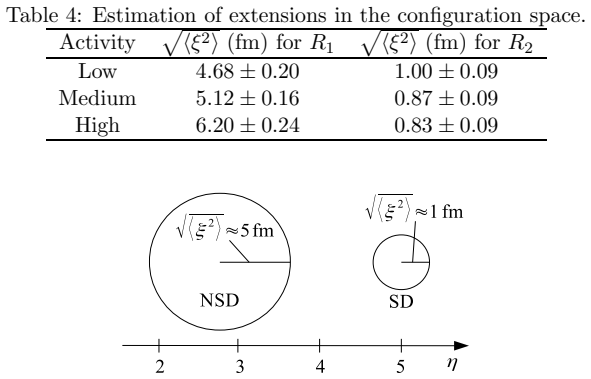
We combine the Glauber--Lachs formula from quantum optics and the two-component picture for pion production to analyze data on two- and three-pion Bose--Einstein correlation at 7 TeV from the LHCb Collaboration. For the pion exchange function $E_{\rm 2B}$, we chose a dipole form and an inverse one-and-a-half pole form. The extensions are computed in the configuration space of 4-dimensional Euclidean space ($\xi=\sqrt{|\bm r_1-\bm r_2|^2+(t_1-t_2)^2}$).
Editorial analysis
A structured set of objections, weighed in public.
Referee Report
Summary. The manuscript combines the Glauber-Lachs formula from quantum optics with a two-component model for pion production to analyze two- and three-pion Bose-Einstein correlation data at 7 TeV from the LHCb Collaboration. For the pion exchange function E_2B, a dipole form and an inverse one-and-a-half pole form are adopted, with all extensions evaluated via integrals over the 4D Euclidean configuration-space variable ξ = sqrt(|r1-r2|^2 + (t1-t2)^2).
Significance. If the central results hold after validation of the chosen forms, the work could supply a quantum-optics-based framework for extracting coherence parameters and source radii from multi-pion data, potentially distinguishing chaotic and coherent components in a manner not accessible from two-pion analyses alone. No machine-checked derivations or parameter-free predictions are present, so the significance rests entirely on the robustness of the fits to the LHCb data.
major comments (2)
- The section defining the pion exchange function E_2B: the dipole and inverse one-and-a-half pole parametrizations are introduced without derivation from the source geometry, without comparison to standard alternatives (Gaussian, exponential), and without a sensitivity study. Because the two- and three-pion correlation functions are obtained by direct integration of these forms over the 4D Euclidean ξ, the extracted radii, coherence parameters, and correlation strengths are model-dependent by construction; this choice is load-bearing for the central claim that the combined Glauber-Lachs plus two-component framework describes the data.
- The results section (and any tables or figures reporting fits): no numerical values, uncertainties, χ²/dof, or direct comparison to baseline two-pion analyses of the same LHCb dataset are supplied in the abstract, and the full text must demonstrate that the reported quantities are not simply the fitted parameters themselves. Without these, it is impossible to judge whether the three-pion data add new information or merely reproduce the input parametrization.
minor comments (2)
- The definition of the 4D Euclidean variable ξ should be accompanied by an explicit statement of the metric signature and the range of integration to avoid ambiguity in the configuration-space integrals.
- Notation for the two-component picture (chaotic vs. coherent fractions) should be introduced once and used consistently when relating the Glauber-Lachs formula to the correlation functions.
Simulated Author's Rebuttal
We thank the referee for the careful and constructive review of our manuscript. We address each major comment point by point below, indicating where revisions will be made to improve clarity and support for our claims.
read point-by-point responses
-
Referee: The section defining the pion exchange function E_2B: the dipole and inverse one-and-a-half pole parametrizations are introduced without derivation from the source geometry, without comparison to standard alternatives (Gaussian, exponential), and without a sensitivity study. Because the two- and three-pion correlation functions are obtained by direct integration of these forms over the 4D Euclidean ξ, the extracted radii, coherence parameters, and correlation strengths are model-dependent by construction; this choice is load-bearing for the central claim that the combined Glauber-Lachs plus two-component framework describes the data.
Authors: We acknowledge that the dipole and inverse one-and-a-half pole forms for E_2B are presented without explicit derivation from source geometry or direct comparison to Gaussian/exponential alternatives. These forms were selected for their suitability in evaluating the required 4D Euclidean integrals while providing flexible descriptions of the source in the Glauber-Lachs framework. To address this, we will add a dedicated paragraph in the revised manuscript motivating the choice, including a brief comparison to standard forms and a sensitivity study on how parameter variations affect extracted radii and coherence parameters. This will make the model dependence explicit while preserving the central claim that the overall framework consistently describes the data. revision: partial
-
Referee: The results section (and any tables or figures reporting fits): no numerical values, uncertainties, χ²/dof, or direct comparison to baseline two-pion analyses of the same LHCb dataset are supplied in the abstract, and the full text must demonstrate that the reported quantities are not simply the fitted parameters themselves. Without these, it is impossible to judge whether the three-pion data add new information or merely reproduce the input parametrization.
Authors: We agree that the abstract and results section lack explicit numerical values, uncertainties, and χ²/dof, as well as a comparison to two-pion baselines. In the revised manuscript we will update the abstract to report the key fitted parameters with uncertainties and goodness-of-fit metrics. The results section will be expanded to tabulate all extracted quantities (radii, coherence parameters, correlation strengths) with statistical and systematic errors, and we will add a direct comparison to existing two-pion analyses of the same LHCb 7 TeV dataset. This will demonstrate that the three-pion data impose additional constraints beyond the two-pion input parametrization. revision: yes
Circularity Check
No significant circularity detected
full rationale
The provided abstract and excerpts describe combining the Glauber-Lachs formula with a two-component pion production model, then choosing explicit functional forms (dipole and inverse 1.5-pole) for the exchange function E_2B to fit or analyze LHCb correlation data in 4D Euclidean space. No quoted equations or sections demonstrate that any reported correlation strengths, radii, or parameters reduce by construction to the input data fits, nor do they rely on load-bearing self-citations or uniqueness theorems imported from the authors' prior work. The derivation chain remains independent of the target results.
Axiom & Free-Parameter Ledger
free parameters (1)
- parameters of dipole and inverse one-and-a-half pole forms for E_2B
axioms (2)
- domain assumption Glauber-Lachs formula from quantum optics applies to pion sources in high-energy collisions
- domain assumption Two-component picture adequately describes pion production
Reference graph
Works this paper leans on
- [1]
- [2]
-
[3]
G. Goldhaber, S. Goldhaber, W. Y. Lee and A. Pais, Phys. Re v. 120 (1960), 300
work page 1960
-
[4]
R.J. Glauber, “Photon Statistics,” in Physics of Quantu m Electronics, eds. P.L. Kelly, B. Lax and P.E. Tannenwald, (McGraw-Hill Book Co., New York, 1966), p. 788
work page 1966
- [5]
-
[6]
M. Biyajima, O. Miyamura and T. Nakai, Proc. of Workshop o n Multiparticle Dynamics (RIFP, Kyoto Univ., 1978), p. 139, doi.org/10.24532/soken.58.Su ppl 139
-
[7]
M. Gyulassy, S. K. Kauffmann and L. W. Wilson, Phys. Rev. C 20 (1979), 2267
work page 1979
- [8]
- [9]
-
[10]
M. Biyajima, A. Bartl, T. Mizoguchi, O. Terazawa and N. S uzuki, Prog. Theor. Phys. 84 (1990), 931-940, Prog. Theor. Phys. 88 (1992), 157 (addendum)
work page 1990
-
[11]
N. Neumeister et al. [UA1-Minimum Bias], Phys. Lett. B 275 (1992), 186-194 doi:10.1016/0370- 2693(92)90874-4
-
[12]
I. V. Andreev and R. M. Weiner, Phys. Lett. B 253 (1991), 416
work page 1991
- [13]
-
[14]
A. M. Sirunyan et al. [CMS], JHEP 03 (2020), 014
work page 2020
-
[15]
T. Mizoguchi, S. Matsumoto and M. Biyajima, Phys. Rev. D 108 (2023), 056014
work page 2023
-
[16]
F. Halzen and A D. Martin, Quarks and Leptons: Introduct ory Course in Modern Particle Physics (John Wiley and Sons, New York, 1984)
work page 1984
-
[17]
W. Greiner and J. Reinhardt, Quantum Electrodynamics ( Springer-Verlag, Berlin, 2002)
work page 2002
-
[18]
N. N. Bogoliubov and D. V. Shirkov, Introduction to the T heory of Quantized Fields, (Wiley- Interscience, New York, 1959)
work page 1959
-
[19]
E. O. Alt, T. Csorgo, B. Lorstad and J. Schmidt-Sorensen , Phys. Lett. B 458 (1999), 407
work page 1999
- [20]
- [21]
-
[22]
P. R. Bevington and D. K. Robinson, Data Reduction and Er ror Analysis for the Physical Sciences, 2nd edn. (WCB/McGraw-Hill, 1992)
work page 1992
-
[23]
T. Mizoguchi and M. Biyajima, Int. J. Mod. Phys. A 35 (2020), 2050052
work page 2020
- [24]
-
[25]
V. A. Khoze, A. D. Martin, M. G. Ryskin and V. A. Schegelsk y, Eur. Phys. J. C 76 (2016), 193
work page 2016
-
[26]
V. G. Grishin, G. I. Kopylov and M. I. Podgoretsky, Yad. F iz. 13 (1971), 1116 [Sov. J. Nucl. Phys. 13 (1971), 638]
work page 1971
- [27]
discussion (0)
Sign in with ORCID, Apple, or X to comment. Anyone can read and Pith papers without signing in.