Beyond the mass-radius plane: Integrated radiative-convective and interior structure simulations of the exoplanet continuum
Pith reviewed 2026-05-10 07:23 UTC · model grok-4.3
The pith
Envelope mass fraction in exoplanets is degenerate with instellation flux and atmospheric metallicity, so temperate sub-Neptunes can host supercritical surfaces or deep magma oceans.
A machine-rendered reading of the paper's core claim, the machinery that carries it, and where it could break.
Core claim
Static structure models are extended by embedding radiative-convective-chemical climate calculations, yielding a library of 504,000 self-consistent exoplanet structures. These calculations demonstrate that envelope mass fraction is frequently degenerate with instellation flux and atmospheric metallicity and is sensitive to the treatment of gravitational acceleration near the mbar level. As a direct result, habitable-zone sub-Neptunes readily develop supercritical surfaces or deep magma oceans even under temperate irradiation. Marginalisation over these uncertainties is achieved by a Bayesian retrieval tool that operates on the full library, delivering robust physical interpretations when the
What carries the argument
The library of 504,000 unified interior-atmosphere simulations that embed radiative-convective-chemical treatments into static structure calculations, allowing envelope mass fraction to be recovered while accounting for flux and metallicity trade-offs.
If this is right
- Envelope mass fraction cannot be inferred from mass and radius data alone without joint constraints on instellation and metallicity.
- Sub-Neptunes in the habitable zone are expected to maintain supercritical or molten surface conditions rather than Earth-like solid surfaces.
- Bayesian retrievals using the simulation library yield more stable composition estimates for individual planets such as Pi Men c and TOI-421 b.
- Observational programs with JWST, Ariel, and PLATO can move from categorical mass-radius bins toward continuous physical interpretations once these degeneracies are marginalised.
Where Pith is reading between the lines
- The static-model approach could be tested by comparing its predicted transmission spectra against actual JWST observations of the same targets to check for unaccounted atmospheric biases.
- Population syntheses that draw from the library might reveal whether the magma-ocean outcome correlates with orbital period or host-star type.
- Adding time-dependent cooling or photochemistry to the current static framework would show whether the reported surface states persist over Gyr timescales.
Load-bearing premise
The static structure models with added radiative-convective-chemical treatments accurately capture real atmospheric physics at the mbar level without unaccounted systematic biases in gravitational acceleration or chemistry.
What would settle it
Spectroscopic or thermal observations of a temperate sub-Neptune that directly measure an envelope mass fraction lying well outside the Bayesian posterior range predicted by the model library for its observed mass, radius, flux, and metallicity would falsify the degeneracy and surface-condition claims.
Figures




read the original abstract
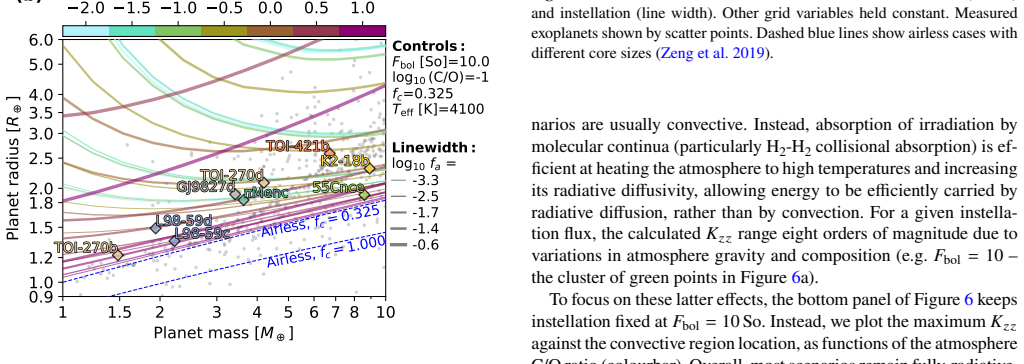
Static structure models, which map mass-radius constraints to bulk planet composition, are frequently used to categorise exoplanets due to their computational efficiency and the high-level insight they offer into planetary properties. However, static structure models typically have simplified atmospheric treatments, which may introduce systematic biases when interpreting the structures -- and therefore the climates -- of sub-Neptunes and super-Earths.We present a framework for recovering exoplanet properties using static structure models that accounts for necessary physical-chemical complexity in their atmospheres. We produce a comprehensive library of 504,000 exoplanet simulations that unify deep planetary interior structure with radiative-convective-chemical climate calculations. From these models we demonstrate that a planet's envelope mass fraction -- a critical parameter to infer -- is frequently degenerate with its instellation flux and atmospheric metallicity, and sensitive to the treatment of gravitational acceleration at the mbar level. Such uncertainties have significant implications for inferring planetary processes, as our modelling shows that habitable-zone sub-Neptunes readily host supercritical surfaces or deep magma oceans, despite their temperate irradiation regime. To marginalise over these uncertainties, we introduce a Bayesian retrieval tool that uses our library of self-consistent models. By applying this Bayesian approach to case-studies of Pi Men c and TOI-421 b, we show that robust physical interpretations are achievable through whole-planet mass-radius retrievals. While new data from JWST, Ariel, and PLATO will expand our observational horizon, physically-consistent modelling provides the means to transition from categorical interpretations toward a comprehensive picture of the exoplanet continuum.
Editorial analysis
A structured set of objections, weighed in public.
Referee Report
Summary. The manuscript presents a framework integrating static interior structure models with radiative-convective-chemical atmospheric calculations to generate a library of 504,000 exoplanet simulations. It claims that envelope mass fraction is frequently degenerate with instellation flux and atmospheric metallicity, that habitable-zone sub-Neptunes can host supercritical surfaces or deep magma oceans despite temperate irradiation, and that a Bayesian retrieval tool applied to Pi Men c and TOI-421 b enables robust whole-planet interpretations.
Significance. If validated, the integrated modeling approach and large simulation library would advance exoplanet characterization by reducing systematic biases from simplified atmospheres, with direct implications for inferring compositions, climates, and habitability across the sub-Neptune to super-Earth continuum. The Bayesian marginalization tool is a practical strength for handling degeneracies.
major comments (3)
- [Abstract] The central claims on envelope mass fraction degeneracy and interior states (supercritical surfaces, magma oceans) rest on the 504k simulation grid, yet the manuscript provides no validation metrics, error analysis, or direct comparisons to independent radiative-transfer codes, solar-system analogs, or observed transmission spectra (Abstract and library construction description).
- [Simulation library and sensitivity discussion] The noted sensitivity of results to gravitational acceleration treatment at the mbar level is flagged but not quantified in terms of its effect on inferred envelope fractions or deep adiabats across the parameter space; this directly undermines in the reported degeneracies and temperate sub-Neptune interior states.
- [Case-study applications] The Bayesian retrieval demonstrations for Pi Men c and TOI-421 b lack explicit details on priors, likelihood construction, and convergence diagnostics, making it impossible to assess whether the tool truly marginalizes the flagged uncertainties in a robust manner.
minor comments (2)
- [Abstract] The abstract would be strengthened by briefly stating the ranges of mass, radius, metallicity, and instellation covered by the 504k models.
- Notation for envelope mass fraction and instellation flux should be defined consistently on first use in the main text.
Simulated Author's Rebuttal
We thank the referee for their constructive and detailed report, which identifies key areas where the manuscript can be strengthened. We address each major comment below and will incorporate revisions to improve validation, quantification, and methodological transparency while preserving the core scientific contributions.
read point-by-point responses
-
Referee: [Abstract] The central claims on envelope mass fraction degeneracy and interior states (supercritical surfaces, magma oceans) rest on the 504k simulation grid, yet the manuscript provides no validation metrics, error analysis, or direct comparisons to independent radiative-transfer codes, solar-system analogs, or observed transmission spectra (Abstract and library construction description).
Authors: We agree that the abstract and library construction section would benefit from explicit validation details. The underlying interior and radiative-convective models are drawn from established, previously benchmarked codes (with references provided in the methods), but we will add a dedicated validation subsection in the revised manuscript. This will include convergence error analysis across the grid, comparisons to solar-system analogs (Earth and Neptune) for radius and thermal profiles, and cross-checks against an independent radiative-transfer code for a representative subset of models. Direct comparisons to observed transmission spectra fall outside the paper's primary focus on mass-radius structure retrievals, but we will add a brief limitations statement and note potential future extensions. These changes will be made. revision: partial
-
Referee: [Simulation library and sensitivity discussion] The noted sensitivity of results to gravitational acceleration treatment at the mbar level is flagged but not quantified in terms of its effect on inferred envelope fractions or deep adiabats across the parameter space; this directly undermines in the reported degeneracies and temperate sub-Neptune interior states.
Authors: The referee is correct that the sensitivity is flagged but not quantified across the full parameter space. To address this directly, we will perform additional targeted sensitivity experiments varying the mbar-level gravity treatment and report the resulting variations in envelope mass fractions and deep adiabats for representative cases spanning the grid. These quantitative results will be added to the simulation library and sensitivity discussion section, allowing readers to better evaluate the robustness of the reported degeneracies and interior states. revision: yes
-
Referee: [Case-study applications] The Bayesian retrieval demonstrations for Pi Men c and TOI-421 b lack explicit details on priors, likelihood construction, and convergence diagnostics, making it impossible to assess whether the tool truly marginalizes the flagged uncertainties in a robust manner.
Authors: We acknowledge that the current description of the Bayesian tool lacks sufficient detail for full assessment. In the revised manuscript, we will expand the case-study section to explicitly state the priors employed, the construction of the likelihood function from mass-radius data, and convergence diagnostics (including trace plots, autocorrelation times, and Gelman-Rubin statistics). These additions will demonstrate how the tool marginalizes the identified uncertainties and will be included in the updated version. revision: yes
Circularity Check
No circularity: forward simulation library generates independent outputs
full rationale
The paper generates a library of 504,000 integrated static structure plus radiative-convective-chemical models from physical assumptions and then derives claims about envelope mass fraction degeneracy with flux and metallicity, plus interior states for temperate sub-Neptunes, directly from analysis of that library. These are forward-model outputs, not quantities fitted to the target results or observations. The subsequent Bayesian retrieval tool simply queries the pre-computed library for case studies; no step reduces a claimed prediction or first-principles result to an input by construction, self-definition, or load-bearing self-citation. The derivation chain remains self-contained as an exploratory simulation study.
Axiom & Free-Parameter Ledger
free parameters (2)
- atmospheric metallicity
- instellation flux
axioms (2)
- domain assumption Radiative-convective-chemical equilibrium governs the atmospheric structure
- domain assumption Static structure models can be corrected for atmospheric complexity without full time-dependent dynamics
Forward citations
Cited by 1 Pith paper
-
Coupled atmospHere Interior modeL Intercomparison (CHILI). I. Evolutionary Modelling -- Primordial Magma Oceans of Earth and Venus
An intercomparison of planetary evolution codes finds Earth magma oceans solidify in about 4 million years while Venus scenarios show more varied prolonged stages up to 50 million years, with outcomes sensitive to ini...
Reference graph
Works this paper leans on
-
[1]
R., Seager S., Elkins-Tanton L., 2008, Astrophys
Adams E. R., Seager S., Elkins-Tanton L., 2008, Astrophys. J., 673, 1160 AndraultD.,Bolfan-CasanovaN.,NigroG.L.,BouhifdM.A.,GarbarinoG., Mezouar M., 2011, Earth Planet. Sci. Lett., 304, 251 Arnscheidt C. W., Wordsworth R. D., Ding F., 2019, Astrophys. J., 881, 60 Asplund M., Grevesse N., Sauval A. J., Scott P., 2009, Annual Review of Astronomy and Astroph...
-
[2]
et al., 2018, A&A, 619, A1 Bower D
Bourrier, V. et al., 2018, A&A, 619, A1 Bower D. J., Kitzmann D., Wolf A. S., Sanan P., Dorn C., Oza A. V., 2019, Astronomy & Astrophysics, 631, A103 Bower D. J., Hakim K., Sossi P. A., Sanan P., 2022, The Planetary Science Journal, 3, 93 Box G. E. P., 1976, Journal of the American Statistical Association, 71, 791 Breza B., Nixon M. C., Kempton E. M.-R., ...
-
[3]
Handbook of Exoplanets , year = 2018, eid =
Lodders, Bruce Fegley. LopezE.D.,2017,MonthlyNoticesoftheRoyalAstronomicalSociety,472, 245 Lopez E. D., Fortney J. J., 2014, The Astrophysical Journal, 792, 1 Luque R., Palle E., 2022, Science, 377, 1211 LuuC.,YuX.,GleinC.,InnesH.,TsaiS.-M.,MosesJ.I.,2024,Astrobiology Science Conference (AbSciCon) 2024, pp 325–04 MadhusudhanN., 2018,in ,Handbook ofExoplan...
-
[4]
Press, Cambridge Piaulet-Ghorayeb C., et al., 2024, Astrophys. J. Lett., 974, L10 Piaulet-Ghorayeb C., Thorngren D. P., Kempton E. M.-R., Lipper J., Rogers L., Horta F. C., Sun S. L., 2025, arXiv Pierrehumbert R., 2010, Principles of planetary climate. Cambridge Univer- sity Press, Cambridge New York Pierrehumbert R., Gaidos E., 2011, Astrophys. J. Lett.,...
discussion (0)
Sign in with ORCID, Apple, or X to comment. Anyone can read and Pith papers without signing in.