The inviscid Euler limit as a critical boundary for moment-based aerodynamic system identification
Pith reviewed 2026-05-10 06:53 UTC · model grok-4.3
The pith
The two-dimensional inviscid Euler equations have no window-independent memory time because their impulse response makes the second temporal moment diverge logarithmically.
A machine-rendered reading of the paper's core claim, the machinery that carries it, and where it could break.
Core claim
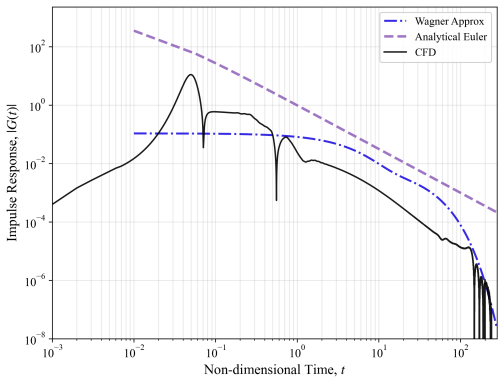
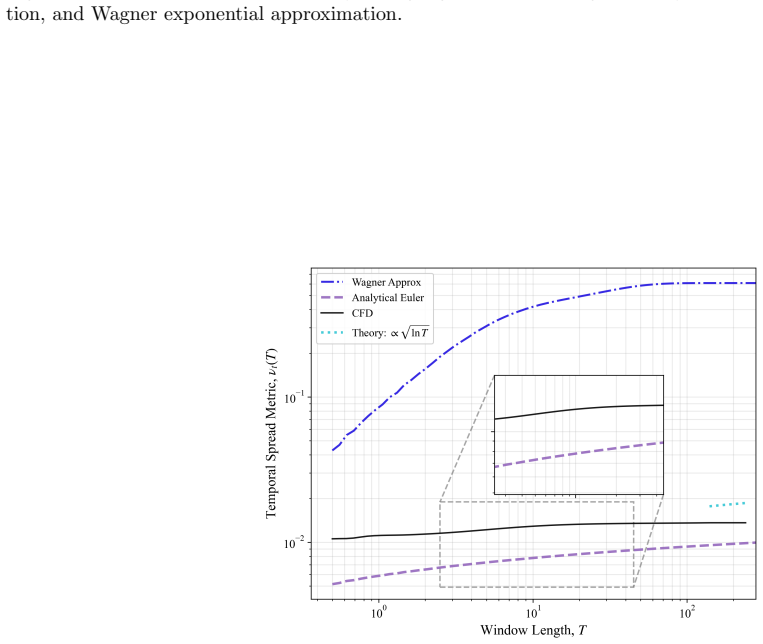
In the two-dimensional inviscid limit the second temporal moment of the impulse response kernel diverges logarithmically with the observation window T. This divergence implies that the characteristic memory time scales as sqrt(ln T) and that no fixed, window-independent time scale exists for moment-based system identification.
What carries the argument
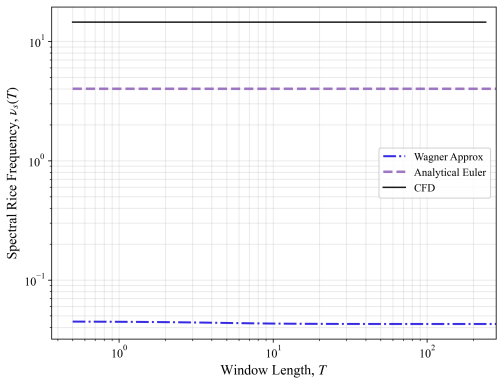
The temporal-moment diagnostic ν_t(T), the ratio of the second to the zeroth windowed moment of the impulse response kernel, which directly exposes the logarithmic divergence produced by the t^{-3/2} tail.
If this is right
- Exponential models exhibit stable memory-time plateaus because their decay is fast enough for moments to converge.
- Compressible Euler simulations reproduce the sqrt(ln T) growth of memory time at intermediate times.
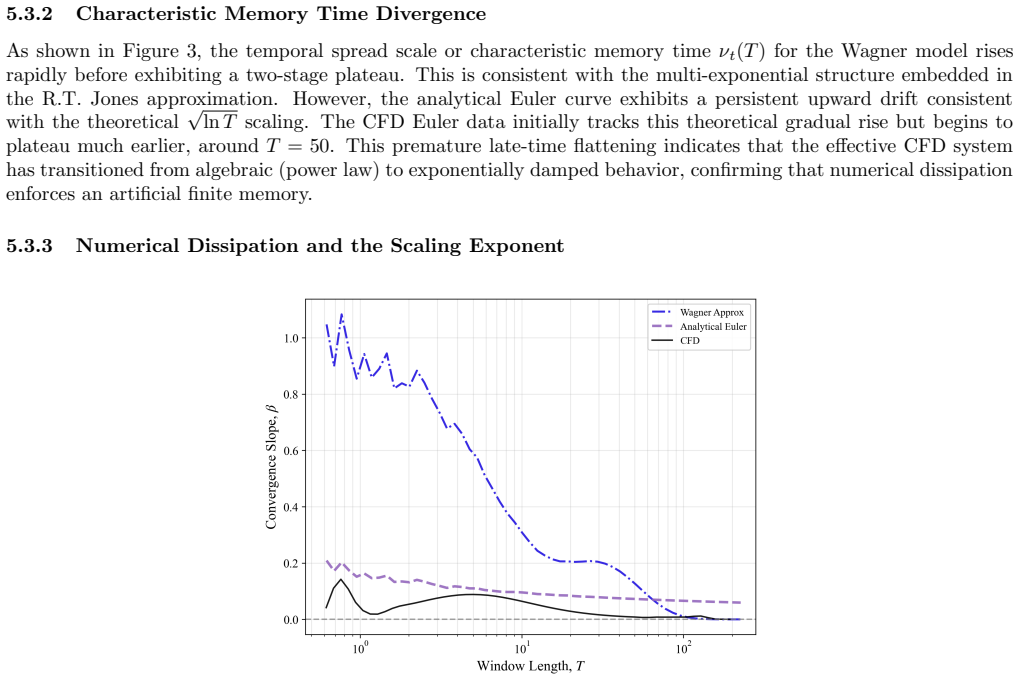
- Numerical dissipation present in any discretization acts as an artificial regularizer that forces moment convergence at late times.
- Finite-dimensional state-space models fitted to inviscid data parameterize the observation horizon rather than intrinsic flow physics.
Where Pith is reading between the lines
- Flows with even small viscosity will cross over to exponential decay after a Reynolds-number-dependent cutoff time, restoring a fixed memory scale.
- System identification routines applied to nearly inviscid data must treat the data-window length as an explicit parameter rather than an arbitrary choice.
- The same moment-divergence mechanism may appear in other two-dimensional vortical systems whose far-field response decays slower than t to the minus two.
Load-bearing premise
The known t to the minus three-halves asymptotic decay of the two-dimensional Euler impulse response remains the dominant contribution over the finite but growing observation windows used in system identification.
What would settle it
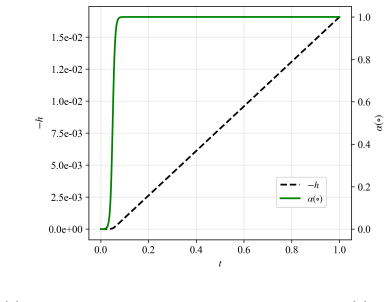
Extract the second moment of the impulse response from two-dimensional inviscid Euler simulations over successively longer time windows and test whether the moment increases in proportion to the logarithm of the window length.
Figures
read the original abstract
Finite-dimensional state-space representations of unsteady aerodynamics implicitly assume a system with fading memory. However, the impulse response of the two-dimensional inviscid (Euler) equations is characterized by an asymptotic $t^{-3/2}$ power-law decay due to the persistence of shed vorticity. The present work demonstrates that this decay rate constitutes a critical boundary for moment convergence: the second temporal moment diverges logarithmically, causing the characteristic memory time to grow as $\sqrt{\ln T}$ with the observation window $T$. As a result, no window-independent characteristic time scale exists, and finite-dimensional models fitted to inviscid data effectively parameterize the observation horizon rather than intrinsic flow physics. To quantify this behavior, a temporal-moment diagnostic, $\nu_t(T)$, is introduced based on the ratio of the second and zeroth windowed moments of the impulse response kernel. Exponential models exhibit stable memory time plateaus, as their sufficiently fast decay ensures convergence of the moment diagnostic. Compressible Euler simulation results confirm the predicted $\sqrt{\ln T}$ scaling at intermediate times, while numerical dissipation inherent to the discretization acts as an artificial regularizer that enforces convergence at late times. These results establish the two-dimensional inviscid limit as a critical boundary for moment-based system identification, where the absence of a dissipative mechanism prevents the definition of a window-independent characteristic memory time.
Editorial analysis
A structured set of objections, weighed in public.
Referee Report
Summary. The manuscript claims that the asymptotic t^{-3/2} decay of the impulse response for the 2D inviscid Euler equations marks a critical boundary for moment-based system identification. It asserts that this decay causes the second temporal moment to diverge logarithmically (rather than as a power law), so that a characteristic memory time defined from the windowed moments grows as sqrt(ln T) with observation window T. Consequently, no window-independent time scale exists, and finite-dimensional models fitted to such data effectively encode the horizon T instead of intrinsic physics. A diagnostic nu_t(T) based on the ratio of second to zeroth windowed moments is introduced; exponential kernels are shown to produce stable plateaus while Euler simulations are said to confirm the sqrt(ln T) scaling at intermediate times before numerical dissipation enforces convergence.
Significance. If the central scaling result held, the work would usefully delineate a theoretical limit for the applicability of moment-based reduced-order models in unsteady aerodynamics, showing that the 2D inviscid case lacks a dissipative mechanism sufficient to produce a finite, window-independent memory time. The introduction of the nu_t(T) diagnostic and the explicit contrast with exponentially decaying kernels would provide a practical tool for assessing when system-identification assumptions break down.
major comments (2)
- [Abstract] Abstract (and the central derivation): the stated t^{-3/2} decay of h(t) does not produce logarithmic divergence of the second moment. With m_2(T) = ∫_0^T t^2 h(t) dt and h(t) ∼ t^{-3/2}, the integrand scales as t^{1/2}, so m_2(T) ∼ T^{3/2} (power-law divergence). Logarithmic divergence of m_2 instead requires h(t) ∼ t^{-3}. The claimed sqrt(ln T) growth of the memory time (presumably sqrt(m_2/m_0)) is therefore incompatible with the given decay rate under standard moment definitions. This directly affects the central claim that no window-independent scale exists and the interpretation of the simulation results.
- [Abstract] Abstract and simulation discussion: the manuscript states that compressible Euler simulations confirm the predicted sqrt(ln T) scaling at intermediate times. However, no quantitative details (grid resolution, time-stepping scheme, domain size, or how the impulse response is extracted) are provided to allow verification that the observed growth is not an artifact of the numerical dissipation that the text itself identifies as an artificial regularizer at late times.
minor comments (1)
- The precise definition of the temporal-moment diagnostic nu_t(T) (ratio of which moments, normalization, and how the characteristic time is extracted from it) should be stated explicitly in the main text rather than only alluded to in the abstract.
Simulated Author's Rebuttal
We thank the referee for their detailed and insightful report. The two major comments identify a mathematical inconsistency in the moment scaling and a lack of numerical details. We agree with both points and will revise the manuscript accordingly. The core qualitative conclusion—that the 2D inviscid Euler equations lack a window-independent memory time for moment-based system identification—remains valid under the corrected scaling, as the second moment still diverges with T.
read point-by-point responses
-
Referee: [Abstract] Abstract (and the central derivation): the stated t^{-3/2} decay of h(t) does not produce logarithmic divergence of the second moment. With m_2(T) = ∫_0^T t^2 h(t) dt and h(t) ∼ t^{-3/2}, the integrand scales as t^{1/2}, so m_2(T) ∼ T^{3/2} (power-law divergence). Logarithmic divergence of m_2 instead requires h(t) ∼ t^{-3}. The claimed sqrt(ln T) growth of the memory time (presumably sqrt(m_2/m_0)) is therefore incompatible with the given decay rate under standard moment definitions. This directly affects the central claim that no window-independent scale exists and the interpretation of the simulation results.
Authors: We thank the referee for catching this error in our derivation. Re-examination confirms that for an asymptotic decay h(t) ∼ t^{-3/2}, the integrand t^2 h(t) ∼ t^{1/2} yields m_2(T) ∼ T^{3/2} (power-law divergence), not logarithmic. The sqrt(ln T) scaling for the memory time is therefore incorrect. We will revise the abstract, introduction, and derivation sections to state the proper T^{3/2} divergence of m_2 and the resulting T^{3/4} growth of a memory time defined via sqrt(m_2/m_0). The central claim is unaffected: because m_2 diverges with the observation window T, no finite, window-independent characteristic time exists, and finite-dimensional models fitted to such data still parameterize the horizon rather than intrinsic physics. We will also re-analyze the simulation data against the corrected scaling. revision: yes
-
Referee: [Abstract] Abstract and simulation discussion: the manuscript states that compressible Euler simulations confirm the predicted sqrt(ln T) scaling at intermediate times. However, no quantitative details (grid resolution, time-stepping scheme, domain size, or how the impulse response is extracted) are provided to allow verification that the observed growth is not an artifact of the numerical dissipation that the text itself identifies as an artificial regularizer at late times.
Authors: We agree that the current manuscript lacks sufficient numerical details for independent verification. In the revised version we will add a dedicated methods subsection (or appendix) specifying: grid resolution and refinement strategy, time-stepping scheme and CFL condition, computational domain size with far-field boundary treatment, and the precise procedure for extracting the impulse response (including the form of the impulsive forcing). We will also include a brief resolution study or comparison of dissipation effects to demonstrate that the intermediate-time growth is not an artifact of numerical viscosity. These additions will allow readers to assess the results directly. revision: yes
Circularity Check
Derivation starts from externally known t^{-3/2} decay; moment diagnostic defined directly without fitting or self-definition
full rationale
The paper takes the t^{-3/2} asymptotic decay of the 2D Euler impulse response as an externally known input (not derived or fitted within the work). It then defines the diagnostic ν_t(T) explicitly as the ratio of the second and zeroth windowed moments of the impulse response kernel and applies the known decay to obtain the claimed logarithmic divergence and √(ln T) scaling. No parameter is fitted to the target result, no self-citation is invoked as a load-bearing uniqueness theorem, and no ansatz is smuggled in. The central claim therefore remains independent of its own output, qualifying as no significant circularity (minor score assigned only because the scaling derivation is presented as a first-principles consequence of the input decay).
Axiom & Free-Parameter Ledger
axioms (1)
- domain assumption The impulse response of the 2D inviscid Euler equations decays asymptotically as t^{-3/2} due to persistent shed vorticity.
invented entities (1)
-
temporal-moment diagnostic nu_t(T)
no independent evidence
Reference graph
Works this paper leans on
-
[1]
Nasa turbulence modeling resource grids
AIAA Turbulence Model Benchmarking Working Group . Nasa turbulence modeling resource grids. https://github.com/TMBWG/turbmodels/blob/main/NACA0012numerics_grids/n0012familyI.5.p2dfmt.gz, 2026
work page 2026
-
[2]
Optimal control: linear quadratic methods
Brian DO Anderson and John B Moore. Optimal control: linear quadratic methods. Prentice-Hall, Inc., 1990
work page 1990
-
[3]
Eduardo F Camacho and Carlos Bordons. Model predictive control. Springer science & business media, 2013
work page 2013
-
[4]
Scott T. M. Dawson and Steven L. Brunton. Improved approximations to wagner function using sparse identification of nonlinear dynamics. AIAA Journal, 60 0 (3): 0 1691--1707, 2022. doi:10.2514/1.J060863. URL https://doi.org/10.2514/1.J060863
-
[5]
SU2: An Open- Source Suite for Multiphysics Simulation and Design,
Thomas D. Economon, Francisco Palacios, Sean R. Copeland, Trent W. Lukaczyk, and Juan J. Alonso. Su2: An open-source suite for multiphysics simulation and design. AIAA Journal, 54 0 (3): 0 828--846, 2016. doi:10.2514/1.J053813. URL https://doi.org/10.2514/1.J053813
-
[6]
Robert T. Jones. The unsteady lift of a wing of finite aspect ratio. NACA Report, 681: 0 1--8, 1940
work page 1940
-
[7]
Jer-Nan Juang and Richard S. Pappa. An eigensystem realization algorithm for modal parameter identification and model reduction. Journal of Guidance, Control, and Dynamics, 8 0 (5): 0 620--627, 1985. doi:10.2514/3.20031. URL https://doi.org/10.2514/3.20031
-
[8]
Jer-Nan Juang, Minh Phan, Lucas G. Horta, and Richard W. Longman. Identification of observer/kalman filter markov parameters - theory and experiments. Journal of Guidance, Control, and Dynamics, 16 0 (2): 0 320--329, 1993. doi:10.2514/3.21006. URL https://doi.org/10.2514/3.21006
-
[9]
Joseph Katz and Allen Plotkin. Low-speed aerodynamics. Cambridge university press, 2001
work page 2001
-
[10]
Harvard Lomax, Max A. Heaslet, Franklyn B. Fuller, and Loma Sluder. Derivation and application of a general formula for directly computing the aerodynamic forces on wings in generalized motion. NACA Report, 1066, 1952
work page 1952
-
[11]
L2roe: a low dissipation version of roe's approximate riemann solver for low mach numbers
Kai O wald, Alexander Siegmund, Philipp Birken, Volker Hannemann, and Andreas Meister. L2roe: a low dissipation version of roe's approximate riemann solver for low mach numbers. International Journal for Numerical Methods in Fluids, 81 0 (2): 0 71--86, 2016
work page 2016
-
[12]
Stephen O. Rice. Mathematical analysis of random noise. The Bell System Technical Journal, 23 0 (3): 0 282--332, 1944. doi:10.1002/j.1538-7305.1944.tb00874.x
-
[13]
Stephen O. Rice. Mathematical analysis of random noise (continued). The Bell System Technical Journal, 24 0 (1): 0 46--156, 1945. doi:10.1002/j.1538-7305.1945.tb00453.x
-
[14]
Christopher L. Rumsey, Brian R. Smith, and George P. Huang. Description of a website resource for turbulence modeling verification and validation. In 40th AIAA Fluid Dynamics Conference and Exhibit, Chicago, IL, 2010
work page 2010
-
[15]
William R. Sears. Operational methods in the theory of airfoils in non-uniform motion. Journal of the Franklin Institute, 230 0 (1): 0 95--111, 1940
work page 1940
-
[16]
General theory of aerodynamic instability and the mechanism of flutter
Theodore Theodorsen. General theory of aerodynamic instability and the mechanism of flutter. Report 496, National Advisory Committee for Aeronautics, Washington, D.C., 1935
work page 1935
-
[17]
Towards the ultimate conservative difference scheme
Bram van Leer. Towards the ultimate conservative difference scheme. v. a second-order sequel to godunov's method. Journal of Computational Physics, 32 0 (1): 0 101--136, 1979
work page 1979
-
[18]
uber die E ntstehung des dynamischen A uftriebes von T ragfl\
Herbert Wagner. \"uber die E ntstehung des dynamischen A uftriebes von T ragfl\"ugeln. Zeitschrift f\"ur Angewandte Mathematik und Mechanik, 5 0 (1): 0 17--35, 1925. doi:10.1002/zamm.19250050103
discussion (0)
Sign in with ORCID, Apple, or X to comment. Anyone can read and Pith papers without signing in.