Thermal-fluctuator driven decoherence of an oscillator resonantly coupled to a two-level system
Pith reviewed 2026-05-10 02:31 UTC · model grok-4.3
The pith
Bath-driven transitions in a thermally activated two-level fluctuator cause irreversible coherence decay in an oscillator coupled to a near-resonant two-level system.
A machine-rendered reading of the paper's core claim, the machinery that carries it, and where it could break.
Core claim
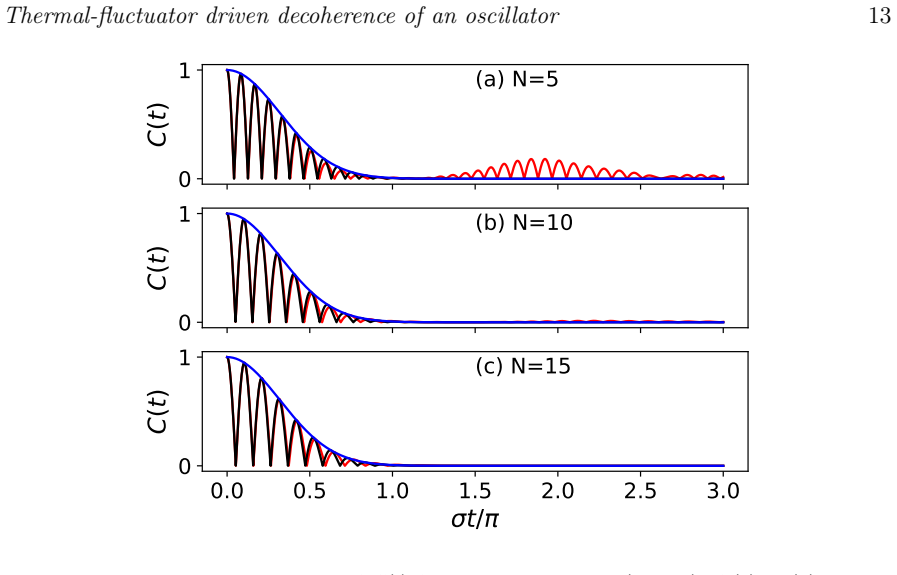
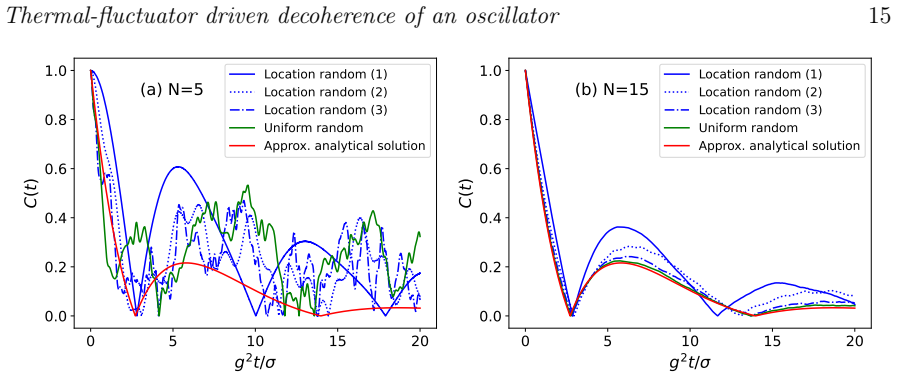
Bath-driven transitions in the TLF cause irreversible coherence decay at a rate that is highly sensitive to both the couplings and the transition rate. For an ensemble of TLFs, different regimes of non-exponential phase-averaging-driven coherence decay appear, and numerical calculations show the extent to which systems with just a few TLFs differ from the large-ensemble limit.
What carries the argument
Bath-driven transitions in the TLF that produce irreversible coherence decay, together with phase averaging over an ensemble of TLFs.
If this is right
- A single TLF can generate coherence oscillations that coexist with or replace the Rabi oscillations of the oscillator-TLS system.
- The irreversible decay rate depends sensitively on both the oscillator-TLF and TLF-TLS coupling strengths.
- An ensemble of TLFs produces distinct non-exponential decay regimes governed by phase averaging.
- Systems containing only a few TLFs can deviate measurably from the continuum-ensemble limit, as quantified by numerical calculations.
Where Pith is reading between the lines
- Device coherence times in superconducting resonators could be improved by engineering TLF transition rates or by reducing the relevant coupling strengths.
- Temperature-dependent measurements of decay rates would directly test the predicted sensitivity to TLF transition rates.
- The same TLF-induced mechanism may set limits on coherence in other hybrid quantum systems that combine oscillators with TLSs.
Load-bearing premise
The dominant source of decoherence is the specified couplings to thermally activated TLFs with given transition rates, without significant contributions from other unmodeled noise sources.
What would settle it
Experimental measurement of the oscillator's coherence decay rate as a function of the TLF transition rate (for example by varying temperature) that fails to show the predicted strong sensitivity or that remains purely exponential rather than displaying the calculated non-exponential regimes.
Figures




read the original abstract
Recent experiments on a range of engineered quantum systems have highlighted the important role of interacting two-level systems (TLSs) in modifying device properties and generating fluctuations. Focusing on the case of an oscillator coupled to a single near-resonant TLS, we explore how interactions between the TLS and lower-frequency thermally activated two-level fluctuators (TLFs) degrade the oscillator's coherence. Depending on the strength of the couplings, a single TLF can give rise to coherence oscillations that appear alongside, or supplant, Rabi oscillations of the oscillator-TLS system. Bath-driven transitions in the TLF cause irreversible coherence decay at a rate that is highly sensitive to both the couplings and the transition rate. For an ensemble of TLFs, we identify and characterise the different regimes of non-exponential phase-averaging-driven coherence decay that the oscillator can display. Using numerical calculations, we examine the extent to which systems with just a few TLFs differ from the limit of a large (continuum) TLF ensemble. Our work provides a theoretical framework for understanding the interplay of coherent TLS interactions and TLF-induced dephasing in quantum devices such as superconducting and phononic resonators.
Editorial analysis
A structured set of objections, weighed in public.
Referee Report
Summary. The manuscript investigates decoherence of an oscillator resonantly coupled to a two-level system (TLS) arising from interactions with lower-frequency thermally activated two-level fluctuators (TLFs). Numerical calculations show that a single TLF can produce coherence oscillations alongside or instead of Rabi oscillations, while bath-driven TLF transitions induce irreversible coherence decay whose rate depends sensitively on the couplings and TLF transition rate. For an ensemble of TLFs the work identifies and characterizes distinct regimes of non-exponential, phase-averaging-driven decay and compares the few-TLF case to the continuum limit, providing a framework relevant to superconducting and phononic resonators.
Significance. If the numerical results hold, the paper supplies a timely theoretical framework for TLF-induced dephasing in engineered quantum systems where TLS-TLF interactions are known to affect device performance. The explicit mapping of parameter regimes (coupling strengths, transition rates) to qualitative decay behaviors, together with the few-versus-continuum comparison, offers concrete guidance for experiment design and data interpretation. The reliance on direct numerical integration of the open-system dynamics is a clear strength that allows exploration of non-Markovian and non-exponential features without additional approximations.
minor comments (3)
- [Numerical methods section] The numerical method (likely a stochastic Liouville or master-equation integrator) is described only at a high level; adding a brief statement on integrator type, time-step convergence tests, and ensemble averaging procedure would improve reproducibility.
- [Figure captions] Several figure captions omit the precise values of the TLF transition rate and coupling strengths used in each panel, forcing the reader to cross-reference the main text repeatedly.
- [Ensemble TLF analysis] The definition of the phase-averaging procedure for the ensemble case could be stated more explicitly (e.g., whether it is an average over static TLF configurations or a dynamical average over transition trajectories).
Simulated Author's Rebuttal
We thank the referee for their positive assessment of our manuscript, accurate summary of the key results, and recommendation for minor revision. The significance statement correctly identifies the relevance to superconducting and phononic resonators and the value of the numerical approach for capturing non-Markovian and non-exponential features.
Circularity Check
No significant circularity; derivation self-contained via standard open-system modeling
full rationale
The paper's central claims rest on a standard treatment of an oscillator coupled to a TLS with additional TLFs, using master-equation or stochastic methods to derive coherence decay rates and regimes from the Hamiltonian couplings and transition rates. Numerical calculations distinguish few-TLF vs continuum limits without reducing any prediction to a fitted input or self-referential definition. No load-bearing self-citations, ansatz smuggling, or uniqueness theorems from prior author work are invoked in the abstract or described framework; the sensitivity to couplings and non-exponential phase-averaging follow directly from averaging over the TLF parameters as independent inputs. The analysis is externally falsifiable via the stated assumptions and numerics.
Axiom & Free-Parameter Ledger
free parameters (2)
- coupling strengths between TLF, TLS, and oscillator
- TLF transition rate
axioms (2)
- standard math Resonant coupling between oscillator and TLS can be treated within standard quantum mechanics
- domain assumption TLFs are thermally activated at lower frequencies and interact via the described couplings
Reference graph
Works this paper leans on
- [1]
-
[2]
Anderson P W, Halperin B I and Varma C M 1972Phil. Mag.251
-
[3]
Phillips W A 1987Rep. Prog. Phys501657
-
[4]
Hunklinger S 1988Cryogenics28224
-
[5]
Stephens R B and Liu X 2021Low-Energy Excitations in Disordered Solids (Singapore: World Scientific)
-
[6]
Paladino E, Faoro L, Falci G and Fazio R 2002Phys. Rev. Lett.88228304
-
[7]
Galperin Y M, Altshuler B, Bergli J and Shantsev D 2006Phys. Rev. Lett.96 097009
- [8]
-
[9]
Paladino E, Galperin Y, Falci G and Altshuler B 2014Rev. Mod. Phys.86361–418
-
[10]
Matityahu S, Shnirman A, Schön G and Schechter M 2016Phys. Rev. B93134208
-
[11]
Müller C, Cole J H and Lisenfeld J 2019Rep. Prog. Phys.82124501
-
[12]
Simmonds R W, Lang K M, Hite D A, Nam S, Pappas D P and Martinis J M 2004 Phys. Rev. Lett.93077003
work page 2004
-
[13]
Lisenfeld J, Grabovskij G J, Müller C, Cole J H, Weiss G and Ustinov A V 2015 Nat. Commun.66182
work page 2015
-
[14]
Müller C, Lisenfeld J, Shnirman A and Poletto S 2015Phys. Rev. B92035442
-
[15]
Burnett J, Faoro L, Wisby I, Gurtovoi V L, Chernykh A V, Mikhailov G M, Tulin V A, Shaikhaidarov R, Antonov R V, Meeson P J, Tzalenchuk A Y and Lindström T 2014Nat. Commun.54119
-
[16]
Faoro L and Ioffe L B 2015Phys. Rev. B91014201
-
[17]
Béjanin J H, Earnest C T, Sharafeldin A S and Mariantoni M 2021Phys. Rev. B 104094106
-
[18]
Cattiaux D, Golokolenov I, Kumar S, Sillanpää M, Mercier de Lépinay L, Gazizulin R R, Zhou X, Armour A D, Bourgeois O, Fefferman A and Collin E 2021Nat. Commun.126182
- [19]
-
[20]
Bozkurt A B, Golami O, Yu Y, Tian H and Mirhosseini M 2025Nature Physics21 1469
- [21]
-
[22]
Carruzzo H M and Yu C C 2020Phys. Rev. Lett.124075902
-
[23]
Maksymowych M, Yuksel M, Hitchcock O, Lee N, Mayor F, Jiang W, Roukes M and Safavi-Naeini A 2025Phys. Rev. Appl.24044066
-
[24]
Matityahu S, Shnirman A and Schechter M 2024Phys. Rev. Appl.21044055 REFERENCES24
-
[25]
Jaynes E T and Cummings F W 2005Proceedings of the IEEE5189
-
[26]
Garrison J and Chiao R 2008Quantum Optics(Oxford: Oxford University Press)
-
[27]
Wang Y and Haw J Y 2015Physics Letters A379779
-
[28]
Remus L G, Blencowe M P and Tanaka Y 2009Phys. Rev. B80174103
-
[29]
Remus L G and Blencowe M P 2012Phys. Rev. B86205419
-
[30]
Walls D F and Milburn G J 1985Phys. Rev. A312403
-
[31]
Haroche S and Raimond J M 2006Exploring the Quantum: Atoms, Cavities, and Photons(Oxford: Oxford University Press)
-
[32]
Billingsley P 1995Probability and Measure3rd ed (Hoboken: John Wiley & Sons)
-
[33]
Behunin R O, Intravaia F and Rakich P T 2016Phys. Rev. B93224110
-
[34]
Lisenfeld J, Bilmes A, Matityahu S, Zanker S, Marthaler M, Schechter M, Schön G, Shnirman A, Weiss G and Ustinov A V 2016Scientific Reports623786
-
[35]
Hitchcock O A, Mayor F M, Jiang W, Maksymowych M P, Malik S and Safavi- Naeini A H 2026Phys. Rev. Appl.25024005
-
[36]
Cattaneo M, Giorgi G L, Maniscalco S and Zambrini R 2019New J. Phys.21 113045
discussion (0)
Sign in with ORCID, Apple, or X to comment. Anyone can read and Pith papers without signing in.