Cosmology of the interacting Tsallis holographic dark energy in f(R,T) gravity framework
Pith reviewed 2026-05-10 02:13 UTC · model grok-4.3
The pith
Interacting Tsallis holographic dark energy reaches the Lambda CDM fixed point in f(R,T) gravity models.
A machine-rendered reading of the paper's core claim, the machinery that carries it, and where it could break.
Core claim
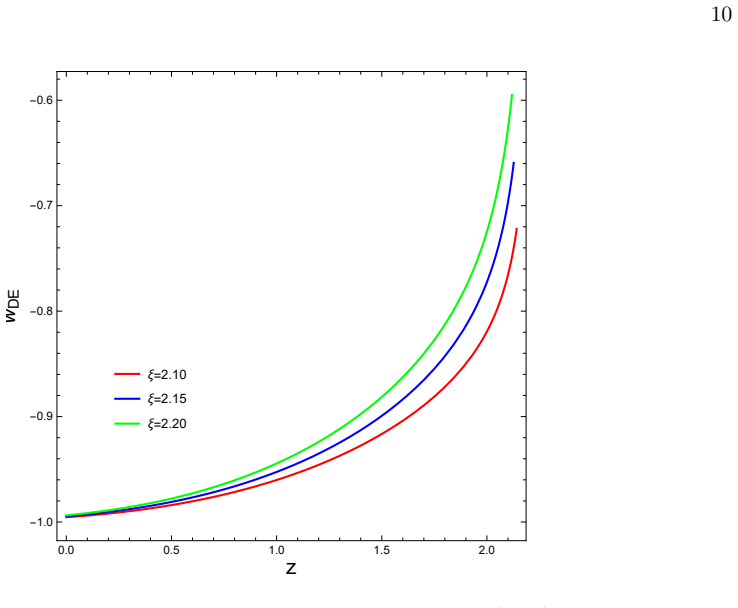
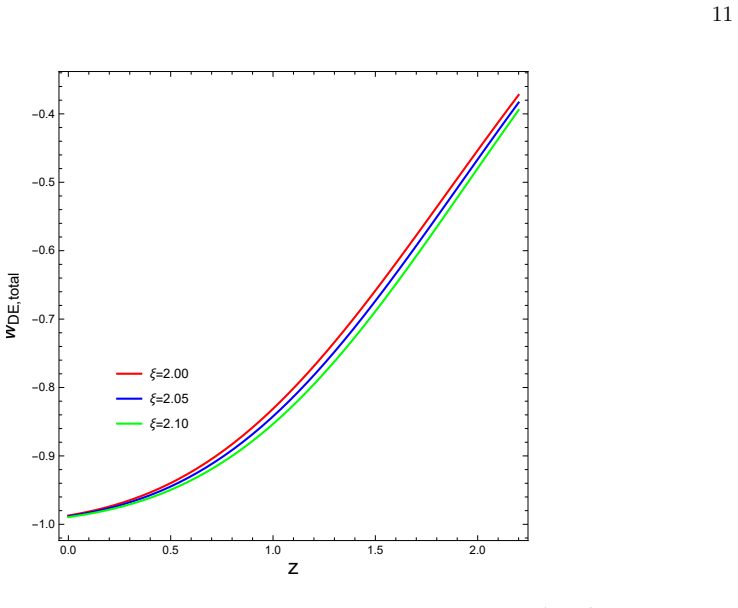
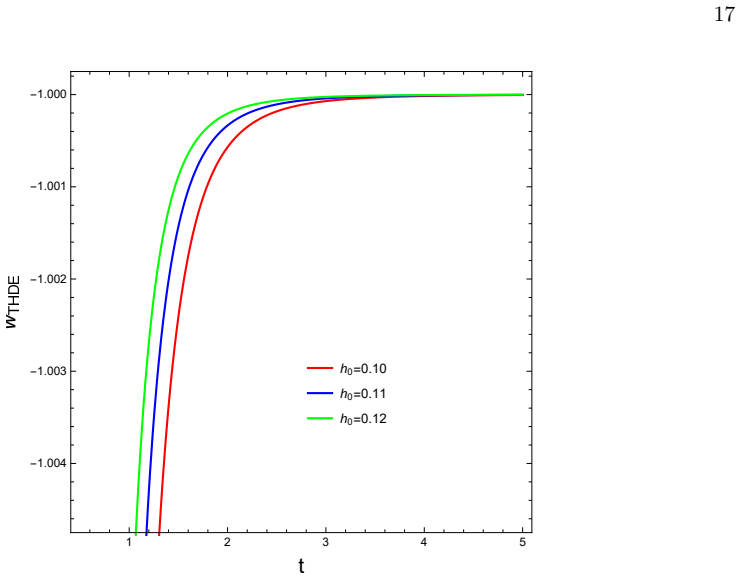
In both the linear f(R,T) = μR + νT and the quadratic f(R,T) = R + γR² + ξT models, the interacting THDE with Hubble cutoff produces an equation-of-state parameter that drives acceleration, a negative deceleration parameter at late times, and statefinder trajectories that converge to the Lambda CDM fixed point (1,0); the same diagnostics remain consistent when the models are constrained by chi-squared fits to observational data sets.
What carries the argument
The interaction term between Tsallis holographic dark energy density and dark matter, together with the Hubble horizon cutoff, inserted into the f(R,T) field equations to modify the Friedmann dynamics.
If this is right
- The deceleration parameter turns negative at low redshift, reproducing the observed cosmic acceleration.
- Statefinder and wDE-w'DE planes both approach the Lambda CDM fixed point for the fitted parameter values.
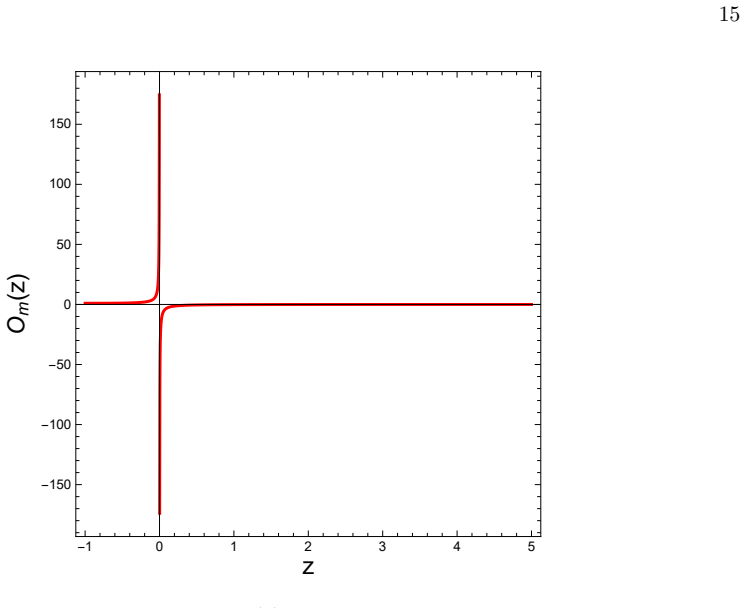
- Om(z) and r-q diagnostics remain consistent with current data in both linear and quadratic f(R,T) cases.
- The chi-squared procedure supplies explicit bounds on the coefficients μ, ν, γ, and ξ.
Where Pith is reading between the lines
- The same diagnostic suite could be applied to other holographic dark-energy models inside f(R,T) gravity to test generality.
- The interaction term offers a mechanism that may alleviate the coincidence problem between dark energy and dark matter densities.
- Updated datasets from upcoming surveys would further narrow the allowed ranges for the model coefficients.
Load-bearing premise
The chosen interaction term between THDE and dark matter plus the Hubble horizon cutoff correctly capture the relevant physical dynamics.
What would settle it
A future high-redshift measurement of the statefinder pair or deceleration parameter that lies outside the trajectories obtained from the chi-squared-constrained parameter ranges would rule out the models.
Figures






read the original abstract
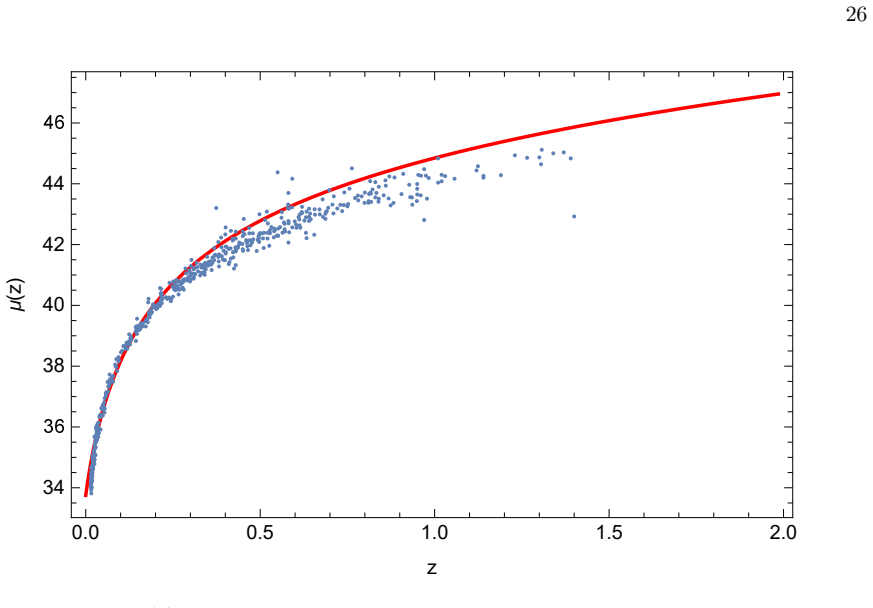
In this work, we have analyzed the cosmology of the Tsallis holographic dark energy (THDE), a particular case of Nojiri-Odintsov HDE proposed in [S. Nojiri and S. D. Odintsov, \textit{Gen. Relativ. Gravit.} \textbf{38} (2006), 1285; \textit{Eur. Phys. J. C} \textbf{77} (2017) 528], using Hubble's horizon cutoff in $f(R,T)=\mu R+\nu T$ model considering pressureless dark matter. We have examined the equation of state (EoS) parameters in this scenario. The deceleration parameter has been evaluated for this interacting model to justify the late-time acceleration of the expanding universe. We have also studied the cosmological consequences of Statefinder pair, $O_{m}(z)$ diagnostics, $r-q$ plane, and $w_{DE}-w^{'}_{DE}$ pair for interacting THDE in $f(R,T)=\mu R+\nu T$ model. We have also illustrated the cosmology of the interacting THDE using Hubble's horizon cutoff in $f(R,T)=R+\gamma R^2+\xi T$ model. The EoS parameter, deceleration parameter and Statefinder pair are studied in this interacting scenario. Attainment of $\Lambda$CDM fixed point has been observed for both models. We have also constrained model parameters based on observational data sets through the formalism of $\chi^{2}$ minimum test.
Editorial analysis
A structured set of objections, weighed in public.
Referee Report
Summary. The manuscript examines the cosmology of interacting Tsallis holographic dark energy (THDE) with Hubble horizon cutoff in two f(R,T) gravity models (f(R,T)=μR+νT and f(R,T)=R+γR²+ξT) coupled to pressureless dark matter. It derives the equation-of-state parameter, deceleration parameter, statefinder pair, Om(z) diagnostic, r-q plane, and w_DE-w'_DE plane; reports that both models attain the ΛCDM fixed point (r=1,s=0); and constrains the free parameters (μ,ν,γ,ξ, interaction strength) via χ² minimization against observational datasets.
Significance. If the central claims hold after clarification, the work extends holographic dark energy constructions to f(R,T) gravity using Tsallis entropy, supplies explicit late-time acceleration diagnostics, and demonstrates observational viability through parameter fitting. The reported attainment of the ΛCDM fixed point in both models would indicate consistency with standard cosmology at late times, while the χ² constraints provide a concrete link to data. These elements are standard strengths in modified-gravity cosmology papers.
major comments (3)
- [Abstract and results sections] Abstract and results sections: the reported attainment of the ΛCDM fixed point and the diagnostic trajectories (statefinder, Om(z), etc.) are obtained only after the model parameters have been fitted to data via χ² minimization. By the paper's own procedure these quantities are therefore defined by the fit rather than independent predictions, introducing circularity that directly affects the strength of the cosmological-consequences claim.
- [Model setup] Model setup (interaction term): the explicit functional form of the interaction Q between THDE and dark matter is not stated, nor are the specific observational datasets used for the χ² test. Without these the derived EoS, deceleration parameter, best-fit values, and fixed-point location cannot be reproduced or independently verified.
- [THDE density and cutoff implementation] THDE density and cutoff implementation: the Hubble-horizon cutoff (ρ_THDE ∝ H^{2δ}) is inserted into the modified Friedmann equations for both f(R,T) models, yet the autonomous system, fixed-point coordinates, and stability analysis are not shown explicitly. Altering either the cutoff or the interaction form changes the location and stability of the reported ΛCDM fixed point, so the claim is not robust to the model-building assumptions.
minor comments (2)
- [Notation] Notation: the free parameters μ, ν, γ, ξ and the interaction strength are introduced without explicit ranges or initial definitions, which reduces readability in the abstract and early sections.
- [References] References: the citations to Nojiri-Odintsov (2006, 2017) should be checked for complete journal, volume, and page information.
Simulated Author's Rebuttal
We thank the referee for the careful reading and constructive comments on our manuscript. We have revised the paper to improve clarity and reproducibility, particularly regarding the dynamical analysis and model specifications. Below we address each major comment point by point.
read point-by-point responses
-
Referee: [Abstract and results sections] Abstract and results sections: the reported attainment of the ΛCDM fixed point and the diagnostic trajectories (statefinder, Om(z), etc.) are obtained only after the model parameters have been fitted to data via χ² minimization. By the paper's own procedure these quantities are therefore defined by the fit rather than independent predictions, introducing circularity that directly affects the strength of the cosmological-consequences claim.
Authors: The ΛCDM fixed point (r=1, s=0) is identified by setting the derivatives to zero in the autonomous system derived from the modified Friedmann equations and the continuity equations with interaction, prior to any numerical fitting. This fixed point is a structural feature of the phase space for both f(R,T) models under the Hubble cutoff. The χ² minimization is applied afterward solely to constrain the free parameters (μ, ν, γ, ξ, b) and to confirm that the best-fit trajectories approach the fixed point, as visualized in the diagnostic planes. To eliminate any ambiguity regarding order or circularity, we have reorganized the results section to present the analytic derivation of the autonomous equations and fixed-point coordinates first, followed by the observational constraints and numerical plots. This revision makes the logical sequence explicit without altering the original claims. revision: partial
-
Referee: [Model setup] Model setup (interaction term): the explicit functional form of the interaction Q between THDE and dark matter is not stated, nor are the specific observational datasets used for the χ² test. Without these the derived EoS, deceleration parameter, best-fit values, and fixed-point location cannot be reproduced or independently verified.
Authors: We agree that these details were insufficiently explicit. The interaction term is Q = 3b² H (ρ_THDE + ρ_m), where b is the dimensionless coupling parameter. The χ² analysis employs the Pantheon+ Type Ia supernovae compilation, BAO measurements from SDSS DR12 and eBOSS, and Planck 2018 CMB distance priors. In the revised manuscript we have added a dedicated subsection detailing the interaction form, the full expression for the Hubble parameter evolution, the χ² likelihood function, and the datasets with references. This ensures that the EoS parameter, deceleration parameter, best-fit values, and fixed-point results can be independently reproduced. revision: yes
-
Referee: [THDE density and cutoff implementation] THDE density and cutoff implementation: the Hubble-horizon cutoff (ρ_THDE ∝ H^{2δ}) is inserted into the modified Friedmann equations for both f(R,T) models, yet the autonomous system, fixed-point coordinates, and stability analysis are not shown explicitly. Altering either the cutoff or the interaction form changes the location and stability of the reported ΛCDM fixed point, so the claim is not robust to the model-building assumptions.
Authors: We accept that the autonomous system was not written out explicitly. We have now included the full set of autonomous differential equations (in terms of Ω_DE, w_DE, and the interaction) in a new subsection, together with the fixed-point solution obtained by setting dΩ_DE/dN = 0 and dw_DE/dN = 0, which yields the ΛCDM point for both linear and quadratic f(R,T) models. Stability is assessed via the eigenvalues of the Jacobian matrix at that point. We have also clarified in the text that the reported fixed point and its stability are specific to the Hubble cutoff and the chosen interaction form; the explicit equations now permit readers to examine robustness under variations of these assumptions. revision: yes
Circularity Check
No significant circularity; derivation remains independent of fitted outputs.
full rationale
The paper derives the modified Friedmann equations from the chosen f(R,T) forms, inserts the THDE density with Hubble cutoff and a stated interaction Q, then computes EoS, deceleration parameter, statefinder, Om(z) and phase-plane trajectories directly from those equations. The chi-squared minimization is applied afterward solely to bound the free parameters (mu, nu, gamma, xi, b^2, delta); the reported Lambda-CDM fixed-point attainment is a numerical outcome evaluated at those best-fit values rather than an identity forced by the fitting procedure itself. No self-citation supplies a load-bearing uniqueness theorem, no ansatz is imported without justification, and the autonomous-system fixed point is not redefined in terms of the data fit. The model choices (cutoff, Q) are explicit assumptions whose consequences are explored, not hidden equivalences.
Axiom & Free-Parameter Ledger
free parameters (3)
- mu, nu
- gamma, xi
- interaction strength
axioms (2)
- standard math FLRW metric and standard cosmological equations hold
- domain assumption Tsallis holographic dark energy with Hubble cutoff is the correct dark-energy model
Reference graph
Works this paper leans on
-
[1]
Copeland, E.J., Sami, M. and Tsujikawa, S., 2006. Dynamics of dark energy. International Journal of Modern Physics D, 15(11), pp.1753-1935
work page 2006
-
[2]
Dark energy: the cosmological challeng e of the millennium
Padmanabhan, T., 2005. Dark energy: the cosmological challeng e of the millennium. Current Science, pp.1057-1067
work page 2005
-
[3]
Bamba, K., Capozziello, S., Nojiri, S.I. and Odintsov, S.D., 2012. Dar k energy cosmology: the equiv- alent description via different theoretical models and cosmography tests. Astrophysics and Space Science, 342, pp.155-228
work page 2012
-
[4]
Spergel, D.N., Verde, L., Peiris, H.V., Komatsu, E., Nolta, M.R., Benne tt, C.L., Halpern, M., Hin- shaw, G., Jarosik, N., Kogut, A. and Limon, M., 2003. First-year Wilkin son Microwave Anisotropy Probe (WMAP)* observations: determination of cosmological para meters. The Astrophysical Journal Supplement Series, 148(1), p.175
work page 2003
-
[5]
Perlmutter, S., Aldering, G., Goldhaber, G., Knop, R.A., Nugent, P., Castro, P.G., Deustua, S., Fabbro, S., Goobar, A., Groom, D.E. and Hook, I.M., 1999. Measurem ents of ω and Λ from 42 high-redshift supernovae. ApJ, 517(2)
work page 1999
-
[6]
Modified gravity models of dark energy
Tsujikawa, S., 2010. Modified gravity models of dark energy. In L ectures on Cosmology: Accelerated Expansion of the Universe (pp. 99-145). Berlin, Heidelberg: Spring er Berlin Heidelberg
work page 2010
-
[7]
Nojiri, S.I. and Odintsov, S.D., 2007. Introduction to modified gra vity and gravitational alternative for dark energy. International Journal of Geometric Methods in Modern Physics, 4(01), pp.115-145
work page 2007
-
[8]
Clifton, T., Ferreira, P.G., Padilla, A. and Skordis, C., 2012. Modified gravity and cosmology. Physics reports, 513(1-3), pp.1-189
work page 2012
-
[9]
Models for Simulation of Fractal-like Particle Clu sters with Prescribed Fractal Dimension
Tomchuk, O., 2023. Models for Simulation of Fractal-like Particle Clu sters with Prescribed Fractal Dimension. Fractal and Fractional, 7(12), p.866
work page 2023
-
[10]
Liao, J.H., Miao, S.P. and Woodard, R.P., 2019. Cosmological Colema n-Weinberg potentials and inflation. Physical Review D, 99(10), p.103522
work page 2019
-
[11]
Cosmology with fractional action principle
Rami, E.N.A., 2007. Cosmology with fractional action principle. Rom anian Reports in Physics, 59(3), pp.763-771
work page 2007
-
[12]
El-Nabulsi, R.A. and Anukool, W., 2024. Constraining the fractal Chern–Simons modified gravity with astronomical observations and estimation of the fractal dime nsion of the universe. The European Physical Journal Plus, 139(4), pp.1-18
work page 2024
-
[13]
El-Nabulsi, R.A., 2009. Maxwell brane cosmology with higher-orde r string curvature corrections, a nonminimally coupled scalar field, dark matter–dark energy interact ion and a varying speed of light. International Journal of Modern Physics D, 18(02), pp.289-318
work page 2009
-
[14]
El-Nabulsi, R.A. and Anukool, W., 2024. Estimating power-law expo nents from observations in elec- 30 tromagnetic non-minimal Maxwell-Gauss-Bonnet coupling cosmology . Journal of High Energy Astro- physics, 42, pp.104-114
work page 2024
-
[15]
Kiritsis, E. and Kofinas, G., 2009. Hoˇ rava–lifshitz cosmology. N uclear Physics B, 821(3), pp.467-480
work page 2009
-
[16]
Nishioka, T., 2009. Hoˇ rava–lifshitz holography. Classical and Q uantum Gravity, 26(24), p.242001
work page 2009
-
[17]
Nojiri, S.I. and Odintsov, S.D., 2005. Modified Gauss–Bonnet the ory as gravitational alternative for dark energy. Physics Letters B, 631(1-2), pp.1-6
work page 2005
-
[18]
Li, B., Barrow, J.D. and Mota, D.F., 2007. Cosmology of modified Ga uss-Bonnet gravity. Physical Review D, 76(4), p.044027
work page 2007
-
[19]
Nojiri, S.I. and Odintsov, S.D., 2006. Modified f (R) gravity consis tent with realistic cosmology: From a matter dominated epoch to a dark energy universe. Physical Rev iew D, 74(8), p.086005
work page 2006
-
[20]
Nojiri, S.I. and Odintsov, S.D., 2008. Modified f (R) gravity unifying R m inflation with the ΛCDM epoch. Physical Review D, 77(2), p.026007
work page 2008
-
[21]
Cai, Y.F., Chen, S.H., Dent, J.B., Dutta, S. and Saridakis, E.N., 2011 . Matter bounce cosmology with the f (T) gravity. Classical and Quantum Gravity, 28(21), p.215011
work page 2011
-
[22]
Ferraro, R. and Fiorini, F., 2007. Modified teleparallel gravity: I nflation without an inflaton. Physical Review D, 75(8), p.084031
work page 2007
-
[23]
Bamba, K., Geng, C.Q., Lee, C.C. and Luo, L.W., 2011. Equation of s tate for dark energy in f (T ) gravity. Journal of Cosmology and Astroparticle Physics, 2011(01), p.021
work page 2011
-
[24]
Einstein’s Other Gravity and the Acceleration of the Universe
Bamba, K., Geng, C.Q. and Lee, C.C., 2010. Comment on “Einstein’s Other Gravity and the Accel- eration of the Universe”. arXiv preprint arXiv:1008.4036
-
[25]
Jawad, A., Chattopadhyay, S. and Pasqua, A., 2013. Reconst ruction of f (G) gravity with the new agegraphic dark-energy model. The European Physical Journal P lus, 128, pp.1-7
work page 2013
-
[26]
Banijamali, A., Fazlpour, B. and Setare, M.R., 2012. Energy cond itions in f (G) modified gravity with non-minimal coupling to matter. Astrophysics and Space Science, 338, pp.327-332
work page 2012
-
[27]
Sotiriou, T.P. and Faraoni, V., 2010. f (R) theories of gravity. Reviews of Modern Physics, 82(1), p.451
work page 2010
-
[28]
De Felice, A. and Tsujikawa, S., 2010. f (R) theories. Living Reviews in Relativity, 13(1), pp.1-161
work page 2010
-
[29]
f (R) gravity and scalar–tensor theory
Sotiriou, T.P., 2006. f (R) gravity and scalar–tensor theory. Classical and Quantum Gravit y, 23(17), p.5117
work page 2006
-
[30]
Capozziello, S. and De Laurentis, M., 2011. Extended theories o f gravity. Physics Reports, 509(4-5), pp.167-321
work page 2011
-
[31]
Bamba, K. and Geng, C.Q., 2009. Thermodynamics in F (R) gravity with phantom crossing. Physics Letters B, 679(3), pp.282-287
work page 2009
-
[32]
Akbar, M. and Cai, R.G., 2007. Thermodynamic behavior of field eq uations for f (R) gravity. Physics Letters B, 648(2-3), pp.243-248
work page 2007
-
[33]
Harko, T., Lobo, F.S., Nojiri, S.I. and Odintsov, S.D., 2011. f (R, T ) gravity. Physical Review D, 84(2), p.024020. 31
work page 2011
-
[34]
A Lagrangian description of interacting da rk energy
Poplawski, N.J., 2006. A Lagrangian description of interacting da rk energy. arXiv preprint gr- qc/0608031
-
[35]
Harko, T., Lobo, F.S., Nojiri, S.I. and Odintsov, S.D., 2011. f (R,T) gravity. Physical Review D, 84(2), p.024020
work page 2011
-
[36]
A study on the interacting Ricci dar k energy in f (R, T ) gravity
Chattopadhyay, S., 2014. A study on the interacting Ricci dar k energy in f (R, T ) gravity. Proceedings of the National Academy of Sciences, India Section A: Physical Scie nces, 84(1), pp.87-93
work page 2014
-
[37]
Nojiri, S.I. and Odintsov, S.D., 2011. Unified cosmic history in modifi ed gravity: from F (R) theory to Lorentz non-invariant models. Physics Reports, 505(2-4), pp.59-144
work page 2011
-
[38]
Nojiri, S. and Odintsov, S.D., 2007. Int. J. Geom. Methods Mod. Phys
work page 2007
-
[39]
Capozziello, S. and Faraoni, V., 2010. Beyond Einstein gravity: A Survey of gravitational theories for cosmology and astrophysics (Vol. 170). Springer Science & Business Media
work page 2010
-
[40]
Bamba, K. and Odintsov, S.D., 2015. Inflationary cosmology in mo dified gravity theories. Symmetry, 7(1), pp.220-240
work page 2015
-
[41]
Joyce, A., Jain, B., Khoury, J. and Trodden, M., 2015. Beyond t he cosmological standard model. Physics Reports, 568, pp.1-98
work page 2015
-
[42]
A study on the interacting Ricci dar k energy in f (R, T ) gravity
Chattopadhyay, S., 2014. A study on the interacting Ricci dar k energy in f (R, T ) gravity. Proceedings of the National Academy of Sciences, India Section A: Physical Scie nces,84(1), pp.87-93
work page 2014
-
[43]
Nojiri, S., Odintsov, S.D. and Oikonomou, V., 2017. Modified gravit y theories on a nutshell: Inflation, bounce and late-time evolution. Physics Reports, 692, pp.1-104
work page 2017
-
[44]
Cohen, A.G., Kaplan, D.B. and Nelson, A.E., 1999. Effective field the ory, black holes, and the cosmo- logical constant. Physical Review Letters, 82(25), p.4971
work page 1999
-
[45]
Hoˇ rava, P. and Minic, D., 2000. Probable values of the cosmolog ical constant in a holographic theory. Physical Review Letters, 85(8), p.1610
work page 2000
-
[46]
Holography stabilizes the vacuum energy
Thomas, S., 2002. Holography stabilizes the vacuum energy. Ph ysical Review Letters, 89(8), p.081301
work page 2002
-
[47]
A model of holographic dark energy
Li, M., 2004. A model of holographic dark energy. Physics Lette rs B, 603(1-2), pp.1-5
work page 2004
-
[48]
Shen, J., Wang, B., Abdalla, E. and Su, R.K., 2005. Constraints on the dark energy from the holo- graphic connection to the small l CMB suppression. Physics Letter s B, 609(3-4), pp.200-205
work page 2005
-
[49]
Dynamical vacuum energy, holographic quinto m, and the reconstruction of scalar- field dark energy
Zhang, X., 2006. Dynamical vacuum energy, holographic quinto m, and the reconstruction of scalar- field dark energy. Physical Review D, 74(10), p.103505
work page 2006
-
[50]
Setare, M.R. and Jamil, M., 2010. Correspondence between ent ropy-corrected holographic and Gauss- Bonnet dark-energy models. Europhysics Letters, 92(4), p.49003
work page 2010
-
[51]
Interacting agegraphic tachyon model of d ark energy
Sheykhi, A., 2010. Interacting agegraphic tachyon model of d ark energy. Physics Letters B, 682(4-5), pp.329-333
work page 2010
-
[52]
Ghaffari, S., Dehghani, M.H. and Sheykhi, A., 2014. Holographic da rk energy in the DGP braneworld with Granda-Oliveros cutoff. Physical Review D, 89(12), p.123009
work page 2014
-
[53]
Wang, S., Wang, Y. and Li, M., 2017. Holographic dark energy. Ph ysics reports, 696, pp.1-57
work page 2017
-
[54]
Wang, B., Abdalla, E., Atrio-Barandela, F. and Pavon, D., 2016. D ark matter and dark energy 32 interactions: theoretical challenges, cosmological implications and observational signatures. Reports on Progress in Physics, 79(9), p.096901
work page 2016
-
[55]
Bir´ o, T.S. and Czinner, V.G., 2013. A q-parameter bound for pa rticle spectra based on black hole thermodynamics with R´ enyi entropy. Physics Letters B, 726(4-5), pp.861-865
work page 2013
-
[56]
Bialas, A. and Czyz, W., 2008. Renyi entropies of a black hole fro m Hawking radiation. Europhysics Letters, 83(6), p.60009
work page 2008
-
[57]
Czinner, V.G. and Iguchi, H., 2017. A zeroth law compatible model to Kerr black hole thermodynamics. Universe, 3(1), p.14
work page 2017
-
[58]
Black hole entropy and the zeroth law of the rmodynamics
Czinner, V.G., 2015. Black hole entropy and the zeroth law of the rmodynamics. International Journal of Modern Physics D, 24(09), p.1542015
work page 2015
-
[59]
Ourabah, K. and Tribeche, M., 2014. Implication of Tsallis entrop y in the Thomas–Fermi model for self-gravitating fermions. Annals of Physics, 342, pp.78-82
work page 2014
-
[60]
Moradpour, H., Bonilla, A., Abreu, E.M. and Neto, J.A., 2017. Acce lerated cosmos in a nonextensive setup. Physical Review D, 96(12), p.123504
work page 2017
-
[61]
Implications, consequences and interpr etations of generalized entropy in the cosmological setups
Moradpour, H., 2016. Implications, consequences and interpr etations of generalized entropy in the cosmological setups. International Journal of Theoretical Phy sics, 55, pp.4176-4184
work page 2016
-
[62]
Abreu, E.M. and Neto, J.A., 2013. Considerations on gravity as a n entropic force and entangled states. Physics Letters B, 727(4-5), pp.524-526
work page 2013
-
[63]
Connecting inflation with late cosmic accelerat ion by particle production
Nunes, R.C., 2016. Connecting inflation with late cosmic accelerat ion by particle production. Inter- national Journal of Modern Physics D, 25(06), p.1650067
work page 2016
-
[64]
Komatsu, N. and Kimura, S., 2013. Entropic cosmology for a gen eralized black-hole entropy. Physical Review D, 88(8), p.083534
work page 2013
-
[67]
Moradpour, H., Moosavi, S.A., Lobo, I.P., Gra¸ ca, J.M., Jawad, A. and Salako, I.G., 2018. Thermody- namic approach to holographic dark energy and the R´ enyi entrop y. The European Physical Journal C, 78, pp.1-6
work page 2018
-
[68]
Non-extensive statistical mechanics and black hole entropy from quantum geometry
Majhi, A., 2017. Non-extensive statistical mechanics and black hole entropy from quantum geometry. Physics Letters B, 775, pp.32-36
work page 2017
-
[69]
Abe, S., 2002. Stability of Tsallis entropy and instabilities of R´ eny i and normalized Tsallis entropies: A basis for q-exponential distributions. Physical Review E, 66(4), p.046134
work page 2002
-
[70]
When is a quantity additive, and when is it ex tensive?
Touchette, H., 2002. When is a quantity additive, and when is it ex tensive?. Physica A: Statistical Mechanics and its Applications, 305(1-2), pp.84-88
work page 2002
-
[71]
Bir´ o, T.S. and V´ an, P., 2011. Zeroth law compatibility of nonadd itive thermodynamics. Physical Review E, 83(6), p.061147
work page 2011
-
[72]
Dynamical scenario for nonextensive statistic al mechanics
Tsallis, C., 2004. Dynamical scenario for nonextensive statistic al mechanics. Physica A: Statistical 33 Mechanics and its Applications, 340(1-3), pp.1-10
work page 2004
-
[73]
Tsallis, C. and Cirto, L.J., 2013. Black hole thermodynamical entr opy. The European Physical Journal C, 73, pp.1-7
work page 2013
-
[74]
S. Nojiri and S. D. Odintsov, Unifying phantom inflation with late- time acceleration: Scalar phantom- non-phantom transition model and generalized holographic dark en ergy, Gen. Rel. Grav. 38 (2006), 1285-1304 doi:10.1007/s10714-006-0301-6 [arXiv:hep-th/05062 12 [hep-th]]
-
[75]
S. Nojiri and S. D. Odintsov, Covariant Generalized Holographic Dark Energy and Accelerating Uni- verse, Eur. Phys. J. C 77 (2017) no.8, 528 doi:10.1140/epjc/s10052-017-5097-x [arXiv:170 3.06372 [hep-th]]
-
[76]
S. Nojiri, S. D. Odintsov and T. Paul, Different Faces of Generaliz ed Holographic Dark Energy, Symmetry 13 (2021) no.6, 928 doi:10.3390/sym13060928 [arXiv:2105.08438 [gr-qc ]]
-
[77]
S. Nojiri, S. D. Odintsov and T. Paul, Barrow entropic dark ener gy: A member of generalized holo- graphic dark energy family, Phys. Lett. B 825 (2022), 136844 doi:10.1016/j.physletb.2021.136844 [arXiv:2112.10159 [gr-qc]]
-
[78]
S. Nojiri, S. D. Odintsov and E. N. Saridakis, Modified cosmology f rom extended entropy with varying exponent, Eur. Phys. J. C 79 (2019) no.3, 242 doi:10.1140/epjc/s10052-019-6740-5 [arXiv:190 3.03098 [gr-qc]]
-
[79]
Rashki, M. and Jalalzadeh, S., 2015. Holography from quantum c osmology. Physical Review D, 91(2), p.023501
work page 2015
-
[80]
Sahni, V., Saini, T.D., Starobinsky, A.A. and Alam, U., 2003. Statefi nder — a new geometrical diagnostic of dark energy. Journal of Experimental and Theoret ical Physics Letters, 77, pp.201-206
work page 2003
-
[81]
Alam, U., Sahni, V., Deep Saini, T. and Starobinsky, A.A., 2003. Exp loring the expanding universe and dark energy using the Statefinder diagnostic. Monthly Notices of the Royal Astronomical Society, 344(4), pp.1057-1074
work page 2003
-
[82]
Yi, Z.L. and Zhang, T.J., 2007. Statefinder diagnostic for the mo dified polytropic Cardassian universe. Physical Review D, 75(8), p.083515
work page 2007
discussion (0)
Sign in with ORCID, Apple, or X to comment. Anyone can read and Pith papers without signing in.