Recognition: unknown
An Efficient Multilevel Preconditioned Nonlinear Conjugate Gradient Method for Incremental Potential Contact
Pith reviewed 2026-05-10 00:27 UTC · model grok-4.3
The pith
The MAS-PNCG method with a Sparse-Input Woodbury update adapts multilevel preconditioners to changing contacts, enabling faster nonlinear conjugate gradient solves than Newton's method while keeping simulations intersection-free.
A machine-rendered reading of the paper's core claim, the machinery that carries it, and where it could break.
Core claim
The central claim is that the Sparse-Input Woodbury update algorithm incrementally adapts the fine-level MAS components to rapidly evolving contact sets, reducing maintenance cost to near-zero while capturing the complex spectral properties of the contact system; when combined with Hessian-aware 2D subspace minimization and fast per-subdomain conservative CCD, the resulting MAS-PNCG solver outperforms state-of-the-art Newton-PCG solvers GIPC and StiffGIPC (both preconditioned with MAS) by up to 5.66x and 2.07x respectively.
What carries the argument
The Sparse-Input Woodbury update algorithm that incrementally adapts the fine-level MAS components to rapidly evolving contact sets without full preconditioner rebuilds.
If this is right
- MAS-PNCG removes the need to assemble and factor the full Hessian at every Newton iteration.
- The preconditioner stays current across nonlinear steps at near-zero added cost.
- Per-subdomain CCD permits larger stable time steps without global penetration checks.
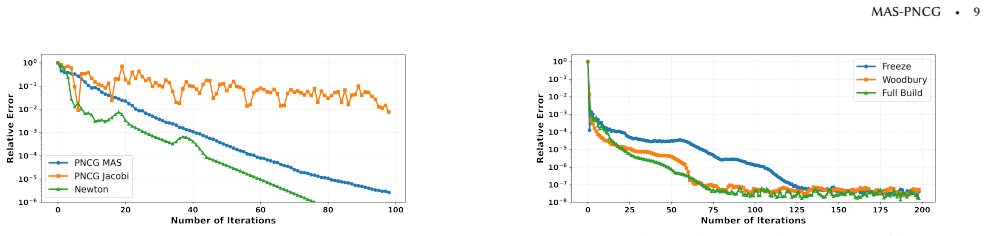
- The overall solver converges reliably in stiff, contact-dense regimes where plain Jacobi-preconditioned CG previously failed.
Where Pith is reading between the lines
- The incremental update technique could transfer to other nonlinear solvers that rely on hierarchical preconditioners whose sparsity pattern shifts over time.
- Similar Woodbury-style maintenance might reduce the cost of dynamic reordering or domain decomposition in large-scale finite-element codes beyond graphics.
- If the update preserves spectral bounds across broader classes of constraint changes, it could support adaptive time-stepping schemes that currently force conservative step sizes.
Load-bearing premise
The Sparse-Input Woodbury update maintains effective spectral properties of the multilevel preconditioner for rapidly changing contact sets without requiring full rebuilds or introducing instability in the nonlinear iterations.
What would settle it
A contact-rich simulation in which the number of preconditioned CG iterations per nonlinear step rises sharply or the solver diverges once contact sets begin changing rapidly, compared with the same solver using full MAS rebuilds each iteration.
Figures






read the original abstract
Incremental Potential Contact (IPC) guarantees intersection-free simulation but suffers from high computational costs due to the expensive Hessian assembly and linear solves required by Newton's method. While Preconditioned Nonlinear Conjugate Gradient (PNCG) avoids Hessian assembly, it has historically struggled with poor convergence in stiff, contact-rich scenarios due to the lack of effective preconditioners; simple Jacobi preconditioners fail to capture the global coupling, while advanced hierarchy-based preconditioners like Multilevel Additive Schwarz (MAS) are computationally prohibitive to rebuild at every nonlinear iteration. We present MAS-PNCG, a method that unlocks the power of hierarchical preconditioning for nonlinear optimization. Our key technical innovation is a Sparse-Input Woodbury update algorithm that incrementally adapts the fine-level MAS components to rapidly evolving contact sets. This bypasses the need for full preconditioner rebuilds, reducing maintenance cost to near-zero while capturing the complex spectral properties of the contact system. Furthermore, we replace heuristic PNCG search directions with a Hessian-aware 2D subspace minimization that optimally combines the preconditioned gradient and previous direction. We also apply a fast per-subdomain conservative CCD method that ensures penetration-free trajectories while avoiding overly restrictive global step sizes. Experiments demonstrate that our MAS-PNCG outperforms state-of-the-art Newton-PCG solvers, GIPC and StiffGIPC, both preconditioned with MAS up to 5.66$\times$ and 2.07$\times$ respectively.
Editorial analysis
A structured set of objections, weighed in public.
Referee Report
Summary. The manuscript proposes MAS-PNCG, a preconditioned nonlinear conjugate gradient solver for Incremental Potential Contact (IPC) that avoids full Hessian assembly. The core innovation is a Sparse-Input Woodbury update that incrementally adapts only the fine-level components of the Multilevel Additive Schwarz (MAS) preconditioner to evolving contact sets, bypassing expensive full rebuilds at each nonlinear iteration. Additional contributions include a Hessian-aware 2D subspace minimization to replace heuristic search directions and a per-subdomain conservative CCD method for penetration-free trajectories. Experiments report speedups of up to 5.66× over GIPC and 2.07× over StiffGIPC, both using MAS preconditioning.
Significance. If the Woodbury update is shown to preserve the multilevel preconditioner's spectral effectiveness, the work would meaningfully advance practical IPC simulation by making hierarchical preconditioning viable for stiff, contact-rich problems without prohibitive rebuild costs. This could improve scalability for complex scenes while retaining intersection-free guarantees, addressing a recognized bottleneck in nonlinear contact optimization.
major comments (3)
- [Method section (Sparse-Input Woodbury update)] The Sparse-Input Woodbury update (described in the method section) is asserted to maintain the complex spectral properties of MAS by updating only fine-level components. However, no eigenvalue bounds, condition-number tracking, or proof of spectral equivalence to a full rebuild is supplied. Contact changes can indirectly affect coarse-grid operators and inter-level transfers, risking degradation of the global coupling that distinguishes MAS from Jacobi; this directly underpins the claimed speedups.
- [Experiments section] Experiments section: The reported speedups (5.66× vs. GIPC and 2.07× vs. StiffGIPC) are presented without quantitative error metrics, convergence plots, condition-number histories, or verification that intersection-free guarantees remain intact after incremental updates. Detailed scene descriptions, baseline implementations, and timing breakdowns are also absent, leaving the robustness of the performance claims difficult to assess.
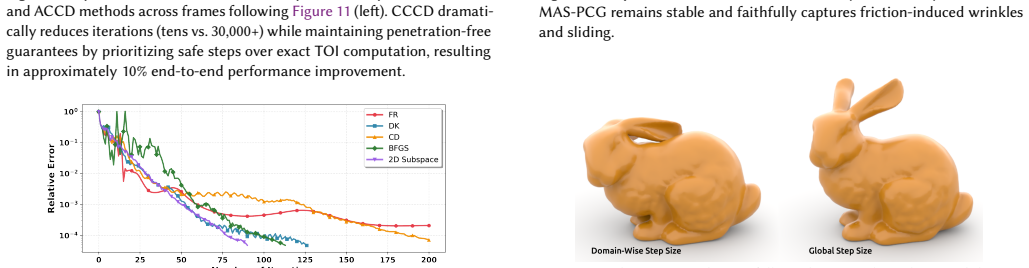
- [Method section (2D subspace minimization)] The Hessian-aware 2D subspace minimization is introduced to combine the preconditioned gradient and previous direction, yet no analysis or pseudocode shows how it interacts with the updated MAS preconditioner in rapidly changing contact scenarios, nor are iteration counts or failure rates compared to standard PNCG.
minor comments (2)
- [Abstract] The abstract states maintenance cost is reduced to 'near-zero' but provides no explicit quantification or comparison against full MAS rebuild costs.
- [Throughout] Ensure all acronyms (MAS, PNCG, IPC, GIPC, CCD) are defined at first use and used consistently throughout.
Simulated Author's Rebuttal
We thank the referee for their thoughtful and constructive feedback on our manuscript. We believe the suggested revisions will significantly improve the clarity and rigor of our presentation. We address each of the major comments in detail below.
read point-by-point responses
-
Referee: [Method section (Sparse-Input Woodbury update)] The Sparse-Input Woodbury update (described in the method section) is asserted to maintain the complex spectral properties of MAS by updating only fine-level components. However, no eigenvalue bounds, condition-number tracking, or proof of spectral equivalence to a full rebuild is supplied. Contact changes can indirectly affect coarse-grid operators and inter-level transfers, risking degradation of the global coupling that distinguishes MAS from Jacobi; this directly underpins the claimed speedups.
Authors: We thank the referee for this insightful observation. The Sparse-Input Woodbury update is specifically designed to modify only the fine-level diagonal blocks and contact-related terms in the MAS preconditioner, leaving the coarse-grid operators and prolongation/restriction matrices unchanged. This is because the coarse levels are constructed from the aggregated fine-level information, but in our incremental approach, we update the fine-level contributions in a way that the effective coarse operators remain consistent with the current contact configuration without full recomputation. We will revise the method section to include a more detailed explanation of why the spectral properties are preserved, including a sketch of the eigenvalue analysis based on the additive Schwarz framework. Additionally, we will incorporate condition-number tracking plots in the experiments to demonstrate that the incremental updates do not degrade the preconditioner quality compared to full rebuilds. revision: partial
-
Referee: [Experiments section] Experiments section: The reported speedups (5.66× vs. GIPC and 2.07× vs. StiffGIPC) are presented without quantitative error metrics, convergence plots, condition-number histories, or verification that intersection-free guarantees remain intact after incremental updates. Detailed scene descriptions, baseline implementations, and timing breakdowns are also absent, leaving the robustness of the performance claims difficult to assess.
Authors: We agree with the referee that the experimental section would benefit from additional details to strengthen the validation of our claims. In the revised version, we will add convergence plots showing residual reduction over iterations for both our method and baselines, quantitative metrics including final energy values, maximum penetration depths to confirm intersection-free guarantees, and condition number histories. We will also provide more detailed descriptions of the test scenes, pseudocode or references for the baseline implementations (GIPC and StiffGIPC), and a breakdown of timing for preconditioner update, linear solve, and CCD steps. These additions will allow readers to better assess the robustness and reproducibility of the reported speedups. revision: yes
-
Referee: [Method section (2D subspace minimization)] The Hessian-aware 2D subspace minimization is introduced to combine the preconditioned gradient and previous direction, yet no analysis or pseudocode shows how it interacts with the updated MAS preconditioner in rapidly changing contact scenarios, nor are iteration counts or failure rates compared to standard PNCG.
Authors: Thank you for pointing this out. The Hessian-aware 2D subspace minimization computes an optimal step by solving a small 2x2 system using the Hessian-vector products approximated via the updated MAS preconditioner. This ensures that the direction is adapted to the current contact state. We will include pseudocode for this minimization procedure in the revised method section and add an analysis paragraph discussing its behavior in dynamic contact scenarios, particularly how the incremental Woodbury update affects the preconditioned gradient. We will also augment the experiments with tables reporting average iteration counts and any failure cases compared to standard PNCG without the subspace minimization. revision: partial
Circularity Check
No circularity: empirical performance claims rest on external benchmarks, not self-referential definitions or fitted inputs.
full rationale
The paper presents MAS-PNCG as an algorithmic combination of multilevel preconditioning, Sparse-Input Woodbury updates, 2D subspace minimization, and conservative CCD. All central claims (speedups of 5.66× and 2.07×) are justified by direct experimental comparison against GIPC and StiffGIPC on external test cases. No equation or section reduces a derived quantity to a fitted parameter or prior self-citation by construction; the Woodbury update is presented as a new incremental procedure whose effectiveness is measured, not assumed tautologically. The derivation chain is therefore self-contained against independent benchmarks.
Axiom & Free-Parameter Ledger
Reference graph
Works this paper leans on
-
[1]
Proceedings of the Platform for Advanced Scientific Computing Conference , pages=
Preconditioning nonlinear conjugate gradient with diagonalized quasi-newton , author=. Proceedings of the Platform for Advanced Scientific Computing Conference , pages=
-
[2]
SIAM Journal on Optimization , volume=
The limited memory conjugate gradient method , author=. SIAM Journal on Optimization , volume=. 2013 , publisher=
2013
-
[3]
Mathematical programming , volume=
QN-like variable storage conjugate gradients , author=. Mathematical programming , volume=. 1983 , publisher=
1983
-
[4]
Proceedings of the 21st Pan-Hellenic Conference on Informatics , pages=
A hybrid conjugate gradient method based on the self-scaled memoryless BFGS update , author=. Proceedings of the 21st Pan-Hellenic Conference on Informatics , pages=
-
[5]
OPTIMIZATION LETTERS , volume=
Novel Quasi--Newton updates for Preconditioned Nonlinear Conjugate Gradient methods , author=. OPTIMIZATION LETTERS , volume=
-
[6]
Applied Mathematics and Computation , volume=
Preconditioned nonlinear conjugate gradient methods based on a modified secant equation , author=. Applied Mathematics and Computation , volume=. 2018 , publisher=
2018
-
[7]
ACM Transactions on Graphics (TOG) , volume=
A contact proxy splitting method for Lagrangian solid-fluid coupling , author=. ACM Transactions on Graphics (TOG) , volume=. 2023 , publisher=
2023
-
[8]
IEEE Transactions on Visualization and Computer Graphics , volume=
Augmented incremental potential contact for sticky interactions , author=. IEEE Transactions on Visualization and Computer Graphics , volume=. 2023 , publisher=
2023
-
[9]
Computer Graphics Forum , volume=
A Finite Element Formulation of Baraff-Witkin Cloth , author=. Computer Graphics Forum , volume=. 2020 , organization=
2020
-
[10]
ACM SIGGRAPH 2023 conference proceedings , pages=
High-order incremental potential contact for elastodynamic simulation on curved meshes , author=. ACM SIGGRAPH 2023 conference proceedings , pages=
2023
-
[11]
ACM Transactions on Graphics (TOG) , volume=
Beyond Chainmail: Computational Modeling of Discrete Interlocking Materials , author=. ACM Transactions on Graphics (TOG) , volume=. 2023 , publisher=
2023
-
[12]
ACM SIGGRAPH 2024 Conference Papers , pages=
A Dynamic Duo of Finite Elements and Material Points , author=. ACM SIGGRAPH 2024 Conference Papers , pages=
2024
-
[13]
Yuksel, Cem , title =. 2022 , isbn =. doi:10.1145/3532836.3536266 , booktitle =
-
[14]
2024 , url=
Physics-Based Simulation , author=. 2024 , url=
2024
-
[15]
ACM SIGGRAPH 2024 Conference Papers , pages=
Preconditioned Nonlinear Conjugate Gradient Method for Real-time Interior-point Hyperelasticity , author=. ACM SIGGRAPH 2024 Conference Papers , pages=
2024
-
[16]
ACM Transactions on Graphics (TOG) , volume=
Vertex block descent , author=. ACM Transactions on Graphics (TOG) , volume=. 2024 , publisher=
2024
-
[17]
ACM Transactions on Graphics (TOG) , volume=
A Cubic Barrier with Elasticity-Inclusive Dynamic Stiffness , author=. ACM Transactions on Graphics (TOG) , volume=. 2024 , publisher=
2024
-
[18]
ACM Transactions on Graphics , year=
StiffGIPC: Advancing GPU IPC for Stiff Affine-Deformable Simulation , author=. ACM Transactions on Graphics , year=
-
[19]
ACM Transactions on Graphics , volume=
GIPC: Fast and stable Gauss-Newton optimization of IPC barrier energy , author=. ACM Transactions on Graphics , volume=. 2024 , publisher=
2024
-
[20]
Lan, Lei and Li, Minchen and Jiang, Chenfanfu and Wang, Huamin and Yang, Yin , title =. 2023 , issue_date =. doi:10.1145/3592104 , journal =
-
[21]
Mathematical programming , volume=
Restart procedures for the conjugate gradient method , author=. Mathematical programming , volume=. 1977 , publisher=
1977
-
[22]
Nonlinear programming , volume=
Some global convergence properties of a variable metric algorithm for minimization without exact line searches , author=. Nonlinear programming , volume=. 1976 , publisher=
1976
-
[23]
ACM Transactions on Graphics , volume=
Differentiable solver for time-dependent deformation problems with contact , author=. ACM Transactions on Graphics , volume=. 2024 , publisher=
2024
-
[24]
ACM Transactions on Graphics , volume=
Fast GPU-Based Two-Way Continuous Collision Handling , author=. ACM Transactions on Graphics , volume=. 2023 , publisher=
2023
-
[25]
ACM Transactions on Graphics (TOG) , volume=
Descent methods for elastic body simulation on the GPU , author=. ACM Transactions on Graphics (TOG) , volume=. 2016 , publisher=
2016
-
[26]
Projective dynamics , volume =
Bouaziz, Sofien and Martin, Sebastian and Liu, Tiantian and Kavan, Ladislav and Pauly, Mark , year =. Projective dynamics , volume =. ACM Transactions on Graphics , doi =
-
[27]
ACM Transactions on Graphics (TOG) , volume=
Penetration-free projective dynamics on the GPU , author=. ACM Transactions on Graphics (TOG) , volume=. 2022 , publisher=
2022
-
[28]
ACM Transactions on Graphics (TOG) , volume=
Stable neo-hookean flesh simulation , author=. ACM Transactions on Graphics (TOG) , volume=. 2018 , publisher=
2018
-
[29]
ACM SIGGRAPH 2022 Courses , pages=
Dynamic deformables: implementation and production practicalities (now with code!) , author=. ACM SIGGRAPH 2022 Courses , pages=
2022
-
[30]
SIAM Journal on optimization , volume=
On the implementation of a primal-dual interior point method , author=. SIAM Journal on optimization , volume=. 1992 , publisher=
1992
-
[31]
, author=
Incremental potential contact: intersection-and inversion-free, large-deformation dynamics. , author=. ACM Trans. Graph. , volume=
-
[32]
ACM Transactions on Graphics (TOG) , volume=
A GPU-based multilevel additive schwarz preconditioner for cloth and deformable body simulation , author=. ACM Transactions on Graphics (TOG) , volume=. 2022 , publisher=
2022
-
[33]
SIAM Journal on Optimization , volume=
A nonlinear conjugate gradient algorithm with an optimal property and an improved Wolfe line search , author=. SIAM Journal on Optimization , volume=. 2013 , publisher=
2013
-
[34]
2020 , publisher=
Nonlinear conjugate gradient methods for unconstrained optimization , author=. 2020 , publisher=
2020
-
[35]
SIAM Journal on optimization , volume=
A new conjugate gradient method with guaranteed descent and an efficient line search , author=. SIAM Journal on optimization , volume=. 2005 , publisher=
2005
-
[36]
Applied Mathematics and Computation , volume=
Acceleration of conjugate gradient algorithms for unconstrained optimization , author=. Applied Mathematics and Computation , volume=. 2009 , publisher=
2009
-
[37]
Journal of Computational and Applied Mathematics , volume=
Several efficient gradient methods with approximate optimal stepsizes for large scale unconstrained optimization , author=. Journal of Computational and Applied Mathematics , volume=. 2018 , publisher=
2018
-
[38]
Journal of Optimization Theory and Applications , volume=
Another conjugate gradient algorithm with guaranteed descent and conjugacy conditions for large-scale unconstrained optimization , author=. Journal of Optimization Theory and Applications , volume=. 2013 , publisher=
2013
-
[39]
SIAM review , volume=
Convergence conditions for ascent methods , author=. SIAM review , volume=. 1969 , publisher=
1969
-
[40]
2000 , publisher=
Practical methods of optimization , author=. 2000 , publisher=
2000
-
[41]
The computer journal , volume=
Function minimization by conjugate gradients , author=. The computer journal , volume=. 1964 , publisher=
1964
-
[42]
Note sur la convergence de m
Polak, Elijah and Ribiere, Gerard , journal=. Note sur la convergence de m. 1969 , publisher=
1969
-
[43]
USSR Computational Mathematics and Mathematical Physics , volume=
The conjugate gradient method in extremal problems , author=. USSR Computational Mathematics and Mathematical Physics , volume=. 1969 , publisher=
1969
-
[44]
SIAM Journal on optimization , volume=
A nonlinear conjugate gradient method with a strong global convergence property , author=. SIAM Journal on optimization , volume=. 1999 , publisher=
1999
-
[45]
Applied Mathematics and optimization , volume=
New conjugacy conditions and related nonlinear conjugate gradient methods , author=. Applied Mathematics and optimization , volume=. 2001 , publisher=
2001
-
[46]
Proceedings of the 14th annual conference on Computer graphics and interactive techniques , pages=
Elastically deformable models , author=. Proceedings of the 14th annual conference on Computer graphics and interactive techniques , pages=
-
[47]
Artificial intelligence , volume=
Constraints on deformable models: Recovering 3D shape and nonrigid motion , author=. Artificial intelligence , volume=. 1988 , publisher=
1988
-
[48]
The visual computer , volume=
Deformable models , author=. The visual computer , volume=. 1988 , publisher=
1988
-
[49]
Proceedings Computer Animation 1999 , pages=
Virtual reality simulation modeling for a haptic glove , author=. Proceedings Computer Animation 1999 , pages=. 1999 , organization=
1999
-
[50]
ACM Transactions on Graphics (TOG) , volume=
Rule-free sewing pattern adjustment with precision and efficiency , author=. ACM Transactions on Graphics (TOG) , volume=. 2018 , publisher=
2018
-
[51]
IEEE Transactions on Visualization and Computer Graphics , volume=
Modal warping: Real-time simulation of large rotational deformation and manipulation , author=. IEEE Transactions on Visualization and Computer Graphics , volume=. 2005 , publisher=
2005
-
[52]
Computer methods and programs in biomedicine , volume=
Real-time deformable models for surgery simulation: a survey , author=. Computer methods and programs in biomedicine , volume=. 2005 , publisher=
2005
-
[53]
2013 IEEE/RSJ international conference on Intelligent Robots and Systems , pages=
Highly deformable 3-D printed soft robot generating inching and crawling locomotions with variable friction legs , author=. 2013 IEEE/RSJ international conference on Intelligent Robots and Systems , pages=. 2013 , organization=
2013
-
[54]
Computer methods in applied mechanics and engineering , volume=
Finite element analysis of nonsmooth contact , author=. Computer methods in applied mechanics and engineering , volume=. 1999 , publisher=
1999
-
[55]
ACM SIGGRAPH Asia 2008 papers , pages=
Staggered projections for frictional contact in multibody systems , author=. ACM SIGGRAPH Asia 2008 papers , pages=
2008
-
[56]
Acm Transactions on Graphics (TOG) , volume=
Quasi-newton methods for real-time simulation of hyperelastic materials , author=. Acm Transactions on Graphics (TOG) , volume=. 2017 , publisher=
2017
-
[57]
ACM Transactions on Graphics (TOG) , volume=
Efficient and accurate collision response for elastically deformable models , author=. ACM Transactions on Graphics (TOG) , volume=. 2019 , publisher=
2019
-
[58]
ACM SIGGRAPH 2008 papers , pages=
Discrete elastic rods , author=. ACM SIGGRAPH 2008 papers , pages=
2008
-
[59]
Computer Methods in Applied Mechanics and Engineering , volume=
BFEMP: Interpenetration-free MPM--FEM coupling with barrier contact , author=. Computer Methods in Applied Mechanics and Engineering , volume=. 2022 , publisher=
2022
-
[60]
ACM Transactions on Graphics , volume=
Guaranteed globally injective 3D deformation processing , author=. ACM Transactions on Graphics , volume=
-
[61]
ACM Transactions on Graphics , volume=
Medial IPC: accelerated incremental potential contact with medial elastics , author=. ACM Transactions on Graphics , volume=
-
[62]
Kaufman and Chenfanfu Jiang , title =
Minchen Li and Danny M. Kaufman and Chenfanfu Jiang , title =. ACM Trans. Graph. (SIGGRAPH) , year =
-
[63]
ACM Transactions on Graphics , volume=
Intersection-free rigid body dynamics , author=. ACM Transactions on Graphics , volume=
-
[64]
Lan, Lei and Kaufman, Danny M. and Li, Minchen and Jiang, Chenfanfu and Yang, Yin , title =. 2022 , issue_date =. doi:10.1145/3528223.3530064 , month =
-
[65]
Computer Methods in Applied Mechanics and Engineering , volume=
A barrier method for frictional contact on embedded interfaces , author=. Computer Methods in Applied Mechanics and Engineering , volume=. 2022 , publisher=
2022
-
[66]
SIGGRAPH Asia 2023 Conference Papers , pages=
Subspace-preconditioned gpu projective dynamics with contact for cloth simulation , author=. SIGGRAPH Asia 2023 Conference Papers , pages=
2023
-
[67]
Journal of research of the National Bureau of Standards , volume=
Methods of conjugate gradients for solving linear systems , author=. Journal of research of the National Bureau of Standards , volume=
-
[68]
1994 , publisher=
An introduction to the conjugate gradient method without the agonizing pain , author=. 1994 , publisher=
1994
-
[69]
ACM Transactions on Graphics (TOG) , volume=
Taichi: a language for high-performance computation on spatially sparse data structures , author=. ACM Transactions on Graphics (TOG) , volume=. 2019 , publisher=
2019
-
[70]
Bonet, Javier and Wood, Richard D. , year=. Nonlinear Continuum Mechanics for Finite Element Analysis , DOI=
-
[71]
PeerJ Computer Science , issn =
SymPy: symbolic computing in Python , author =. PeerJ Computer Science , issn =
-
[72]
ACM Transactions on Graphics (TOG) , volume=
Accelerated complex-step finite difference for expedient deformable simulation , author=. ACM Transactions on Graphics (TOG) , volume=. 2019 , publisher=
2019
-
[73]
IMA journal of numerical analysis , volume=
Two-point step size gradient methods , author=. IMA journal of numerical analysis , volume=. 1988 , publisher=
1988
-
[74]
Yu, Chang and Xu, Yi and Kuang, Ye and Hu, Yuanming and Liu, Tiantian , title =. ACM Trans. Graph. , month =. 2022 , issue_date =. doi:10.1145/3550454.3555430 , abstract =
-
[75]
Optimized Spatial Hashing for Collision Detection of Deformable Objects , volume =
Teschner, Matthias and Heidelberger, Bruno and Müller, Matthias and Pomeranets, Danat and Gross, Markus , year =. Optimized Spatial Hashing for Collision Detection of Deformable Objects , volume =
-
[76]
matthias-research/pages , url =
Müller, Matthias and matthimf and Selstad, Johnathon and Oberbichler, Thomas and Waite, Elliot , date =. matthias-research/pages , url =. 2023 , month =
2023
-
[77]
, author=
Optimized spatial hashing for collision detection of deformable objects. , author=. Vmv , volume=
-
[78]
Proceedings of the 9th International Conference on Motion in Games , pages=
XPBD: position-based simulation of compliant constrained dynamics , author=. Proceedings of the 9th International Conference on Motion in Games , pages=
-
[79]
Proceedings of the 2005 ACM SIGGRAPH/Eurographics symposium on Computer animation , pages=
Robust quasistatic finite elements and flesh simulation , author=. Proceedings of the 2005 ACM SIGGRAPH/Eurographics symposium on Computer animation , pages=
2005
-
[80]
1999 , publisher=
Numerical optimization , author=. 1999 , publisher=
1999
discussion (0)
Sign in with ORCID, Apple, or X to comment. Anyone can read and Pith papers without signing in.