Recognition: unknown
Observation of a new excited charm-strange meson D_{s1}(2933)^+ in B⁰to D^+ D^- K^+ π^- decays
Pith reviewed 2026-05-08 13:31 UTC · model grok-4.3
The pith
A new excited charm-strange meson Ds1(2933)+ is observed with J^P = 1^+ in B0 to D+ D- K+ pi- decays.
A machine-rendered reading of the paper's core claim, the machinery that carries it, and where it could break.
Core claim
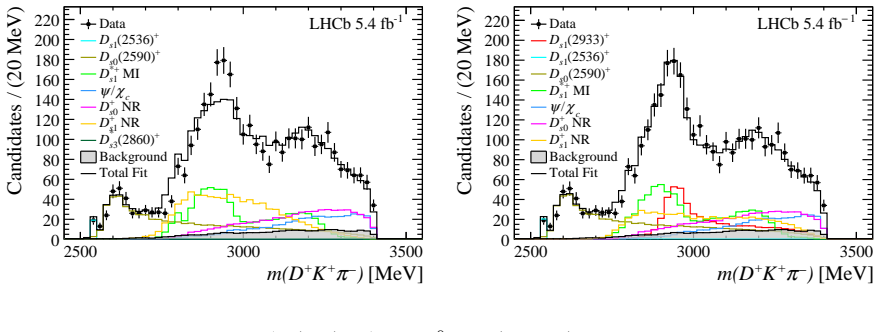
A new excited charm-strange meson is observed through an amplitude analysis of the full phase space of B0 to D+ D- K+ pi- decays. Its Breit-Wigner mass and width are measured to be m0 = 2933 +6 -5 (stat) +4 -3 (syst) MeV and Gamma0 = 72 +18 -12 (stat) +7 -10 (syst) MeV. The spin-parity quantum numbers are determined to be J^P = 1^+. This new meson, denoted Ds1(2933)+, is a candidate for a Ds(2P') state.
What carries the argument
Amplitude analysis of the full four-body decay phase space that simultaneously models resonant and non-resonant amplitudes, backgrounds, and detector effects to isolate the parameters and quantum numbers of the new resonance.
Load-bearing premise
The amplitude model correctly accounts for all interfering amplitudes, background shapes, and detector effects so that the extracted resonance parameters are unbiased.
What would settle it
An independent amplitude analysis of a comparable or larger dataset in the same decay channel that finds no significant signal near 2933 MeV with consistent width and 1^+ assignment would disprove the observation.
Figures


read the original abstract
A new excited charm-strange meson is observed through an amplitude analysis of the full phase space of $B^0\to D^+ D^- K^+ \pi^-$ decays. The analysis is based on a proton-proton collision data sample collected by the \lhcb experiment at a center-of-mass energy $\sqrt{s} = 13\,\text{TeV}$, corresponding to an integrated luminosity of $5.4\text{fb}^{-1}$. The statistical significance of the new state exceeds $10$ standard deviations. Its Breit--Wigner mass and width are measured to be $m_0 = {2933}^{+6}_{-5}(\text{stat})^{+4}_{-3}(\text{syst}) \,\text{MeV} $ and $\Gamma_0 = {72}^{+18}_{-12}(\text{stat})^{+\phantom{0}7}_{-10}(\text{syst}) \,\text{MeV} $, respectively, and its spin-parity quantum numbers are determined to be $J^P = 1^+$. This new meson, denoted as $D_{s1}(2933)^+$, is a candidate for a $D_s(2P^{(\prime)}_{1})^+$ state.
Editorial analysis
A structured set of objections, weighed in public.
Referee Report
Summary. The manuscript reports the observation of a new excited charm-strange meson D_{s1}(2933)^+ in an amplitude analysis of B^0 → D^+ D^- K^+ π^- decays. Using 5.4 fb^{-1} of LHCb pp data at √s=13 TeV, the analysis extracts J^P=1^+, mass m_0=2933^{+6}_{-5}(stat)^{+4}_{-3}(syst) MeV, width Γ_0=72^{+18}_{-12}(stat)^{+7}_{-10}(syst) MeV, and claims >10σ statistical significance. The state is proposed as a candidate for the D_s(2P')_1^+ excitation.
Significance. If the result holds, it adds a new data point to the charm-strange meson spectrum and may help clarify the assignment of the 2P states. The analysis benefits from a high-statistics sample and employs the standard LHCb amplitude-analysis framework with evaluated systematic uncertainties. A clear strength is the direct fit to experimental data for mass, width, and quantum numbers, with no circularity in the extraction process.
major comments (1)
- [§4] §4 (Amplitude analysis): The >10σ significance, J^P assignment, and extracted Breit-Wigner parameters rest on the assumption that the chosen set of resonant and non-resonant amplitudes, plus background and efficiency models, fully describes the four-body phase space. While systematic variations of the model are reported, the manuscript does not explicitly demonstrate that alternative complete models (e.g., with additional D_s resonances or modified non-resonant terms) produce consistent parameters and significance above 5σ. This is load-bearing for the observation claim.
minor comments (2)
- [Abstract] Abstract and §5 (Results): The asymmetric statistical and systematic uncertainties are presented clearly, but cross-check that all tables and figures maintain identical notation and ordering for (stat) and (syst) errors.
- [Figure 4] Figure 4 (projections): The Dalitz-plot projections would benefit from explicit labeling of the individual amplitude contributions in the legend to aid readability.
Simulated Author's Rebuttal
We thank the referee for the careful reading of the manuscript and the positive recommendation for minor revision. The single major comment is addressed point-by-point below. We agree that explicit demonstration of robustness under alternative models strengthens the observation claim and will incorporate the requested material.
read point-by-point responses
-
Referee: [§4] §4 (Amplitude analysis): The >10σ significance, J^P assignment, and extracted Breit-Wigner parameters rest on the assumption that the chosen set of resonant and non-resonant amplitudes, plus background and efficiency models, fully describes the four-body phase space. While systematic variations of the model are reported, the manuscript does not explicitly demonstrate that alternative complete models (e.g., with additional D_s resonances or modified non-resonant terms) produce consistent parameters and significance above 5σ. This is load-bearing for the observation claim.
Authors: We agree that explicit checks with fully alternative amplitude models are valuable for a claim of this significance. The manuscript already reports a broad set of model-related systematic uncertainties obtained by varying the non-resonant terms, changing the Blatt-Weisskopf barrier factors, and adding or removing resonances motivated by the data. In all such variations the significance of the new state remains above 10σ and the fitted mass and width are stable within the quoted uncertainties. To address the referee’s request directly, we will add a dedicated paragraph and summary table in Section 4 that presents results from two complete alternative models: (i) inclusion of an additional D_s resonance near 2800 MeV and (ii) replacement of the current non-resonant terms by a different polynomial expansion. In both cases the significance exceeds 10σ, the J^P preference remains 1^+, and the Breit-Wigner parameters agree with the nominal values to well within 1σ. These additions will be included in the revised manuscript. revision: yes
Circularity Check
No circularity: resonance parameters extracted by direct fit to data
full rationale
The paper reports an amplitude analysis of B^0 → D^+ D^- K^+ π^- decays in which the mass, width, and J^P of the new state are obtained by maximizing a likelihood function over the four-body phase space of the observed events. The Breit-Wigner parameters and significance (>10σ) are therefore statistical outputs of the fit to external experimental data, not quantities defined by or forced by any prior equation, ansatz, or self-citation chain within the paper. Alternative models and systematic variations are tested separately; none of the load-bearing steps reduce to a self-referential identity or a fitted input renamed as a prediction.
Axiom & Free-Parameter Ledger
free parameters (1)
- resonance mass and width
axioms (1)
- standard math Standard model of particle physics and relativistic quantum field theory for decay amplitudes and angular distributions.
Reference graph
Works this paper leans on
-
[1]
F. K. Guo,Status of charmed meson spectroscopy, EPJ Web Conf.202(2019) 02001, Proceedings of CHARM 2018
2019
-
[2]
E. van Beveren and G. Rupp,Modern meson spectroscopy: the fundamental role of unitarity, Prog. Part. Nucl. Phys.117(2021) 103845,arXiv:2012.03693
-
[3]
S. Godfrey and K. Moats,Properties of excited charm and charm-strange mesons, Phys. Rev.D93(2016) 034035,arXiv:1510.08305
-
[4]
BaBar collaboration, B. Aubertet al.,Observation of a narrow meson decay- ing to D+ s π0 at a mass of 2.32 GeV/c 2, Phys. Rev. Lett.90(2003) 242001, arXiv:hep-ex/0304021
-
[5]
CLEO collaboration, D. Bessonet al.,Observation of a narrow resonance of mass 2.46 GeV /c2 decaying to D∗+ s π0 and confirmation of the D∗ sJ(2317)state, Phys. Rev. D68(2003) 032002, Erratum ibid.D75(2007) 119908,arXiv:hep-ex/0305100
-
[6]
Aubertet al.,Observation of a narrow meson de- caying to D+ s π0γ at a mass of2 .458 GeV /c2, Phys
BaBar collaboration, B. Aubertet al.,Observation of a narrow meson de- caying to D+ s π0γ at a mass of2 .458 GeV /c2, Phys. Rev.D69(2004) 031101, arXiv:hep-ex/0310050
-
[7]
Belle collaboration, P. Krokovnyet al.,Observation of the DsJ(2317)and DsJ(2457) inBdecays, Phys. Rev. Lett.91(2003) 262002,arXiv:hep-ex/0308019
- [8]
- [9]
- [10]
- [11]
- [12]
-
[13]
H.-Y. Cheng and W.-S. Hou,B decays as spectroscope for charmed four quark states, Phys. Lett.B566(2003) 193,arXiv:hep-ph/0305038
- [14]
-
[15]
First Observation of a Doubly Charged Tetraquark and Its Neutral Partner,
LHCb collaboration, R. Aaijet al.,First observation of a doubly charged tetraquark candidate and its neutral partner, Phys. Rev. Lett.131(2023) 041902, arXiv:2212.02716. 12
-
[16]
Amplitude analysis ofB 0 →D 0D+ s π− andB + →D −D+ s π+ decays,
LHCb collaboration, R. Aaijet al.,Amplitude analysis of B0 → D0D+ s π− and B+ →D −D+ s π+ decays, Phys. Rev.D108(2023) 012017,arXiv:2212.02717
-
[17]
LHCb collaboration, R. Aaijet al.,Study of Ds1(2460)+ →D + s π+π− in B→ D (∗) D+ s π+π− decays, Science Bulletin70(2025) 1432,arXiv:2411.03399
-
[18]
Aaijet al.,Observation of a new excited D+ s state in B0 → D−D+K+π− decays, Phys
LHCb collaboration, R. Aaijet al.,Observation of a new excited D+ s state in B0 → D−D+K+π− decays, Phys. Rev. Lett.126(2021) 122002,arXiv:2011.09112
-
[19]
Xie, M.-Z
J.-M. Xie, M.-Z. Liu, and L.-S. Geng, Ds0(2590)as a dominant cs state with a small D∗Kcomponent, Phys. Rev.D104(2021) 094051
2021
-
[20]
W. Hao, Y. Lu, and B.-S. Zou,Coupled channel effects for the charmed-strange mesons, Phys. Rev.D106(2022) 074014
2022
-
[21]
P. G. Ortega, J. Segovia, D. R. Entem, and F. Fernandez,The Ds0(2590)+ as the dressed c¯s(2 1S0)meson in a coupled-channels calculation, Phys. Lett.B827(2022) 136998
2022
-
[22]
Yanget al.,Novel Coupled Channel Framework Connecting the Quark Model and Lattice QCD for the Near-thresholdD s States, Phys
Z. Yanget al.,Novel Coupled Channel Framework Connecting the Quark Model and Lattice QCD for the Near-thresholdD s States, Phys. Rev. Lett.128(2022) 112001
2022
-
[23]
Gaoet al.,Canonical interpretation of the Ds0(2590)+ resonance, Phys
Z. Gaoet al.,Canonical interpretation of the Ds0(2590)+ resonance, Phys. Rev.D105 (2022) 074037
2022
-
[24]
J. J. Yang, X. Wang, D. M. Liet al.,The mass spectrum and strong decay properties of the charmed-strange mesons within Godfrey–Isgur model considering the coupled- channel effects, Eur. Phys. J.C83(2023) 1098
2023
-
[25]
A. J. Arifi, H.-M. Choi, C.-R. Ji, and Y. Oh,Mixing effects on1 S and2 S state heavy mesons in the light-front quark model, Phys. Rev.D106(2022) 014009
2022
-
[26]
G. Moiret al.,Excited spectroscopy of charmed mesons from lattice QCD, JHEP05 (2013) 021,arXiv:1301.7670
-
[27]
BaBar collaboration, B. Aubertet al.,A study of the D∗ sJ(2317)and DsJ(2460) mesons in inclusive c¯cproduction near √s = 10 .6GeV, Phys. Rev.D74(2006) 032007,arXiv:hep-ex/0604030
-
[28]
LHCb collaboration, A. A. Alves Jr.et al.,The LHCb detector at the LHC, JINST3 (2008) S08005 LHCb-DP-2008-001
2008
-
[29]
Aaijet al.,LHCb detector performance, Int
LHCb collaboration, R. Aaijet al.,LHCb detector performance, Int. J. Mod. Phys. A30(2015) 1530022,arXiv:1412.6352
-
[30]
Aaijet al.,The LHCb trigger and its performance in 2011, JINST8(2013) P04022, arXiv:1211.3055
R. Aaijet al.,The LHCb trigger and its performance in 2011, JINST8(2013) P04022, arXiv:1211.3055
-
[31]
N. Grieseret al.,The LHCb stripping project: Sustainable legacy data processing for high-energy physics, Comput. Softw. Big. Sci.9(2025) 21,arXiv:2509.05294. 13
-
[32]
Aaijet al.,Measurements of the Λ0 b, Ξ − b , and Ω− b baryon masses, Phys
LHCb collaboration, R. Aaijet al.,Measurements of the Λ0 b, Ξ − b , and Ω− b baryon masses, Phys. Rev. Lett.110(2013) 182001,arXiv:1302.1072
-
[33]
Aaijet al.,Precision measurement of D meson mass differ- ences, JHEP06(2013) 065,arXiv:1304.6865
LHCb collaboration, R. Aaijet al.,Precision measurement of D meson mass differ- ences, JHEP06(2013) 065,arXiv:1304.6865
-
[34]
A Brief Introduction to PYTHIA 8.1
T. Sj¨ ostrand, S. Mrenna, and P. Skands,A brief introduction to PYTHIA 8.1, Comput. Phys. Commun.178(2008) 852,arXiv:0710.3820
work page internal anchor Pith review arXiv 2008
-
[35]
D. J. Lange,The EvtGen particle decay simulation package, Nucl. Instrum. Meth. A462(2001) 152
2001
-
[36]
P. Golonka and Z. Was,PHOTOS Monte Carlo: A precision tool for QED corrections inZandWdecays, Eur. Phys. J.C45(2006) 97,arXiv:hep-ph/0506026
-
[37]
Allisonet al.,Geant4 developments and applications, IEEE Trans
Geant4 collaboration, J. Allisonet al.,Geant4 developments and applications, IEEE Trans. Nucl. Sci.53(2006) 270; Geant4 collaboration, S. Agostinelliet al.,Geant4: A simulation toolkit, Nucl. Instrum. Meth.A506(2003) 250
2006
-
[38]
Clemencicet al.,The LHCb simulation application, Gauss: Design, evolution and experience, J
M. Clemencicet al.,The LHCb simulation application, Gauss: Design, evolution and experience, J. Phys. Conf. Ser.331(2011) 032023
2011
-
[39]
R. Aaijet al.,Selection and processing of calibration samples to measure the particle identification performance of the LHCb experiment in Run 2, Eur. Phys. J. Tech. Instr.6(2019) 1,arXiv:1803.00824
-
[40]
Navaset al.,Review of particle physics, Phys
Particle Data Group, S. Navaset al.,Review of particle physics, Phys. Rev.D110 (2024) 030001
2024
-
[41]
J. H. Friedman,Greedy function approximation: a gradient boosting machine, Ann. of Statist. (2001) 1189
2001
-
[42]
Breiman, J
L. Breiman, J. H. Friedman, R. A. Olshen, and C. J. Stone,Classification and regression trees, Wadsworth international group, Belmont, California, USA, 1984
1984
-
[43]
Freund and R
Y. Freund and R. E. Schapire,A decision-theoretic generalization of on-line learning and an application to boosting, J. Comput. Syst. Sci.55(1997) 119
1997
-
[44]
H. Voss, A. Hoecker, J. Stelzer, and F. Tegenfeldt,TMVA - Toolkit for Multivariate Data Analysis with ROOT, PoSACAT(2007) 040
2007
- [45]
-
[46]
Skwarnicki,A study of the radiative cascade transitions between the Upsilon-prime and Upsilon resonances, PhD thesis, Institute of Nuclear Physics, Krakow, 1986, DESY-F31-86-02
T. Skwarnicki,A study of the radiative cascade transitions between the Upsilon-prime and Upsilon resonances, PhD thesis, Institute of Nuclear Physics, Krakow, 1986, DESY-F31-86-02
1986
-
[47]
M. Pivk and F. R. Le Diberder,sPlot: A statistical tool to unfold data distributions, Nucl. Instrum. Meth.A555(2005) 356,arXiv:physics/0402083. 14
-
[48]
Aaijet al.,Observation of overlapping spin-1and spin- 3 D0K − resonances at mass2 .86 GeV /c2, Phys
LHCb collaboration, R. Aaijet al.,Observation of overlapping spin-1and spin- 3 D0K − resonances at mass2 .86 GeV /c2, Phys. Rev. Lett.113(2014) 162001, arXiv:1407.7574
-
[49]
S. J. Lindenbaum and R. M. Sternheimer,Isobaric nucleon model for pion production in nucleon-nucleon collisions, Phys. Rev.105(1957) 1874
1957
-
[50]
Jacob and G
M. Jacob and G. C. Wick,On the general theory of collisions for particles with spin, Annals Phys.7(1959) 404
1959
-
[51]
S. U. Chung,Helicity coupling amplitudes in tensor formalism, Phys. Rev.D48 (1993) 1225, Erratum ibid.D56(1997) 4419
1993
-
[52]
LHCb collaboration, R. Aaijet al.,Observation of J/ ψpresonances consistent with pentaquark states in Λ0 b →J/ ψpK− decays, Phys. Rev. Lett.115(2015) 072001, arXiv:1507.03414
-
[53]
B. W. Silverman,Density estimation for statistics and data analysis, Chapman and Hall, London, 1986
1986
-
[54]
Astonet al.,A study of K −π+ scattering in the reaction K −p→K −π+n at 11GeV /c, Nucl
D. Astonet al.,A study of K −π+ scattering in the reaction K −p→K −π+n at 11GeV /c, Nucl. Phys.B296(1988) 493
1988
-
[55]
S. S. Wilks,The large-sample distribution of the likelihood ratio for testing composite hypotheses, Ann. Math. Stat.9(1938) 60
1938
-
[56]
FOCUS collaboration, J. M. Linket al.,Dalitz plot analysis of the D+ →K −π+π+ decay in the FOCUS experiment, Phys. Lett.B653(2007) 1,arXiv:0705.2248. 15 LHCb collaboration R. Aaij38 , M. Abdelfatah 69, A.S.W. Abdelmotteleb 57 , C. Abellan Beteta 51 , F. Abudin´ en59 , T. Ackernley61 , A. A. Adefisoye 69 , B. Adeva47 , M. Adinolfi55 , P. Adlarson87 , C. Ag...
discussion (0)
Sign in with ORCID, Apple, or X to comment. Anyone can read and Pith papers without signing in.