Loop-Induced Higgs Boson Decays into Gauge Bosons in Radiative Natural Supersymmetry
Pith reviewed 2026-05-09 20:37 UTC · model grok-4.3
The pith
In radiative natural supersymmetry a chosen parameter region raises the Higgs partial width to Z gamma to about 7.5 keV while satisfying existing ATLAS and diphoton constraints.
A machine-rendered reading of the paper's core claim, the machinery that carries it, and where it could break.
Core claim
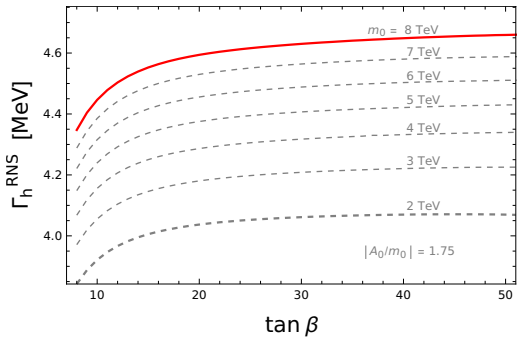
The authors reproduce the standard one-loop MSSM expressions for the partial widths Gamma(h to Z gamma), Gamma(h to gamma gamma), and Gamma(h to gg). Within the radiative natural supersymmetry scenario they locate a slice of parameter space that maximizes the h to Z gamma width; in that slice the width reaches a peak value of about 7.5 keV, remains compatible with the present ATLAS measurement, produces at most a five-percent shift in the diphoton channel, and induces an approximately twelve-percent suppression in the gluon channel.
What carries the argument
The selected region of parameter space in radiative natural supersymmetry that simultaneously maximizes chargino and stop loop contributions to the h to Z gamma amplitude while obeying the experimental bounds on the gamma-gamma and gluon-gluon modes.
If this is right
- The diphoton partial width stays within five percent of its Standard Model value across the chosen region.
- The gluon-fusion partial width experiences a moderate suppression of about twelve percent.
- The h to Z gamma enhancement remains compatible with the existing ATLAS measurement.
- Both the gamma-gamma and gg channels stay inside the experimental limits that currently constrain supersymmetric models.
Where Pith is reading between the lines
- Future LHC runs with higher statistics on h to Z gamma could directly test whether the maximizing region is realized in nature.
- The moderate suppression in the gluon channel may become visible in precision Higgs production measurements at the High-Luminosity LHC.
- The same parameter choices that enhance Z gamma could be checked for consistency with other loop-sensitive observables such as the muon anomalous magnetic moment or electroweak precision data.
Load-bearing premise
A region of parameter space exists that can be tuned to maximize the h to Z gamma width and still satisfy all current Higgs constraints from the gamma-gamma and gg channels without requiring further fine-tuning.
What would settle it
A future precision measurement of the h to Z gamma branching fraction that lies well below the 7.5 keV upper value reported for the maximizing region, or that forces the diphoton or gluon widths outside their currently allowed windows, would rule out the existence of such an enhancing parameter slice.
Figures



read the original abstract
In this article, we study loop-induced Higgs decays into gauge bosons within the framework of Radiative Natural Supersymmetry. We reproduce the one-loop MSSM calculations for the Higgs partial decay widths into a Z boson-photon pair, two photons, and two gluons, providing the corresponding analytical expressions for the scattering amplitudes. We focus on the region of parameter space that maximizes the rare decay width of the process $h \to Z\gamma$, and analyze the correlated predictions for the remaining Higgs decay channels. In the selected region of parameter space, the $h \to Z\gamma$ decay width is enhanced, reaching a maximum value of $\simeq 7.5~\mathrm{keV}$, while remaining compatible with the current ATLAS measurement. At the same time, this region satisfies current Higgs constraints from the $h \to \gamma\gamma$ and $h \to gg$ channels. The diphoton mode remains close to the Standard Model expectation, with deviations at the level of $\lesssim 5\%$. The gluon channel exhibits a stronger sensitivity to the considered region of parameter space, leading to a moderate suppression of about $12\%$ in the corresponding partial width.
Editorial analysis
A structured set of objections, weighed in public.
Referee Report
Summary. The paper studies loop-induced Higgs boson decays to Zγ, γγ, and gg in the radiative natural supersymmetry framework. It reproduces the one-loop MSSM amplitudes for these processes, supplies the corresponding analytic expressions, and identifies a parameter region that maximizes the h → Zγ partial width at ≃ 7.5 keV. This region is stated to remain compatible with ATLAS measurements, with the diphoton width deviating by ≲ 5% from the SM and the digluon width suppressed by ~12%.
Significance. If the numerical results and parameter selection hold, the work supplies a concrete, falsifiable prediction for an enhanced rare decay mode within a motivated natural SUSY scenario, together with correlated constraints on the other loop-induced channels. The provision of analytic expressions for the amplitudes is a clear strength, enabling independent verification and further model-building. The analysis of simultaneous compatibility with γγ and gg data adds robustness to the central claim.
major comments (1)
- [Parameter region selection (abstract and results section)] Parameter region selection (abstract and results section): The manuscript must explicitly confirm that the point yielding the maximum h → Zγ width of 7.5 keV preserves the radiative naturalness criterion (low electroweak fine-tuning measure) that defines the model. Adjustments to soft terms (e.g., stop mixing or μ) to maximize the Zγ form factor could increase fine-tuning or violate the naturalness threshold used to select the framework, rendering the compatibility claim load-bearing and in need of direct demonstration via a table or plot of the fine-tuning measure at that point.
minor comments (3)
- A brief table comparing the reproduced one-loop MSSM widths in the SM limit or standard benchmarks with literature values would aid verification of the analytic expressions.
- The renormalization scheme employed for the loop integrals and any numerical stability checks for the 7.5 keV maximum should be stated explicitly.
- Figures showing the parameter scans should clearly mark the location of the maximizing point and report the simultaneous values of Γ(h → γγ) and Γ(h → gg) at that point.
Simulated Author's Rebuttal
We thank the referee for the careful reading of our manuscript and the constructive comments. We address the major comment on parameter region selection below.
read point-by-point responses
-
Referee: Parameter region selection (abstract and results section): The manuscript must explicitly confirm that the point yielding the maximum h → Zγ width of 7.5 keV preserves the radiative naturalness criterion (low electroweak fine-tuning measure) that defines the model. Adjustments to soft terms (e.g., stop mixing or μ) to maximize the Zγ form factor could increase fine-tuning or violate the naturalness threshold used to select the framework, rendering the compatibility claim load-bearing and in need of direct demonstration via a table or plot of the fine-tuning measure at that point.
Authors: We agree that an explicit check is warranted to confirm the selected point lies within the natural regime. Our parameter scan is restricted to the radiative natural supersymmetry (RNS) framework, in which the soft terms are chosen such that the electroweak fine-tuning measure Δ_EW remains low by construction. The point that maximizes the h → Zγ partial width is taken from within this natural region. To address the referee's request directly, we will add a table (or supplementary plot) in the revised results section that reports the value of Δ_EW at the highlighted point and at nearby points in the scan. This will demonstrate that the fine-tuning measure stays below the threshold used to define naturalness in the model and that adjustments to stop mixing or μ do not push the point outside the natural domain. revision: yes
Circularity Check
No significant circularity in derivation chain
full rationale
The paper reproduces standard one-loop MSSM amplitudes for h→Zγ, h→γγ and h→gg, then scans a parameter region in radiative natural SUSY to maximize the Zγ width and reports the resulting value (~7.5 keV) together with correlated effects on the other channels. This is a conventional model prediction obtained from explicit loop integrals and parameter choices; the reported maximum is not defined in terms of itself, nor is any fitted input relabeled as an independent prediction. No load-bearing self-citation, imported uniqueness theorem, or ansatz smuggling appears in the provided text. The derivation remains self-contained against external ATLAS constraints and does not reduce to its inputs by construction.
Axiom & Free-Parameter Ledger
axioms (1)
- standard math One-loop effective field theory for Higgs-gauge boson couplings in supersymmetric models
Reference graph
Works this paper leans on
-
[1]
that is almost purely Higgsino-like, assuming the limit where gaugino mass parametersM 1 (bino) andM 2 (wino) are much heavier than the Higgsino massµ. All other superpartners, including heavier neutralinos ˜χ0 j=2,3,4, charginos ˜χ± i=1,2, sleptons ˜lj and squarks ˜qj, have significantly larger masses. This implies that decays of the Higgs boson into SUS...
work page 2024
-
[2]
S. P. Martin and D. G. Robertson, Phys. Rev. D100, 073004 (2019)
work page 2019
-
[3]
S. P. Martin, Phys. Rev. D105, 056014 (2022)
work page 2022
-
[4]
S. P. Martin, Phys. Rev. D106, 013007 (2022)
work page 2022
-
[5]
S. P. Martin, Phys. Rev. D107, 053005 (2023)
work page 2023
-
[6]
E. A. Reyes R. and A. R. Fazio, Phys. Rev. D108, 053007 (2023)
work page 2023
-
[7]
Aadet al.(ATLAS Collaboration and CMS Collaboration), J
G. Aadet al.(ATLAS Collaboration and CMS Collaboration), J. High Energy Phys.2016 (45), 08
work page 2016
- [8]
-
[9]
A. Hayrapetyanet al.(CMS), Phys. Rev. D111, 092014 (2025)
work page 2025
-
[10]
E. A. Reyes R. and A. R. Fazio, Particles5, 53 (2022)
work page 2022
- [11]
- [12]
- [13]
- [14]
- [15]
-
[16]
Aadet al.(ATLAS Collaboration and CMS Collaboration), J
G. Aadet al.(ATLAS Collaboration and CMS Collaboration), J. High Energy Phys.08, 045
- [17]
-
[18]
Aadet al.(ATLAS Collaboration and CMS Collaboration), Phys
G. Aadet al.(ATLAS Collaboration and CMS Collaboration), Phys. Rev. Lett.132, 021803 (2024)
work page 2024
-
[19]
G. Aadet al.(ATLAS), Search for the Higgs boson decay to aZboson and a photon inpp collisions at √s= 13 TeV and 13.6 TeV with the ATLAS detector, (2025), arXiv:2507.12598 [hep-ex]
work page internal anchor Pith review arXiv 2025
- [20]
- [21]
-
[22]
H. Baer, V. Barger, P. Huang, A. Mustafayev, and X. Tata, Phys. Rev. Lett.109, 161802 (2012)
work page 2012
-
[23]
H. Baer, V. Barger, P. Huang, D. Mickelson, A. Mustafayev, and X. Tata, Phys. Rev. D87, 115028 (2013)
work page 2013
-
[24]
H. A. Baer, V. Barger, D. Martinez, and S. Salam, J. High Energy Phys.2022(3), 186
work page 2022
-
[25]
E. A. Reyes R., C. A. Lopez A., O. R. Torrijo G., and D. G. Melo P., Phys. Rev. D112, 095012 (2025)
work page 2025
-
[26]
Aadet al., Physics Letters B , 140313 (2026)
G. Aadet al., Physics Letters B , 140313 (2026). [26]Search for the rare Higgs boson decay H to Z gamma in proton-proton collisions at sqrt(s)=13 and 13.6 TeV, Tech. Rep. (CERN, Geneva, 2026). 16
work page 2026
-
[27]
loop-induced higgs boson decays into gauge bosons in radiative natural supersymmetry
E. A. Reyes R., Ancillary files for “loop-induced higgs boson decays into gauge bosons in radiative natural supersymmetry”,https://github.com/fisicateoricaUDP/HiggsDecays. git(2026)
work page 2026
-
[28]
H. Baer, J. Ferrandis, S. Kraml, and W. Porod, Phys. Rev. D73, 015010 (2006)
work page 2006
-
[29]
F. E. Paige, S. D. Protopopescu, H. Baer, and X. Tata, ISAJET 7.69: A Monte Carlo event generator for pp, anti-p p, and e+e- reactions, (2003), arXiv:hep-ph/0312045
work page internal anchor Pith review arXiv 2003
- [30]
- [31]
-
[32]
St¨ ockinger, Journal of High Energy Physics2005, 076 (2005)
D. St¨ ockinger, Journal of High Energy Physics2005, 076 (2005)
work page 2005
-
[33]
Navaset al.(Particle Data Group), Phys
S. Navaset al.(Particle Data Group), Phys. Rev. D110, 030001 (2024)
work page 2024
- [34]
-
[35]
J. R. Ellis, M. K. Gaillard, and D. V. Nanopoulos, Nuclear Physics B106, 292 (1976)
work page 1976
-
[36]
M. Shifman, A. Vainshtein, M. B. Voloshin, and V. Zakharov, Phys. Rev. D85, 013015 (2012)
work page 2012
-
[37]
R. N. Cahn, M. S. Chanowitz, and N. Fleishon, Phys. Lett. B82, 113 (1979)
work page 1979
- [38]
- [39]
-
[40]
T. Gehrmann, S. Guns, and D. Kara, Journal of High Energy Physics2015, 038 (2015)
work page 2015
-
[41]
Z.-Q. Chen, L.-B. Chen, C.-F. Qiao, and R. Zhu, Phys. Rev. D110, L051301 (2024)
work page 2024
-
[42]
W.-L. Sang, F. Feng, and Y. Jia, Phys. Rev. D110, L051302 (2024)
work page 2024
- [43]
-
[44]
Hahn, Computer Physics Communications140, 418 (2001)
T. Hahn, Computer Physics Communications140, 418 (2001)
work page 2001
-
[45]
V. Shtabovenko, R. Mertig, and F. Orellana, Computer Physics Communications256, 107478 (2020)
work page 2020
-
[46]
Shtabovenko, Computer Physics Communications218, 48 (2017)
V. Shtabovenko, Computer Physics Communications218, 48 (2017)
work page 2017
-
[47]
H. H. Patel, Computer Physics Communications197, 276 (2015)
work page 2015
-
[48]
T. Hahn and M. P´ erez-Victoria, Computer Physics Communications118, 153 (1999)
work page 1999
-
[49]
G. Aadet al.(ATLAS, CMS), Highlights of the HL-LHC physics projections by ATLAS and CMS, (2025), arXiv:2504.00672 [hep-ex]
-
[50]
H. Bahl, T. Hahn, S. Heinemeyer, W. Hollik, S. Paßehr, H. Rzehak, and G. Weiglein, Computer Physics Communications249, 107099 (2020)
work page 2020
-
[51]
Aadet al.(ATLAS), Journal of High Energy Physics07, 088 (2023)
G. Aadet al.(ATLAS), Journal of High Energy Physics07, 088 (2023)
work page 2023
-
[52]
Handbook of LHC Higgs Cross Sections: 4. Deciphering the Nature of the Higgs Sector
D. de Florianet al., Handbook of lhc higgs cross sections: 4. deciphering the nature of the higgs sector, CERN Yellow Reports: Monographs2, 1 (2017), arXiv:1610.07922 [hep-ph]. 17
work page Pith review arXiv 2017
discussion (0)
Sign in with ORCID, Apple, or X to comment. Anyone can read and Pith papers without signing in.