Solving Einstein's Equation Numerically on Manifolds with Non-Orientable Spatial Slices
Pith reviewed 2026-05-08 10:19 UTC · model grok-4.3
The pith
Numerical solutions to Einstein's equations can be built on compact non-orientable spatial manifolds for cosmological models of varying curvature.
A machine-rendered reading of the paper's core claim, the machinery that carries it, and where it could break.
Core claim
Solutions to Einstein's equation have been obtained numerically on manifolds with non-orientable spatial slices that are compact. These include examples with positive, negative, and vanishing spatial scalar curvatures. One solution is locally indistinguishable from a homogeneous Friedman cosmological model, while others exhibit significant inhomogeneities. The examples explore the strengths and limitations of the numerical methods and test the implementing code.
What carries the argument
Numerical evolution of Einstein's equations on non-orientable manifolds using code that correctly implements the topology for compact slices.
If this is right
- Cosmological models on non-orientable spaces can be studied numerically alongside standard orientable cases.
- Both homogeneous and inhomogeneous solutions are accessible with the same methods.
- The approach allows exploration of how topology affects global properties while preserving local physics.
- Limitations of the methods become visible through comparisons across curvature types.
Where Pith is reading between the lines
- Local observations in cosmology could remain consistent with standard models even if the global topology is non-orientable.
- The methods could be extended to include matter fields or perturbations on these manifolds for more realistic models.
- Direct comparison of the same code on orientable and non-orientable versions of similar metrics would further isolate topology effects.
Load-bearing premise
The numerical code and methods accurately represent the physics on non-orientable manifolds without introducing topology-induced artifacts or instabilities.
What would settle it
If the constructed solutions on a non-orientable manifold develop instabilities or deviate from expected local behavior when compared to an equivalent orientable case run with the same code, the claim of reliable construction would fail.
Figures


read the original abstract
This paper presents solutions to Einstein's equation -- and the numerical methods used to construct them -- that describe simple cosmological models on manifolds with compact non-orientable spatial slices. These solutions have been constructed on a selection of manifolds having positive, negative, and vanishing spatial scalar curvatures. One example is shown to be indistinguishable locally from a homogeneous Friedman cosmological model, others are constructed with significant inhomogeneities. Together these examples are used to explore the strengths and the limitations of the numerical methods used in this study, and to test the code used to implement them.
Editorial analysis
A structured set of objections, weighed in public.
Referee Report
Summary. This paper presents solutions to Einstein's equation -- and the numerical methods used to construct them -- that describe simple cosmological models on manifolds with compact non-orientable spatial slices. These solutions have been constructed on a selection of manifolds having positive, negative, and vanishing spatial scalar curvatures. One example is shown to be indistinguishable locally from a homogeneous Friedman cosmological model, others are constructed with significant inhomogeneities. Together these examples are used to explore the strengths and the limitations of the numerical methods used in this study, and to test the code used to implement them.
Significance. If the constructed solutions are accurate and the numerical methods free of topology-induced artifacts, the work would provide concrete examples of GR solutions on non-orientable compact manifolds across curvature signs. This could serve as a technical foundation for studying global topology effects in cosmology and supply test cases for code validation in numerical relativity.
major comments (1)
- The abstract states that solutions were constructed and used to test methods, but provides no equations, error bars, convergence tests, or data on how well the numerics match the equations. Without these, the support for the central claim cannot be verified.
minor comments (1)
- The abstract uses 'Friedman' instead of the standard 'Friedmann' spelling for the cosmological model.
Simulated Author's Rebuttal
We thank the referee for their careful review of our manuscript on numerical solutions to Einstein's equations on non-orientable manifolds. We address the single major comment below.
read point-by-point responses
-
Referee: The abstract states that solutions were constructed and used to test methods, but provides no equations, error bars, convergence tests, or data on how well the numerics match the equations. Without these, the support for the central claim cannot be verified.
Authors: We agree that the abstract is a concise, high-level summary and therefore omits specific equations, error bars, and quantitative test data, as is conventional due to length limits. The full manuscript details the adapted Einstein equations for the relevant topologies, the numerical discretization and evolution methods, and the results of validation tests. These include convergence studies under refinement, direct comparisons of one solution to the locally homogeneous Friedman model (showing indistinguishability within the expected tolerances), and assessments of inhomogeneities against the constraints. The central claims regarding the construction of solutions across curvature signs and the exploration of method limitations are thus supported by the body of the work rather than the abstract alone. We are willing to revise the abstract to include a brief reference to the presence of these tests and comparisons. revision: partial
Circularity Check
No significant circularity detected in numerical construction of Einstein solutions
full rationale
The paper describes direct numerical solutions to Einstein's equations on compact non-orientable spatial slices for various scalar curvatures, including comparisons to Friedman models and inhomogeneous cases. These are constructed via numerical methods and code implementation, with explicit testing of strengths, limitations, and accuracy. No derivation step reduces a claimed prediction or result to a fitted input, self-definition, or self-citation chain by construction. The central claims rest on computational output rather than tautological renaming or imported uniqueness theorems. The work is self-contained against external benchmarks of numerical relativity.
Axiom & Free-Parameter Ledger
Reference graph
Works this paper leans on
-
[1]
vanishes on any compact manifold. Therefore the constants K and Λ must be chosen in a way that makes it possible for the integral of the right side of this equation to vanish as well. Convenient choices for these constants would pro- duce solutions to Eq. ( 3) with φ ≈ 1. Such choices can be identified by setting φ = 1 in the expression on the 4 right side...
-
[2]
If φ > 0 and ˜R >0 this integral can vanish only if K 2 − 3Λ < 0
must vanish for any solution φ. If φ > 0 and ˜R >0 this integral can vanish only if K 2 − 3Λ < 0. Thus no φ> 0 solution can exist to Eq. ( 3) when ˜R> 0 unless the cosmological constant satisfies the inequality, Λ > 1 3K 2 ≥ 0. The Ricci scalar curvatureR determined from the phys- ical metric gij is related to the Ricci scalar curvature ˜R associated with ...
-
[3]
and ( 30). For the homogeneous non-orientable cosmological mod- els constructed in this study, it will be interesting to com- pare the numerical evolution of ⟨a(t)⟩ with the analogous solutions fora(η) from Eqs. (
-
[4]
and (25). These compar- isons are complicated by the fact that the gauge choice made to ensure stable numerical evolutions do not keep the lapse N (t) fixed at its initial value. Consequently the relationship between the numerical time coordinate, t, and the time coordinate, η, used on the standard cos- mological models must be determined before comparison...
-
[5]
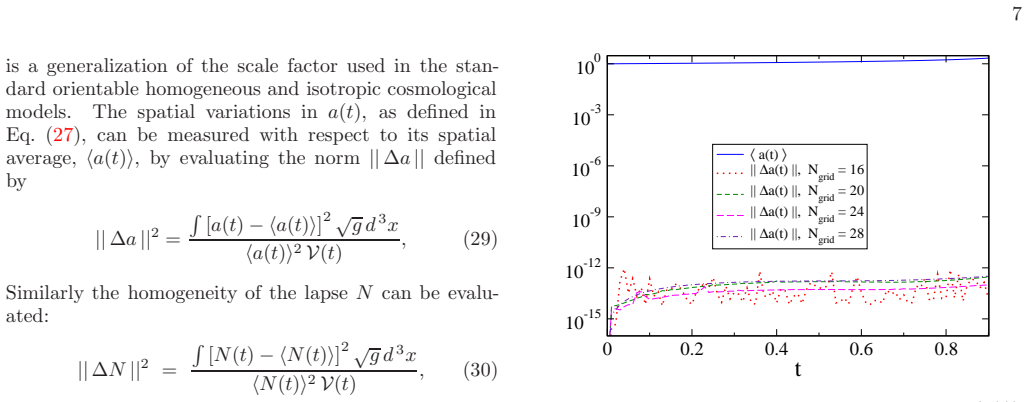
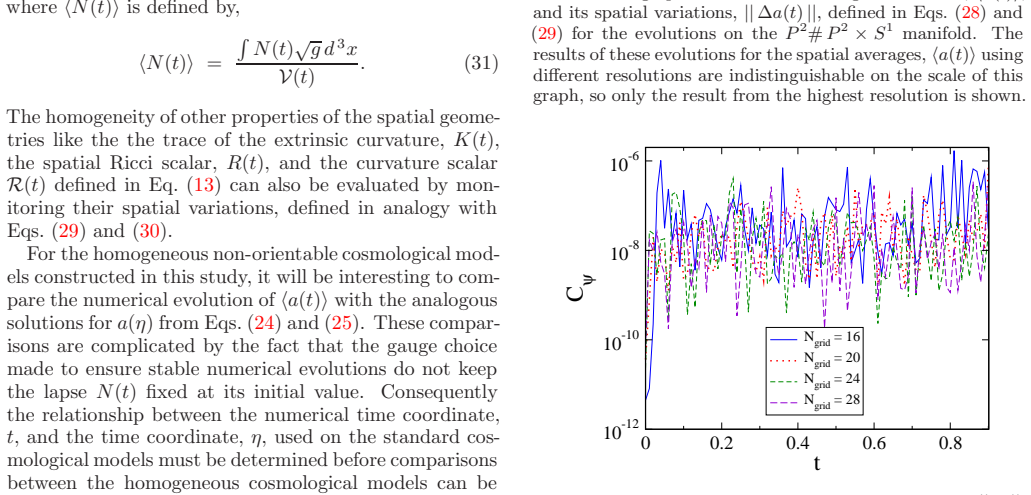
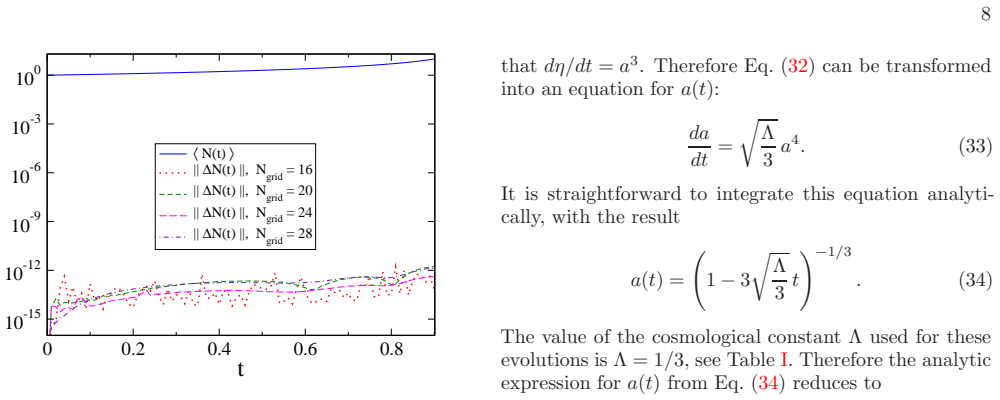
and ( 30). end. This implies that the time coordinate t used in the numerical evolutions is not the same as the time co- ordinate η used in the standard representations of the homogeneous cosmological models. Empirically we find that ⟨N ⟩ ≈ ⟨ a⟩3 for the evolutions on the P 2#P 2 × S1 manifold, as demonstrated in Fig. 8 for the Ngrid = 28 evolution. 0 0.2 ...
-
[6]
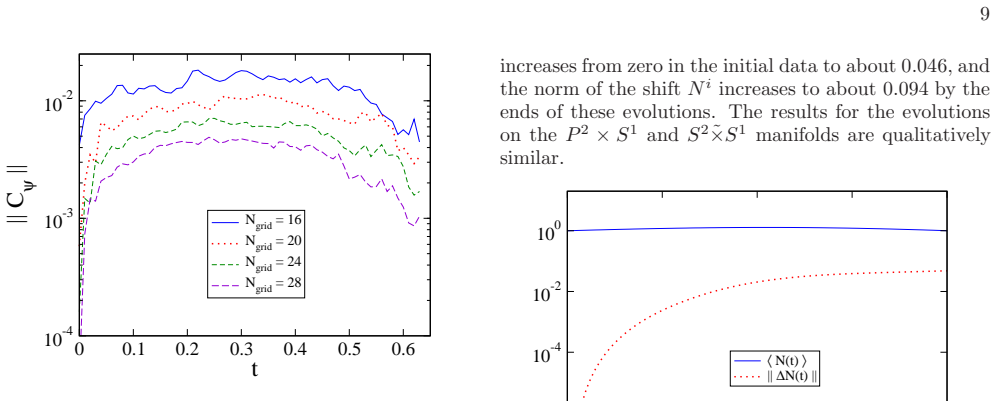
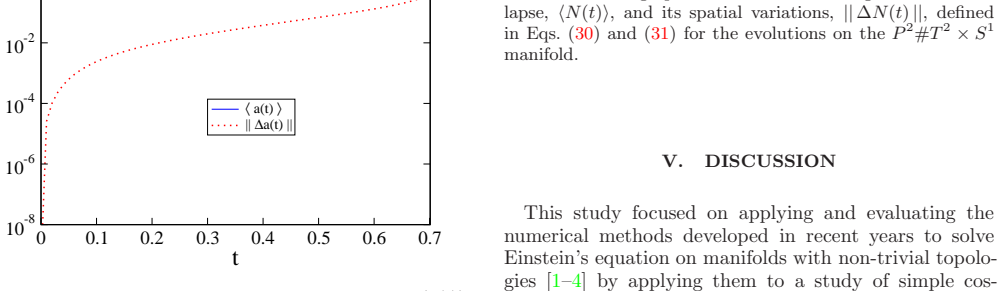
and ( 31) for the evolutions on the P 2#T 2 × S1 manifold. V. DISCUSSION This study focused on applying and evaluating the numerical methods developed in recent years to solve Einstein’s equation on manifolds with non-trivial topolo- gies [ 1–4] by applying them to a study of simple cos- mological models on manifolds with non-orientable spa- tial slices. ...
- [7]
- [8]
- [9]
- [10]
-
[11]
Geroch, Journal of Mathematical Physics 9, 1739 (1968)
R. Geroch, Journal of Mathematical Physics 9, 1739 (1968)
work page 1968
-
[12]
Geroch, Journal of Mathematical Physics 11, 343 (1970)
R. Geroch, Journal of Mathematical Physics 11, 343 (1970)
work page 1970
- [13]
-
[14]
Sadourny, Monthly Weather Review 100, 136 (1972)
R. Sadourny, Monthly Weather Review 100, 136 (1972)
work page 1972
- [15]
- [16]
- [17]
- [18]
-
[19]
H.P. Pfeiffer, L.E. Kidder, M.A. Scheel, S.A. Teukolsky , Comput. Phys. Commun. 152, 253 (2003)
work page 2003
-
[20]
S. Balay, S. Abhyankar, M.F. Adams, S. Benson, J. Brown, P. Brune, K. Buschelman, E. Constantinescu, L. Dalcin, A. Dener, V. Eijkhout, W.D. Gropp, V. Hapla, T. Isaac, P. Jolivet, D. Karpeev, D. Kaushik, M.G. Kne- pley, F. Kong, S. Kruger, D.A. May, L.C. McInnes, R.T. Mills, L. Mitchell, T. Munson, J.E. Roman, K. Rupp, P. Sanan, J. Sarich, B.F. Smith, S. Z...
work page 2021
-
[21]
R. Arnowett, S. Deser, C.W. Misner, in Gravitational: An Introduction to Current Research , ed. by L. Witten (Wily, New York, 1962), pp. 227–265
work page 1962
-
[22]
B. Chow, D. Knopf, The Ricci Flow: An Introduc- tion, Mathematical Surveys and Monographs , vol. 110 (Amer. Math. Soc., 2004)
work page 2004
discussion (0)
Sign in with ORCID, Apple, or X to comment. Anyone can read and Pith papers without signing in.