Enhanced Atom Capture via Multi-Frequency Magneto-Optical Trapping
Pith reviewed 2026-05-08 06:52 UTC · model grok-4.3
The pith
Multiple closely spaced frequencies in the cooling laser of a rubidium magneto-optical trap double the steady-state atom number and increase the loading rate by up to a factor of four.
A machine-rendered reading of the paper's core claim, the machinery that carries it, and where it could break.
Core claim
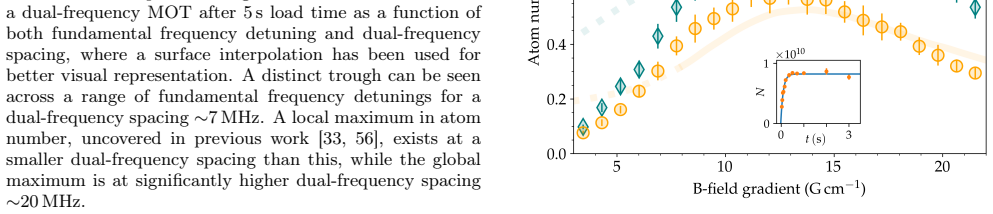
Employing multiple, closely spaced optical frequency components in the cooling light of a 87Rb magneto-optical trap—without utilizing any additional slowing techniques—can double the steady state atom number and increase the loading rate by up to a factor of 4 compared to a conventional single-frequency implementation, allowing capture of up to 1.0(1)×10^10 atoms with a loading rate of up to 1.3(2)×10^11 atoms s^{-1} from a thermal background. Numerical simulations reproduce the observed trends and predict substantially larger gains for increased trap sizes beyond the experimental bounds.
What carries the argument
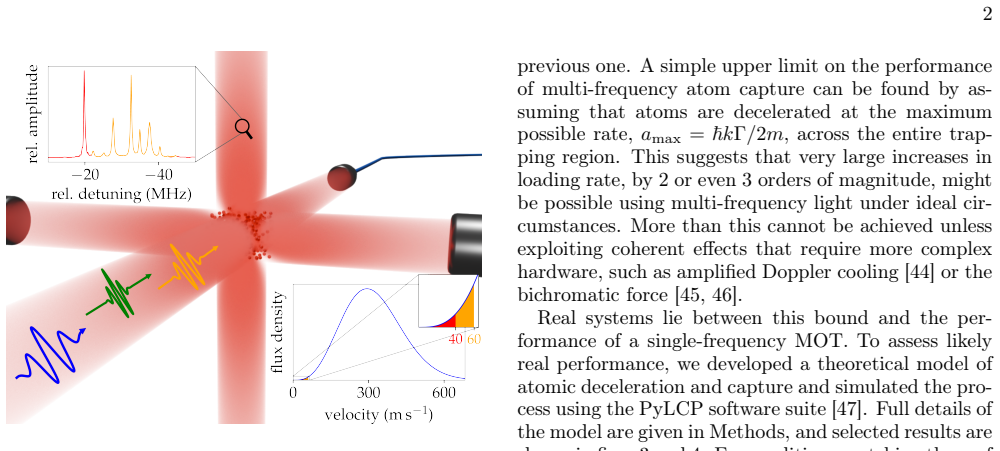
Multi-frequency spectrum added to the MOT cooling light, which broadens the velocity capture range while preserving trap depth and minimizing heating or loss.
If this is right
- Atom numbers and loading rates sufficient for higher-bandwidth portable quantum sensors can be reached without enlarging the apparatus or adding slowing stages.
- Atom-interferometric tests of fundamental physics gain access to larger-mass quantum systems in the same compact footprint.
- Earlier limitations reported for multi-frequency cooling are avoided with present-day laser and electronics hardware.
- Numerical models indicate that further scaling of trap size will yield proportionally larger gains in atom flux.
Where Pith is reading between the lines
- The same multi-frequency approach could be adapted to other atomic species or to molecular MOTs if the frequency comb is retuned to their hyperfine structure.
- Portable devices might eliminate separate slowing stages entirely, reducing size, weight, and power draw for field-deployed sensors.
- Higher steady-state numbers could improve signal-to-noise in precision measurements by increasing the number of atoms interrogated per cycle.
Load-bearing premise
The chosen set of frequencies and intensities produces no net heating, reduced trap depth, or new velocity-dependent loss channels that would cancel the capture improvement, and the numerical model remains accurate when scaled to larger trap volumes.
What would settle it
Measuring a lower or unchanged atom number when the multi-frequency spectrum is turned on at fixed total laser power, or finding that the numerical model over-predicts atom number once the trap size is increased.
Figures



read the original abstract
Magneto-optical traps are central to atomic and molecular quantum technologies and precision tests of fundamental physics, where both sensitivity and bandwidth scale strongly with atom number and loading rate. We demonstrate that employing multiple, closely spaced optical frequency components in the cooling light of a $^{87}$Rb magneto-optical trap -- without utilizing any additional slowing techniques -- can double the steady state atom number and increase the loading rate by up to a factor of 4, compared to a conventional single-frequency implementation. Subsequently, we capture up to $1.0(1)\times10^{10}$ atoms with a loading rate of up to $1.3(2)\times 10^{11}\,\mathrm{atoms\,s^{-1}}$ from a thermal background. Numerical simulations reproduce the observed trends and predict substantially larger gains for increased trap sizes beyond our experimental bounds. By re-examining earlier studies of multi-frequency atom capture in the context of modern experimental hardware and emerging applications, we show that previously identified limitations can be avoided and establish multi-frequency cooling as a practical and scalable route to high-flux cold-atom sources. These results have immediate applications in portable atom-based quantum sensing, where higher bandwidth and precision can be achieved without forgoing compactness, and in atom-interferometric tests of fundamental physics, which benefit from access to larger-mass quantum systems.
Editorial analysis
A structured set of objections, weighed in public.
Referee Report
Summary. The paper demonstrates that employing multiple closely spaced optical frequency components in the cooling light of a 87Rb magneto-optical trap can double the steady-state atom number and increase the loading rate by up to a factor of 4 compared to a conventional single-frequency implementation, without additional slowing techniques. The authors report capturing up to 1.0(1)×10^10 atoms with a loading rate of up to 1.3(2)×10^11 atoms s^{-1} from a thermal background. Numerical simulations reproduce the observed trends and predict substantially larger gains for increased trap sizes. The work re-examines earlier multi-frequency studies to argue that previously identified limitations can be avoided with modern hardware.
Significance. If the central experimental claims hold, this offers a practical, hardware-minimal route to higher-flux cold-atom sources with immediate relevance to portable quantum sensors and atom-interferometric tests of fundamental physics. Strengths include direct experimental comparison under matched total power and geometry, quantitative gains with error bars, consistency checks on temperature and lifetime, and simulations that match the measured loading curves rather than being tuned post hoc.
minor comments (3)
- Abstract: the specific frequency spacing, number of components, and relative intensities are not summarized; adding one sentence would improve reproducibility context.
- Figure captions (e.g., loading-rate and steady-state plots): explicitly state that total laser power and beam geometry are identical for single- versus multi-frequency data to make the comparison unambiguous.
- Discussion section: the re-examination of prior multi-frequency work would benefit from a short table contrasting the present parameters with those earlier studies.
Simulated Author's Rebuttal
We thank the referee for their positive review and recommendation to accept the manuscript. We appreciate the recognition of the experimental gains, simulation consistency, and relevance to portable quantum sensors and atom interferometry.
Circularity Check
No significant circularity detected
full rationale
The paper's core results derive from direct experimental comparisons of single- versus multi-frequency MOT performance under matched total power and geometry, with loading curves and steady-state numbers measured independently. Numerical simulations reproduce the observed trends without re-fitting parameters to the central claim or redefining inputs as predictions. Extrapolations to larger trap sizes are presented as model-based forecasts rather than load-bearing derivations. No self-definitional equations, fitted-input predictions, or load-bearing self-citations appear in the derivation chain; the work is self-contained against external benchmarks.
Axiom & Free-Parameter Ledger
free parameters (2)
- frequency spacing and number of components
- relative laser intensities and detunings
axioms (2)
- domain assumption The total scattering force is the incoherent sum of contributions from each frequency component acting on different velocity classes.
- ad hoc to paper No significant optical pumping or heating arises from the simultaneous presence of multiple frequencies inside the trap volume.
Reference graph
Works this paper leans on
-
[1]
Beam truncation Varying the beam size within a MOT modifies both the available capture volume and the intensity profile experiencedbytheatoms. However, changingthebeam size by adjusting the beam waist is experimentally cum- bersome, requiring significant and repeated modifica- tion of the optical setup. Such an approach is therefore impractical for system...
-
[2]
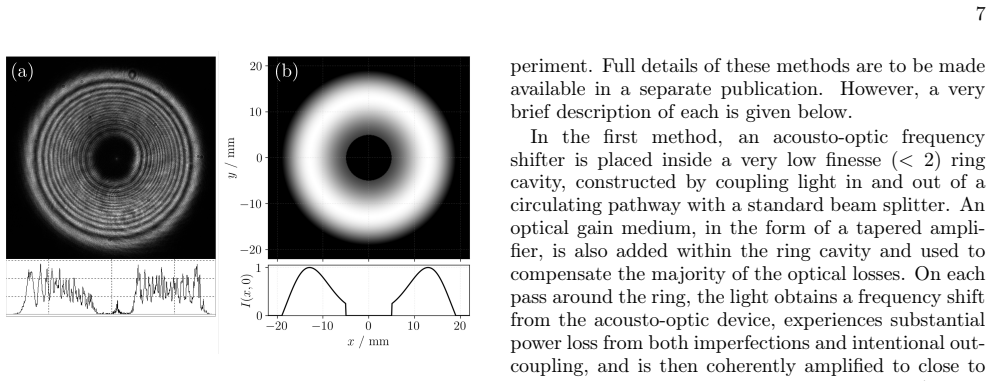
Cooler ‘ring’ beam production A pair of axicon lenses is used to transform an ini- tially Gaussian input beam into a hollow, ring-shaped intensity distribution, which we see in our experiment (see fig. 6). The formation of the ring beam can be understood geometrically in terms of ray optics. Each point on the input beam is mapped to a corresponding propag...
-
[3]
has been applied uniformly to the magnetic field gradient in all simulations. To model the steady-state atom number, we obtain an empirical characteristic load timeτfrom a fit of eq. (1) to experimental data under the simulated condi- tions or, where they extend beyond the range of our experimental parameters, under the closest available experimental cond...
-
[4]
E. Raab, M. Prentiss, A. Cable, S. Chu, and D. E. Pritchard, Trapping of neutral sodium atoms with ra- diation pressure, Phys. Rev. Lett.59, 2631 (1987)
work page 1987
-
[5]
Georgescu, 25 years of BEC, Nature Reviews Physics 2, 396 (2020)
I. Georgescu, 25 years of BEC, Nature Reviews Physics 2, 396 (2020)
work page 2020
-
[6]
Törmä, Physics of ultracold fermi gases revealed by spectroscopies, Physica Scripta91, 043006 (2016)
P. Törmä, Physics of ultracold fermi gases revealed by spectroscopies, Physica Scripta91, 043006 (2016)
work page 2016
-
[7]
V. Menoret, P. Vermeulen, N. Le Moigne, S. Bonva- lot, P. Bouyer, A. Landragin, and B. Desruelle, Gravity measurements below 10−9 g with a transportable abso- lute quantum gravimeter, Sci. Rep.8, 12300 (2018)
work page 2018
-
[8]
C. Cassens, B. Meyer-Hoppe, E. Rasel, and C. Klempt, Entanglement-enhanced atomic gravimeter, Phys. Rev. X15, 011029 (2025)
work page 2025
-
[9]
B. Tennstedt, N. Weddig, and S. Schön, Improved in- ertial navigation with cold atom interferometry, Gy- roscopy and Navigation12, 294 (2021)
work page 2021
-
[10]
Z.-X. Meng, P.-Q. Yan, S.-Z. Wang, X.-J. Li, H.- B. Xue, and Y.-Y. Feng, Closed-loop dual-atom- interferometer inertial sensor with continuous cold atomic beams, Phys. Rev. Appl.21, 034050 (2024)
work page 2024
-
[11]
A. Fregosi, C. Gabbanini, S. Gozzini, L. Lenci, C. Marinelli, and A. Fioretti, Magnetic induction imag- ing with a cold-atom radio frequency magnetometer, Appl. Phys. Lett.117, 144102 (2020)
work page 2020
-
[12]
Z. Ma, C. Han, Z. Tan, H. He, S. Shi, X. Kang, J. Wu, J. Huang, B. Lu, and C. Lee, Adaptive cold-atom mag- netometry mitigating the trade-off between sensitiv- ity and dynamic range, Science Advances11, eadt3938 (2025)
work page 2025
-
[13]
T. Kobayashi, D. Akamatsu, K. Hosaka, Y. Hisai, A. Nishiyama, A. Kawasaki, M. Wada, H. Inaba, T. Tanabe, T. Suzuyama, F.-L. Hong, and M. Yasuda, Generation of a precise time scale assisted by a near- continuously operating optical lattice clock, Phys. Rev. Appl.21, 064015 (2024)
work page 2024
-
[14]
A. Chu, V. J. Martínez-Lahuerta, M. Miklos, K. Kim, P. Zoller, K. Hammerer, J. Ye, and A. M. Rey, Ex- ploring the dynamical interplay between mass-energy equivalence, interactions, and entanglement in an opti- cal lattice clock, Phys. Rev. Lett.134, 093201 (2025)
work page 2025
-
[15]
M. D’Arcangelo, L.-P. Henry, L. Henriet, D. Loco, N. Gouraud, S. Angebault, J. Sueiro, J. Forêt, P. Mon- marché, and J.-P. Piquemal, Leveraging analog quan- tum computing with neutral atoms for solvent configu- ration prediction in drug discovery, Phys. Rev. Res.6, 043020 (2024)
work page 2024
-
[16]
L.-M. Steinert, P. Osterholz, R. Eberhard, L. Festa, N. Lorenz, Z. Chen, A. Trautmann, and C. Gross, Spa- tially tunable spin interactions in neutral atom arrays, Phys. Rev. Lett.130, 243001 (2023)
work page 2023
- [17]
-
[18]
L. Badurina, E. Bentine, D. Blas, K. Bongs, D. Borto- letto, T. Bowcock, K. Bridges, W. Bowden, O. Buch- mueller, C. Burrage,et al., AION: an atom interferom- eter observatory and network, J. Cosmol. Astropart. Phys.2020, 011 (2020)
work page 2020
-
[19]
Q. Beaufils, L. A. Sidorenkov, P. Lebegue, B. Venon, D. Holleville, L. Volodimer, M. Lours, J. Junca, X. Zou, A. Bertoldi, M. Prevedelli, D. O. Sabulsky, P. Bouyer, 10 A. Landragin, B. Canuel, and R. Geiger, Cold-atom sources for the matter-wave laser interferometric grav- itation antenna (miga), Scientific Reports12, 19000 (2022)
work page 2022
-
[20]
S. Baum, Z. Bogorad, and P. W. Graham, Gravita- tional wave measurement in the mid-band with atom interferometers, Journal of Cosmology and Astroparti- cle Physics2024(05), 027
-
[21]
L. Badurina, O. Buchmueller, J. Ellis, M. Lewicki, C. McCabe, and V. Vaskonen, Prospective sensitivi- ties of atom interferometers to gravitational waves and ultralight dark matter, Philosophical Transactions of the Royal Society A: Mathematical, Physical and En- gineering Sciences380, 20210060 (2022)
work page 2022
-
[22]
P. Asenbaum, C. Overstreet, M. Kim, J. Curti, and M. A. Kasevich, Atom-interferometric test of the equiv- alence principle at the10 −12 level, Phys. Rev. Lett. 125, 191101 (2020)
work page 2020
-
[23]
M. He, X. Chen, J. Fang, Q. Chen, H. Sun, Y. Wang, J. Zhong, L. Zhou, C. He, J. Li, D. Zhang, G. Ge, W. Wang, Y. Zhou, X. Li, X. Zhang, L. Qin, Z. Chen, R. Xu, Y. Wang, Z. Xiong, J. Jiang, Z. Cai, K. Li, G. Zheng, W. Peng, J. Wang, and M. Zhan, The space cold atom interferometer for testing the equivalence principle in the China space station, npj Microgr...
work page 2023
-
[24]
N. Sherrill, A. O. Parsons, C. F. A. Baynham, W. Bow- den, E. Anne Curtis, R. Hendricks, I. R. Hill, R. Hob- son, H. S. Margolis, B. I. Robertson, M. Schioppo, K. Szymaniec, A. Tofful, J. Tunesi, R. M. Godun, and X. Calmet, Analysis of atomic-clock data to constrain variations of fundamental constants, New Journal of Physics25, 093012 (2023)
work page 2023
-
[25]
S. Kanthak, J. Pahl, D. Reiche, and M. Krutzik, Pro- posal for a bose–einstein condensate based test of born’s rule using light–pulse atom interferometry, Ad- vanced Quantum Technologies8, 2400436 (2025)
work page 2025
-
[26]
B. Schrinski, P. Haslinger, J. Schmiedmayer, K. Horn- berger, and S. Nimmrichter, Testing collapse mod- els with bose-einstein-condensate interferometry, Phys. Rev. A107, 043320 (2023)
work page 2023
-
[27]
G. M. Tino, Testing gravity with cold atom interfer- ometry: results and prospects, Quantum Science and Technology6, 024014 (2021)
work page 2021
- [28]
-
[29]
O. Buchmueller, J. Ellis, and U. Schneider, Large-scale atom interferometry for fundamen- tal physics, Contemporary Physics64, 93 (2023), https://doi.org/10.1080/00107514.2023.2239008
-
[30]
C. J. Baker, W. Bertsche, A. Capra, C. Carruth, C. L. Cesar, M. Charlton, A. Christensen, R. Collis- ter, A. C. Mathad, S. Eriksson, A. Evans, N. Evetts, J. Fajans, T. Friesen, M. C. Fujiwara, D. R. Gill, P. Grandemange, P. Granum, J. S. Hangst, W. N. Hardy, M. E. Hayden, D. Hodgkinson, E. Hunter, C. A. Isaac, M. A. Johnson, J. M. Jones, S. A. Jones, S. J...
work page 2021
-
[31]
K. Shu, Y. Tajima, R. Uozumi, N. Miyamoto, S. Shi- raishi, T. Kobayashi, A. Ishida, K. Yamada, R. W. Gladen, T. Namba, S. Asai, K. Wada, I. Mochizuki, T. Hyodo, K. Ito, K. Michishio, B. E. O’Rourke, N. Os- hima, and K. Yoshioka, Cooling positronium to ul- tralow velocities with a chirped laser pulse train, Na- ture633, 793 (2024)
work page 2024
-
[32]
L. T. Glöggler, N. Gusakova, B. Rienäcker, A. Camper, R. Caravita, S. Huck, M. Volponi, T. Wolz, L. Pe- nasa, V. Krumins, F. P. Gustafsson, D. Comparat, M. Auzins, B. Bergmann, P. Burian, R. S. Brusa, F. Castelli, G. Cerchiari, R. Ciuryło, G. Consolati, M. Doser, L. Graczykowski, M. Grosbart, F. Guatieri, S. Haider, M. A. Janik, G. Kasprowicz, G. Kha- tri...
work page 2024
- [33]
-
[34]
N. B. Vilas, C. Hallas, L. Anderegg, P. Robichaud, A. Winnicki, D. Mitra, and J. M. Doyle, Magneto- optical trapping and sub-doppler cooling of a poly- atomic molecule, Nature606, 70 (2022)
work page 2022
-
[36]
C.Qiang, L.Xin-Yu, G.Kui-Yi, W.Xiao-Rui, C.Dong- Min, and W. Ru-Quan, Improved atom number with a dual color magneto—optical trap, Chinese Physics B 21, 043203 (2012)
work page 2012
-
[37]
B. P. Anderson and M. A. Kasevich, Enhanced loading of a magneto-optic trap from an atomic beam, Phys. Rev. A50, R3581 (1994)
work page 1994
-
[38]
K. Li, D. Zhang, T. Gao, S.-G. Peng, and K. Jiang, Enhanced trapping of cold6Liusing multiple-sideband cooling in a two-dimensional magneto-optical trap, Phys. Rev. A92, 013419 (2015)
work page 2015
-
[39]
J. H. Lee and J. Mun, Optimized atomic flux from a frequency-modulated two-dimensional magneto-optical trap for cold fermionic potassium atoms, J. Opt. Soc. Am. B34, 1415 (2017)
work page 2017
-
[40]
K. E. Gibble, S. Kasapi, and S. Chu, Improved magneto-optic trapping in a vapor cell, Opt. Lett.17, 526 (1992)
work page 1992
-
[41]
K. Lindquist, M. Stephens, and C. Wieman, Experi- mental and theoretical study of the vapor-cell zeeman optical trap, Phys. Rev. A46, 4082 (1992)
work page 1992
-
[42]
A. S. Parkins and P. Zoller,σ+-σ− laser-cooling config- uration with broadband laser fields: Instability at zero velocity, Phys. Rev. A45, R6161 (1992)
work page 1992
- [43]
- [44]
-
[45]
S. E. Park, H. S. Lee, E. joo Shin, T. Y. Kwon, S. H. Yang, and H. Cho, Generation of a slow and continuous cesium atomic beam for an atomic clock, J. Opt. Soc. Am. B19, 2595 (2002)
work page 2002
-
[46]
S. F. Cooper, C. Rasor, R. G. Bullis, A. D. Brandt, and D. C. Yost, Optical deceleration of atomic hydrogen, New Journal of Physics25, 093038 (2023)
work page 2023
-
[47]
T. Freegarde, G. Daniell, and D. Segal, Coherent am- plification in laser cooling and trapping, Phys. Rev. A 73, 033409 (2006)
work page 2006
-
[48]
X. Hua, C. Corder, and H. Metcalf, Simulation of laser cooling by the bichromatic force, Phys. Rev. A93, 063410 (2016)
work page 2016
-
[49]
R. Y. Ilenkov, O. N. Prudnikov, A. A. Kirpichnikova, A. V. Taichenachev, and V. I. Yudin, Laser cooling of lithium-6 atoms in a bichromatic light field, Journal of Experimental and Theoretical Physics137, 229 (2023)
work page 2023
- [50]
-
[51]
A.Paris-Mandoki, M.D.Jones, J.Nute, J.Wu, S.War- riar, and L. Hackermüller, Versatile cold atom source for multi-species experiments, Review of Scientific In- struments85, 113103 (2014)
work page 2014
-
[52]
C. Chen, K. Liu, D. Deng, S. Ma, P. Zhu, Z. He, J. Chen, X. Wu, and P. Chen, Compact dual-beam zee- man slower for high-flux cold atoms, Phys. Rev. Appl. 24, 054071 (2025)
work page 2025
-
[53]
S. Chaudhuri, S. Roy, and C. S. Unnikrishnan, Real- ization of an intense cold rb atomic beam based on a two-dimensional magneto-optical trap: Experiments and comparison with simulations, Phys. Rev. A74, 023406 (2006)
work page 2006
- [54]
-
[55]
Walraven, High-flux two-dimensional magneto-optical- trap source for cold lithium atoms, Phys
T.G.Tiecke, S.D.Gensemer, A.Ludewig,andJ.T.M. Walraven, High-flux two-dimensional magneto-optical- trap source for cold lithium atoms, Phys. Rev. A80, 013409 (2009)
work page 2009
-
[56]
A. Gallagher and D. E. Pritchard, Exoergic collisions of cold Na∗-Na, Phys. Rev. Lett.63, 957 (1989)
work page 1989
-
[57]
D. Hoffmann, P. Feng, and T. Walker, Measurements of rb trap-loss collision spectra, Journal of the Optical Society of America B11, 712 (1994)
work page 1994
-
[58]
A. G. Sinclair, E. Riis, and M. J. Snadden, Improved trapping in a vapor-cell magneto-optical trap with mul- tiple laser frequencies, J. Opt. Soc. Am. B11, 2333 (1994)
work page 1994
-
[59]
James,Tools and fundamental techniques for Bose- Einstein condensate microscopy, Ph.D
T. James,Tools and fundamental techniques for Bose- Einstein condensate microscopy, Ph.D. thesis, Univer- sity of Sussex (2020)
work page 2020
-
[60]
M. Zhu, C. W. Oates, and J. L. Hall, Continuous high- flux monovelocity atomic beam based on a broadband laser-cooling technique, Phys. Rev. Lett.67, 46 (1991)
work page 1991
-
[61]
J. E. O. Buchmueller and U. Schneider, Large-scale atom interferometry for fundamental physics, Contem- porary Physics64, 93 (2023)
work page 2023
-
[62]
A. Bassi, L. Cacciapuoti, S. Capozziello, S. Dell’Agnello, E. Diamanti, D. Giulini, L. Iess, P. Jetzer, S. K. Joshi, A. Landragin, C. L. Poncin- Lafitte, E. Rasel, A. Roura, C. Salomon, and H. Ulbricht, A way forward for fundamental physics in space, npj Microgravity8, 49 (2022)
work page 2022
-
[63]
P. Cheinet, B. Canuel, F. Pereira Dos Santos, A. Gau- guet, F. Yver-Leduc, and A. Landragin, Measurement of the sensitivity function in a time-domain atomic in- terferometer, IEEE Transactions on Instrumentation and Measurement57, 1141 (2008)
work page 2008
-
[64]
H. Xue, Y. Feng, S. Chen, X. Wang, X. Yan, Z. Jiang, and Z. Zhou, A continuous cold atomic beam interfer- ometer, Journal of Applied Physics117, 094901 (2015)
work page 2015
-
[65]
I. Dutta, D. Savoie, B. Fang, B. Venon, C. Gar- rido Alzar, R. Geiger, and A. Landragin, Continu- ous cold-atom inertial sensor with 1 nrad/sec rotation stability, Physical Review Letters116, 10.1103/phys- revlett.116.183003 (2016)
- [66]
-
[67]
H. J. McGuinness, A. V. Rakholia, and G. W. Bieder- mann, High data-rate atom interferometer for measur- ing acceleration, Applied Physics Letters100, 011106 (2012)
work page 2012
-
[68]
Y. Chew, T. Tomita, T. P. Mahesh, S. Sugawa, S. de Léséleuc, and K. Ohmori, Ultrafast energy ex- change between two single rydberg atoms on a nanosec- ond timescale, Nat. Photonics16, 724 (2022)
work page 2022
- [69]
-
[70]
N. Cooper and T. Freegarde, Trapping of85Rb atoms by optical pumping between metastable hyperfine states, J. Phys. B46, 215003 (2013)
work page 2013
-
[71]
W. Muessel, H. Strobel, D. Linnemann, D. B. Hume, and M. K. Oberthaler, Scalable spin squeezing for quantum-enhanced magnetometry with bose-einstein condensates, Phys. Rev. Lett.113, 103004 (2014)
work page 2014
-
[72]
J. M. Robinson, M. Miklos, Y. M. Tso, C. J. Kennedy, T. Bothwell, D. Kedar, J. K. Thompson, and J. Ye, Direct comparison of two spin-squeezed optical clock ensembles at the 10-17 level, Nature Physics20, 208 (2024)
work page 2024
- [73]
-
[74]
J. Oppenheim, C. Sparaciari, B. Šoda, and Z. Weller- Davies, Gravitationally induced decoherence vs space- time diffusion: testing the quantum nature of gravity, Nature Communications14, 7910 (2023)
work page 2023
-
[75]
R. Howl, V. Vedral, D. Naik, M. Christodoulou, C. Rovelli, and A. Iyer, Non-gaussianity as a signa- ture of a quantum theory of gravity, PRX Quantum2, 010325 (2021)
work page 2021
-
[76]
G. C. Ghirardi, P. Pearle, and A. Rimini, Markov pro- cesses in hilbert space and continuous spontaneous lo- calization of systems of identical particles, Physical Re- view A42, 78 (1990)
work page 1990
-
[77]
P. T. Starkley, A software framework for con- trol and automation of precisely timed experiments 10.26180/8637200.v1 (2019)
-
[78]
C. J. Billington, State-dependent forces in cold quan- tum gases 10.26180/5bd68acaf0696 (2019). 12
-
[79]
P. T. Starkey, C. J. Billington, S. P. Johnstone, M. Jasperse, K. Helmerson, L. D. Turner, and R. P. Anderson, A scripted control system for autonomous hardware-timed experiments, Review of Scientific In- struments84, 085111 (2013)
work page 2013
-
[80]
Reif,Fundamentals of Statistical and Thermal Physics(McGraw-Hill, New York, 1965)
F. Reif,Fundamentals of Statistical and Thermal Physics(McGraw-Hill, New York, 1965)
work page 1965
-
[81]
A. M. Steane, M. Chowdhury, and C. J. Foot, Radia- tion force in the magneto-optical trap, Journal of the Optical Society of America B Optical Physics9, 2142 (1992)
work page 1992
discussion (0)
Sign in with ORCID, Apple, or X to comment. Anyone can read and Pith papers without signing in.