Phase diagram of a dual-species Rydberg atom ladder
Pith reviewed 2026-05-07 17:02 UTC · model grok-4.3
The pith
Dual-species Rydberg atom ladders host a smooth crossover between distinct Z2-ordered regimes and a multi-critical point where Ising, chiral, and first-order lines meet.
A machine-rendered reading of the paper's core claim, the machinery that carries it, and where it could break.
Core claim
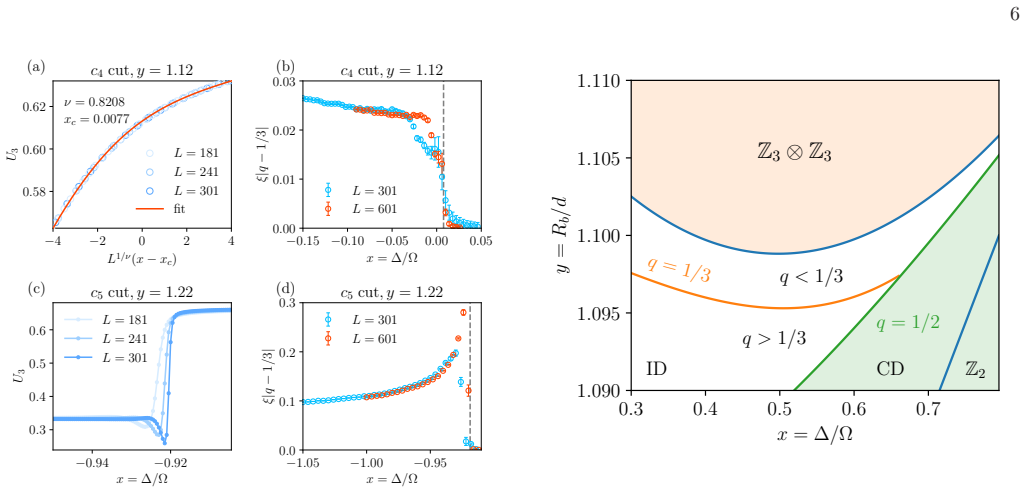
In the dual-species Rydberg atom ladder, the ground state exhibits a smooth crossover between distinct Z2-ordered regimes that reflects a reorganization of low-energy degrees of freedom rather than a true phase transition, a feature absent in single-species Rydberg arrays. Large-scale DMRG calculations further reveal a multi-critical point at the boundary between the Z2 ⊗ Z2 and Z3 ⊗ Z3 ordered phases, where Ising, chiral, and first-order transition lines intersect. The phase diagram also includes disordered phases, ordered phases with Z3 and Z4 symmetry, and floating phases with incommensurate wave vectors and algebraically decaying correlations.
What carries the argument
The dual-species Rydberg atom ladder Hamiltonian, whose competing interaction scales and enhanced quantum fluctuations enable the crossover and multi-critical behavior.
Load-bearing premise
The numerical DMRG results with the used bond dimensions and finite system sizes faithfully capture the infinite-system behavior, including the smooth nature of the crossover and the precise location of the multi-critical point.
What would settle it
Numerical calculations on much larger systems or with significantly higher bond dimensions showing a sharp discontinuity or first-order jump instead of a smooth crossover in the Z2 regime, or experimental measurements in a physical dual-species array failing to show the predicted intersection of transition lines.
Figures




read the original abstract
Dual-species Rydberg atom arrays extend single-species platforms by introducing competing interaction scales and enhanced quantum fluctuations, enabling phenomena beyond homogeneous settings. In this work, we study the ground-state phase diagram of a one-dimensional dual-species Rydberg atom ladder using large-scale density-matrix renormalization group calculations. We identify disordered phases, multiple ordered phases with $\mathbb{Z}_2$, $\mathbb{Z}_3$, and $\mathbb{Z}_4$ symmetry, as well as floating phases characterized by incommensurate wave vectors and algebraically decaying correlations. Importantly, we observe a smooth crossover between distinct $\mathbb{Z}_2$-ordered regimes, reflecting a reorganization of low-energy degrees of freedom rather than a true phase transition, which is absent in single-species Rydberg arrays. We further uncover a multi-critical point at the boundary between the $\mathbb{Z}_2 \otimes \mathbb{Z}_2$ and $\mathbb{Z}_3 \otimes \mathbb{Z}_3$ ordered phases, where Ising, chiral, and first-order transition lines intersect. Our results demonstrate that dual-species Rydberg atom arrays provide a unique platform for realizing crossover physics and multi-critical behavior inaccessible in single-species architectures.
Editorial analysis
A structured set of objections, weighed in public.
Referee Report
Summary. The manuscript presents a numerical study of the ground-state phase diagram for a one-dimensional dual-species Rydberg atom ladder using large-scale DMRG calculations. It identifies disordered phases, ordered phases with Z2, Z3, and Z4 symmetries, and floating phases with incommensurate wave vectors and algebraically decaying correlations. Central results include a smooth crossover between distinct Z2-ordered regimes (explicitly not a phase transition) and a multi-critical point at the Z2⊗Z2 / Z3⊗Z3 boundary where Ising, chiral, and first-order transition lines intersect.
Significance. If the DMRG identifications are robust, the work is significant for showing how dual-species Rydberg ladders realize crossover physics and multi-critical behavior absent in single-species arrays, due to competing interactions and enhanced fluctuations. This provides a platform for studying low-energy degree-of-freedom reorganization and intersecting transition lines. The choice of large-scale DMRG is a strength, as it is a standard and appropriate method for 1D quantum lattice models.
major comments (2)
- [Abstract] Abstract: The claims of 'a smooth crossover between distinct Z2-ordered regimes... rather than a true phase transition' and 'a multi-critical point... where Ising, chiral, and first-order transition lines intersect' are load-bearing for the paper's novelty. However, the abstract (and by extension the supporting results) provides no details on bond dimensions, system sizes, convergence criteria, or error estimates, leaving the support for distinguishing a crossover from a weak transition or locating the intersection point difficult to assess.
- [Results section on ordered phases and multi-critical point] Results on Z2 and Z2⊗Z2 / Z3⊗Z3 phases: Distinguishing a smooth crossover from a weak first-order transition and accurately locating the multi-critical point requires that correlation lengths, order-parameter derivatives, and wave-vector incommensurability are free of truncation artifacts and finite-size rounding. No bond-dimension extrapolation, finite-size scaling, or explicit convergence checks at these points are reported, which could shift the intersection by O(1) in parameter space or misclassify the crossover.
minor comments (2)
- [Figure captions] Figure captions for the phase diagram could explicitly note the numerical criteria used to identify floating phases versus ordered phases.
- [Introduction] The notation Z2 ⊗ Z2 and Z3 ⊗ Z3 is clear but could be briefly defined in the text upon first use for readers less familiar with tensor-product symmetry labels.
Simulated Author's Rebuttal
We thank the referee for their positive evaluation of the significance of our work and for the constructive comments on the presentation of numerical details. We address each major comment below and will incorporate revisions to strengthen the manuscript.
read point-by-point responses
-
Referee: The abstract lacks details on bond dimensions, system sizes, convergence criteria, or error estimates, leaving the support for distinguishing a crossover from a weak transition or locating the intersection point difficult to assess.
Authors: We agree that the abstract would benefit from additional technical context to support the central claims. In the revised version we will expand the abstract to specify the largest bond dimension employed (D = 400), the maximum system sizes studied (L = 120), the truncation-error threshold (below 10^{-10}), and the procedure used to confirm convergence of correlation lengths and order parameters. These additions will allow readers to directly evaluate the robustness of the reported smooth Z2 crossover and the location of the multi-critical point. revision: yes
-
Referee: Distinguishing a smooth crossover from a weak first-order transition and accurately locating the multi-critical point requires correlation lengths, order-parameter derivatives, and wave-vector incommensurability to be free of truncation artifacts and finite-size rounding. No bond-dimension extrapolation, finite-size scaling, or explicit convergence checks at these points are reported.
Authors: We acknowledge that systematic extrapolation strengthens the identification of crossovers versus transitions. Although our DMRG runs were performed at multiple bond dimensions up to D = 400 and system sizes up to L = 120, with convergence verified by monitoring the discarded weight and comparing observables between successive D values, explicit extrapolations were not included in the original manuscript. In the revision we will add (i) bond-dimension extrapolation plots for the Z2 order parameters and correlation lengths at representative points along the crossover and near the multi-critical point, and (ii) a finite-size scaling analysis of the transition lines to confirm the intersection location and the absence of a true phase transition in the Z2 regime. These data will be presented in a new appendix. revision: yes
Circularity Check
No circularity: direct numerical DMRG phase diagram with no derivations or fitted predictions
full rationale
The manuscript reports ground-state phases and transitions obtained exclusively from large-scale DMRG simulations of the dual-species Rydberg ladder Hamiltonian. No analytical derivations, parameter fits, or self-referential predictions are present; the claims of a smooth Z2 crossover and a multi-critical point at the Z2⊗Z2 / Z3⊗Z3 boundary follow directly from the computed correlation functions, order parameters, and entanglement spectra. Because the central results are numerical outputs rather than reductions of prior fitted quantities or self-cited theorems, the derivation chain contains no self-definitional, fitted-input, or self-citation-load-bearing steps.
Axiom & Free-Parameter Ledger
axioms (1)
- domain assumption DMRG provides a reliable approximation to the ground state of one-dimensional quantum lattice models when bond dimension is sufficiently large
Reference graph
Works this paper leans on
-
[1]
L. Henriet, L. Beguin, A. Signoles, T. Lahaye, A. Browaeys, G.-O. Reymond, and C. Jurczak, Quantum computing with neutral atoms, Quantum4, 327 (2020)
work page 2020
-
[2]
A. Browaeys and T. Lahaye, Many-body physics with in- dividually controlled rydberg atoms, Nature Physics16, 132 (2020)
work page 2020
-
[3]
P.-I. Schneider and A. Saenz, Quantum computation with ultracold atoms in a driven optical lattice, Phys. Rev. A 85, 050304 (2012)
work page 2012
-
[4]
M. Martinez-Dorantes, W. Alt, J. Gallego, S. Ghosh, L. Ratschbacher, Y. V¨ olzke, and D. Meschede, Fast non- destructive parallel readout of neutral atom registers in optical potentials, Phys. Rev. Lett.119, 180503 (2017)
work page 2017
- [5]
-
[6]
A. Ga¨ etan, Y. Miroshnychenko, T. Wilk, A. Chotia, M. Viteau, D. Comparat, P. Pillet, A. Browaeys, and P. Grangier, Observation of collective excitation of two individual atoms in the rydberg blockade regime, Nature Physics5, 115–118 (2009)
work page 2009
- [7]
- [8]
- [9]
-
[10]
H. Bernien, S. Schwartz, A. Keesling, H. Levine, A. Om- ran, H. Pichler, S. Choi, A. S. Zibrov, M. Endres, M. Greiner, V. Vuleti´ c, and M. D. Lukin, Probing many- body dynamics on a 51-atom quantum simulator, Nature 551, 579–584 (2017)
work page 2017
-
[11]
M. J. O’Rourke and G. K.-L. Chan, Entanglement in the quantum phases of an unfrustrated rydberg atom array, Nature Communications14, 5397 (2023)
work page 2023
-
[12]
R. Samajdar, W. W. Ho, H. Pichler, M. D. Lukin, and S. Sachdev, Complex density wave orders and quantum phase transitions in a model of square-lattice rydberg atom arrays, Phys. Rev. Lett.124, 103601 (2020)
work page 2020
-
[13]
R. Samajdar, W. W. Ho, H. Pichler, M. D. Lukin, and S. Sachdev, Quantum phases of rydberg atoms on a kagome lattice, Proceedings of the National Academy of Sciences118, e2015785118 (2021)
work page 2021
- [14]
-
[15]
C. J. Turner, A. A. Michailidis, D. A. Abanin, M. Serbyn, and Z. Papi´ c, Weak ergodicity breaking from quantum many-body scars, Nature Physics14, 745 (2018)
work page 2018
-
[16]
W. W. Ho, S. Choi, H. Pichler, and M. D. Lukin, Pe- riodic orbits, entanglement, and quantum many-body scars in constrained models: Matrix product state ap- proach, Phys. Rev. Lett.122, 040603 (2019)
work page 2019
-
[17]
S. Choi, C. J. Turner, H. Pichler, W. W. Ho, A. A. Michailidis, Z. Papi´ c, M. Serbyn, M. D. Lukin, and D. A. Abanin, Emergent su(2) dynamics and perfect quantum many-body scars, Phys. Rev. Lett.122, 220603 (2019)
work page 2019
-
[18]
R. Verresen, M. D. Lukin, and A. Vishwanath, Prediction of toric code topological order from rydberg blockade, Phys. Rev. X11, 031005 (2021)
work page 2021
-
[19]
K. J. Satzinger, Y.-J. Liu, A. Smith, C. Knapp, M. Newman, C. Jones, Z. Chen, C. Quintana, X. Mi, A. Dunsworth, C. Gidney, I. Aleiner, F. Arute, K. Arya, J. Atalaya, R. Babbush, J. C. Bardin, R. Barends, J. Basso, A. Bengtsson, A. Bilmes, M. Broughton, B. B. Buckley, D. A. Buell, B. Burkett, N. Bushnell, B. Chiaro, R. Collins, W. Courtney, S. Demura, A. R...
work page 2021
-
[20]
M. Rader and A. M. L¨ auchli, Floating phases in one-dimensional rydberg ising chains (2019), arXiv:1908.02068 [cond-mat.quant-gas]
-
[21]
X.-J. Yu, S. Yang, J.-B. Xu, and L. Xu, Fidelity susceptibility as a diagnostic of the commensurate- incommensurate transition: A revisit of the pro- grammable rydberg chain, Phys. Rev. B106, 165124 (2022)
work page 2022
-
[22]
I. A. Maceira, N. Chepiga, and F. Mila, Conformal and chiral phase transitions in rydberg chains, Phys. Rev. Res.4, 043102 (2022)
work page 2022
-
[23]
J. Soto-Garcia and N. Chepiga, Numerical investigation of quantum phases and phase transitions in a two-leg lad- der of rydberg atoms, Phys. Rev. Res.7, 013215 (2025)
work page 2025
-
[24]
S.-A. Liao, J. Zhang, and L.-P. Yang, Phase diagram of rydberg atoms in a two-leg rectangular ladder, Phys. Rev. B111, 165154 (2025)
work page 2025
-
[25]
M. Tsitsishvili, T. Chanda, M. Votto, P. Fromholz, M. Dalmonte, and A. Nersesyan, Phase diagram of rydberg-dressed atoms on two-leg square ladders: Cou- pling supersymmetric conformal field theories on the lat- tice, Phys. Rev. B105, 155159 (2022)
work page 2022
-
[26]
P. Fromholz, M. Tsitsishvili, M. Votto, M. Dalmonte, A. Nersesyan, and T. Chanda, Phase diagram of rydberg- dressed atoms on two-leg triangular ladders, Phys. Rev. B106, 155411 (2022)
work page 2022
-
[27]
Y. Han, H. Zhang, and L. He, Exploring the finite- temperature behavior of rydberg atom arrays: A tensor network approach, Phys. Rev. B111, 235133 (2025)
work page 2025
-
[28]
C.-X. Li, S. Yang, and J.-B. Xu, Quantum phases of ryd- berg atoms on a frustrated triangular-lattice array, Opt. Lett.47, 1093 (2022)
work page 2022
-
[29]
S. Yang and J.-B. Xu, Density-wave-ordered phases of rydberg atoms on a honeycomb lattice, Phys. Rev. E106, 034121 (2022)
work page 2022
-
[30]
M. Kornjaˇ ca, R. Samajdar, T. Macr` ı, N. Gemelke, S.-T. Wang, and F. Liu, Trimer quantum spin liquid in a hon- eycomb array of rydberg atoms, Communications Physics 6, 10.1038/s42005-023-01470-z (2023)
-
[31]
M. R. Hirsbrunner, M. Kornjaˇ ca, R. Samajdar, S. Darbha, M. Hamdan, J. Balewski, E. Rrapaj, S.-T. Wang, D. Camps, F. Liu, P. L. S. Lopes, and K. Klymko, Quantum criticality and nonequilibrium dynamics on a lieb lattice of rydberg atoms (2025), arXiv:2508.05737 [cond-mat.quant-gas]
work page internal anchor Pith review arXiv 2025
- [32]
-
[33]
Y. Zeng, P. Xu, X. He, Y. Liu, M. Liu, J. Wang, D. J. Papoular, G. V. Shlyapnikov, and M. Zhan, Entangling two individual atoms of different isotopes via rydberg blockade, Phys. Rev. Lett.119, 160502 (2017)
work page 2017
- [34]
- [35]
- [36]
-
[37]
C. Li, S. Liu, H. Wang, W. Zhang, Z.-X. Li, H. Zhai, and Y. Gu, Uncovering emergent spacetime supersymmetry with rydberg atom arrays, Physical Review Letters133, 10.1103/physrevlett.133.223401 (2024)
-
[38]
Quantum cellular automata on a dual-species rydberg processor,
R. White, V. Ramesh, A. Impertro, S. Anand, F. Cesa, G. Giudici, T. Iadecola, H. Pichler, and H. Bernien, Quantum cellular automata on a dual-species rydberg processor (2026), arXiv:2601.16257 [quant-ph]
- [39]
- [40]
-
[41]
N. ˇSibali´ c, J. Pritchard, C. Adams, and K. Weatherill, Arc: An open-source library for calculating properties of alkali rydberg atoms, Computer Physics Communica- tions220, 319 (2017)
work page 2017
-
[42]
S. R. White, Density matrix formulation for quantum renormalization groups, Phys. Rev. Lett.69, 2863 (1992). 12
work page 1992
-
[43]
S. R. White, Density-matrix algorithms for quantum renormalization groups, Phys. Rev. B48, 10345 (1993)
work page 1993
-
[44]
U. Schollw¨ ock, The density-matrix renormalization group in the age of matrix product states, Annals of Physics 326, 96 (2011), january 2011 Special Issue
work page 2011
-
[45]
M. Fishman, S. R. White, and E. M. Stoudenmire, The ITensor Software Library for Tensor Network Calcula- tions, SciPost Phys. Codebases , 4 (2022)
work page 2022
-
[46]
M. Fishman, S. R. White, and E. M. Stoudenmire, Code- base release 0.3 for ITensor, SciPost Phys. Codebases , 4 (2022)
work page 2022
-
[47]
P. Calabrese and J. Cardy, Entanglement entropy and conformal field theory, Journal of Physics A: Mathemat- ical and Theoretical42, 504005 (2009)
work page 2009
-
[48]
P. Calabrese and J. Cardy, Entanglement entropy and quantum field theory, Journal of Statistical Mechanics: Theory and Experiment2004, P06002 (2004)
work page 2004
-
[49]
Binder, Critical properties from monte carlo coarse graining and renormalization, Phys
K. Binder, Critical properties from monte carlo coarse graining and renormalization, Phys. Rev. Lett.47, 693 (1981)
work page 1981
-
[50]
K. Binder, Finite size scaling analysis of ising model block distribution functions, Zeitschrift f¨ ur Physik B Condensed Matter43, 119 (1981)
work page 1981
-
[51]
D. A. Huse and M. E. Fisher, Domain walls and the melt- ing of commensurate surface phases, Phys. Rev. Lett.49, 793 (1982)
work page 1982
-
[52]
V. Zauner-Stauber, L. Vanderstraeten, M. T. Fishman, F. Verstraete, and J. Haegeman, Variational optimization algorithms for uniform matrix product states, Phys. Rev. B97, 045145 (2018)
work page 2018
-
[53]
R. Samajdar, S. Choi, H. Pichler, M. D. Lukin, and S. Sachdev, Numerical study of the chiral𭟋 3 quantum phase transition in one spatial dimension, Phys. Rev. A 98, 023614 (2018)
work page 2018
-
[54]
Giamarchi,Quantum Physics in One Dimension(Ox- ford University Press, 2003)
T. Giamarchi,Quantum Physics in One Dimension(Ox- ford University Press, 2003)
work page 2003
-
[55]
C. Karrasch and J. E. Moore, Luttinger liquid physics from the infinite-system density matrix renormalization group, Phys. Rev. B86, 155156 (2012)
work page 2012
- [56]
-
[57]
S. R. White, I. Affleck, and D. J. Scalapino, Friedel oscil- lations and charge density waves in chains and ladders, Phys. Rev. B65, 165122 (2002)
work page 2002
-
[58]
P. Fendley, K. Sengupta, and S. Sachdev, Competing density-wave orders in a one-dimensional hard-boson model, Phys. Rev. B69, 075106 (2004)
work page 2004
-
[59]
X. Wu, X. Liang, Y. Tian, F. Yang, C. Chen, Y.-C. Liu, M. K. Tey, and L. You, A concise review of rydberg atom based quantum computation and quantum simulation*, Chinese Physics B30, 020305 (2021)
work page 2021
discussion (0)
Sign in with ORCID, Apple, or X to comment. Anyone can read and Pith papers without signing in.