Recognition: unknown
Energy-differential measurement of the ^{nat}C(n,p) and ^{nat}C(n,d) reactions at the n_TOF facility at CERN
Pith reviewed 2026-05-07 13:52 UTC · model grok-4.3
The pith
Measurements of natural carbon neutron reactions show a higher (n,p) cross section than current evaluations.
A machine-rendered reading of the paper's core claim, the machinery that carries it, and where it could break.
Core claim
The energy-differential cross sections for the natC(n,p) and natC(n,d) reactions were measured and found to be largely inconsistent with major evaluation libraries for the (n,p) channel, which yields significantly higher values supporting a prior integral measurement.
What carries the argument
Position-sensitive silicon telescopes for identifying and measuring emitted charged particles, combined with corrections for population of excited states in daughter nuclei.
Load-bearing premise
The branching ratios and angular distributions of particles emitted from excited states in the daughter nuclei, adopted from model calculations, accurately represent the physical process.
What would settle it
An independent experiment measuring the same energy-differential cross section for the natural carbon (n,p) reaction that matches the lower values in current evaluation libraries within experimental uncertainties.
Figures



read the original abstract
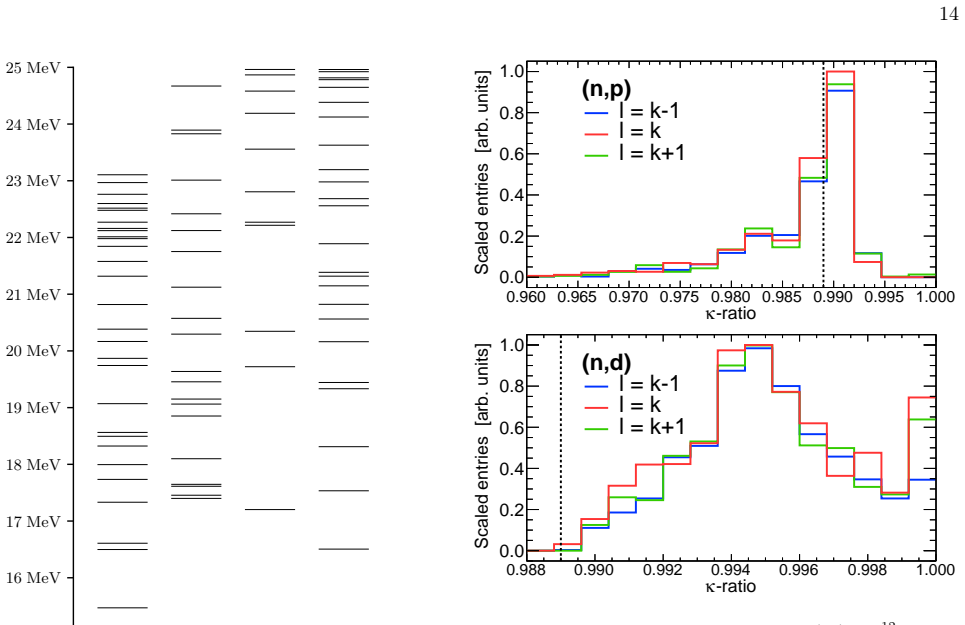
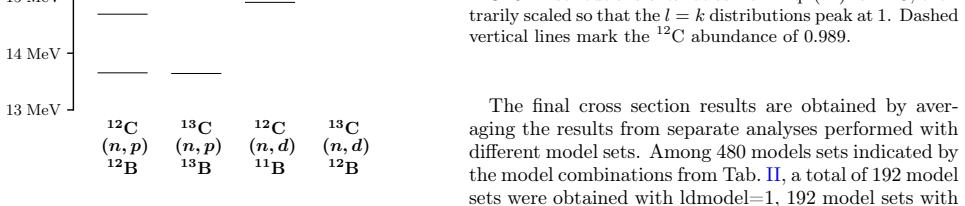
Energy-differential cross section of the $^{\mathrm{nat}}$C(n,p) and $^{\mathrm{nat}}$C(n,d) reactions was measured at the neutron time of flight facility n_TOF at CERN. The measurement was performed in the first experimental area (EAR1; flight path of 182.5 m). Two position-sensitive $\Delta E$-$E$ silicon telescopes were used. Two naturally occurring carbon isotopes, $^{12}$C and $^{13}$C, contribute to the reactions on natural carbon, with the (n,p) reaction threshold at 13.7 MeV and the (n,d) threshold at 14.9 MeV (determined by the $^{12}$C isotope for both reactions). This paper provides the details of the analysis leading to the final results published previously as a Letter. The cross section results are reported up to 25 MeV. During the data analysis the population of the excited states in the daughter nuclei $^{11}$B, $^{12}$B, $^{13}$B had to be considered, requiring the adoption of the branching ratios and angular distributions of the emitted particles from an external source of information. TALYS-2.0 calculations were used as the main source and an in-depth analysis of the model-related uncertainties was performed. The n_TOF results are largely inconsistent with the major evaluation libraries. On the other hand, an unexpected agreement is found with TALYS-2.0 calculations. Specifically, the obtained cross section for the (n,p) reaction is significantly higher than in the available evaluations, fully supporting the earlier finding from an integral measurement at n_TOF.
Editorial analysis
A structured set of objections, weighed in public.
Referee Report
Summary. The manuscript details the analysis of energy-differential cross-section measurements for the natC(n,p) and natC(n,d) reactions at the n_TOF facility (EAR1, 182.5 m flight path) using two position-sensitive ΔE-E silicon telescopes. Thresholds are given as 13.7 MeV for (n,p) and 14.9 MeV for (n,d), both driven by 12C. The work accounts for population of excited states in 11B, 12B, and 13B by adopting branching ratios and angular distributions from TALYS-2.0, performs an in-depth uncertainty analysis on these inputs, and reports results up to 25 MeV. The extracted (n,p) cross sections are significantly higher than major evaluations, supporting a prior n_TOF integral measurement, while showing unexpected agreement with TALYS-2.0.
Significance. If the central results hold after addressing model dependence, the data would supply important differential constraints on carbon neutron-induced reactions, with implications for evaluations used in neutron transport, dosimetry, and astrophysics. The provision of full analysis details beyond the prior Letter, combined with the explicit uncertainty study on external model inputs, strengthens the contribution. The observed discrepancy with evaluations versus agreement with TALYS-2.0 highlights potential shortcomings in current libraries but requires careful separation of experimental and model effects.
major comments (1)
- [Data analysis] Data analysis section (description of excited-state corrections): Branching ratios and angular distributions for emitted particles from excited states in 11B, 12B, and 13B are adopted directly from TALYS-2.0 as the primary external source. While an uncertainty analysis on these choices is reported, the same model family is subsequently used as the benchmark for the final cross sections. This shared dependence means any systematic bias in TALYS branching or angular distributions propagates into both the absolute scale of the extracted (n,p) cross sections and the apparent agreement with TALYS-2.0, weakening the claim that the discrepancy with evaluations is a fully independent experimental finding.
minor comments (1)
- [Abstract] The abstract states that the (n,p) result 'fully supporting the earlier finding from an integral measurement' but does not quantify the level of agreement or reference the specific prior work; adding a brief citation and overlap metric would improve clarity.
Simulated Author's Rebuttal
We thank the referee for the constructive comments and the opportunity to clarify aspects of our data analysis. We address the major comment below.
read point-by-point responses
-
Referee: [Data analysis] Data analysis section (description of excited-state corrections): Branching ratios and angular distributions for emitted particles from excited states in 11B, 12B, and 13B are adopted directly from TALYS-2.0 as the primary external source. While an uncertainty analysis on these choices is reported, the same model family is subsequently used as the benchmark for the final cross sections. This shared dependence means any systematic bias in TALYS branching or angular distributions propagates into both the absolute scale of the extracted (n,p) cross sections and the apparent agreement with TALYS-2.0, weakening the claim that the discrepancy with evaluations is a fully independent experimental finding.
Authors: We acknowledge the referee's valid concern regarding potential model dependence. TALYS-2.0 is used exclusively for the auxiliary corrections of branching ratios and angular distributions needed to account for excited-state population in the daughter nuclei, as our telescopes detect all protons and deuterons without state selection. The primary cross-section extraction remains data-driven from the measured yields. We performed a dedicated uncertainty analysis by varying the TALYS inputs over plausible ranges and propagated these into the final uncertainties. The major evaluations rely on independent experimental datasets and different modeling approaches, not TALYS-2.0, so the reported discrepancy with them is not undermined. The agreement with TALYS-2.0 is described as unexpected in the manuscript and may indicate strengths in its reaction modeling; we will add an explicit discussion paragraph in the revised data-analysis section to address the limitations of this model dependence and its implications for the comparisons. revision: partial
Circularity Check
No significant circularity detected; experimental measurement remains self-contained
full rationale
The paper reports an experimental energy-differential cross-section measurement for natC(n,p) and natC(n,d) using position-sensitive silicon telescopes at n_TOF EAR1. The central results up to 25 MeV are obtained from measured yields after corrections that include adoption of branching ratios and angular distributions for excited states in 11B, 12B, and 13B from TALYS-2.0 as an external source, accompanied by a dedicated uncertainty analysis on those inputs. The extracted cross sections are then compared to major evaluation libraries (showing inconsistency) and to TALYS-2.0 (showing agreement), while also supporting a prior integral measurement. No equations or steps in the provided text reduce the final cross-section values to the TALYS inputs by construction, nor is there any fitted parameter renamed as a prediction, self-definitional loop, or load-bearing self-citation of a uniqueness theorem. The derivation chain relies on direct experimental data with external model inputs for corrections only, satisfying the criterion of being self-contained against external benchmarks.
Axiom & Free-Parameter Ledger
axioms (2)
- standard math Nuclear reaction thresholds and kinematics for (n,p) and (n,d) on 12C and 13C
- domain assumption TALYS-2.0 provides reliable branching ratios and angular distributions for excited-state decay
Reference graph
Works this paper leans on
-
[1]
M. Chadwick, L. J. Cox , P. G. Young, A. S. Meigooni, Nucl. Sci. Eng. 123 (1996) 17. [10.13182/NSE96-A24210]
-
[2]
A. Ibarra, W. Królas, D. Bernardi, et al., Nucl. Fusion 65 (2025) 122006. [10.1088/1741-4326/adcd86]
-
[3]
I. Podadera, P. Cara, B. Bolzon, et al., Nucl. Fusion 65 (2025) 122011. [10.1088/1741-4326/ade267]
-
[4]
W. E. Kreger, B. D. Kern, Phys. Rev. 113 (1959) 890. [10.1103/PhysRev.113.890]
-
[5]
E. M. Rimmer, P. S. Fisher, Nucl. Phys. 108 (1968) 567. [10.1016/0375-9474(68)90325-4]
-
[6]
V. E. Ablesimov, E. K. Bonyushkin, A. P. Morozov, Neu- tron Physics Conf., Kiev 1971, Vol.1, p.173 (1971)
1971
-
[7]
V. V. Bobyr, G. I. Primenko, K. K. Revyuk, et al., Izv. Akad. Nauk SSSR, Ser. Fiz. 36 (1972) 2621
1972
-
[8]
M. Pillon, M. Angelone, A. Krása, et al., AIP Conf. Proc. 1412 (2011) 121. [10.1063/1.3665305]
-
[9]
M. Pillon, M. Angelone, F. Belloni, et al., EPJ Web Conf. 146 (2017) 11005. [10.1051/epjconf/201714611005]
-
[11]
M. W. McNaughton, N. S. P. King, F. P. Brady, J. L. Ullman, Nucl. Instrum. Methods. 129 (1975) 241. [10.1016/0029-554X(75)90135-4]
-
[12]
K. P. Jackson, A. Celler, W. P. Alford, et al., Phys. Lett. 201 (1988) 25. [10.1016/0370-2693(88)90073-1]
-
[13]
F. P. Brady, T. D. Ford, G. A. Needham, et al., Phys. Rev. C 43 (1991) 2284. [10.1103/PhysRevC.43.2284]
-
[14]
D. S. Sorenson, X. Aslanoglou, F. P. Brady, et al., Phys. Rev. C 45 (1992) R500(R). [10.1103/PhysRevC.45.R500]
-
[15]
X. Yang, L. Wang, J. Rapaport, et al., Phys. Rev. C 48 (1993) 1158. [10.1103/PhysRevC.48.1158]
-
[16]
R. Pourang, J. W. Watson, R. Abegg, et al., Phys. Rev. C 47 (1993) 2751. [10.1103/PhysRevC.47.2751]
-
[17]
N.Olsson, H. Condé, E. Ramström, et al., Nucl. Phys. 559 (1993) 368. [10.1016/0375-9474(93)90159-U]
-
[18]
C. J. Martoff, S. S. Hanna, D. Počanić, et. al, Phys. Rev. C 54 (1996) 2767. [10.1103/PhysRevC.54.2767]
-
[19]
K. Wang, C. J. Martoff, D. Počanić, et. al, Phys. Rev. C 53 (1996) 1718. [10.1103/PhysRevC.53.1718]
-
[20]
I. Slypen, S. Benck, J. P. Meulders, V. Corcalciuc, Nucl. Phys. 671 (2000) 3. [10.1016/S0375-9474(99)00829-5]
-
[21]
M. Majerle, M. Angelone, A. Krása, et al., Nucl. Instrum. Methods Phys. Res. A 951 (2020) 163014. [10.1016/j.nima.2019.163014]
-
[22]
S. A. Kuvin, H. Y. Lee, B. DiGiovine, et al., Phys. Rev. C 104 (2021) 014603. [10.1103/PhysRevC.104.014603]
-
[23]
Z. Cui, H. Jiang, K. Sun, et al., Chin. Phys. C 45 (2021) 064001. [10.1088/1674-1137/abf136]
-
[24]
A. Wantz, A. N. Kuchera, S. A. Kuvin, et al., Phys. Rev. C 112 (2025) 014620. [10.1103/m59q-mh3y]
-
[25]
S.Agostinelli, J.Allison, K.Amako, etal., Nucl.Instrum. Methods Phys. Res. A 506 (2003) 250. [10.1016/S0168- 9002(03)01368-8]
-
[26]
J. Allison, K. Amako, J. Apostolakis, et al., IEEE Trans. Nucl. Sci. 53 (2006) 270. [10.1109/TNS.2006.869826]
-
[27]
J. Allison, K. Amako, J. Apostolakis, et al., Nucl. Instrum. Methods Phys. Res. A 835 (2016) 186. [10.1016/j.nima.2016.06.125]
-
[28]
P. Žugec, N. Colonna, D. Bosnar, et al., Eur. Phys. J. A 52 (2016) 101. [10.1140/epja/i2016-16101-7]
-
[29]
P. Žugec, N. Colonna, D. Bosnar, et al., Phys. Rev. C 90 (2014) 021601(R). [10.1103/PhysRevC.90.021601]
-
[30]
P. Žugec, N. Colonna, D. Rochman, et al., Phys. Lett. B 868 (2025) 139713. [10.1016/j.physletb.2025.139713]
-
[31]
Rubbia, S
C. Rubbia, S. Andriamonje, D. Bouvet-Bensimon, et al., A high Resolution Spallation driven Facility at the CERN-PS to Measure Neutron Cross Sections in the In- terval from 1 eV to 250 MeV, CERN-LHC-98-002-EET (1998). [CERN-LHC-98-002-EET]
1998
-
[32]
N. Patronis, A. Mengoni, S. Goula, et al., EPJ Tech. Instr. 10 (2023) 13. [10.1140/epjti/s40485-023-00100-w]
-
[33]
M. Barbagallo, C. Guerrero, A. Tsinganis, et al., Eur. Phys. J. A 49 (2013) 156. [10.1140/epja/i2013-13156-x]
-
[34]
M. Sabaté-Gilarte, M. Barbagallo, N. Colonna, et al., Eur. Phys. J. A 53 (2017) 210. [10.1140/epja/i2017- 12392-4]
-
[35]
S. Lo Meo, M. A. Cortés-Giraldo, C. Massimi, et al., Eur. Phys. J. A 51 (2015) 160. [10.1140/epja/i2015-15160-6]
-
[36]
J. Lerendegui-Marco, S. Lo Meo, C. Guerrero, et al., Eur. Phys. J. A 52 (2016) 100. [10.1140/epja/i2016-16100-8]
-
[37]
C. Guerrero, A. Tsinganis, E. Berthoumieux, et al., Eur. Phys. J. A 49 (2013) 27. [10.1140/epja/i2013-13027-6] 22
-
[38]
C. Weiß, E. Chiaveri, S. Girod, et al., Nucl. Instrum. Methods Phys. Res. A 799 (2015) 90. [10.1016/j.nima.2015.07.027]
-
[39]
N. Colonna, E. Chiaveri, F. Gunsing, Nucl. Phys. News 25:4 (2015) 19. [10.1080/10619127.2015.1035930]
-
[41]
M. Ferrari, D. Senajova, O. Aberle, et al., Phys. Rev. Accel. Beams 25 (2022) 103001. [10.1103/PhysRevAccel- Beams.25.103001]
-
[42]
M. E. Stamati, P. Torres-Sánchez, P. Pérez-Maroto et al., EPJ Web Conf. 284 (2023) 06009 [10.1051/epj- conf/202328406009]
-
[43]
N. Patronis, A. Mengoni, N. Colonna, et al., The CERN n_TOF NEAR station for astrophysics- and application- related neutron activation measurements, Eur. Phys. J. A 61 (2025) 215. [10.1140/epja/s10050-025-01674-7]
-
[44]
P. Žugec, M. Barbagallo, J. Andrzejewski, et al., Nucl. Instrum. Methods Phys. Res. A 983 (2020) 164606. [10.1016/j.nima.2020.164606]
-
[45]
P. Žugec, M. Barbagallo, J. Andrzejewski, et al., J. Instrum. 15 (2020) P02011. [10.1088/1748- 0221/15/02/P02011]
-
[46]
P. Žugec, M. Barbagallo, J. Andrzejewski, et al., Nucl. Instrum. Methods Phys. Res. A 1033 (2022) 166686. [10.1016/j.nima.2022.166686]
-
[47]
M. Barbagallo, J. Andrzejewski, M. Mastromarco, et al., Nucl. Instrum. Methods Phys. Res. A 887 (2018) 27. [10.1016/j.nima.2017.12.025]
-
[48]
L. Damone, M. Barbagallo, M. Mastromarco, et al., Phys. Rev. Lett. 121 (2018) 042701. [10.1103/Phys- RevLett.121.042701]
-
[49]
Žugec, C.Weiß, C.Guerrero, et al., Nucl
P. Žugec, C.Weiß, C.Guerrero, et al., Nucl. In- strum. Methods Phys. Res. A 812 (2016) 134. [10.1016/j.nima.2015.12.054]
-
[50]
Vlachoudis, M
V. Vlachoudis, M. Sabate-Gilarte, V. Alcayne, et al., On the resolution function of the n_TOF facility: a com- prehensive study and user guide, n_TOF-PUB-2021-001 (2021). [n_TOF-PUB-2021-001]
2021
-
[51]
P. Žugec, N. Colonna, M. Sabate-Gilarte, et al., Nucl. Instrum. Methods Phys. Res. A 875 (2017) 41. [10.1016/j.nima.2017.09.004]
-
[52]
P. Žugec, M. Sabaté-Gilarte, M. Bacak, et al., Nucl. Sci. Tech. 36 (2025) 235. [10.1007/s41365-025-01820-2]
-
[53]
J. M. Belleman, W. Andreazza, A. A. Nosych, Proceed- ings of the 5th International Beam Instrumentation Con- ference, MOPG41 (2017) 143. [ISBN:978-3-95450-177-9]
2017
-
[54]
C. Ahdida, D. Bozzato, D. Calzolari, et al., Front. Phys. 9 (2022) 788253. [10.3389/fphy.2021.788253]
-
[55]
M. B. Chadwick, M. Herman, P. Obložinský, et al., Nucl. Data Sheets 112 (2011) 2887. [10.1016/j.nds.2011.11.002]
-
[56]
Behnke (ed.), K
O. Behnke (ed.), K. Kröninger (ed.), G. Schott (ed.), T. Schörner-Sadenius (ed.), Data Analysis in High Energy Physics, Wiley-VCH, Weinheim, Germany, 2013
2013
-
[57]
A. J. Koning,D. Rochman, Nucl. Data Sheets 113 (2012)
2012
-
[58]
[10.1016/j.nds.2012.11.002]
-
[59]
A. Koning, S. Hilaire, S. Goriely, Eur. Phys. J. A 59 (2023) 131. [10.1140/epja/s10050-023-01034-3]
-
[60]
https://nds.iaea.org/talys/
TALYS & Related Software. https://nds.iaea.org/talys/
-
[61]
A. J. Koning, D. Rochman, J.-Ch. Sublet, et al., Nucl. Data Sheets 155 (2019) 1. [10.1016/j.nds.2019.01.002]
-
[62]
https://tendl.web.psi.ch/tendl_2023/astro/astro.html
-
[63]
D. Rochman, A. Koning, S. Goriely, S. Hi- laire, Nucl. Phys. A 1053 (2025) 122951. [10.1016/j.nuclphysa.2024.122951]
-
[64]
D. Rochman, A. Koning, S. Goriely, S. Hi- laire, Nucl. Phys. A 1054 (2025) 122979. [10.1016/j.nuclphysa.2024.122979]
-
[65]
J. H. Kelley, E. Kwan, J. E. Purcell, et al., Nucl. Phys. A 880 (2012) 88. [10.1016/j.nuclphysa.2012.01.010]
-
[66]
J. H. Kelley, J. E.Purcell, C. G. Sheu, Nucl. Phys. A 968 (2017) 71. [10.1016/j.nuclphysa.2017.07.015]
-
[67]
F. Ajzenberg-Selove, Nucl. Phys. A 523 (1991) 1. [10.1016/0375-9474(91)90446-D]
-
[68]
Rochman, A
D. Rochman, A. J. Koning, TENDL-2009: on Evalua- tions and Monte Carlo Covariances, Proceedings of the Second international Workshop on Nuclear Data Evalua- tion for Reactor applications (Wonder 2009), pp. 105-110
2009
discussion (0)
Sign in with ORCID, Apple, or X to comment. Anyone can read and Pith papers without signing in.