pith. machine review for the scientific record. sign in

arxiv: 2604.25652 · v1 · submitted 2026-04-28 · 🌌 astro-ph.EP · astro-ph.IM· physics.space-ph

Recognition: unknown

Euclid: Asteroid rotation periods from the Euclid Ecliptic Survey

B. Y. Irureta-Goyena , B. Altieri , J.-P. Kneib , M. P\"ontinen , O. R. Hainaut , M. R. Alarcon , M. Granvik , A. A. Nucita
show 137 more authors
B. Carry M. Devogele M. Mahlke R. Vavrek T. M\"uller E. Vilenius C. Snodgrass R. Kohley C. Lemon P. G\'omez-Alvarez G. Verdoes Kleijn J. Licandro S. Kruk L. Conversi A. Franco G. Buenadicha P. Mas-Buitrago K. Kuijken S. Andreon C. Baccigalupi M. Baldi A. Balestra P. Battaglia A. Biviano E. Branchini M. Brescia S. Camera V. Capobianco C. Carbone J. Carretero R. Casas M. Castellano G. Castignani S. Cavuoti K. C. Chambers A. Cimatti C. Colodro-Conde G. Congedo C. J. Conselice Y. Copin F. Courbin H. M. Courtois M. Cropper H. Degaudenzi G. De Lucia C. Dolding H. Dole F. Dubath X. Dupac M. Farina R. Farinelli S. Ferriol M. Frailis M. Fumana S. Galeotta K. George B. Gillis C. Giocoli J. Gracia-Carpio A. Grazian F. Grupp S. V. H. Haugan H. Hoekstra W. Holmes I. M. Hook F. Hormuth A. Hornstrup K. Jahnke M. Jhabvala A. Kiessling B. Kubik M. K\"ummel M. Kunz H. Kurki-Suonio A. M. C. Le Brun S. Ligori P. B. Lilje V. Lindholm I. Lloro G. Mainetti O. Mansutti O. Marggraf M. Martinelli N. Martinet F. Marulli R. J. Massey E. Medinaceli S. Mei E. Merlin G. Meylan A. Mora L. Moscardini R. Nakajima C. Neissner S.-M. Niemi C. Padilla S. Paltani F. Pasian K. Pedersen W. J. Percival V. Pettorino G. Polenta L. A. Popa F. Raison R. Rebolo A. Renzi J. Rhodes G. Riccio E. Romelli M. Roncarelli R. Saglia Z. Sakr D. Sapone M. Schirmer P. Schneider A. Secroun E. Sihvola P. Simon C. Sirignano G. Sirri L. Stanco P. Tallada-Cresp\'i I. Tereno S. Toft R. Toledo-Moreo F. Torradeflot I. Tutusaus J. Valiviita T. Vassallo Y. Wang J. Weller F. M. Zerbi J. Garc\'ia-Bellido J. Mart\'in-Fleitas V. Scottez G. Helou D. Scott
Authors on Pith no claims yet

Pith reviewed 2026-05-07 14:42 UTC · model grok-4.3

classification 🌌 astro-ph.EP astro-ph.IMphysics.space-ph
keywords asteroid rotation periodsEuclid missionlight curvesspin barrierMCMC analysisLomb-Scargle periodogrammain belt asteroidssuper-fast rotators
0
0 comments X

The pith

Euclid calibration data yields rotation periods for 889 asteroids, 93 percent of them new.

A machine-rendered reading of the paper's core claim, the machinery that carries it, and where it could break.

The paper demonstrates that streaked images from the Euclid Ecliptic Survey can be turned into usable light curves for measuring asteroid spin periods. The authors extracted data from more than 23,000 appearances of 2321 known asteroids and applied a Lomb-Scargle period search followed by MCMC sampling to characterize the periods and their aliases. This matters because only 7 percent of these asteroids had published periods before, so the work adds a large set of new measurements that can test models of asteroid internal structure and evolution. The results include 16 candidate super-fast rotators and an open catalogue of light curves and periods for community use.

Core claim

The central claim is that multiple-aperture photometry along asteroid streaks in Euclid VIS images produces light curves with sufficient time resolution to recover spin periods via Lomb-Scargle analysis and MCMC posterior sampling. Validation against 48 published periods shows that 44 percent agree to within 1 percent and 98 percent to within 15 percent, with the best solution lying among the first three aliases at 98 percent confidence. The pipeline yields 889 high-quality periods, 93 percent of which are first-ever measurements, along with 16 candidates below the 2.2-hour spin barrier for objects brighter than absolute magnitude 19, all released in an open catalogue.

What carries the argument

Multi-aperture sampling along streaked asteroid trails to build time-resolved light curves, followed by Lomb-Scargle periodogram analysis and MCMC sampling to map posterior distributions and identify aliases.

If this is right

  • The 889 periods substantially enlarge the sample of known asteroid spins, especially for main-belt objects, Mars crossers, Cybeles, Hildas, and Hungarias.
  • The 16 super-fast rotator candidates below the 2.2-hour barrier can be targeted for shape and density studies to test material strength limits.
  • The open light-curve catalogue allows direct comparison with future Euclid observations and with ground-based surveys.
  • The 98 percent confidence that the correct period lies among the first three aliases supports efficient use of the method on larger data sets.

Where Pith is reading between the lines

These are editorial extensions of the paper, not claims the author makes directly.

  • Extending the same streak-analysis pipeline to the full Euclid survey could produce thousands of additional periods, enabling statistical comparisons of spin distributions across dynamical families.
  • Cross-checking the reported periods against independent shape models from other surveys could reveal correlations between rotation rate, size, and surface properties.
  • Confirmation of the fast-rotator candidates would tighten constraints on the cohesion forces inside small asteroids.

Load-bearing premise

The observed brightness changes along the streaks are dominated by the asteroid's rotation rather than by tumbling, albedo patches, or instrumental effects.

What would settle it

Independent period measurements for the same set of asteroids obtained with other telescopes or missions that disagree with the high-quality Euclid periods at a rate much higher than the 2 percent level reported here.

Figures
Figures reproduced from arXiv: 2604.25652 by A. A. Nucita, A. Balestra, A. Biviano, A. Cimatti, A. Franco, A. Grazian, A. Hornstrup, A. Kiessling, A. M. C. Le Brun, A. Mora, A. Renzi, A. Secroun, B. Altieri, B. Carry, B. Gillis, B. Kubik, B. Y. Irureta-Goyena, C. Baccigalupi, C. Carbone, C. Colodro-Conde, C. Dolding, C. Giocoli, C. J. Conselice, C. Lemon, C. Neissner, C. Padilla, C. Sirignano, C. Snodgrass, D. Sapone, D. Scott, E. Branchini, E. Medinaceli, E. Merlin, E. Romelli, E. Sihvola, E. Vilenius, F. Courbin, F. Dubath, F. Grupp, F. Hormuth, F. Marulli, F. M. Zerbi, F. Pasian, F. Raison, F. Torradeflot, G. Buenadicha, G. Castignani, G. Congedo, G. De Lucia, G. Helou, G. Mainetti, G. Meylan, G. Polenta, G. Riccio, G. Sirri, G. Verdoes Kleijn, H. Degaudenzi, H. Dole, H. Hoekstra, H. Kurki-Suonio, H. M. Courtois, I. Lloro, I. M. Hook, I. Tereno, I. Tutusaus, J. Carretero, J. Garc\'ia-Bellido, J. Gracia-Carpio, J. Licandro, J. Mart\'in-Fleitas, J.-P. Kneib, J. Rhodes, J. Valiviita, J. Weller, K. C. Chambers, K. George, K. Jahnke, K. Kuijken, K. Pedersen, L. A. Popa, L. Conversi, L. Moscardini, L. Stanco, M. Baldi, M. Brescia, M. Castellano, M. Cropper, M. Devogele, M. Farina, M. Frailis, M. Fumana, M. Granvik, M. Jhabvala, M. K\"ummel, M. Kunz, M. Mahlke, M. Martinelli, M. P\"ontinen, M. R. Alarcon, M. Roncarelli, M. Schirmer, N. Martinet, O. Mansutti, O. Marggraf, O. R. Hainaut, P. Battaglia, P. B. Lilje, P. G\'omez-Alvarez, P. Mas-Buitrago, P. Schneider, P. Simon, P. Tallada-Cresp\'i, R. Casas, R. Farinelli, R. J. Massey, R. Kohley, R. Nakajima, R. Rebolo, R. Saglia, R. Toledo-Moreo, R. Vavrek, S. Andreon, S. Camera, S. Cavuoti, S. Ferriol, S. Galeotta, S. Kruk, S. Ligori, S. Mei, S.-M. Niemi, S. Paltani, S. Toft, S. V. H. Haugan, T. M\"uller, T. Vassallo, V. Capobianco, V. Lindholm, V. Pettorino, V. Scottez, W. Holmes, W. J. Percival, X. Dupac, Y. Copin, Y. Wang, Z. Sakr.

Figure 1
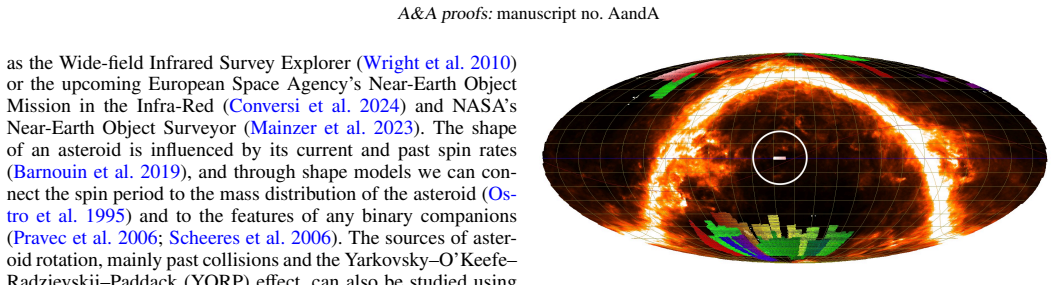
Figure 1. Figure 1: shows the EES in context, projected in ecliptic co￾ordinates, and view at source ↗
Figure 2
Figure 2. Figure 2: Detail of the observing strategy of the EES, which starts on the rightmost squares on 23 December 2023 (black) and ends on the left￾most squares on 31 December 2023 (pink). Each square corresponds to a single exposure of 560.5 s (dither) and each observation is comprised by four dithers. Within each observation, the four dithers follow an S￾shaped pattern. The observations had a high overlap to ensure that… view at source ↗
Figure 3
Figure 3. Figure 3: Diagram summarising the general workflow of our pipeline. We first build our light curves, excluding the outliers and cases with insufficient signal. Then, we search the period using multiple algorithms and, after filtering, compare our results with those published in the catalogue view at source ↗
Figure 5
Figure 5. Figure 5: Cut-out of VIS image comprising (left) and the same image with the overlaid mask of cosmic rays in red (right). 4.2.2. Lomb–Scargle pre-search As is discussed in Sect. 1, the Lomb–Scargle algorithm is more robust than simple Fourier analysis for unevenly sampled time series (VanderPlas 2018), which is generally the case for aster￾oid light curves. It is often applied to infer a period that is used as an in… view at source ↗
Figure 9
Figure 9. Figure 9: Light curve of asteroid 2010 ES89 fitted by a constant. The data are coloured by streak of origin. The fit is adequate, which implies that the data do not have enough signal to allow for a high-quality period search. We discarded this light curve. run by optimising the posterior in two stages. We first explored the parameter space with a global search using differential evo￾lution within the bounds of the … view at source ↗
Figure 7
Figure 7. Figure 7: Light curve of asteroid 2000 SQ24. The time range covers less than one full rotation, which makes the spin-period determination highly suspect. Each data cluster and colour corresponds to a different streak of origin. 4.2.3. Bayesian inference via MCMC Following the approach discussed in Foreman-Mackey et al. (2013), we improved the parameter estimates before the MCMC 60306.0 60306.2 60306.4 60306.6 MJD 20… view at source ↗
Figure 8
Figure 8. Figure 8: Light curve of asteroid 2005 RE29. The time range covers sev￾eral rotations, which allows for reliable spin-period determination. Each data cluster and colour corresponds to a different streak of origin. 23.2 23.4 23.6 23.8 Magnitude s 2 : 0.017 χ 2 ν : 1.9, Ndof=89 Constant model (mean magnitude) 60304.1 60304.2 60304.3 60304.4 60304.5 MJD −0.25 0.00 0.25 Residuals view at source ↗
Figure 10
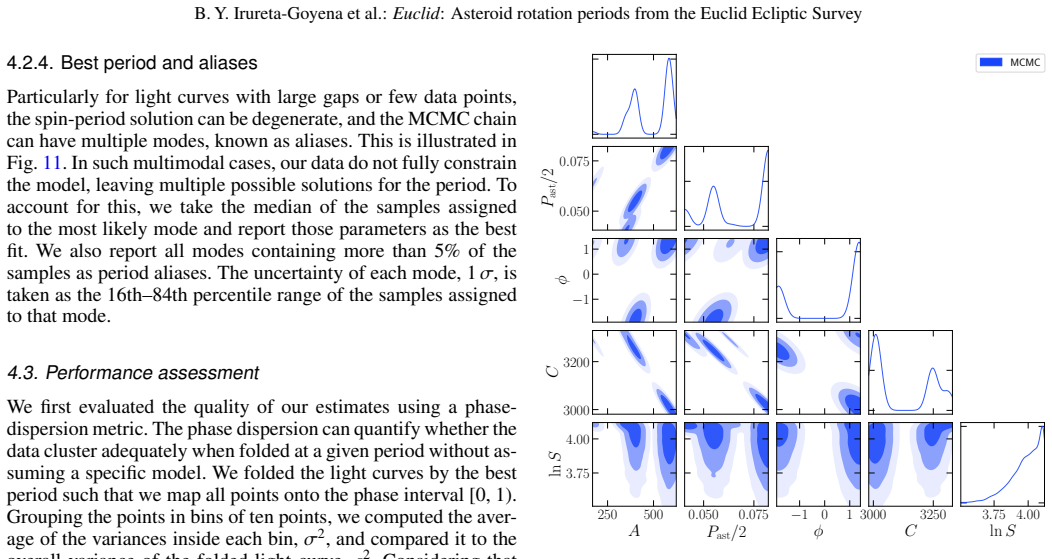
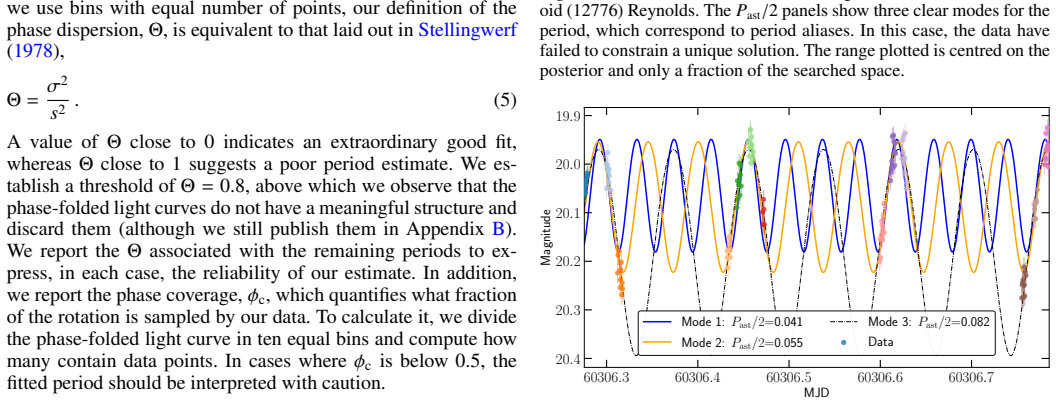
Figure 10. Figure 10: Posterior distributions found during an MCMC search for aster￾oid (12776) Reynolds. The Past/2 panels show three clear modes for the period, which correspond to period aliases. In this case, the data have failed to constrain a unique solution. The range plotted is centred on the posterior and only a fraction of the searched space. 60306.3 60306.4 60306.5 60306.6 60306.7 MJD 19.9 20.0 20.1 20.2 20.3 20.4 M… view at source ↗
Figure 11
Figure 11. Figure 11: In such multimodal cases, our data do not fully constrain the model, leaving multiple possible solutions for the period. To account for this, we take the median of the samples assigned to the most likely mode and report those parameters as the best fit. We also report all modes containing more than 5% of the samples as period aliases. The uncertainty of each mode, 1σ, is taken as the 16th–84th percentile … view at source ↗
Figure 12
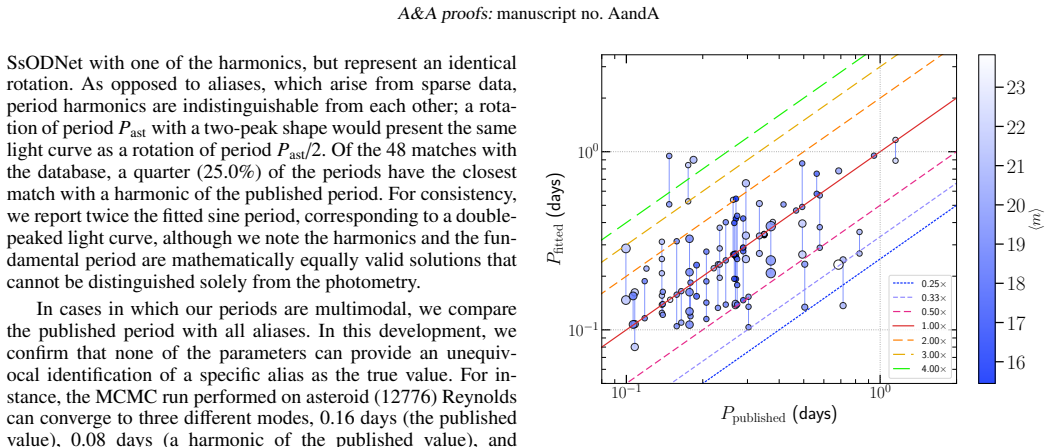
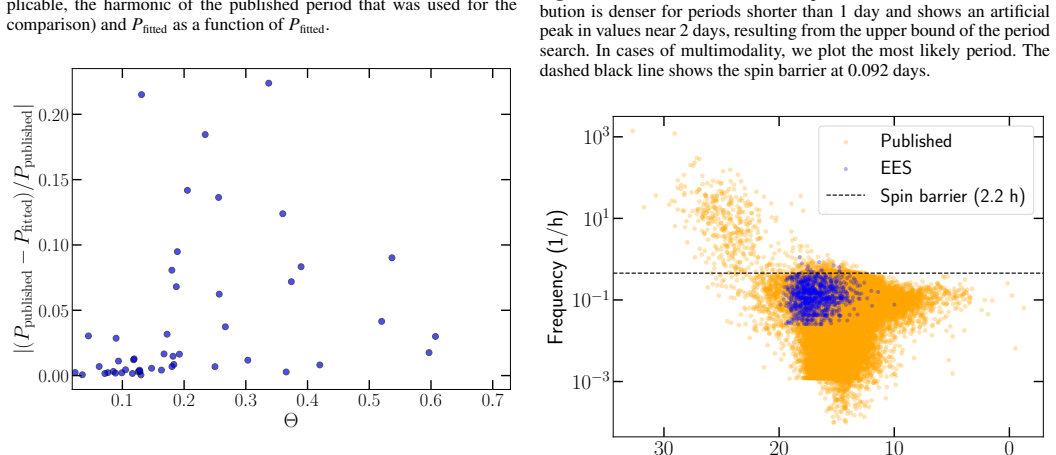
Figure 12. Figure 12: shows the location of the fitted periods with respect to their published value. All modes found for a given period are connected by a line. The size of the points is proportional to their Θ, where a smaller size implies a better fit, while a darker shade of blue correlates with a brighter apparent magnitude view at source ↗
Figure 13
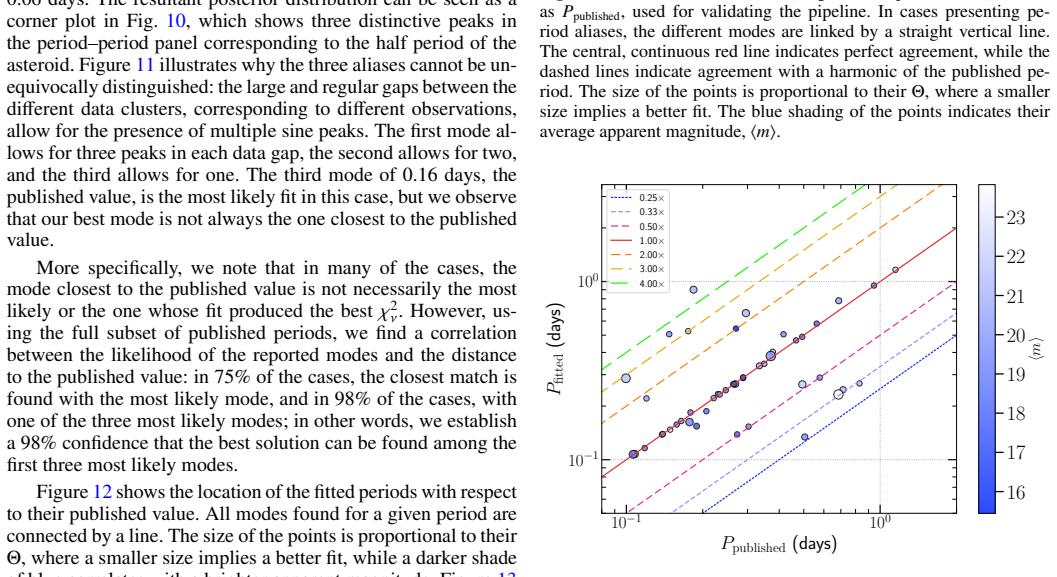
Figure 13. Figure 13: Same as view at source ↗
Figure 14
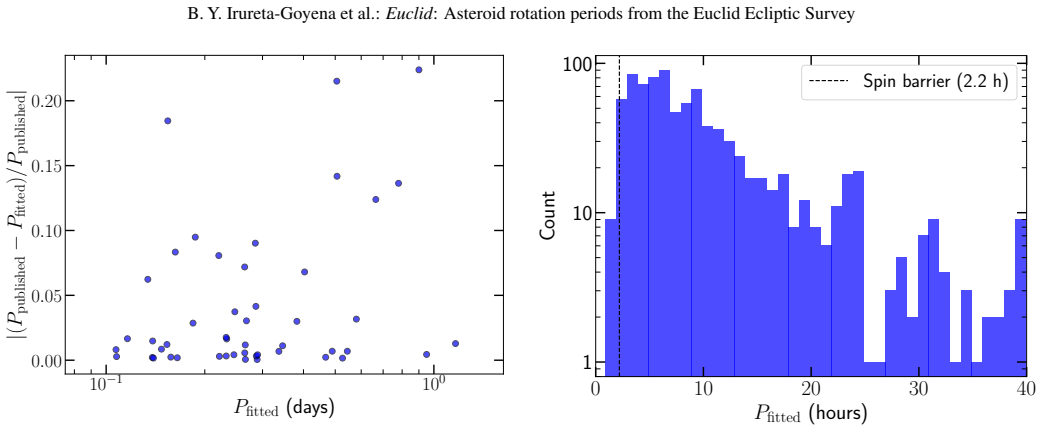
Figure 14. Figure 14: Absolute fractional difference between Ppublished (or, when ap￾plicable, the harmonic of the published period that was used for the comparison) and Pfitted as a function of Pfitted. 0.1 0.2 0.3 0.4 0.5 0.6 0.7 Θ 0.00 0.05 0.10 0.15 0.20 |( Ppublished − Pfitted )/Ppublished| view at source ↗
Figure 15
Figure 15. Figure 15: Absolute fractional difference between Ppublished and Pfitted as a function of Θ. reported in the literature, we appear to achieve similar accuracy results for much fainter objects. In addition, we should note that, even though we set the pub￾lished periods as the ground truth, in some cases our data from the EES are more densely sampled and have better resolution than the published data using ground-base… view at source ↗
Figure 18
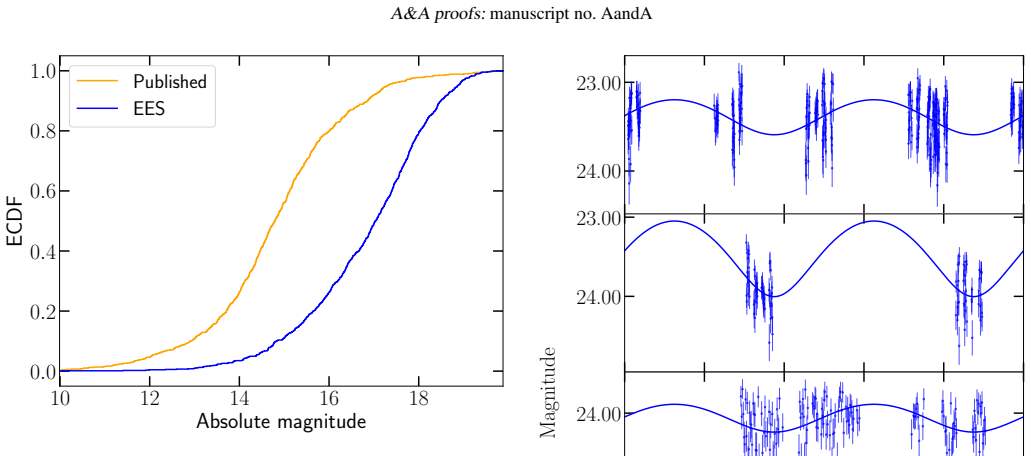
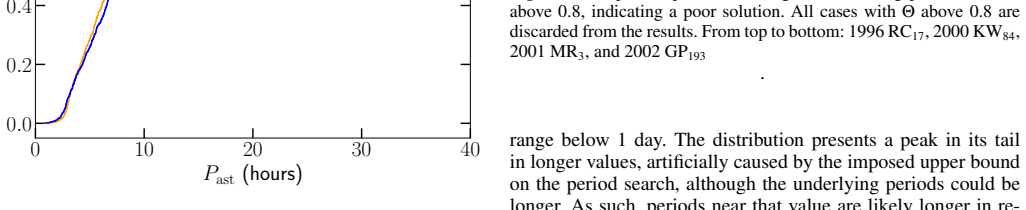
Figure 18. Figure 18: One-dimensional K–S test comparing the empirical cumulative distribution functions (ECDFs) of our magnitude distribution and the published over the same period-magnitude range. The two distributions diverge, with cumulative differences of up to 55%. As expected, the EES objects are fainter. 0 10 20 30 40 Past (hours) 0.0 0.2 0.4 0.6 0.8 1.0 ECDF Published EES view at source ↗
Figure 20
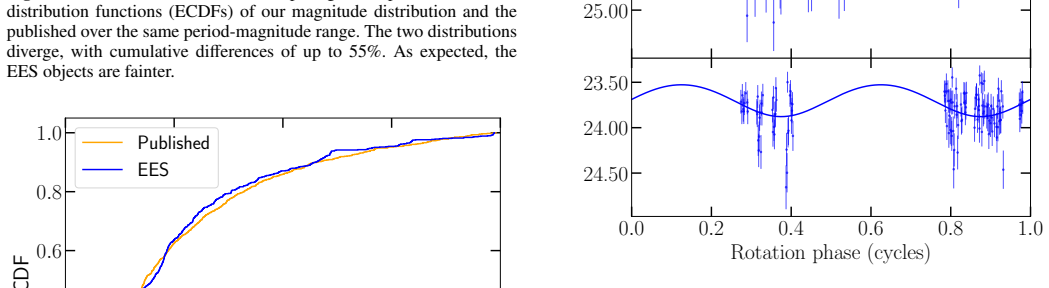
Figure 20. Figure 20: Examples of phase-folded light curves using periods with Θ above 0.8, indicating a poor solution. All cases with Θ above 0.8 are discarded from the results. From top to bottom: 1996 RC17, 2000 KW84, 2001 MR3, and 2002 GP193 . range below 1 day. The distribution presents a peak in its tail in longer values, artificially caused by the imposed upper bound on the period search, although the underlying periods… view at source ↗
Figure 19
Figure 19. Figure 19: One-dimensional K–S test comparing the empirical cumulative distribution functions (ECDFs) of our period distribution and the pub￾lished one. The two distributions are found to be broadly consistent, with a maximum difference between the two cumulative distributions of 6%. We present a preview of the results in Table A.2; the remain￾ing results are available as an electronic table at the Strasbourg Astron… view at source ↗
Figure 21
Figure 21. Figure 21: Examples of phase-folded light curves using periods with Θ below 0.1, indicating an excellent solution. From top to bottom: 2000 VW31, 2006 WG108, (18957) Mijacobsen, and (2165) Young . mission reaches fainter magnitudes than most dedicated asteroid surveys, this behaviour is expected. The second quality test we performed was to assess the relia￾bility of the Θ indicator. We visually confirm that whenever… view at source ↗
read the original abstract

The Euclid Ecliptic Survey was conducted during the calibration phase of the mission, 23-31 December 2023, as a campaign to study Solar System objects. We used data from this survey to analyse more than 23 000 appeareances of 2321 known asteroids. Due to their high apparent angular motion relative to the background stars (5-$60^{\prime\prime}\,\mathrm{h}^{-1}$), these objects appear as streaks in VIS long-exposure images. We set out to estimate their spin periods, since only $7\%$ of them have periods published in the literature. We used multiple apertures along each streak to increase the time resolution of our light curves. Our method combines a Lomb-Scargle approach with a Markov chain Monte Carlo (MCMC) algorithm to characterise the posterior distributions. Some asteroids show multimodality in the MCMC search, indicating period aliases; in these cases, we report all aliases and their likelihoods. We validate our pipeline by comparing our fitted periods with 48 published periods, including period harmonics. We find that $44\%$ of our periods are within $1\%$ of those published and $98\%$ are within $15\%$, and we establish that with $98\%$ confidence the best solution can be found among the first three aliases. All reliable periods reported agree with our current understanding of the spin-period distribution for asteroids. We find 16 periods below the spin barrier of 2.2 h with absolute magnitudes below 19, and thus 16 candidate super-fast rotators. We provide light curves for all 2321 objects observed and 889 high-quality periods in an open-access catalogue. The asteroids with reported periods include five Mars crossers, four Cybeles, four Hildas, three Hungarias, and 877 asteroids in other regions of the main belt. Our results represent the first batch of spin periods extracted from Euclid light curves and include the first-ever period measurements for $93\%$ of the objects.

Editorial analysis

A structured set of objections, weighed in public.

Desk editor's note, referee report, simulated authors' rebuttal, and a circularity audit. Tearing a paper down is the easy half of reading it; the pith above is the substance, this is the friction.

Referee Report

2 major / 3 minor

Summary. The paper analyzes streak photometry from the Euclid Ecliptic Survey calibration phase (23-31 Dec 2023) for 2321 known asteroids (23,000+ appearances). It extracts light curves via multiple apertures along streaks, applies Lomb-Scargle periodograms combined with MCMC sampling to derive posterior period distributions, reports aliases where multimodality occurs, validates the pipeline against 48 literature periods (44% within 1%, 98% within 15%, best solution among top three aliases at 98% confidence), identifies 16 candidate super-fast rotators, and releases an open catalogue of 889 high-quality periods plus light curves for all objects.

Significance. If the validation holds, the work is significant for providing the first substantial set of Euclid-derived asteroid spin periods, with 93% being first measurements. The open release of the full light-curve dataset and catalogue enables community reuse and reproducibility. The demonstration of multi-aperture streak photometry plus MCMC on space-based data is a useful methodological contribution, and the super-fast rotator candidates add to the observational constraints on the spin barrier.

major comments (2)
  1. [Abstract and §3] Abstract and §3 (methods): the pipeline description omits explicit criteria for data quality cuts (e.g., minimum streak length, aperture selection thresholds, or signal-to-noise requirements) and the precise treatment of photometric uncertainties in the MCMC likelihood; these omissions prevent independent reproduction of the 889 high-quality periods and limit assessment of whether the reported 98% within-15% agreement could be affected by selection biases.
  2. [§4] §4 (validation): while the 48-period comparison is a strong external test, the manuscript does not report the distribution of the validation sample in magnitude, streak length, or orbital class relative to the full 2321-object set; without this, it is unclear whether the 44%/98% agreement statistics generalize to the fainter or faster-moving objects that dominate the new catalogue.
minor comments (3)
  1. [Abstract] Abstract: 'appeareances' is a typographical error and should read 'appearances'.
  2. [Abstract and §5] The abstract states that 'all reliable periods reported agree with our current understanding of the spin-period distribution' but provides no quantitative comparison (e.g., Kolmogorov-Smirnov test or histogram overlay) against the known main-belt distribution; adding this would strengthen the claim.
  3. [§3] The manuscript should cite the specific implementations or reference papers for the Lomb-Scargle and MCMC routines used, as well as any prior asteroid streak-photometry studies that motivated the multi-aperture approach.

Simulated Author's Rebuttal

2 responses · 0 unresolved

We thank the referee for their positive assessment and constructive comments. We address each major comment below and will make the indicated revisions to improve reproducibility and validation transparency.

read point-by-point responses
  1. Referee: [Abstract and §3] Abstract and §3 (methods): the pipeline description omits explicit criteria for data quality cuts (e.g., minimum streak length, aperture selection thresholds, or signal-to-noise requirements) and the precise treatment of photometric uncertainties in the MCMC likelihood; these omissions prevent independent reproduction of the 889 high-quality periods and limit assessment of whether the reported 98% within-15% agreement could be affected by selection biases.

    Authors: We agree that additional explicit details are needed for full reproducibility. In the revised manuscript we will expand §3 to state the precise data-quality criteria applied (minimum streak length, aperture selection thresholds, and signal-to-noise requirements) and to give the exact form of the likelihood function used in the MCMC, including the treatment of photometric uncertainties as Gaussian errors. These criteria were used in the analysis but were not stated with sufficient precision in the original text. revision: yes

  2. Referee: [§4] §4 (validation): while the 48-period comparison is a strong external test, the manuscript does not report the distribution of the validation sample in magnitude, streak length, or orbital class relative to the full 2321-object set; without this, it is unclear whether the 44%/98% agreement statistics generalize to the fainter or faster-moving objects that dominate the new catalogue.

    Authors: We acknowledge that a direct comparison of sample properties would strengthen the validation section. We will revise §4 to include a table (or supplementary figure) comparing the distributions of absolute magnitude, streak length, and orbital class for the 48 validation objects versus the full 2321-object set, together with a brief discussion of any differences and their implications for the reported agreement statistics. revision: yes

Circularity Check

0 steps flagged

No significant circularity in derivation chain

full rationale

The paper extracts asteroid rotation periods directly from new Euclid streak photometry by applying standard Lomb-Scargle periodograms followed by MCMC posterior sampling on multi-aperture light curves. All reported periods are validated against an independent external set of 48 literature values (44% within 1%, 98% within 15%), with no internal equations or parameters defined in terms of the target periods themselves. The method uses established, non-self-referential statistical tools on fresh observational data, releases the full light curves and catalogue openly, and contains no self-citation load-bearing steps or ansatz smuggling. The derivation is therefore self-contained against external benchmarks.

Axiom & Free-Parameter Ledger

0 free parameters · 1 axioms · 0 invented entities

The analysis rests on standard assumptions in asteroid photometry and time-series analysis; no free parameters or invented entities are introduced beyond the data themselves.

axioms (1)
  • domain assumption Brightness variations along asteroid streaks are dominated by rotational modulation
    Invoked when interpreting light curves as spin signals; standard in the field but not proven for every object.

pith-pipeline@v0.9.0 · 6481 in / 1213 out tokens · 65357 ms · 2026-05-07T14:42:57.387334+00:00 · methodology

discussion (0)

Sign in with ORCID, Apple, or X to comment. Anyone can read and Pith papers without signing in.

Reference graph

Works this paper leans on

3 extracted references · 2 canonical work pages

  1. [1]

    Perego, A

    Barnouin, O. S., Daly, M. G., Palmer, E. E., et al. 2019, Nat. Geosci., 12, 247 Bellm, E. C., Kulkarni, S. R., Graham, M. J., et al. 2018, PASP, 131, 018002 Berthier, J., Carry, B., Mahlke, M., & Normand, J. 2023, A&A, 671, A151 Berthier, J., Vachier, F., Thuillot, W., et al. 2006, in Astron. Data Anal. Softw. Syst. XV , V ol. 351, 367 Byrd, R. H., Lu, P....

  2. [2]

    E. Pancini

    2026,https://doi.org/10.57780/esa-d079c51 Foreman-Mackey, D., Hogg, D. W., Lang, D., & Goodman, J. 2013, PASP, 125, 306 Fraser, W., Alexandersen, M., Schwamb, M. E., et al. 2016, AJ, 151, 158 Garrison, L. H., Foreman-Mackey, D., Shih, Y .-H., & Barnett, A. 2024, Res. Notes AAS, 8, 250 Gómez-Alvarez, P., Dupac, X., Buenadicha, G., et al. 2018, in Software ...

  3. [3]

    (2015); Waszczak et al

    Stephens (2012); Chang et al. (2015); Waszczak et al. (2015); Chang et al. (2016); ˇDurech et al. (2018); Chang et al. (2019); Erasmus et al. (2020); Pál et al. (2020); Yeh et al. (2020); Podlewska-Gaca et al. (2021); ˇDurech et al. (2022); ˇDurech & Hanuš (2023); Lam et al. (2023); McNeill et al. (2023); Cellino et al. (2024). Article number, page 18 of 18