Equifinality of Venus-like CO₂ Atmospheres
Pith reviewed 2026-05-07 14:25 UTC · model grok-4.3
The pith
A massive CO2 atmosphere on Venus can arise through primary outgassing, secondary degassing, or carbonate remobilisation, making it an equifinal state rather than evidence of a specific past.
A machine-rendered reading of the paper's core claim, the machinery that carries it, and where it could break.
Core claim
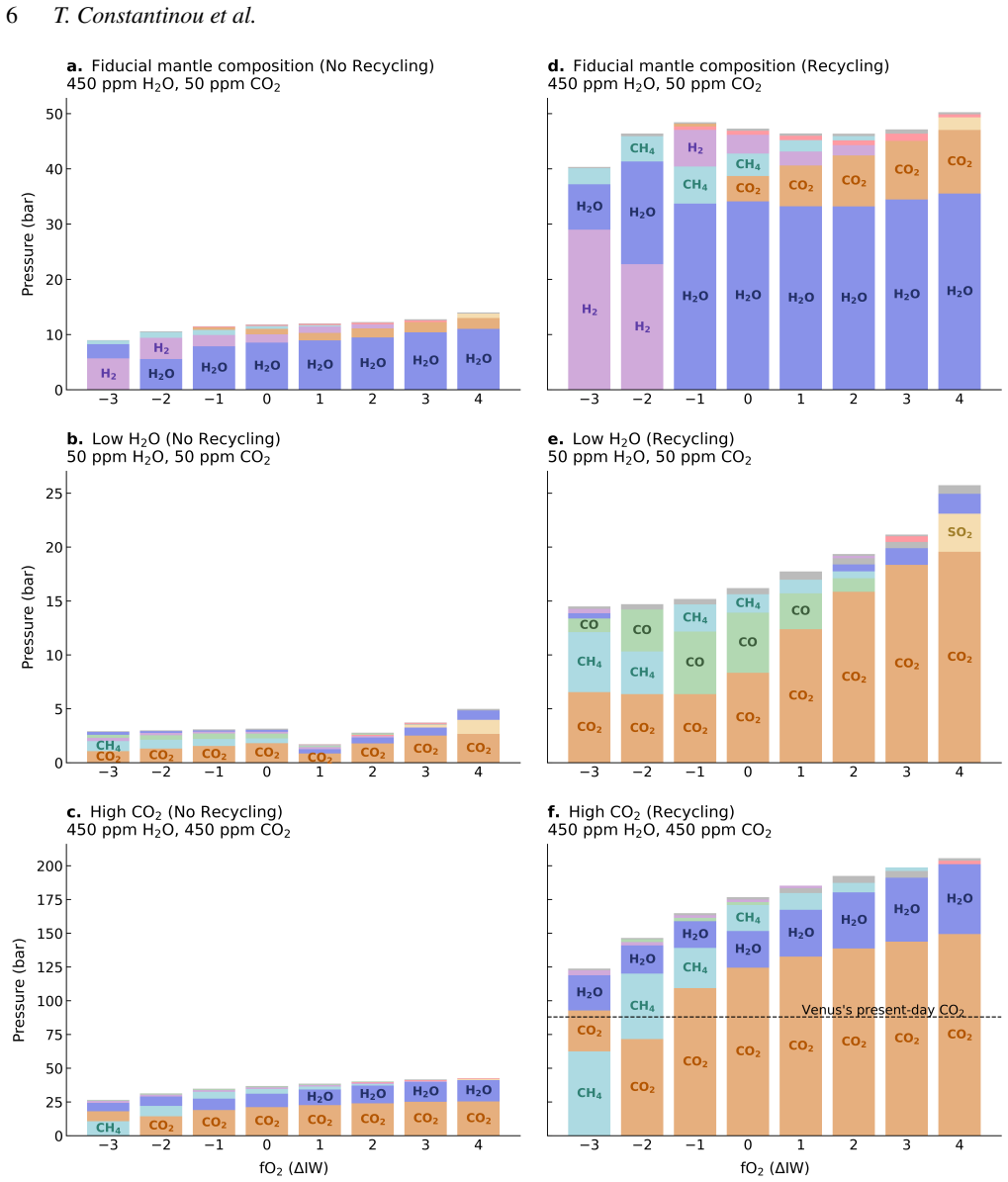
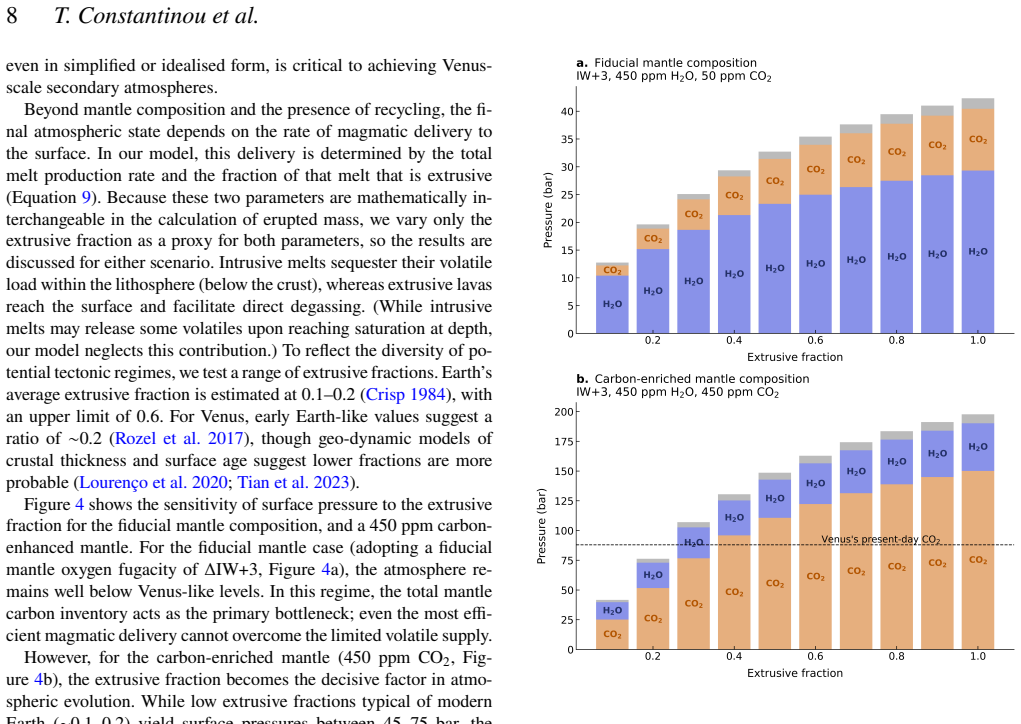
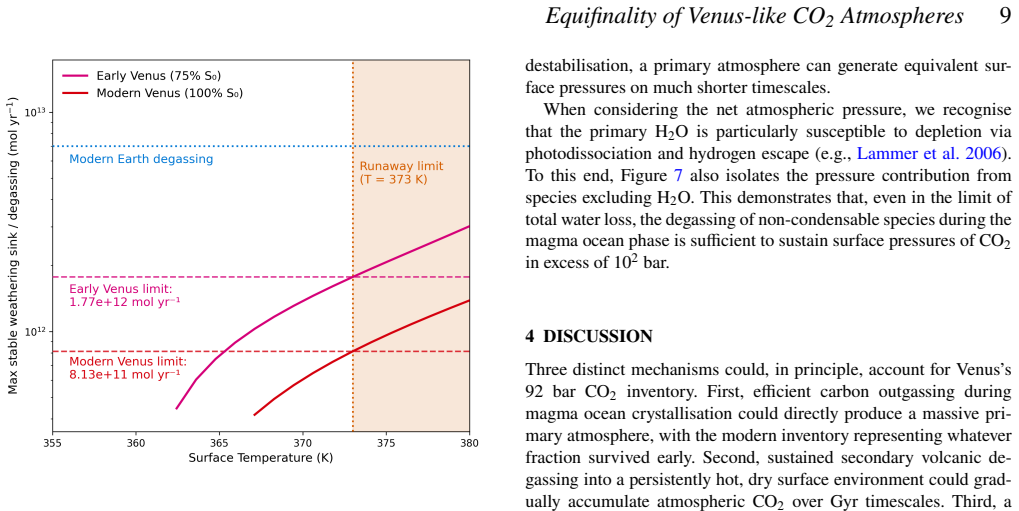
Using a coupled climate-weathering framework, a past habitable Venus could have stored about 20 bar of CO2 as crustal carbonates that would be released over tens of millions of years upon climate destabilization. Secondary degassing from a MORB-like mantle reaches about 25 bar but can reach Venus levels with carbon enrichment, higher extrusion rates, or carbon recycling. Primary outgassing can exceed 100 bar though retention after escape is uncertain. A Venus-like CO2 atmosphere is therefore an equifinal outcome and does not uniquely diagnose a temperate past.
What carries the argument
Three carbon release pathways—primary magma-ocean outgassing, secondary volcanic degassing in stagnant-lid regime, and remobilisation of crustal carbonates after runaway greenhouse transition—each evaluated with a coupled climate-weathering model to show they can produce comparable atmospheric inventories.
If this is right
- A past habitable Venus would imply a substantial crustal carbonate reservoir that gets released upon climate collapse over tens of Myr.
- Stagnant-lid secondary outgassing can build massive CO2 atmospheres if the mantle is carbon-enriched or if melt delivery to the surface is high.
- Primary outgassing during formation can supply over 100 bar of CO2, though the amount retained after early atmospheric escape remains uncertain.
- Venus's observed atmosphere is consistent with multiple evolutionary scenarios and therefore cannot alone confirm or refute a temperate phase.
Where Pith is reading between the lines
- Observations of crustal mineralogy or mantle composition on Venus could distinguish which pathway dominated if they show signatures of past carbonate storage or volatile depletion.
- Similar modeling applied to exoplanets with thick CO2 atmospheres might reveal that atmospheric mass alone is insufficient to infer past surface conditions without geological context.
- Testing the sensitivity to mantle composition assumptions could show how common equifinal massive atmospheres are among rocky planets.
Load-bearing premise
The secondary degassing calculations rely on a MORB-like mantle that depletes its volatiles over time and on the climate-weathering framework correctly forecasting about 20 bar of crustal carbonate storage during habitable conditions.
What would settle it
Measurement of Venus's surface showing either no ancient carbonates or a mantle volatile content that does not match progressive depletion would undermine the ability of the secondary and remobilisation routes to explain the current atmosphere.
Figures




read the original abstract
While Earth locks much of its carbon in its crust as carbonates, Venus retains a comparable carbon inventory almost entirely in its atmosphere as CO$_2$. On Earth, the geological carbon cycle that has produced this vast crustal carbonate inventory is regulated by biology, liquid water, and plate tectonics, which together have stabilised climate over geological timescales. Venus presently lacks all these processes. We test whether Venus's massive CO$_2$ atmosphere is diagnostic of a specific evolutionary pathway by quantifying three routes: primary magma-ocean outgassing, secondary volcanic degassing in a stagnant-lid regime, and remobilisation of crustal carbonates after climate destabilisation. Using a coupled climate--weathering framework, we find that a past habitable Venus could have stored $\sim$20 bar of CO$_2$ as crustal carbonates. Following transition to runaway conditions, crustal heating releases this reservoir over tens of Myr. In stagnant-lid secondary-degassing models with a MORB-like mantle, outgassing reaches only $\sim$25 bar CO$_2$, limited by progressive mantle volatile depletion. However, Venus-like inventories can be achieved through: (i) magmatic carbon enrichment, (ii) increased magmatic delivery to the surface (high extrusion or melt production), and (iii) the recycling of undegassed carbon back into the planet's interior. Primary magma-ocean outgassing can generate $>10^2$ bar CO$_2$, but the retained fraction after early escape remains uncertain. Ultimately, a Venus-like massive CO$_2$ atmosphere is an equifinal outcome and does not uniquely diagnose a temperate past.
Editorial analysis
A structured set of objections, weighed in public.
Referee Report
Summary. The manuscript models three pathways to a Venus-like CO2 inventory (>90 bar): primary magma-ocean outgassing, secondary volcanic degassing under stagnant-lid conditions with a MORB-like mantle, and remobilization of ~20 bar of crustal carbonate after a habitable-to-runaway transition. A coupled climate-weathering framework is used to show that habitable conditions can sequester ~20 bar in carbonates, which are later released by crustal heating; secondary degassing is limited to ~25 bar by progressive mantle depletion but can reach Venus-like levels via magmatic enrichment, higher extrusion rates, or recycling. The central conclusion is that a massive CO2 atmosphere is equifinal and does not uniquely diagnose a temperate past.
Significance. If the quantitative thresholds hold, the result is significant for Venus evolution and exoplanet interpretation: it demonstrates that multiple independent geological pathways converge on the observed inventory, weakening the inference that the current atmosphere requires a specific (habitable) history. The coupled climate-weathering treatment and explicit enumeration of three routes constitute a clear strength.
major comments (2)
- [§3] §3 (secondary-degassing calculations): the ~25 bar upper limit is produced by the chosen MORB-like mantle volatile content, depletion rate, and extrusion assumptions; the abstract states that Venus-like inventories require magmatic enrichment or recycling, but no sensitivity tests to initial mantle C/H2O, melt fraction, or extrusion rate are reported, making the claim that standard secondary degassing cannot reach the observed inventory load-bearing yet unquantified.
- [§4] §4 (coupled climate-weathering framework): the ~20 bar crustal carbonate storage under habitable conditions depends on the specific weathering kinetics and climate parameters; the abstract presents this as a model output without error bars, sensitivity to initial mantle C/H2O or temperature, or cross-checks against independent Venus mantle constraints, which directly supports the remobilization route and thus the equifinality conclusion.
minor comments (2)
- [Abstract] Abstract: the retained fraction after early escape in the primary-outgassing route is stated as uncertain; a brief quantitative range or reference to the escape model would improve clarity.
- Notation: the distinction between total outgassed CO2 and the retained atmospheric inventory is not always explicit in the route summaries; consistent use of symbols or a summary table would reduce ambiguity.
Simulated Author's Rebuttal
We thank the referee for their constructive review and for recognizing the significance of demonstrating equifinality in Venus-like CO2 atmospheres. We address each major comment point by point below, agreeing where the manuscript can be strengthened through additional analyses.
read point-by-point responses
-
Referee: [§3] §3 (secondary-degassing calculations): the ~25 bar upper limit is produced by the chosen MORB-like mantle volatile content, depletion rate, and extrusion assumptions; the abstract states that Venus-like inventories require magmatic enrichment or recycling, but no sensitivity tests to initial mantle C/H2O, melt fraction, or extrusion rate are reported, making the claim that standard secondary degassing cannot reach the observed inventory load-bearing yet unquantified.
Authors: We agree that the ~25 bar upper limit in our baseline stagnant-lid model is specific to the MORB-like mantle volatile content, depletion rate, and extrusion assumptions adopted in §3. The manuscript already states that Venus-like inventories (>90 bar) require magmatic carbon enrichment, higher extrusion rates, or recycling of undegassed carbon, as noted in both the abstract and the discussion of secondary degassing. To make this claim more robust and quantified, we will add a new subsection (or appendix) in the revised manuscript that presents sensitivity tests varying initial mantle C/H2O content, melt fraction, and extrusion rate. These tests will delineate the parameter ranges under which secondary degassing can approach or exceed the observed Venus inventory, directly addressing the load-bearing aspect of the standard-case limitation. revision: yes
-
Referee: [§4] §4 (coupled climate-weathering framework): the ~20 bar crustal carbonate storage under habitable conditions depends on the specific weathering kinetics and climate parameters; the abstract presents this as a model output without error bars, sensitivity to initial mantle C/H2O or temperature, or cross-checks against independent Venus mantle constraints, which directly supports the remobilization route and thus the equifinality conclusion.
Authors: The ~20 bar crustal carbonate storage is indeed an output of our specific coupled climate-weathering model under the assumed habitable conditions and weathering kinetics described in §4. We acknowledge that the absence of error bars, sensitivity tests, and cross-checks makes this result less generalizable. In the revised manuscript we will add error bars derived from parameter uncertainties, include sensitivity tests to weathering kinetics, initial mantle C/H2O, and surface temperature, and expand the discussion to incorporate cross-checks against independent Venus mantle constraints available in the literature (e.g., from geophysical models and meteoritic evidence). These additions will better substantiate the remobilization pathway and reinforce the equifinality conclusion. revision: yes
Circularity Check
No significant circularity in derivation chain
full rationale
The paper's central equifinality claim is reached by running a coupled climate-weathering model to obtain ~20 bar crustal carbonate storage under habitable conditions and stagnant-lid secondary-degassing models (MORB-like mantle) to obtain a ~25 bar limit set by progressive volatile depletion. These are presented as computed outputs under explicitly stated assumptions rather than tautological redefinitions or fitted parameters renamed as predictions. Alternative pathways (magmatic enrichment, higher extrusion/melt production, recycling) are explored as independent routes to Venus-like inventories, with primary outgassing noted as capable of >100 bar but with uncertain retention. No equations, self-citations, or uniqueness theorems in the abstract reduce any load-bearing step to its own inputs by construction; the derivation remains self-contained model exploration.
Axiom & Free-Parameter Ledger
free parameters (3)
- MORB-like mantle volatile content
- Crustal carbonate storage under habitable conditions
- Magmatic carbon enrichment and extrusion rate
axioms (2)
- domain assumption Coupled climate-weathering framework accurately predicts carbonate formation and thermal release
- domain assumption Stagnant-lid regime with no plate tectonics and MORB-like mantle composition
Reference graph
Works this paper leans on
-
[1]
CaCO3 +MgSiO 3 +SiO 2 ← − →CaMgSi2O6 +CO 2 65.1 63.3 61.3 58.7
-
[2]
SiO2 +MgCO 3 ← − →MgSiO3 +CO 2 82.8 81.4 79.4 76.9
-
[3]
CaCO3 +SiO 2 ← − →CaSiO3 +CO 2 86.5 84.9 83.0 80.6
-
[4]
CaMg(CO3)2 +SiO 2 ← − →CaCO3 +MgSiO 3 +CO 2 87.5 86.3 84.4 82.1
-
[5]
MgSiO3 +MgCO 3 ← − →Mg2SiO4 +CO 2 89.0 87.1 85.0 82.6
-
[6]
CaMg(CO3)2 +MgSiO 3 ← − →CaCO3 +Mg 2SiO4 +CO 2 93.7 92.0 90.0 87.8
-
[7]
MgCO3 ← − →MgO+CO2 116.8 115.7 114.3 110.5
-
[8]
CaMg(CO3)2 ← − →CaCO3 +MgO+CO 2 120.4 119.2 117.6 115.7
-
[9]
CaCO3 ← − →CaO+CO2 176.0 174.6 173.4 171.9 Figure A2. Thermal-front and CO2 arrival time as a function of crustal source depth, for the post-runaway decarbonation model.The orange curve shows the thermal-front arrival time. The blue dashed and dotted curves show the total CO2 arrival time for the continental crust (Manning & Ingebritsen 1999) and stagnant...
work page 1999
discussion (0)
Sign in with ORCID, Apple, or X to comment. Anyone can read and Pith papers without signing in.