Scale- and Structure-Dependent Fractal Dimensions in a Two-Dimensional Atomizing Liquid Jet
Pith reviewed 2026-05-07 14:45 UTC · model grok-4.3
The pith
Fractal dimension in atomizing liquid jets depends on both measurement scale and which part of the interface is examined.
A machine-rendered reading of the paper's core claim, the machinery that carries it, and where it could break.
Core claim
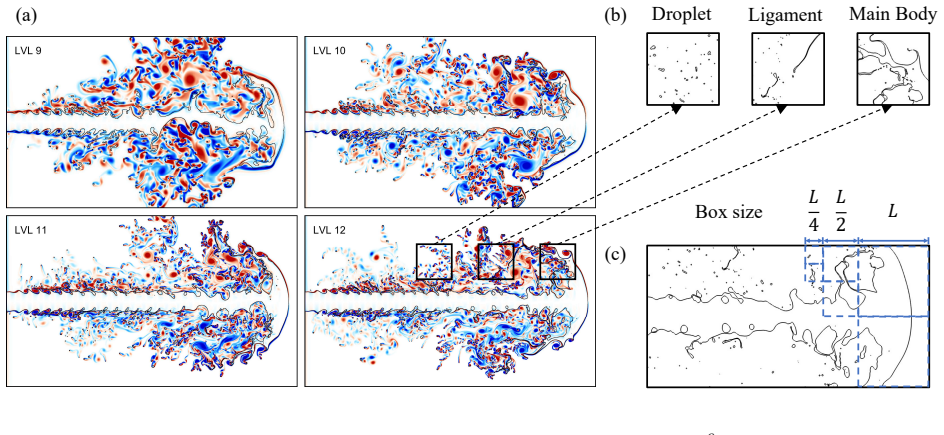
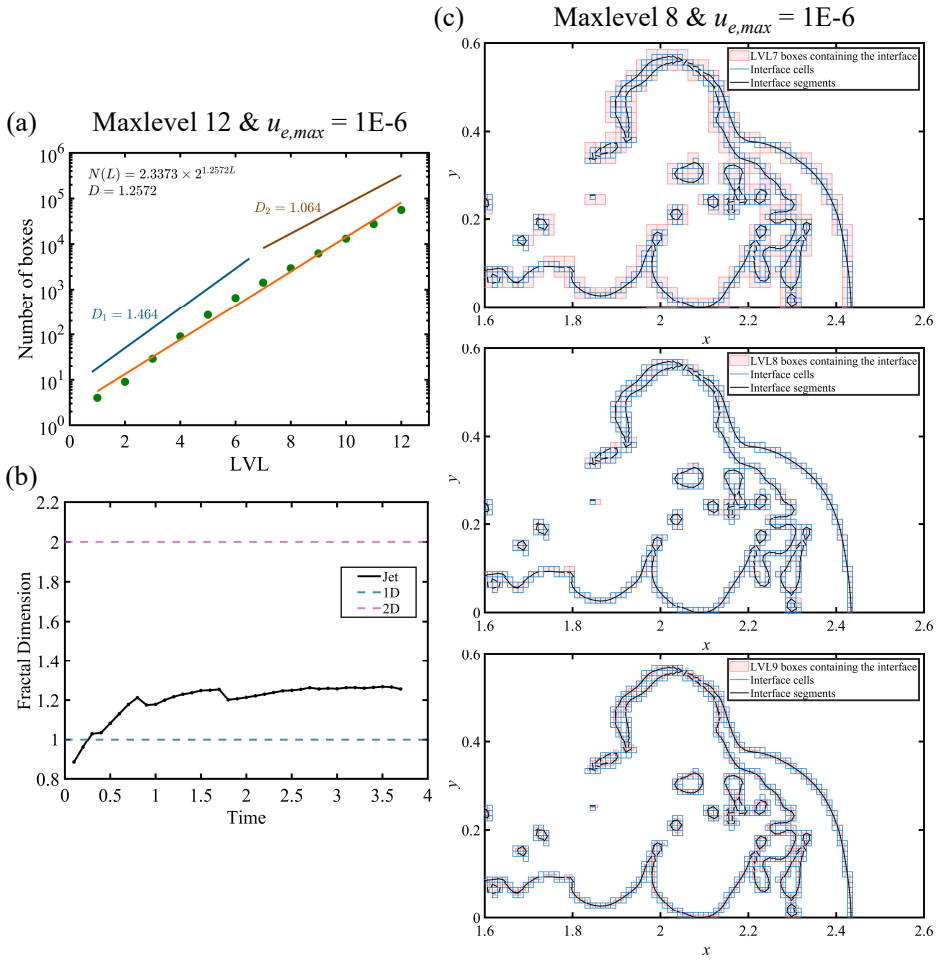
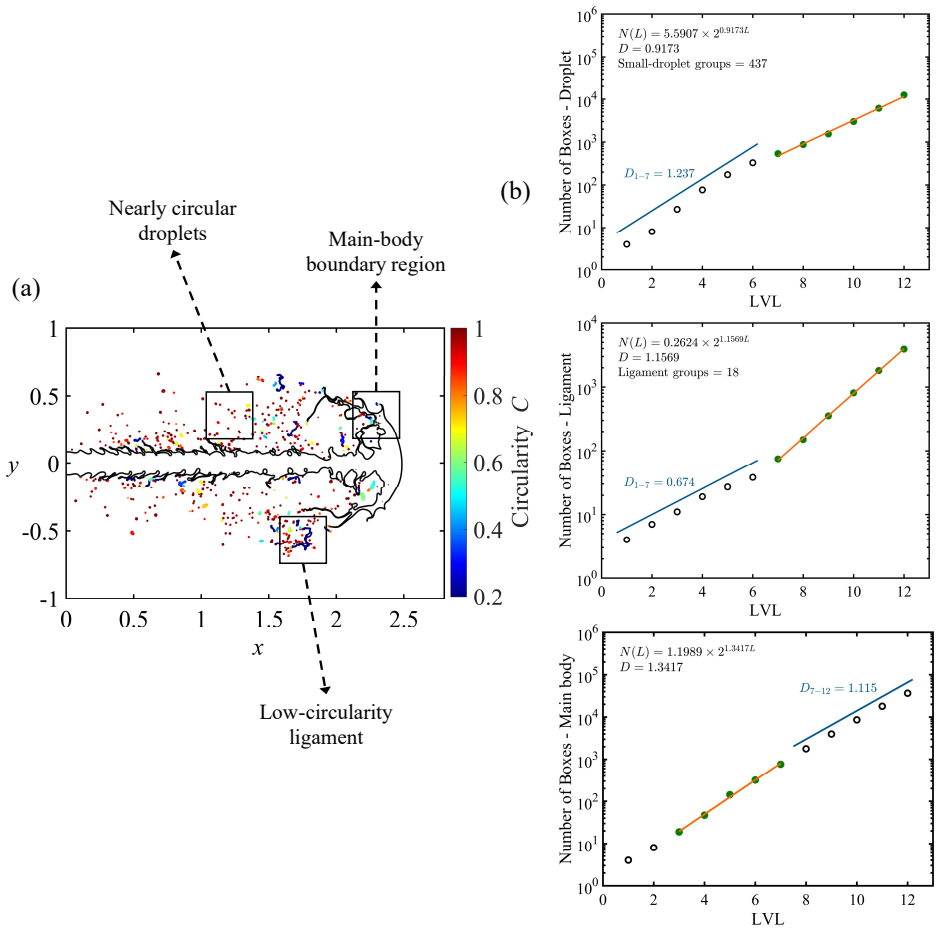
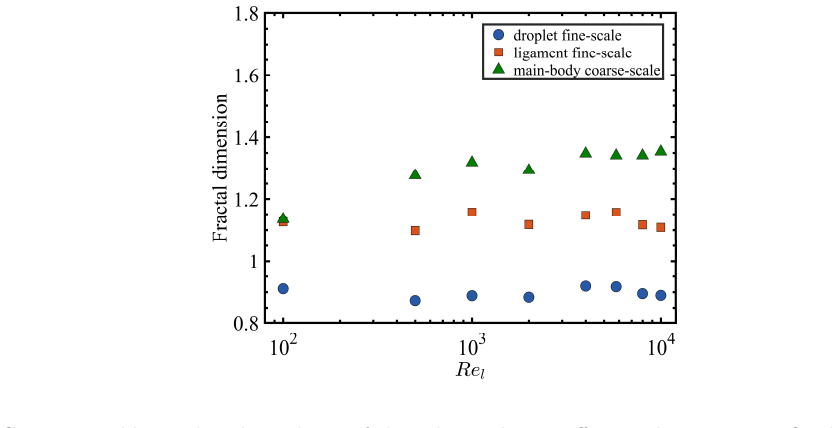
In two-dimensional VOF-DNS of a liquid jet, box-counting fractal dimensions exhibit two distinct scaling ranges separated near a box-counting level of about 7. Coarser boxes capture the folded connected jet envelope, while finer boxes increasingly sample ligaments, droplets, and nearly smooth local interface segments. Decomposing the interface into detached droplets, ligaments, and the connected main body reveals that the effective dimension is structure-dependent: droplets remain near Euclidean at fine scales, ligaments occupy an intermediate level, and the main body carries the largest coarse-scale dimension. This hierarchy persists for liquid Reynolds numbers from 100 to 10000 at fixedgas
What carries the argument
Box counting performed separately on the decomposed interface components (detached droplets, ligaments, and connected main body) within adaptively refined two-dimensional VOF-DNS simulations.
If this is right
- Fractal dimension functions as a scale- and structure-resolved state variable that tracks the progress of interfacial folding and breakup.
- Global fractal measures applied to the whole interface without decomposition will mix distinct physical regimes and lose information about local breakup.
- The crossover scale near box size 7 marks the transition from global jet envelope geometry to local ligament and droplet formation.
- The consistent hierarchy of dimensions across a wide Reynolds-number range indicates that structure dependence is a robust feature of the breakup process in this setting.
Where Pith is reading between the lines
- The scale-dependent behavior could be used to monitor atomization progress in simulations by tracking when the fine-scale dimension drops as droplets detach.
- Similar decomposition into structures might reveal comparable crossovers in three-dimensional simulations, providing a bridge to experimental droplet-size distributions.
- Models of atomization that incorporate local fractal dimension as an input could adjust breakup rates according to whether the interface is still in the folded-envelope regime or the ligament-droplet regime.
Load-bearing premise
The two-dimensional approximation and box counting on adaptively refined meshes faithfully capture the fractal properties of real three-dimensional atomization without dominant numerical artifacts from interface reconstruction or resolution limits.
What would settle it
A single scale-independent exponent appearing when the same box-counting procedure is applied to the full interface in otherwise identical simulations at higher resolution would contradict the reported two-range and structure-dependent behavior.
Figures

read the original abstract
Atomization stretches and folds the liquid-gas interface before fragmenting it into ligaments and droplets, making fractal measures a natural descriptor of the breakup state. We examine this idea in two-dimensional volume-of-fluid direct numerical simulations, VOF-DNS, of a liquid jet with adaptive mesh refinement in Basilisk. Box counting of the full resolved interface does not yield a single scale-independent exponent. Instead, two scaling ranges appear, separated by a crossover near box-counting level Lbox about 7: coarser boxes measure the folded connected jet envelope, whereas finer boxes increasingly sample ligaments, droplets, and nearly smooth local interface segments. Decomposing the interface into detached droplets, ligaments, and the connected main body shows that the relevant effective dimension is structure dependent. Droplets remain near Euclidean at fine scales, ligaments occupy an intermediate level, and the main body carries the largest coarse-scale dimension. This hierarchy persists for liquid Reynolds numbers from 100 to 10000 at fixed gas Weber number 200. Thus, in this two-dimensional VOF-DNS setting, fractal dimension is best interpreted not as a single global exponent, but as a scale- and structure-resolved state variable for interfacial folding and breakup.
Editorial analysis
A structured set of objections, weighed in public.
Referee Report
Summary. The manuscript reports two-dimensional volume-of-fluid direct numerical simulations (VOF-DNS) of a liquid jet atomization using the Basilisk code with adaptive mesh refinement. Through box-counting analysis of the resolved liquid-gas interface, it demonstrates that the fractal dimension is not a single scale-independent value but exhibits two distinct scaling regimes separated by a crossover at approximately Lbox = 7. Further decomposition into structural components (droplets, ligaments, main body) reveals structure-specific effective dimensions that maintain a consistent hierarchy across Reynolds numbers from 100 to 10000 at fixed Weber number 200. The authors conclude that fractal dimension is best interpreted as a scale- and structure-resolved state variable for interfacial dynamics in this setting.
Significance. If the numerical observations prove robust, the work offers a useful reframing of fractal measures in atomization as diagnostics that capture scale-dependent folding and structure-specific breakup rather than a single global exponent. This could inform subgrid modeling in multiphase simulations. The persistence of the dimension hierarchy across a decade in Re at fixed We is a clear strength of the presented data set.
major comments (2)
- [Box-counting analysis] Box-counting results: the crossover scale near Lbox ≈ 7 is presented as separating the folded jet envelope from finer ligament/droplet sampling, but no resolution studies, grid-convergence checks, or sensitivity to minimum cell size are reported; because this crossover underpins the central claim that a single exponent is inadequate, its numerical origin must be verified.
- [Structure decomposition] Structure decomposition: the reported ordering (droplets near Euclidean, ligaments intermediate, main body largest at coarse scales) is shown to persist for Re = 100–10000, yet no error bars, standard deviations from ensemble runs, or statistical convergence metrics accompany the effective dimensions; without these, the robustness of the hierarchy as a state variable remains difficult to assess.
minor comments (2)
- The definition and normalization of the box-counting level Lbox should be stated explicitly (including its relation to the adaptive mesh) in the methods or results section to allow reproduction.
- Figure captions would benefit from indicating the specific Re values and the number of snapshots averaged for each box-counting curve.
Simulated Author's Rebuttal
We thank the referee for the constructive comments and the opportunity to strengthen the manuscript. We address each major comment below.
read point-by-point responses
-
Referee: [Box-counting analysis] Box-counting results: the crossover scale near Lbox ≈ 7 is presented as separating the folded jet envelope from finer ligament/droplet sampling, but no resolution studies, grid-convergence checks, or sensitivity to minimum cell size are reported; because this crossover underpins the central claim that a single exponent is inadequate, its numerical origin must be verified.
Authors: We agree that explicit verification of the crossover's numerical independence is necessary to support the claim that a single exponent is inadequate. The Basilisk AMR setup resolves the interface to a minimum cell size well below the reported crossover (Lbox ≈ 7), but we did not include dedicated sensitivity tests in the original manuscript. In the revision we will add results from simulations performed at one additional refinement level (halved minimum cell size) for at least two Reynolds numbers; these will confirm that the location and character of the crossover remain unchanged, thereby establishing that it is not an artifact of the grid. revision: yes
-
Referee: [Structure decomposition] Structure decomposition: the reported ordering (droplets near Euclidean, ligaments intermediate, main body largest at coarse scales) is shown to persist for Re = 100–10000, yet no error bars, standard deviations from ensemble runs, or statistical convergence metrics accompany the effective dimensions; without these, the robustness of the hierarchy as a state variable remains difficult to assess.
Authors: We acknowledge that the absence of variability measures limits the ability to judge the statistical robustness of the reported dimension hierarchy. The presented data come from single deterministic runs. In the revised manuscript we will perform a small ensemble (three to five realizations with perturbed initial conditions) for a representative Reynolds number and report standard deviations of the structure-specific effective dimensions. We will also document the sensitivity of the hierarchy to the connectivity and size thresholds used to classify droplets, ligaments, and the main body. These additions will allow quantitative assessment of the ordering's stability. revision: yes
Circularity Check
No significant circularity detected
full rationale
The paper reports direct measurements from 2D VOF-DNS simulations: box-counting applied to the resolved interface yields two scaling ranges separated near Lbox ≈ 7, and decomposition into droplets, ligaments, and main body produces structure-specific effective dimensions that persist across Re values. These are empirical outputs of the numerical method and post-processing, not derivations that reduce by construction to fitted inputs or self-referential definitions. No predictions, uniqueness theorems, or ansatzes are invoked; the interpretive conclusion that fractal dimension functions as a scale- and structure-resolved diagnostic follows immediately from the observed data hierarchy without circular reduction.
Axiom & Free-Parameter Ledger
axioms (2)
- domain assumption Volume-of-fluid interface tracking with adaptive mesh refinement accurately captures the resolved liquid-gas boundary in 2D incompressible flow.
- domain assumption Box-counting dimension on the discrete interface provides a meaningful measure of fractal scaling in the presence of numerical smoothing.
Reference graph
Works this paper leans on
-
[1]
The panel illustrates how the covering scale changes the geometry sampled by the count. ligaments, detached droplets, and reconstructed VOF facets, whose geometry is closer to 7 locally one-dimensional contours. The crossover therefore marks the transition from a coarse- scale envelope regime to a fine-scale fragment-and-contour regime, rather than a univ...
-
[2]
The values are extracted using the fitting windows identified in Fig. 3: fine-scale fits for detached droplets and ligament-like fragments, and a coarse-scale fit for the connected main body. The figure is not intended as a scaling law forD(Re l), but as a robustness test of the geometrical hierarchy. AcrossRe l = 100–104, droplets remain closest to the n...
-
[3]
A. H. Lefebvre and V. G. McDonell,Atomization and sprays(CRC press, 2017)
work page 2017
-
[4]
L. P. Bayvel,Liquid atomization(Routledge, 2019)
work page 2019
-
[5]
C. I. Pairetti, S. M. Damian, N. M. Nigro, S. Popinet, and S. Zaleski, Mesh resolution effects on primary atomization simulations, Atomization and Sprays30(2020)
work page 2020
-
[6]
Y. Kulkarni, C. Pairetti, R. Villiers, S. Popinet, and S. Zaleski, The atomising pulsed jet, Journal of Fluid Mechanics1009, A35 (2025)
work page 2025
-
[7]
C. W. Hirt and B. D. Nichols, Volume of fluid (vof) method for the dynamics of free boundaries, Journal of computational physics39, 201 (1981)
work page 1981
-
[8]
S. Popinet, An accurate adaptive solver for surface-tension-driven interfacial flows, Journal of Computational Physics228, 5838 (2009)
work page 2009
-
[9]
P. Moin and K. Mahesh, Direct numerical simulation: a tool in turbulence research, Annual review of fluid mechanics30, 539 (1998)
work page 1998
-
[10]
S. Osher and J. A. Sethian, Fronts propagating with curvature-dependent speed: Algorithms based on hamilton-jacobi formulations, Journal of computational physics79, 12 (1988)
work page 1988
-
[11]
M. Sussman, P. Smereka, and S. Osher, A level set approach for computing solutions to incompressible two-phase flow, Journal of Computational physics114, 146 (1994)
work page 1994
-
[12]
M. Sussman and E. G. Puckett, A coupled level set and volume-of-fluid method for computing 3d and axisymmetric incompressible two-phase flows, Journal of computational physics162, 301 (2000)
work page 2000
-
[13]
T. M´ enard, S. Tanguy, and A. Berlemont, Coupling level set/vof/ghost fluid methods: Vali- dation and application to 3d simulation of the primary break-up of a liquid jet, International Journal of Multiphase Flow33, 510 (2007)
work page 2007
-
[14]
M. Herrmann, Detailed numerical simulations of the primary atomization of a turbulent liquid jet in crossflow, Journal of Engineering for Gas Turbines and Power132, 061506 (2010)
work page 2010
-
[15]
L. F. Richardson,Weather prediction by numerical process(Franklin Classics, 1922). 14
work page 1922
-
[16]
A. N. Kolmogorov, A refinement of previous hypotheses concerning the local structure of tur- bulence in a viscous incompressible fluid at high reynolds number, Journal of Fluid Mechanics 13, 82 (1962)
work page 1962
-
[17]
A. N. Kolmogorov, The local structure of turbulence in incompressible viscous fluid for very large reynolds numbers, Proceedings of the Royal Society of London. Series A: Mathematical and Physical Sciences434, 9 (1991)
work page 1991
-
[18]
K. R. Sreenivasan, Fractals and multifractals in fluid turbulence, Annual review of fluid me- chanics23, 539 (1991)
work page 1991
-
[19]
K. R. Sreenivasan and C. Meneveau, The fractal facets of turbulence, Journal of Fluid Me- chanics173, 357–386 (1986)
work page 1986
-
[20]
B. B. Mandelbrot, The fractal geometry of nature/revised and enlarged edition, New York (1983)
work page 1983
-
[21]
R. R. Prasad and K. Sreenivasan, Quantitative three-dimensional imaging and the structure of passive scalar fields in fully turbulent flows, Journal of Fluid Mechanics216, 1 (1990)
work page 1990
-
[22]
P. Constantin, I. Procaccia, and K. Sreenivasan, Fractal geometry of isoscalar surfaces in turbulence: theory and experiments, Physical review letters67, 1739 (1991)
work page 1991
-
[23]
C. Xu, Y. Long, and J. Wang, Entrainment mechanism of turbulent synthetic jet flow, Journal of Fluid Mechanics958, A31 (2023)
work page 2023
- [24]
-
[25]
F. C. Gouldin, An application of fractals to modeling premixed turbulent flames, Combustion and flame68, 249 (1987)
work page 1987
-
[26]
R. A. El-Nabulsi and W. Anukool, Fractal dimensions in fluid dynamics and their effects on the rayleigh problem, the burger’s vortex and the kelvin–helmholtz instability, Acta Mechanica 233, 363 (2022)
work page 2022
-
[27]
J. Muller and J. McCauley, Implication of fractal geometry for fluid flow properties of sedi- mentary rocks, Transport in Porous Media8, 133 (1992)
work page 1992
-
[28]
P. Constantin, C. Foias, O. P. Manley, and R. Temam, Determining modes and fractal dimen- sion of turbulent flows, Journal of Fluid Mechanics150, 427 (1985)
work page 1985
- [29]
-
[30]
R. A. El-Nabulsi and W. Anukool, Foam drainage equation in fractal dimensions: breaking and instabilities, The European Physical Journal E46, 110 (2023)
work page 2023
-
[31]
Popinetet al., Basilisk C,https://basilisk.fr/(2013–2026), last accessed: April 2026
S. Popinetet al., Basilisk C,https://basilisk.fr/(2013–2026), last accessed: April 2026
work page 2013
-
[32]
S. Popinet, A quadtree-adaptive multigrid solver for the serre–green–naghdi equations, Journal of Computational Physics302, 336 (2015)
work page 2015
-
[33]
Theiler, Estimating fractal dimension, Journal of the optical society of America A7, 1055 (1990)
J. Theiler, Estimating fractal dimension, Journal of the optical society of America A7, 1055 (1990)
work page 1990
-
[34]
Falconer,Fractal geometry: mathematical foundations and applications(John Wiley & Sons, 2013)
K. Falconer,Fractal geometry: mathematical foundations and applications(John Wiley & Sons, 2013)
work page 2013
-
[35]
Wadell, Volume, shape, and roundness of quartz particles, The Journal of geology43, 250 (1935)
H. Wadell, Volume, shape, and roundness of quartz particles, The Journal of geology43, 250 (1935)
work page 1935
-
[36]
S. J. Blott and K. Pye, Particle shape: a review and new methods of characterization and classification, Sedimentology55, 31 (2008)
work page 2008
-
[37]
P. Marmottant and E. Villermaux, On spray formation, Journal of fluid mechanics498, 73 (2004)
work page 2004
-
[38]
Villermaux, Fragmentation, Annu
E. Villermaux, Fragmentation, Annu. Rev. Fluid Mech.39, 419 (2007)
work page 2007
-
[39]
J. Eggers and E. Villermaux, Physics of liquid jets, Reports on progress in physics71, 036601 (2008)
work page 2008
-
[40]
Y. Ling, S. Zaleski, and R. Scardovelli, Multiscale simulation of atomization with small droplets represented by a lagrangian point-particle model, International Journal of Multiphase Flow76, 122 (2015)
work page 2015
-
[41]
J. Eggers, Nonlinear dynamics and breakup of free-surface flows, Reviews of modern physics 69, 865 (1997)
work page 1997
-
[42]
J. Mantzaras, P. Felton, and F. Bracco, Fractals and turbulent premixed engine flames, Com- bustion and flame77, 295 (1989)
work page 1989
-
[43]
M. Murayama and T. Takeno, Fractal-like character of flamelets in turbulent premixed com- bustion, inSymposium (International) on Combustion, Vol. 22 (Elsevier, 1989) pp. 551–559
work page 1989
-
[44]
F. Thiesset, G. Maurice, F. Halter, N. Mazellier, C. Chauveau, and I. G¨ okalp, Geometrical properties of turbulent premixed flames and other corrugated interfaces, Physical Review E 93, 013116 (2016). 16
work page 2016
discussion (0)
Sign in with ORCID, Apple, or X to comment. Anyone can read and Pith papers without signing in.