Molecular Dynamics simulations of Al-Ti metallic alloy melts using a transferable machine-learning potential
Pith reviewed 2026-05-07 13:11 UTC · model grok-4.3
The pith
A machine-learning potential trained only on solids accurately simulates Al-Ti liquid alloy melts.
A machine-rendered reading of the paper's core claim, the machinery that carries it, and where it could break.
Core claim
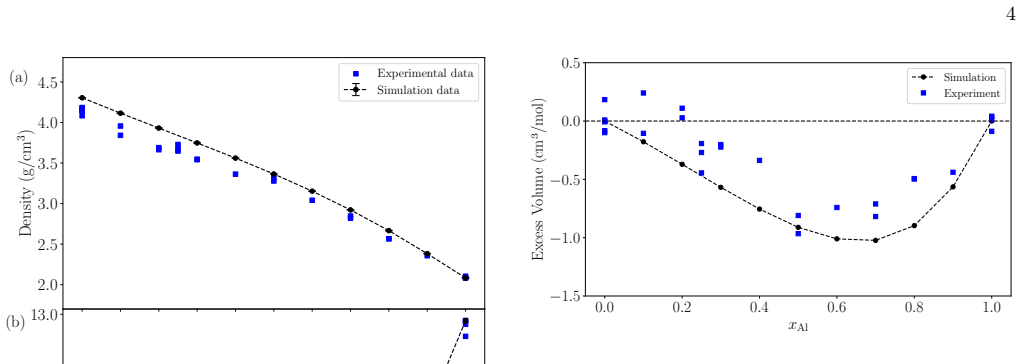
The transferable machine-learning potential, although trained exclusively on solid properties, reproduces experimental data for the liquid Al-Ti alloys well. Excess volume and structural changes with composition are captured accurately. Simulations disentangle local packing from chemical-ordering effects, revealing weak chemical ordering. Dynamical properties such as viscosity and diffusion coefficients are also obtained from the simulations.
What carries the argument
The transferable machine-learning potential trained on solid Al-Ti properties, used in molecular dynamics simulations to model liquid melts.
If this is right
- Excess volume in the liquid alloys can be predicted from solid-trained models.
- Compositional dependence of structure in melts is accessible via simulation.
- Chemical ordering is weak, so local packing dominates structural behavior.
- Viscosity and diffusion coefficients can be simulated for various conditions.
Where Pith is reading between the lines
- This approach could reduce the need for liquid-specific training data in alloy modeling.
- Similar transferable potentials might apply to other metallic alloy systems.
- It opens a route to study solid-liquid phase transitions with a single potential.
- Predictions at unmeasured compositions or temperatures can be tested experimentally.
Load-bearing premise
The machine-learning potential trained on solid properties remains accurate enough for liquid-state simulations without retraining or adjustments.
What would settle it
A significant mismatch between simulated and measured excess volumes or structure factors at high temperatures would indicate the potential fails for liquids.
Figures



read the original abstract
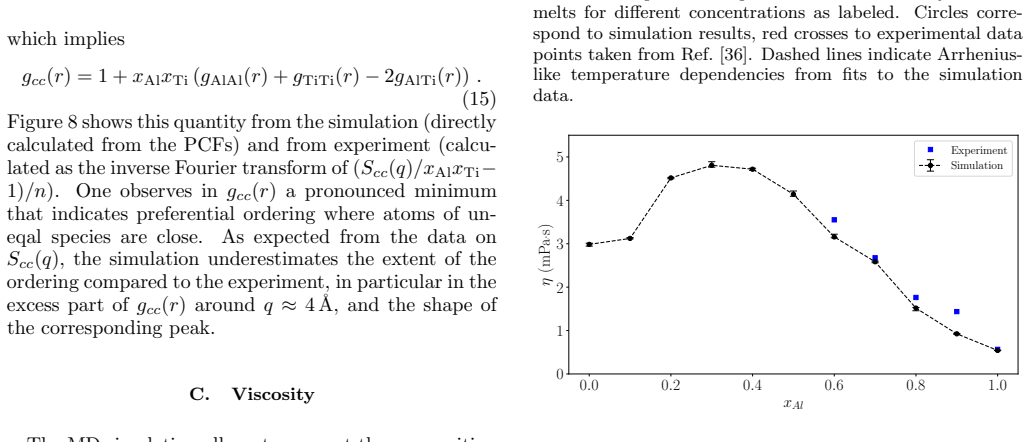
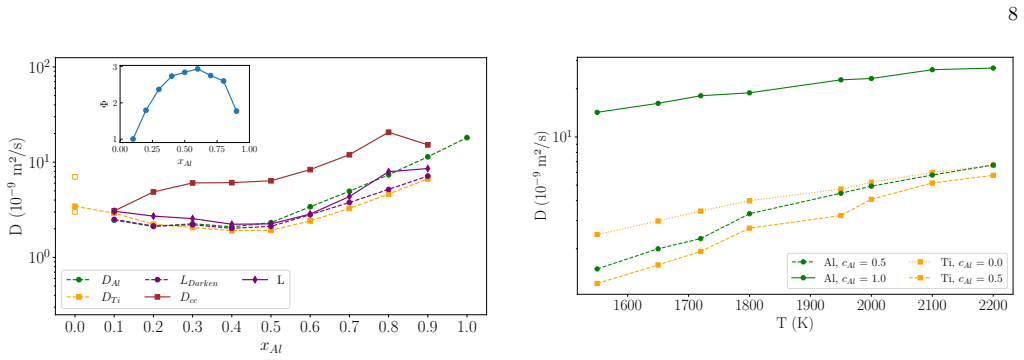
We investigate the structural and dynamical properties of binary aluminum-titanium liquid metallic alloys, as a function of temperature and composition. We make use of MD-simulations, using a transferable machine-learning potential developed by Song et al. [Nature Communications 15, 10208 (2024)], and compare our results to experimental data. Although this potential was initially trained on solid properties, we find good agreement between the experimental data and the simulation results for the liquid state. The excess volume and compositional changes of the structure are captured well by the machine-learned potential. The simulation allows to disentangle local packing from chemical-ordering effects; the latter are found to be weak in Al-Ti. Dynamical quantities like the viscosity and the diffusion coefficients are also discussed.
Editorial analysis
A structured set of objections, weighed in public.
Referee Report
Summary. The manuscript reports molecular dynamics simulations of Al-Ti binary liquid metallic alloys using a transferable machine-learning potential originally trained on solid configurations (Song et al., Nat. Commun. 2024). It compares simulated excess volumes, partial structure factors, viscosity, and diffusion coefficients to experimental data across temperature and composition, concluding that the potential transfers well to the liquid state, that chemical ordering is weak, and that local packing effects can be disentangled from ordering.
Significance. If the transferability holds, the work shows that solid-trained ML potentials can be applied directly to metallic alloy melts for efficient exploration of structural and dynamical properties, with independent experimental benchmarks providing a non-circular validation route. This could reduce the need for liquid-specific retraining in materials modeling.
major comments (2)
- [Abstract] Abstract: the claim of 'good agreement' with experiment on excess volume and compositional changes of the structure is stated without quantitative error metrics (e.g., mean absolute percentage error or R² for volume vs. composition curves) or reference to direct comparison plots; this leaves the strength of the transferability conclusion difficult to assess.
- [Results] Results section (discussion of structure and dynamics): the central transferability assertion would benefit from an explicit side-by-side comparison of ML-MD pair-correlation functions or self-diffusion coefficients against AIMD trajectories at identical compositions and temperatures, to exclude the possibility that experimental agreement arises from error cancellation rather than accurate reproduction of liquid-state physics.
minor comments (1)
- [Methods] Methods: specify the precise set of compositions and temperature points simulated and confirm they match the experimental datasets used for comparison.
Simulated Author's Rebuttal
We thank the referee for their constructive comments, which help clarify the presentation of our results on the transferability of the solid-trained ML potential to Al-Ti melts. We respond to each major comment below and indicate the revisions made.
read point-by-point responses
-
Referee: [Abstract] Abstract: the claim of 'good agreement' with experiment on excess volume and compositional changes of the structure is stated without quantitative error metrics (e.g., mean absolute percentage error or R² for volume vs. composition curves) or reference to direct comparison plots; this leaves the strength of the transferability conclusion difficult to assess.
Authors: We agree that quantitative metrics strengthen the assessment of agreement. In the revised manuscript we have added mean absolute percentage error values for the excess volume across the studied compositions and temperatures, along with R² coefficients for the volume-composition trends. We have also inserted explicit references to the relevant figures (Figs. 2 and 3) directly in the abstract so that readers can immediately locate the supporting data. revision: yes
-
Referee: [Results] Results section (discussion of structure and dynamics): the central transferability assertion would benefit from an explicit side-by-side comparison of ML-MD pair-correlation functions or self-diffusion coefficients against AIMD trajectories at identical compositions and temperatures, to exclude the possibility that experimental agreement arises from error cancellation rather than accurate reproduction of liquid-state physics.
Authors: We acknowledge the referee’s point that an AIMD benchmark would further isolate potential error cancellation. However, the manuscript’s validation strategy is deliberately non-circular: the potential was trained exclusively on solid configurations (Song et al., Nat. Commun. 2024) and is tested against independent experimental measurements of volume, structure, viscosity, and diffusion in the liquid. Because AIMD itself requires validation against the same experimental data and carries its own uncertainties (exchange-correlation functional, finite-size effects), we maintain that the multi-property experimental agreement already supports faithful reproduction of liquid-state physics. In the revised text we have added a paragraph in the Results section explicitly addressing this concern and reiterating why direct AIMD comparison was not performed. revision: partial
Circularity Check
No circularity: external potential validated against independent experiments
full rationale
The paper applies an externally developed ML potential (Song et al. Nature Comm. 2024) to MD simulations and directly compares outputs (excess volume, partial structure factors, viscosity, diffusion) to independent experimental measurements. No equations, fitted parameters, or self-citations reduce any reported quantity to an input defined inside this work. The central claim of transferability is an empirical test against external data, not a self-referential construction.
Axiom & Free-Parameter Ledger
axioms (1)
- domain assumption The machine-learning potential remains accurate for liquid Al-Ti without retraining.
Reference graph
Works this paper leans on
-
[1]
J. Brillo,Thermophysical properties of multicomponent liquid alloys(Walter de Gruyter GmbH & Co KG, 2016)
work page 2016
-
[2]
Y. J. Lv and M. Chen, Thermophysical properties of un- dercooled alloys: An overview of the molecular simula- tion approaches, International Journal of Molecular Sci- ences12, 278 (2011)
work page 2011
-
[3]
S. Terekhov, Application of the mixing rule to evaluation of the thermophysical properties of amorphous Fe 80B20 alloy, Inorganic Materials59, 926 (2023)
work page 2023
-
[4]
S.-S. Li, X. Yue, Q.-Y. Li, H.-L. Peng, B.-X. Dong, T.- S. Liu, H.-Y. Yang, J. Fan, S.-L. Shu, F. Qiu,et al., Development and applications of aluminum alloys for aerospace industry, Journal of materials research and technology27, 944 (2023)
work page 2023
-
[5]
A. A. Alghannam, M. S. Soliman, A. H. Seikh, I. A. Alnaser, A. Fouly, J. A. Mohammed, S. A. Ragab, and H. S. Abdo, Investigation on mechanical properties and corrosion resistance of Ti-modified AA5083 aluminum al- loy for aerospace and automotive applications, Scientific Reports13, 11535 (2023)
work page 2023
-
[6]
J. R. Daviset al.,Aluminum and aluminum alloys(ASM international, 1993)
work page 1993
-
[7]
B. N. Bhat, A. B. Pandey, S. Tamirisakandala, M. V. Nathal, D. L. Ellis, P. B. McGill, J. A. Lee, S. E. Davis, J. Koo, A. Nettles,et al.,Aerospace materials character- istics, Tech. Rep. (American Institute of Aeronautics and Astronautics, 2018)
work page 2018
-
[8]
Y. Plevachuk, I. Egry, J. Brillo, D. Holland-Moritz, and I. Kaban, Density and atomic volume in liquid Al–Fe and Al–Ni binary alloys, International journal of materials research98, 107 (2007)
work page 2007
- [9]
-
[10]
H. Peng, T. Voigtmann, G. Kolland, H. Kobatake, and J. Brillo, Structural and dynamical properties of liquid al-au alloys, Physical Review B92, 184201 (2015)
work page 2015
- [11]
-
[12]
R. R. Zope and Y. Mishin, Interatomic potentials for atomistic simulations of the Ti-Al system, Physical Re- view B68, 024102 (2003)
work page 2003
-
[13]
N. Li, Z. Hao, L. Xu, M. Tang, L. Wei, and L. Wang, A review of molecular dynamics simulation of different Ti-Al-based alloys, Metals14, 1018 (2024)
work page 2024
-
[14]
J. Horbach, R. E. Rozas, T. Unruh, and A. Meyer, Im- provement of computer simulation models for metallic melts via quasielastic neutron scattering: A case study of liquid titanium, Phys. Rev. B80, 212203 (2009)
work page 2009
-
[15]
A. Fellman, J. Byggm¨ astar, F. Granberg, K. Nordlund, and F. Djurabekova, Fast and accurate machine-learned interatomic potentials for large-scale simulations of Cu, Al, and Ni, Physical Review Materials9, 053807 (2025)
work page 2025
-
[16]
J. Sandberg, T. Voigtmann, E. Devijver, and N. Jakse, Homogeneous nucleation of undercooled Al-Ni melts via a machine-learned interaction potential, arXiv preprint arXiv:2410.07886 (2024)
-
[17]
Z. Zhao, M. Yi, W. Guo, and Z. Zhang, General-purpose neural network potential for Ti-Al-Nb alloys towards large-scale molecular dynamics with ab initio accuracy, Physical Review B110, 184115 (2024)
work page 2024
- [18]
-
[19]
K. Song, R. Zhao, J. Liu, Y. Wang, E. Lindgren, Y. Wang, S. Chen, K. Xu, T. Liang, P. Ying,et al., General-purpose machine-learned potential for 16 ele- mental metals and their alloys, Nature Communications 15, 10208 (2024)
work page 2024
- [20]
-
[21]
S. Liu, G. Zhang, F. Yin, A. Barinov, V. Khvesyuk, and N. Yang, Temperature dependence of specific heat capac- ity of nanostructures via neuroevolution machine-learned potential, Journal of Applied Physics138(2025)
work page 2025
- [22]
-
[23]
X. Jia, Y. Bao, S. Cao, Y. Su, and P. Qian, Temperature effects on radiation damage in hcp-zirconium: A molec- ular dynamics study using a fine-tuned machine-learned potential, Available at SSRN 5225377
-
[24]
B. Zhai and H. P. Wang, Accurate interatomic potential for the nucleation in liquid Ti-Al binary alloy developed by deep neural network learning method, Comp. Mater. Sci.216, 111843 (2023)
work page 2023
-
[25]
A. P. Thompson, H. M. Aktulga, R. Berger, D. S. Bolin- tineanu, W. M. Brown, P. S. Crozier, P. J. In’t Veld, A. Kohlmeyer, S. G. Moore, T. D. Nguyen,et al., Lammps – a flexible simulation tool for particle-based materials modeling at the atomic, meso, and continuum scales, Computer physics communications271, 108171 (2022)
work page 2022
-
[26]
J. Horbach, S. K. Das, A. Griesche, M.-P. Macht, G. Fro- hberg, and A. Meyer, Self-diffusion and interdiffusion in Al80Ni20 melts: Simulation and experiment, Physical Re- view B—Condensed Matter and Materials Physics75, 174304 (2007)
work page 2007
-
[27]
L. S. Darken, Diffusion, mobility and their interrelation through free energy in binary metallic systems, Trans. Aime175, 184 (1948). [28]Function to calculate the radial distribution function, https://docs.lammps.org/compute_rdf.html
work page 1948
- [28]
-
[29]
M. Mohr, Y. Dong, G. Bracker, D. Matson, R. Zbo- ray, R. Frison, A. Domman, A. Neels, X. Xiao, J. Brillo, R. Busch, R. Novakovic, P. Srirangam, and H.-J. Fecht, Electromagnetic levitation containerless processing of metallic materials in microgravity: thermophysical prop- erties, npj microgravity9, (2023)
work page 2023
- [30]
-
[31]
D. Holland-Moritz, T. Schenk, P. Convert, T. Hansen, and D. M. Herlach, Electromagnetic levitation apparatus for diffraction investigations on the short-range order of undercooled metallic melts, Meas. Sci. Technol.16, 372 (2005)
work page 2005
- [32]
-
[33]
D. Holland-Moritz, O. Heinen, R. Bellissent, and T. Schenk, Short-range order of stable and undercooled liquid titanium, Materials Science and Engineering: A 449, 42 (2007)
work page 2007
-
[34]
A. B. Bhatia and D. E. Thornton, Structural aspects of the electrical resistivity of binary alloys, Phys. Rev. B2, 3004 (1970)
work page 1970
- [35]
- [36]
- [37]
-
[38]
Y. Feng, Y. Feng, and H.-L. Peng, Ab initio study of chemical effect on structural properties of Ti-Al melts, Chin. Phys. B32, 106101 (2023)
work page 2023
-
[39]
Verlet, Computer ’experiments’ on classical fluids
L. Verlet, Computer ’experiments’ on classical fluids. II. Equilibrium correlation functions, Physical Review165, 201 (1968)
work page 1968
-
[40]
J.-P. Hansen and I. R. McDonald,Theory of simple liq- uids: with applications to soft matter(Academic press, 2013)
work page 2013
-
[41]
R. Novakovic, D. Giuranno, M. Mohr, J. Brillo, and H.-J. Fecht, Viscosity of liquid Ni-based industrial alloys: ex- periments versus theory, International Materials Reviews 69, 63 (2024)
work page 2024
- [42]
-
[43]
Brillo,Thermophysical properties of multicomponent lioquid alloys(de Gruyter, Berlin, Germany, 2026)
J. Brillo,Thermophysical properties of multicomponent lioquid alloys(de Gruyter, Berlin, Germany, 2026)
work page 2026
-
[44]
P. Kuhn, J. Horbach, F. Kargl, A. Meyer, and T. Voigt- mann, Diffusion and interdiffusion in binary metallic 12 melts, Phys. Rev. B90, 024309 (2014)
work page 2014
-
[45]
J. C. Slater, Atomic radii in crystals, The Journal of chemical physics41, 3199 (1964)
work page 1964
- [46]
- [47]
-
[48]
D. B. Miracle, D. Louzguine-Luzgin, L. Louzguina- Luzgina, and A. Inoue, An assessment of binary metal- lic glasses: Correlations between structure, glass forming ability and stability, Int. Mater. Rev.55, 218 (2010)
work page 2010
-
[49]
F. Pabst and S. Baroni, Glassy dynamics in a glass- forming liquid: A first-principles study of toluene, Phys- ical Review E111, L023401 (2025)
work page 2025
-
[50]
Y. Kato, J. Brillo, T. Voigtmann, and L. Heit- meier, Simulation data for ”Molecular Dynamics simulations of Al-Ti metallic alloy melts using a transferable machine-learning potential” (2025), DOI:10.5281/zenodo.18877206
discussion (0)
Sign in with ORCID, Apple, or X to comment. Anyone can read and Pith papers without signing in.