Geodesically Complete Curvature-Bounce Inflation
Pith reviewed 2026-05-07 08:44 UTC · model grok-4.3
The pith
Positive spatial curvature permits a nonsingular bounce followed by standard inflation using one scalar field in general relativity.
A machine-rendered reading of the paper's core claim, the machinery that carries it, and where it could break.
Core claim
A geodesically complete closed k=+1 bounce-plus-inflation cosmology is realized in ordinary general relativity, sourced by a single canonical scalar field with a positive vacuum offset. The bounce is supported by curvature rather than exotic stress energy, the matter content satisfies the NEC throughout and violates only the strong energy condition, and the solved branch remains sub-Planckian before evolving onto a curvature-diluted slow-roll phase whose observables match current constraints.
What carries the argument
The closed FRW metric with positive spatial curvature k=+1 combined with a scalar field potential that has a positive vacuum energy offset, allowing curvature to drive the bounce while the field later supports slow-roll inflation.
If this is right
- The model yields n_s=0.9617 and r=0.0045 at N_*=55, and n_s=0.9650 and r=0.0037 at N_*=60, consistent with current data.
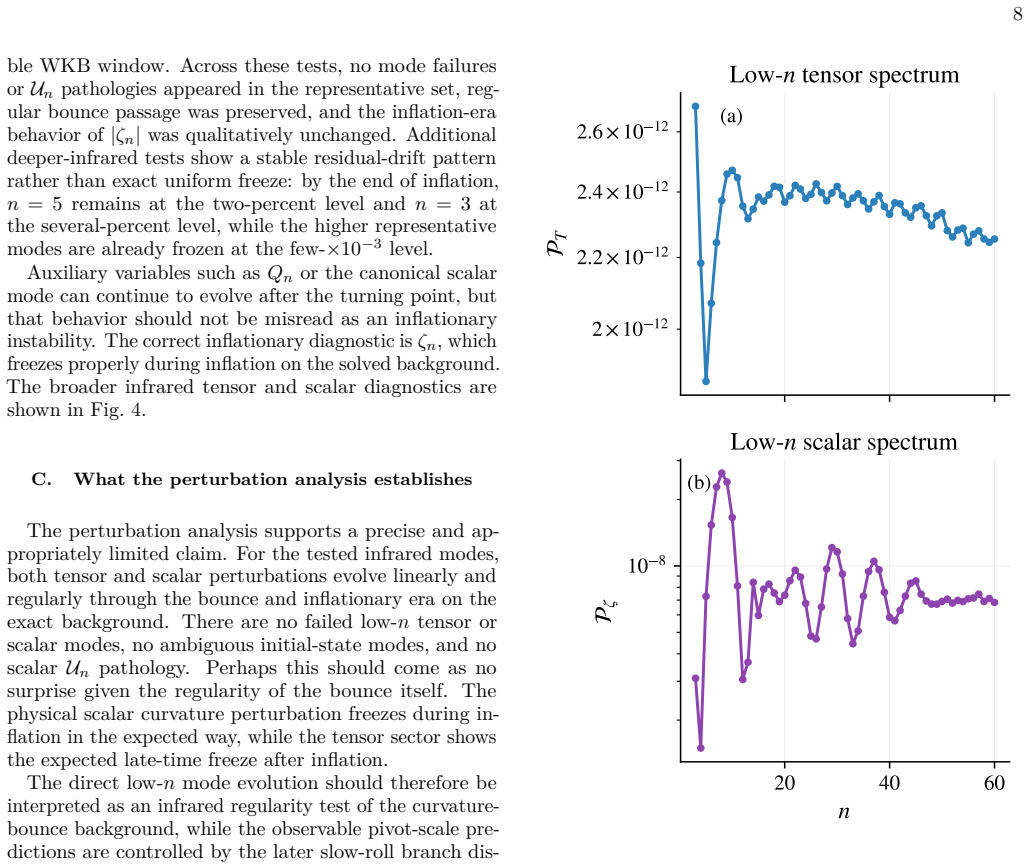
- Both tensor and scalar perturbations propagate regularly through the bounce and inflationary phases, with the curvature perturbation freezing in the standard manner.
- The entire evolution remains sub-Planckian and satisfies the null energy condition while violating only the strong energy condition.
- Spatial curvature is rapidly diluted during inflation, producing an effectively flat universe at late times.
Where Pith is reading between the lines
- Confirmation of positive curvature would make this a minimal way to obtain a complete early universe without introducing new fields or modified gravity.
- The regular passage of perturbations through the bounce suggests similar constructions could address other cosmological singularities if positive curvature is present.
- Direct numerical evolution of closed-universe modes offers a concrete testbed for studying how infrared perturbations behave in nonsingular cosmologies.
Load-bearing premise
Only positive spatial curvature permits a nonsingular, geodesically complete universe with ANEC-respecting matter in non-static FRW cosmology.
What would settle it
A measurement of negative spatial curvature or inflationary observables far outside n_s approximately 0.96 and r approximately 0.004 at 55-60 e-folds would rule out the model's viability.
Figures


read the original abstract
The early universe need not be described by an incomplete inflationary phase connected to a separate, more exotic prehistory. Recent results show that, within non-static FRW cosmology, only positive spatial curvature permits a nonsingular, geodesically complete universe with ANEC-respecting matter. We construct a geodesically complete closed $k=+1$ bounce-plus-inflation cosmology in ordinary general relativity, sourced by a single canonical scalar field with a positive vacuum offset. The bounce is supported by curvature rather than exotic stress energy: the matter content satisfies the NEC throughout and violates only the strong energy condition, as in any accelerated expansion. The solved branch remains sub-Planckian and evolves onto a curvature-diluted slow-roll phase with inflationary observables consistent with current constraints. The pivot-scale predictions are $n_s=0.9617$, $r=0.0045$ at $N_*=55$ and $n_s=0.9650$, $r=0.0037$ at $N_*=60$. Direct evolution of closed-universe infrared perturbations shows regular tensor and scalar propagation through the bounce and inflationary era, with the physical curvature perturbation freezing in the standard way. This gives a minimal explicit realization of a complete early-universe cosmology in the closed FRW branch selected by completeness and ANEC compatibility.
Editorial analysis
A structured set of objections, weighed in public.
Referee Report
Summary. The paper constructs an explicit geodesically complete closed (k=+1) bounce-plus-inflation cosmology in ordinary GR sourced by a single canonical scalar field with positive vacuum offset. The bounce is curvature-supported at finite a_min with rho=3/a_min^2, the matter satisfies the NEC (rho+p = dot{phi}^2 >=0) throughout while violating only the SEC, the field remains sub-Planckian, and the evolution transitions to a curvature-diluted slow-roll phase. Direct numerical integration yields ns=0.9617, r=0.0045 at N*=55 and ns=0.9650, r=0.0037 at N*=60, with regular scalar and tensor perturbation propagation across the bounce and standard freezing of the curvature perturbation.
Significance. If the explicit construction and numerics hold, the result supplies a minimal, observationally consistent realization of a nonsingular early-universe cosmology that avoids geodesic incompleteness by using positive spatial curvature and standard matter, without exotic stress-energy. Credit is due for providing the concrete scalar potential, the numerical background solution exhibiting the curvature bounce and NEC compliance, and the direct integration of perturbation equations through the bounce. This strengthens the case for closed FRW models selected by completeness and ANEC compatibility.
minor comments (3)
- [Introduction] The abstract and introduction cite the foundational result that only k=+1 permits ANEC-compatible geodesic completeness from prior work; a one-sentence recap of the key theorem statement would improve self-contained readability without altering the central construction.
- The specific potential parameters (including the vacuum offset value) that produce the quoted ns and r at N*=55 and 60 are not listed explicitly alongside the observables; adding them would aid reproducibility of the slow-roll phase.
- The description of the numerical integration of the perturbation equations across the bounce could clarify the choice of initial conditions and time-stepping method to confirm absence of singularities.
Simulated Author's Rebuttal
We thank the referee for the positive assessment of our explicit construction of a geodesically complete closed FRW cosmology with curvature-supported bounce and canonical scalar inflation. The recommendation for minor revision is noted; we will address any editorial or presentational improvements in the revised manuscript.
Circularity Check
No significant circularity; explicit construction stands independently
full rationale
The manuscript supplies an explicit scalar potential with positive vacuum offset, a numerical background solution exhibiting curvature-supported bounce (H=0 at finite a_min with rho=3/a_min^2), NEC compliance via rho+p=dot{phi}^2 >=0, sub-Planckian evolution, and direct integration of perturbation equations across the bounce yielding ns=0.9617, r=0.0045 at N*=55 and ns=0.9650, r=0.0037 at N*=60. These observables are computed from the solved dynamics rather than fitted by construction or renamed inputs. The statement that only k=+1 permits ANEC-compatible geodesic completeness is cited from prior work as motivation for the branch choice, but the paper's central derivation chain (potential choice, bounce solution, slow-roll phase, and perturbation freezing) is self-contained against the FRW equations and does not reduce to that citation or to any self-definitional loop.
Axiom & Free-Parameter Ledger
free parameters (1)
- Scalar potential parameters including vacuum offset
axioms (1)
- domain assumption Only positive spatial curvature permits a nonsingular, geodesically complete universe with ANEC-respecting matter in non-static FRW cosmology
Forward citations
Cited by 1 Pith paper
-
Affine ANEC selects the closed FRW branch for geodesically complete cosmology
Affine ANEC obstructs non-static flat and open FRW from being null geodesically complete while ANEC-satisfying, but allows explicit scalar-field realizations for closed FRW with NEC-respecting matter.
discussion (0)
Sign in with ORCID, Apple, or X to comment. Anyone can read and Pith papers without signing in.