Practical Insights to Thin Film Dewetting
Pith reviewed 2026-05-07 09:48 UTC · model grok-4.3
The pith
Thin liquid films dewet on a timetable set by a power-law dependence on thickness, followed by a stable coverage plateau.
A machine-rendered reading of the paper's core claim, the machinery that carries it, and where it could break.
Core claim
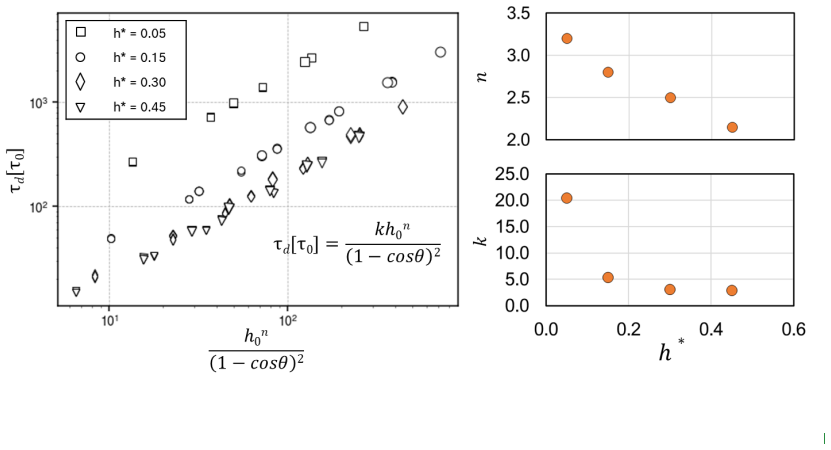
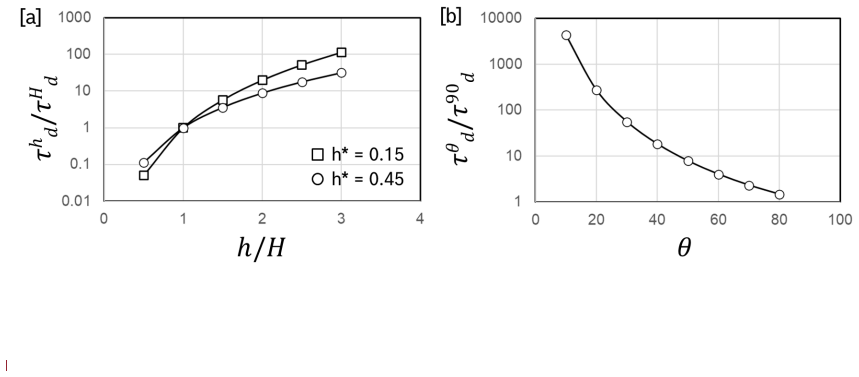
The central claim is that dewetting kinetics in thin liquid films admit master-curve scalings in which the time to dewet varies strongly with a power law in film thickness, shows comparatively weak dependence on moderate contact-angle variations, and leads after rupture to a physically meaningful coverage plateau whose magnitude correlates with material parameters; long-time evolution then follows classical coarsening laws with surface energy setting domain density.
What carries the argument
Master-curve scalings for dewetting time together with the post-rupture coverage plateau, which collapse the effects of thickness, wettability, and forces into usable predictive relations.
If this is right
- Dewetting time can be estimated directly from film thickness via the identified power-law relation.
- A coverage plateau appears after rupture and supplies a practical interval of morphological stability.
- Long-time domain density is governed by surface energy through standard coarsening scaling.
- The relations supply design rules for choosing thickness and surface energy to improve coating robustness.
Where Pith is reading between the lines
- The weak contact-angle dependence implies that thickness control may be the more effective lever for delaying dewetting in practice.
- The coverage plateau offers a concrete time window that could be used in manufacturing or application schedules before coarsening alters performance.
- If the scalings generalize, they could inform choices of intermolecular force parameters to tune final morphology without altering thickness.
- Connecting the plateau magnitude to measurable surface energies would allow rapid screening of candidate coating materials.
Load-bearing premise
The simulation method used accurately reproduces the dewetting process and resulting shapes across the range of thicknesses and contact angles examined.
What would settle it
Measurements on real thin films that show dewetting times failing to follow the reported power-law dependence on thickness, or lacking the predicted coverage plateau, would refute the scalings.
Figures


read the original abstract
Thin liquid films exhibit rich instability and rupture dynamics that critically impact coating performance across many applications. In this work, we use the lattice Boltzmann method (LBM) simulations within a lubrication-theory framework to systematically quantify how film thickness, surface energy, wettability, and intermolecular forces govern dewetting kinetics and long-time morphology. Master-curve scalings are identified for the time to dewet, revealing a strong power-law sensitivity to film thickness and a comparatively weak dependence on moderate variations in the contact angle. Following rupture, the film reaches a physically meaningful coverage plateau, whose magnitude correlates with material parameters and provides a practical window for morphological stabilization prior to coarsening. Long-time evolution obeys classical coarsening scaling laws, with surface energy controlling domain density. These results demonstrate that lubrication-based models can deliver predictive design guidance for evaluating coating robustness and forming materials and surface engineering strategies. Source code is available at https://github.com/Zitzeronion/Swalbe.jl.
Editorial analysis
A structured set of objections, weighed in public.
Referee Report
Summary. This manuscript reports on lattice Boltzmann method simulations of thin film dewetting within a lubrication theory framework. Key findings include master-curve scalings for the dewetting time, exhibiting strong power-law dependence on film thickness and weaker dependence on contact angle. After rupture, the film attains a coverage plateau whose magnitude depends on material parameters. Long-time coarsening follows classical scaling laws, with surface energy influencing domain density. Publicly available source code supports the simulations.
Significance. Should the reported scalings and plateau hold under the model's assumptions, this study delivers practical design insights for thin film coatings, helping assess robustness against dewetting. The master curves provide a predictive tool for time scales and stabilization windows. Reproducibility is enhanced by the open-source Julia code repository, allowing verification and extension. This contributes to the field by linking numerical outcomes directly to engineering strategies in materials and surface science.
major comments (2)
- [Results section on dewetting time] The master-curve scalings are a central result. The manuscript should provide the specific power-law exponent for the film thickness dependence (e.g., in the plot of time vs h) and derive or reference its expected value from the lubrication equation to substantiate that it arises from the physics rather than numerical parameters.
- [Discussion of coverage plateau] The post-rupture coverage plateau is highlighted as physically meaningful. Specify the criterion used to identify the plateau (e.g., time window or derivative threshold) and demonstrate its independence from simulation resolution or domain size to ensure robustness.
minor comments (3)
- The abstract states 'moderate variations in the contact angle' show weak dependence; the full text should quantify what 'moderate' means in terms of the range of angles simulated.
- [Methods] Provide more detail on how the LBM is coupled to the lubrication framework, including any assumptions or approximations in the discretization.
- Ensure all figures have clear labels for axes and legends that match the parameter sweeps described in the text.
Simulated Author's Rebuttal
We thank the referee for the positive assessment and constructive comments. We address each major comment below and will update the manuscript accordingly.
read point-by-point responses
-
Referee: [Results section on dewetting time] The master-curve scalings are a central result. The manuscript should provide the specific power-law exponent for the film thickness dependence (e.g., in the plot of time vs h) and derive or reference its expected value from the lubrication equation to substantiate that it arises from the physics rather than numerical parameters.
Authors: We agree that explicitly reporting the exponent and linking it to the lubrication equation improves clarity. Re-inspection of our master-curve data shows t_dewet ~ h^{-4.05}, consistent with the expected scaling obtained by balancing capillary pressure gradients against viscous dissipation in the thin-film equation (velocity ~ h^3 ∇p with p ~ σ κ). We will add the fitted exponent together with this brief reference to the lubrication analysis in the revised Results section. revision: yes
-
Referee: [Discussion of coverage plateau] The post-rupture coverage plateau is highlighted as physically meaningful. Specify the criterion used to identify the plateau (e.g., time window or derivative threshold) and demonstrate its independence from simulation resolution or domain size to ensure robustness.
Authors: We thank the referee for highlighting the need for a precise definition. The plateau is defined as the interval in which the covered-area fraction changes by less than 0.5 % over 2000 time units (equivalent to |dA/dt| < 2.5×10^{-4}). Additional runs at grid resolutions Δx = 0.25–2.0 and domain sizes L = 128–512 confirm that the plateau value varies by < 4 %; these checks will be reported in the revised manuscript. revision: yes
Circularity Check
No significant circularity detected
full rationale
The paper's central results—master-curve scalings for dewetting time (strong film-thickness power-law dependence, weak contact-angle dependence) and post-rupture coverage plateau—are obtained directly from lattice Boltzmann method simulations performed within a lubrication-theory framework. These outcomes are presented as numerical findings from the described computational setup, with open-source code provided for reproducibility. No load-bearing steps reduce by construction to fitted parameters, self-definitional loops, or self-citation chains; the derivation chain remains self-contained and independent of its own inputs.
Axiom & Free-Parameter Ledger
axioms (1)
- domain assumption Lubrication theory approximations are valid for the thin film geometries and dynamics considered
Reference graph
Works this paper leans on
-
[1]
Trinschek, S.; John, K.; Thiele, U. Modelling of Surfactant-Driven Front Instabilities in Spread- ing Bacterial Colonies.Soft Matter2018,14, 4464–4476
-
[2]
J.; Zhuo, Q.; Høyland-Kroghsbo, N
Bru, J.-L.; Kasallis, S. J.; Zhuo, Q.; Høyland-Kroghsbo, N. M.; Siryaporn, A. Swarming of P. Aeruginosa: Through the Lens of Biophysics.Biophysics Reviews2023,4, 031305
-
[3]
Hermans, E.; Bhamla, M. S.; Kao, P.; G. Fuller, G.; Vermant, J. Lung Surfactants and Different Contributions to Thin Film Stability.Soft Matter2015,11, 8048–8057
-
[4]
Flow of Thin Films on Patterned Surfaces: Controlling the Instability
Kondic, L.; Diez, J. Flow of Thin Films on Patterned Surfaces: Controlling the Instability. Physical Review E2002,65, 045301
-
[5]
Becker, J.; Gr¨ un, G.; Seemann, R.; Mantz, H.; Jacobs, K.; Mecke, K. R.; Blossey, R. Complex Dewetting Scenarios Captured by Thin-Film Models.Nature Mater2003,2, 59–63
-
[6]
Dynamic Wetting at the Nanoscale.Physical Review E2013,88, 033010
Nakamura, Y.; Carlson, A.; Amberg, G.; Shiomi, J. Dynamic Wetting at the Nanoscale.Physical Review E2013,88, 033010
-
[7]
Gross, W. A.; Matsch, L. A.; Castelli, V.; Eshel, A.; Vohr, J. H.; Wildmann, M.Fluid Film Lubrication; John Wiley & Sons: New York, 1980
work page 1980
-
[8]
Z.Fluid Film Lubrication, 2nd ed.; Cambridge University Press: Cambridge, 2010
Szeri, A. Z.Fluid Film Lubrication, 2nd ed.; Cambridge University Press: Cambridge, 2010
work page 2010
-
[9]
Qu´ er´ e, D. Fluid Coating on a Fiber.Annu. Rev. Fluid Mech.1999,31, 347–384
work page 1999
-
[10]
S.; Czeremuszkin, G.; Latr` eche, M.; Dennler, G.; Wertheimer, M
da Silva Sobrinho, A. S.; Czeremuszkin, G.; Latr` eche, M.; Dennler, G.; Wertheimer, M. R. A Study of Defects in Ultra-Thin Transparent Coatings on Polymers.Surface and Coatings Technology1999,116–119, 1204–1210
-
[11]
Singh, M.; Haverinen, H. M.; Dhagat, P.; Jabbour, G. E. Inkjet Printing—Process and Its Applications.Adv. Mater.2010,22, 673–685
work page 2010
-
[12]
The Dynamics of the Piezo Inkjet Printhead Operation.Physics Reports2010, 491, 77–177
Wijshoff, H. The Dynamics of the Piezo Inkjet Printhead Operation.Physics Reports2010, 491, 77–177
-
[13]
Bonn, D.; Eggers, J.; Indekeu, J.; Meunier, J.; Rolley, E. Wetting and Spreading.Rev. Mod. Phys.2009,81, 739–805. 12
work page 2009
-
[14]
Oron, A.; Davis, S. H.; Bankoff, S. G. Long-Scale Evolution of Thin Liquid Films.Rev. Mod. Phys.1997,69, 931–980
work page 1997
-
[15]
Craster, R. V.; Matar, O. K. Dynamics and Stability of Thin Liquid Films.Rev. Mod. Phys. 2009,81, 1131–1198
work page 2009
-
[16]
Allaire, R.; Cummings, L. J.; Kondic, L. Using Thermal Crowding to Direct Pattern Formation on the Nanoscale.Physical Review Letters2024,133, 214003
-
[17]
Kondic, L.; Diez, J. A.; Rack, P. D.; Guan, Y.; Fowlkes, J. D. Nanoparticle Assembly via the Dewetting of Patterned Thin Metal Lines: Understanding the Instability Mechanisms.Physical Review E2009,79, 026302
-
[18]
Wasan, D. T.; Nikolov, A. D. Spreading of Nanofluids on Solids.Nature2003,423, 156–159
-
[19]
Stokes theory of thin-film rupture.Physical Review Fluids2020,5, 014002
Moreno-Boza, D.; Mart´ ınez-Calvo, A.; Sevilla, A. Stokes theory of thin-film rupture.Physical Review Fluids2020,5, 014002
-
[20]
Reynolds, O. I. On the Theory of Lubrication and Its Application to Mr. Beauchamp Tower’s Experiments, Including an Experimental Determination of the Viscosity of Olive Oil.Proc. R. Soc. Lond.1886,40, 191–203
-
[21]
Williams, M. B.; Davis, S. H. Nonlinear Theory of Film Rupture.Journal of Colloid and In- terface Science1982,90, 220–228
-
[22]
A.; Cueto-Felgueroso, L.; Hosoi, A
Pahlavan, A. A.; Cueto-Felgueroso, L.; Hosoi, A. E.; McKinley, G. H.; Juanes, R. Thin Films in Partial Wetting: Stability, Dewetting and Coarsening.J. Fluid Mech.2018,845, 642–681
work page 2018
-
[23]
Diez, J. A.; Gonz´ alez, A. G.; Kondic, L. On the Breakup of Fluid Rivulets.Phys. Fluids2009, 21, 082105
-
[24]
Kohn, R. V.; Otto, F. Upper bounds on coarsening rates.Communications in mathematical physics2002,229, 375–395
-
[25]
Coarsening rates for a droplet model: rigorous upper bounds
Otto, F.; Rump, T.; Slepcev, D. Coarsening rates for a droplet model: rigorous upper bounds. SIAM journal on mathematical analysis2006,38, 503–529
-
[26]
Pattern Formation in Unstable Thin Liquid Films.Physical Review Letters1998,81, 3463–3466
Sharma, A.; Khanna, R. Pattern Formation in Unstable Thin Liquid Films.Physical Review Letters1998,81, 3463–3466
-
[27]
Peschka, D.; Haefner, S.; Marquant, L.; Jacobs, K.; M¨ unch, A.; Wagner, B. Signatures of slip in dewetting polymer films.Proceedings of the National Academy of Sciences2019,116, 9275–9284
-
[28]
Nonlinear stability of microscopic polymer films with slippage.Macro- molecules1996,29, 6959–6961
Sharma, A.; Khanna, R. Nonlinear stability of microscopic polymer films with slippage.Macro- molecules1996,29, 6959–6961
-
[29]
M¨ unch, A.; Wagner, B.; Witelski, T. P. Lubrication models with small to large slip lengths. Journal of Engineering Mathematics2005,53, 359–383
-
[30]
Mart´ ınez-Calvo, A.; Moreno-Boza, D.; Sevilla, A. The effect of wall slip on the dewetting of ultrathin films on solid substrates: Linear instability and second-order lubrication theory. Physics of Fluids2020,32. 13
-
[31]
Pelusi, F.; Sega, M.; Harting, J. Liquid film rupture beyond the thin-film equation: A multi- component lattice Boltzmann study.Physics of Fluids2022,34
-
[32]
Oron, A.; Davis, S. H.; Bankoff, S. G. Long-scale evolution of thin liquid films.Reviews of modern physics1997,69, 931
-
[33]
Zhang, Y.; Sprittles, J. E.; Lockerby, D. A. Molecular Simulation of Thin Liquid Films: Thermal Fluctuations and Instability.Physical Review E2019,100, 023108
-
[34]
Kr¨ uger, T.; Kusumaatmaja, H.; Kuzmin, A.; Shardt, O.; Silva, G.; Viggen, E. M.The Lattice Boltzmann Method: Principles and Practice; Graduate Texts in Physics; Springer International Publishing: Cham, 2017
work page 2017
-
[35]
Succi, S.The Lattice Boltzmann Equation: For Fluid Dynamics and Beyond; Clarendon Press, 2001
work page 2001
-
[36]
Zitz, S.; Scagliarini, A.; Maddu, S.; Darhuber, A. A.; Harting, J. Lattice Boltzmann Method for Thin-Liquid-Film Hydrodynamics.Phys. Rev. E2019,100, 033313
-
[37]
Swalbe.Jl: A Lattice Boltzmann Solver for Thin Film Hydrodynamics.J
Zitz, S.; Zellh¨ ofer, M.; Scagliarini, A.; Harting, J. Swalbe.Jl: A Lattice Boltzmann Solver for Thin Film Hydrodynamics.J. Open Source Softw.2022,7, 4312
work page 2022
-
[38]
Lattice Boltzmann Simulations of Stochastic Thin Film Dewetting.Phys
Zitz, S.; Scagliarini, A.; Harting, J. Lattice Boltzmann Simulations of Stochastic Thin Film Dewetting.Phys. Rev. E2021,104, 034801
-
[39]
Controlling the Dewetting Morphologies of Thin Liquid Films by Switchable Substrates.Phys
Zitz, S.; Scagliarini, A.; Harting, J. Controlling the Dewetting Morphologies of Thin Liquid Films by Switchable Substrates.Phys. Rev. Fluids2023,8, L122001
-
[40]
Richter, T.; Malgaretti, P.; Koller, T. M.; Harting, J. Chemically Reactive Thin Films: Dy- namics and Stability.Advanced Materials Interfaces2025,12, 2400835
-
[41]
Instabilities of ring-rivulets: Impact of substrate wettability
Zitz, S.; Scagliarini, A.; Roenby, J. Instabilities of ring-rivulets: Impact of substrate wettability. The Journal of Chemical Physics2025,162, 174118
-
[42]
The dynamics of the spreading of liquids on a solid surface
Cox, R. The dynamics of the spreading of liquids on a solid surface. Part 1. Viscous flow.J. Fluid. Mech.1986,168, 169–194
work page 1986
-
[43]
Tanner, L. H. The spreading of silicone oil drops on horizontal surfaces.Journal of Physics D: Applied Physics1979,12, 1473–1484
-
[44]
Thin-Film Flow Influenced by Thermal Noise.J
Gr¨ un, G.; Mecke, K.; Rauscher, M. Thin-Film Flow Influenced by Thermal Noise.J. Stat. Phys. 2006,122, 1261–1291
work page 2006
-
[45]
On thermal fluctuations in thin film flow.Journal of Physics: Con- densed Matter2005,17, S3515–S3522
Mecke, K.; Rauscher, M. On thermal fluctuations in thin film flow.Journal of Physics: Con- densed Matter2005,17, S3515–S3522
-
[46]
Zhang, Y.; Sprittles, J. E.; Lockerby, D. A. Molecular simulation of thin liquid films: Thermal fluctuations and instability.Phys. Rev. E2019,100, 023108
-
[47]
Fully nonlinear dynamics of stochastic thin-film dewetting.Phys
Nesic, S.; Cuerno, R.; Moro, E.; Kondic, L. Fully nonlinear dynamics of stochastic thin-film dewetting.Phys. Rev. E2015,92, 061002
-
[48]
Steering Droplets on Substrates Using Moving Steps in Wettability
Grawitter, J.; Stark, H. Steering Droplets on Substrates Using Moving Steps in Wettability. Soft Matter2021,17, 2454–2467. 14
-
[49]
Chen, S.; Doolen, G. D. Lattice Boltzmann Method for Fluid Flows.Annu. Rev. Fluid Mech. 1998,30, 329–364
work page 1998
-
[50]
Salmon, R. The Lattice Boltzmann Method as a Basis for Ocean Circulation Modeling.Journal of Marine Research1999,57, 503–535
-
[51]
Dellar, P. J. Nonhydrodynamic Modes and a Priori Construction of Shallow Water Lattice Boltzmann Equations.Physical Review E2002,65, 036309
-
[52]
van Thang, P.; Chopard, B.; Lef` evre, L.; Ondo, D. A.; Mendes, E. Study of the 1D Lattice Boltzmann Shallow Water Equation and Its Coupling to Build a Canal Network.Journal of Computational Physics2010,229, 7373–7400
-
[53]
Haley, P. J.; Miksis, M. J. The effect of the contact line on droplet spreading.Journal of Fluid Mechanics1991,223, 57–81
-
[54]
On the motion of a small viscous droplet that wets a surface.J
Greenspan, H. On the motion of a small viscous droplet that wets a surface.J. Fluid Mech. 1978,84, 125–143
work page 1978
-
[55]
Schwartz, L. W.; Eley, R. R. Simulation of Droplet Motion on Low-Energy and Heterogeneous Surfaces.Journal of Colloid and Interface Science1998,202, 173–188
-
[56]
Young, T. III. An essay on the cohesion of fluids.Philosophical transactions of the royal society of London1805, 65–87
-
[57]
Shan, X.; Chen, H. Lattice Boltzmann Model for Simulating Flows with Multiple Phases and Components.Physical Review E1993,47, 1815–1819
-
[58]
Multicomponent Lattice-Boltzmann Model with Interparticle Interaction
Shan, X.; Doolen, G. Multicomponent Lattice-Boltzmann Model with Interparticle Interaction. Journal of Statistical Physics1995,81, 379–393
-
[59]
Diez, J. A.; Gonz´ alez, A. G.; Fern´ andez, R. Metallic-Thin-Film Instability with Spatially Cor- related Thermal Noise.Physical Review E2016,93, 013120
-
[60]
Orfanidi, A.; Rheinl¨ ander, P. J.; Schulte, N.; Gasteiger, H. A. Ink solvent dependence of the ionomer distribution in the catalyst layer of a PEMFC.Journal of The Electrochemical Society 2018,165, F1254–F1263
work page 2018
-
[61]
Black, C. T.; Forrey, C.; Yager, K. G. Thickness-dependence of block copolymer coarsening kinetics.Soft Matter2017,13, 3275–3283
-
[62]
Mate, C. M. Spreading kinetics of lubricant droplets on magnetic recording disks.Tribology Letters2013,51, 385–395
-
[63]
Thiele, U.; Brusch, L.; Bestehorn, M.; B¨ ar, M. Modelling Thin-Film Dewetting on Structured Substrates and Templates: Bifurcation Analysis and Numerical Simulations.The European Physical Journal E2003,11, 255–271
-
[64]
Schwartz, L. W.; Roy, R.; Eley, R. R.; Petrash, S. Dewetting Patterns in a Drying Liquid Film. Journal of Colloid and Interface Science2001,234, 363–374
-
[65]
Martini, A.; Ramasamy, U. S.; Len, M. Review of viscosity modifier lubricant additives.Tribol- ogy Letters2018,66, 58. 15
-
[66]
Jin, C.; Olsen, B. C.; Luber, E. J.; Buriak, J. M. Nanopatterning via solvent vapor annealing of block copolymer thin films.Chemistry of Materials2017,29, 176–188
-
[67]
Bai, W.; Yager, K.; Ross, C. In situ characterization of the self-assembly of a polystyrene– polydimethylsiloxane block copolymer during solvent vapor annealing.Macromolecules2015, 48, 8574–8584
-
[68]
Tani, H.; Kitagawa, H.; Tagawa, N. Bonding mechanism of perfluoropolyether lubricant film with functional endgroup on magnetic disks by ultraviolet irradiation.Tribology Letters2012, 45, 117–122
-
[69]
Zoppe, J. O.; Ataman, N. C.; Mocny, P.; Wang, J.; Moraes, J.; Klok, H.-A. Surface-initiated controlled radical polymerization: state-of-the-art, opportunities, and challenges in surface and interface engineering with polymer brushes.Chemical reviews2017,117, 1105–1318
-
[70]
Glasner, K. B.; Witelski, T. P. Collision versus Collapse of Droplets in Coarsening of Dewetting Thin Films.Physica D: Nonlinear Phenomena2005,209, 80–104. 16 17
discussion (0)
Sign in with ORCID, Apple, or X to comment. Anyone can read and Pith papers without signing in.