Quantum in Biology, Quantum for Biology, and Biology for Quantum: Mapping the Evidence and the Road Ahead
Pith reviewed 2026-05-09 20:11 UTC · model grok-4.3
The pith
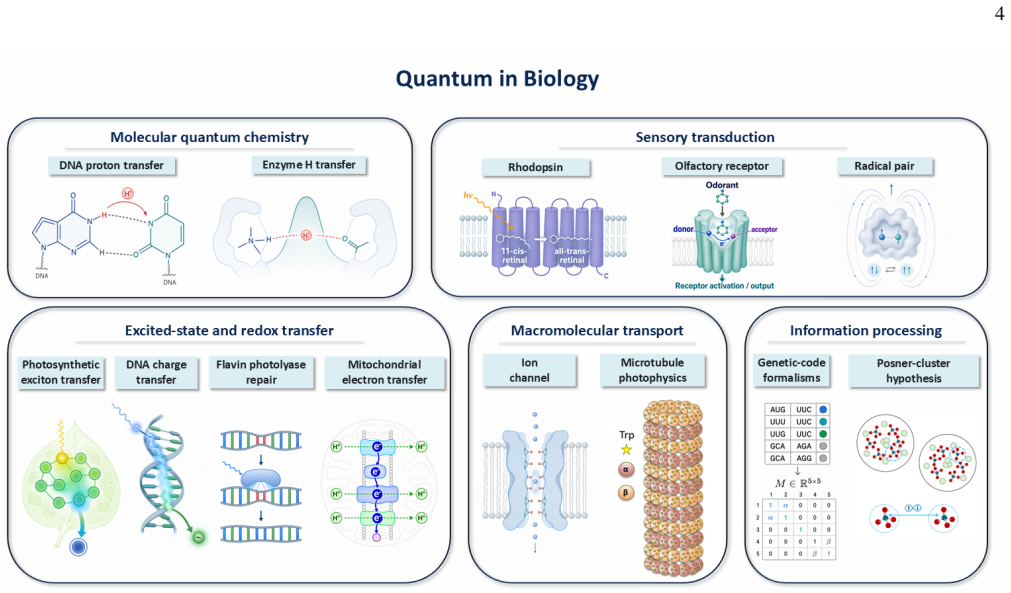
The review maps evidence for quantum effects in biology and finds only enzymatic tunneling and radical-pair magnetoreception as mature cases.
A machine-rendered reading of the paper's core claim, the machinery that carries it, and where it could break.
Core claim
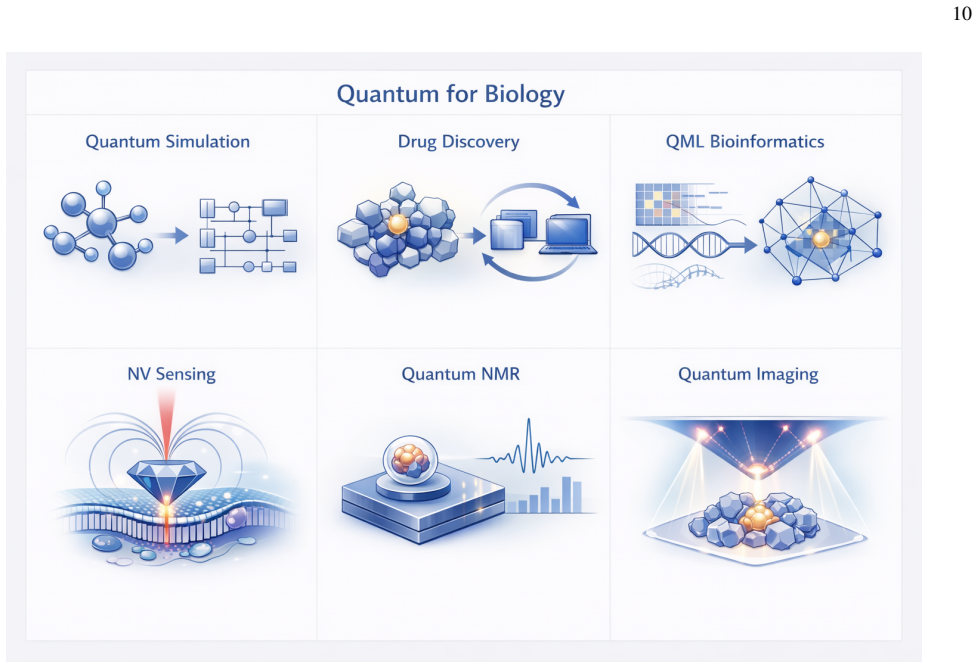
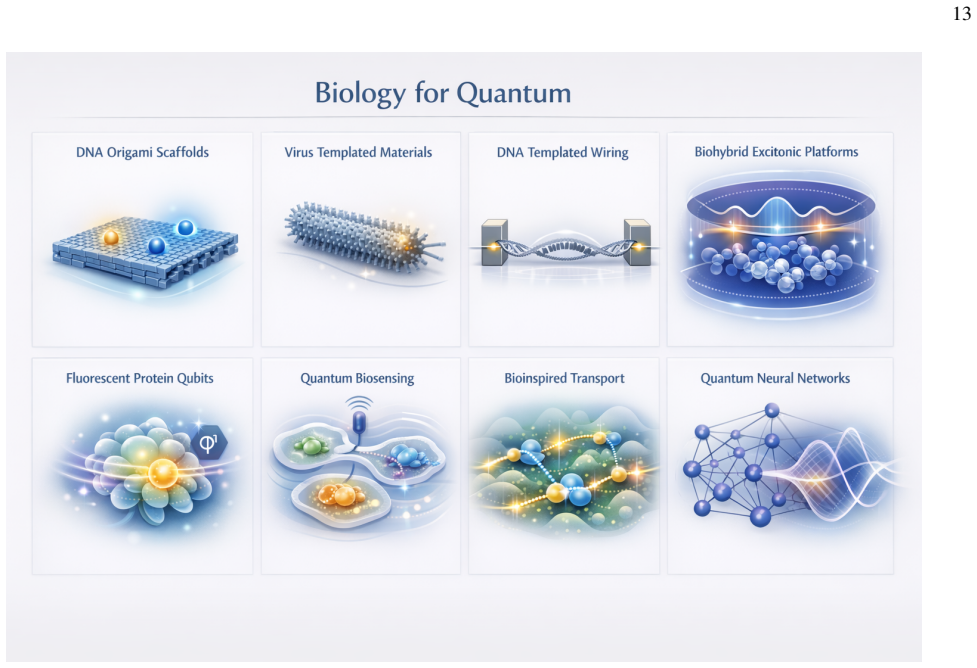
The paper establishes that a structured narrative evidence map of quantum-biology intersections reveals two mature cases in quantum-in-biology—mechanistically constrained tunneling in enzymatic hydrogen-transfer reactions and radical-pair spin chemistry as a viable framework for magnetoreception—while higher-visibility topics stay suggestive but unresolved under physiological conditions. For quantum-for-biology the central question is improvement over classical baselines under realistic constraints, and for biology-for-quantum the strongest claims come from measurable improvements in quantum device fabrication or robustness via biomolecular structure or self-assembly.
What carries the argument
The structured narrative evidence map, which for each topic specifies the mechanistic or technological claim, the invoked quantum resource, strongest experiments and models, competitive classical alternatives or confounds, and decisive tests or benchmarks.
Load-bearing premise
The assumption that the chosen topics, experiments, and classical alternatives fairly represent the current literature without systematic selection bias or omission of contradictory results.
What would settle it
A decisive experiment demonstrating long-lived quantum coherence in photosynthetic systems under physiological conditions with no viable classical alternative would challenge the assessment that such topics remain unresolved.
Figures

read the original abstract
Quantum science and biology now intersect in three complementary directions: quantum in biology, quantum for biology, and biology for quantum. This review provides a structured narrative evidence map of that interface rather than an exhaustive catalogue or formal systematic review. For each topic, we ask what the mechanistic or technological claim is, which quantum resource is invoked, what the strongest experiments and models establish, which classical alternatives or engineering confounds remain competitive, and what decisive tests or benchmarks would most strongly change confidence. The most mature quantum-in-biology cases remain mechanistically constrained tunneling in some enzymatic hydrogen-transfer reactions and radical-pair spin chemistry as a viable framework for magnetoreception, whereas several higher-visibility topics remain suggestive but unresolved under physiological conditions. In quantum for biology, the central issue is whether quantum-enabled tools improve biological inference relative to strong classical baselines under realistic calibration, dose, throughput, and uncertainty constraints. In biology for quantum, the strongest claims arise when biomolecular structure or self-assembly measurably improves fabrication, integration, or robustness in quantum devices. Summary tables in the Appendix provide a compact cross-map view of the current evidence, major confounds, and the experiments or benchmarks most likely to discriminate between competing explanations.
Editorial analysis
A structured set of objections, weighed in public.
Referee Report
Summary. The manuscript offers a structured narrative evidence map of the intersections between quantum science and biology in three directions: quantum in biology, quantum for biology, and biology for quantum. For each topic it examines the mechanistic or technological claim, the quantum resource invoked, the strongest experiments and models, competitive classical alternatives, and decisive tests or benchmarks. The central conclusion is that mechanistically constrained tunneling in some enzymatic hydrogen-transfer reactions and radical-pair spin chemistry as a framework for magnetoreception remain the most mature quantum-in-biology cases, while several higher-visibility topics are suggestive but unresolved under physiological conditions. Summary tables in the Appendix provide a compact cross-map of evidence, confounds, and discriminating experiments.
Significance. If the mapping is accurate, the review supplies a useful evidence-based framework that can help researchers prioritize experiments, distinguish robust quantum effects from classical alternatives, and identify the benchmarks most likely to resolve remaining ambiguities. By systematically addressing per-topic quantum resources, experimental support, and competitive explanations, it reduces the risk of overinterpretation in an interdisciplinary field and offers a compact reference for both experimentalists and theorists.
minor comments (3)
- [Appendix] The appendix tables would be clearer if the column headers explicitly distinguished 'quantum resource invoked' from 'strongest experimental support' and 'competitive classical alternatives' (currently the mapping is inferable but not labeled).
- A short glossary or footnote defining the maturity descriptors ('mechanistically constrained,' 'viable framework,' 'suggestive but unresolved') would aid readers who are not already familiar with the cited literature.
- [Quantum for Biology] A few sentences in the quantum-for-biology section are long and contain multiple clauses; splitting them would improve readability without changing content.
Simulated Author's Rebuttal
We thank the referee for their careful reading and positive assessment of the manuscript. Their summary accurately reflects the scope, structure, and central conclusions of the review. We are pleased that the evidence-mapping approach and the identification of mature versus unresolved cases were found useful. As the referee raises no major comments or requests for clarification, we have no revisions to propose.
Circularity Check
No significant circularity in this evidence-mapping review
full rationale
This is a narrative review paper that structures and summarizes external literature on quantum-biology topics without any internal derivations, equations, predictions, or fitted parameters. It explicitly positions itself as a non-exhaustive evidence map, asking per-topic questions about mechanistic claims, quantum resources, experiments, classical alternatives, and decisive tests, then tabulating external findings. No load-bearing step reduces by construction to a self-definition, a fitted input renamed as prediction, or a self-citation chain; all maturity classifications and conclusions rest on cited external results rather than quantities defined inside the paper. The derivation chain is therefore self-contained against external benchmarks.
Axiom & Free-Parameter Ledger
axioms (1)
- standard math Standard criteria for evaluating mechanistic claims and experimental support in interdisciplinary science
discussion (0)
Sign in with ORCID, Apple, or X to comment. Anyone can read and Pith papers without signing in.