Oxygen Vacancies at Dislocation Core Modulate Plasticity in Strontium Titanate
Pith reviewed 2026-05-09 19:22 UTC · model grok-4.3
The pith
Oxygen vacancies at dislocation cores in SrTiO3 increase with short gliding distances and couple directly to how easily the material deforms plastically.
A machine-rendered reading of the paper's core claim, the machinery that carries it, and where it could break.
Core claim
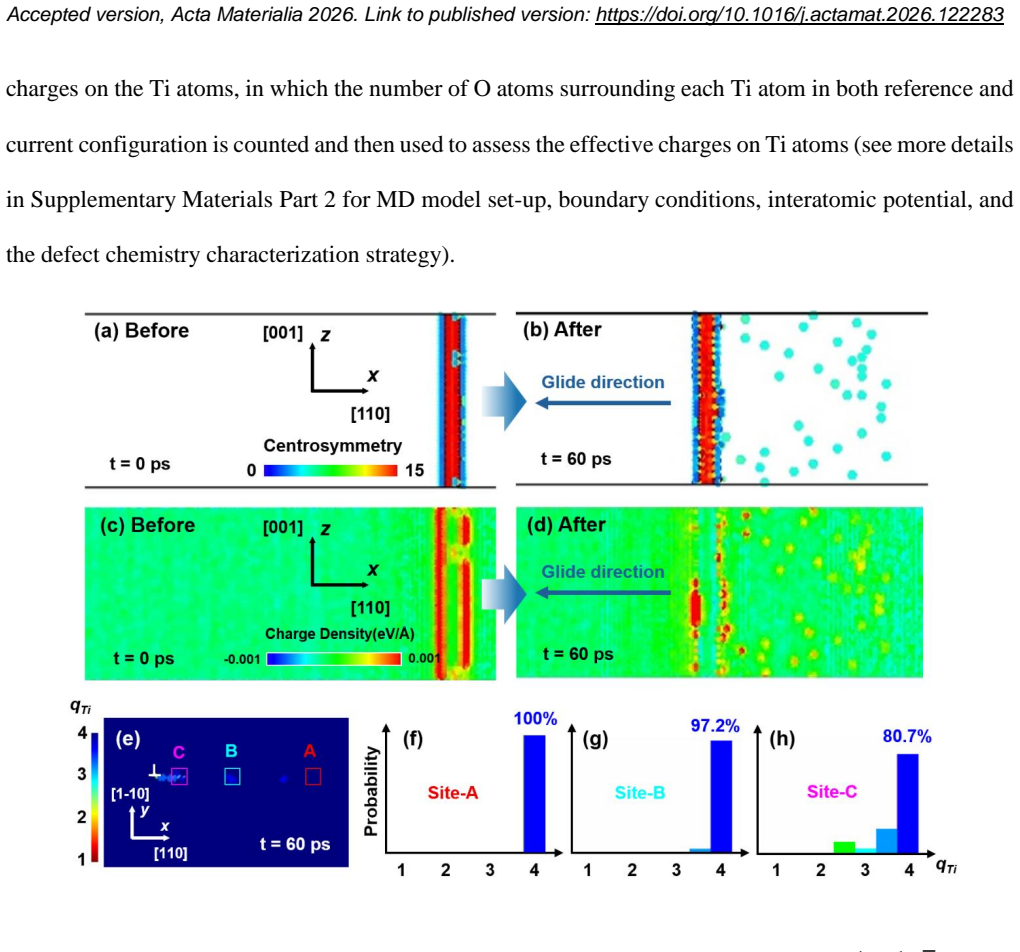
Mechanically induced dislocation loops in SrTiO3 exhibit dissociated cores whose oxygen vacancy density depends on the gliding distance: short loops are Ti-reduced and oxygen-deficient at the edge dislocation core, whereas longer loops remain close to stoichiometry in both the edge and screw components. MD simulations reveal that kink-assisted edge dislocation glide leaves oxygen-deficient trails behind, modulating the oxygen content inside the edge core.
What carries the argument
Kink-assisted glide of edge dislocations that deposits oxygen-deficient trails, thereby raising vacancy density inside the moving core.
Load-bearing premise
The core structures and vacancy densities measured in the mechanically introduced loops represent how dislocations behave in bulk crystals, and the molecular dynamics runs reproduce real atomic moves during glide without major artifacts from the chosen potential or simulation boundaries.
What would settle it
Experimental maps showing no systematic change in oxygen vacancy concentration between short and long dislocation loops of the same type in the same sample.
Figures
read the original abstract
Dislocation core chemistry in oxides critically influences mechanical behavior and functionality; yet the evolution of core chemistry during the dislocation motion in them has not been directly observed. Here, using SrTiO3 as a model material, we combine aberration-corrected scanning transmission electron microscopy and electron energy-loss spectroscopy with atomic-level molecular dynamics (MD) simulations to correlate the <110>{1-10} dislocation core structure, oxygen vacancy density, charge state, and mobility with each other. We find that the mechanically induced dislocation loops exhibit dissociated cores, whose oxygen vacancy density depends on the gliding distance: short loops are Ti-reduced and oxygen-deficient at the edge dislocation core, whereas longer loops remain close to stoichiometry in both the edge and screw components. MD simulations reveal that kink-assisted edge dislocation glide in SrTiO3 leaves oxygen-deficient trails behind, modulating the oxygen content inside the edge core. These results demonstrate that oxygen-vacancy evolution at the dislocation core intrinsically couples with plasticity in ionic crystals, suggesting a mechanism for oxygen vacancy-dependent dislocation mobility in plastically deformed oxides.
Editorial analysis
A structured set of objections, weighed in public.
Referee Report
Summary. The paper claims that in SrTiO3, oxygen-vacancy density at dissociated <110>{1-10} dislocation cores varies with gliding distance in mechanically induced loops: short loops show Ti-reduced, oxygen-deficient edge cores while longer loops remain near-stoichiometric. Aberration-corrected STEM/EELS imaging correlates core structure, vacancy density, and charge state with loop length, while MD simulations show kink-assisted edge glide leaving oxygen-deficient trails that modulate core stoichiometry, demonstrating intrinsic coupling between vacancy evolution and plasticity.
Significance. If validated, the work provides direct experimental-simulation evidence that core chemistry evolves dynamically with dislocation motion in ionic crystals, offering a mechanistic explanation for oxygen-vacancy-dependent mobility. This advances understanding of plasticity in oxides beyond purely mechanical descriptions and has implications for functional materials where dislocations influence both mechanics and electronic/ionic transport.
major comments (2)
- [MD Simulations] The MD simulations section (and associated methods): the claim that kink-assisted glide leaves oxygen-deficient trails (central to the vacancy-mobility coupling) rests on an interatomic potential whose accuracy for oxygen vacancy formation energies, migration barriers, and charge-state interactions under the dislocation strain field is not demonstrated. Without explicit validation against DFT or experimental benchmarks for these quantities (including finite-size and strain-rate effects), the simulated trails risk being potential artifacts rather than intrinsic behavior, weakening the mechanistic interpretation.
- [Results] Experimental results on loop-length dependence: the EELS quantification of vacancy density versus gliding distance (abstract and results) lacks reported error bars, spatial resolution limits, and controls for post-deformation relaxation or surface effects. This makes it unclear whether the observed stoichiometry differences are representative of bulk core evolution or influenced by sample preparation/transfer artifacts.
minor comments (2)
- [Abstract] The abstract states that longer loops 'remain close to stoichiometry in both the edge and screw components' but does not define the quantitative threshold used for 'close to stoichiometry' or how it was determined from EELS data.
- [Introduction] Notation for dislocation type (<110>{1-10}) is standard but should be clarified in the introduction with a brief Burgers vector and plane description for readers outside the dislocation community.
Simulated Author's Rebuttal
We thank the referee for the positive assessment of our work's significance and for the constructive major comments. We address each point below and have revised the manuscript to strengthen the validation and reporting of both simulations and experiments.
read point-by-point responses
-
Referee: [MD Simulations] The MD simulations section (and associated methods): the claim that kink-assisted glide leaves oxygen-deficient trails (central to the vacancy-mobility coupling) rests on an interatomic potential whose accuracy for oxygen vacancy formation energies, migration barriers, and charge-state interactions under the dislocation strain field is not demonstrated. Without explicit validation against DFT or experimental benchmarks for these quantities (including finite-size and strain-rate effects), the simulated trails risk being potential artifacts rather than intrinsic behavior, weakening the mechanistic interpretation.
Authors: We thank the referee for this important observation. The interatomic potential is a standard one previously validated in the literature for SrTiO3 dislocation cores and basic defect energetics. To address the concern directly, the revised manuscript now includes new DFT benchmarks comparing the potential's oxygen vacancy formation energies and migration barriers against DFT results, both in bulk and under representative strain fields from the dislocation core. Finite-size effects are discussed via convergence tests with varying cell dimensions. Charge-state interactions are treated as neutral vacancies consistent with experimental conditions, with explicit discussion of this approximation and its limitations. While MD strain rates are high by nature, the qualitative mechanism of kink-assisted trails is robust and directly supports the experimental loop-length dependence; we have added this context to the methods and discussion sections. revision: yes
-
Referee: [Results] Experimental results on loop-length dependence: the EELS quantification of vacancy density versus gliding distance (abstract and results) lacks reported error bars, spatial resolution limits, and controls for post-deformation relaxation or surface effects. This makes it unclear whether the observed stoichiometry differences are representative of bulk core evolution or influenced by sample preparation/transfer artifacts.
Authors: We agree that quantitative reporting and artifact controls are essential. The revised manuscript now reports error bars on all vacancy-density versus gliding-distance data, obtained from the standard deviation of multiple EELS acquisitions per loop length. Spatial resolution is stated as ~0.1 nm, accounting for probe size and delocalization. New control data and discussion have been added, including EELS from undeformed reference samples showing no comparable variations, analysis of possible relaxation during foil preparation, and arguments that the systematic correlation with independently measured loop length (set by deformation conditions) is inconsistent with uniform surface or transfer artifacts. The thin-foil geometry is standard for atomic-resolution STEM/EELS of dislocations, and the edge-specific Ti reduction further supports relevance to bulk core evolution. revision: yes
Circularity Check
No circularity; derivation is self-contained via independent experiment and simulation
full rationale
The paper's claims rest on direct experimental imaging (aberration-corrected STEM/EELS) of dislocation core structures and oxygen vacancy densities in mechanically induced loops, correlated with separate atomic-level MD simulations of kink-assisted glide. No equations, parameters, or results are shown to reduce by construction to fitted inputs, self-definitions, or load-bearing self-citations; the observed dependence of vacancy density on gliding distance and the simulated oxygen-deficient trails are presented as emergent from the methods rather than presupposed. The central conclusion follows from these external-to-the-claim observations without renaming known results or smuggling ansatzes. This is the normal case of a self-contained paper against external benchmarks.
Axiom & Free-Parameter Ledger
axioms (2)
- domain assumption Standard interpretation of EELS for oxygen vacancy and Ti valence state identification holds under the experimental conditions.
- domain assumption The chosen MD interatomic potential accurately reproduces dislocation core structures and oxygen diffusion during glide in SrTiO3.
Reference graph
Works this paper leans on
- [1]
-
[2]
J. Chen, T. Sekiguchi, J. Li, S. Ito, W. Yi, and A. Ogura, Investigation of dislocations in Nb-doped SrTiO3 by electron-beam-induced current and transmission electron microscopy, Appl. Phys. Lett. 106, (2015)
work page 2015
-
[3]
D. Marrocchelli, L. Sun, and B. Yildiz, Dislocations in SrTiO 3: Easy to Reduce but Not so Fast for Oxygen Transport, J. Am. Chem. Soc. 137, 4735 (2015)
work page 2015
-
[4]
C. Rodenbücher, S. Menzel, D. Wrana, T. Gensch, C. Korte, F. Krok, and K. Szot, Current channeling along extended defects during electroreduction of SrTiO3, Sci. Rep. 9, 2502 (2019)
work page 2019
-
[5]
K. Szot, W. Speier, G. Bihlmayer, and R. Waser, Switching the electrical resistance of individual dislocations in single-crystalline SrTiO3, Nat. Mater. 5, 312 (2006)
work page 2006
- [6]
-
[7]
C. Rodenbücher, K. Bittkau, G. Bihlmayer, D. Wrana, T. Gensch, C. Korte, F. Krok, and K. Szot, Mapping the conducting channels formed along extended defects in SrTiO3 by means of scanning near-field optical microscopy, Sci. Rep. 10, 17763 (2020)
work page 2020
-
[8]
J. F. Schooley, W. R. Hosler, and M. L. Cohen, Superconductivity in Semiconducting SrTiO3, Phys. Rev. Lett. 12, 474 (1964)
work page 1964
-
[9]
M. N. Gastiasoro, J. Ruhman, and R. M. Fernandes, Superconductivity in dilute SrTiO3: A review, Ann. Phys. (N. Y). 417, 168107 (2020)
work page 2020
-
[10]
C. W. Rischau et al., A ferroelectric quantum phase transition inside the superconducting dome of Sr1−xCaxTiO3−δ, Nat. Phys. 13, 643 (2017)
work page 2017
-
[11]
J. R. Arce -Gamboa and G. G. Guzmán -Verri, Quantum ferr oelectric instabilities in superconducting doped polar semiconductors, Phys. Rev. Mater. 2, 104804 (2018)
work page 2018
-
[12]
S. Hameed et al., Enhanced superconductivity and ferroelectric quantum criticality in plastically deformed strontium titanate, Nat. Mater. 21, 54 (2022)
work page 2022
-
[13]
C. Collignon, X. Lin, C. W. Rischau, B. Fauqué, and K. Behnia, Metallicity and Superconductivity in Doped SrTiO3, Annu. Rev. Condens. Matter Phys. 10, 25 (2019)
work page 2019
- [14]
-
[15]
A. A. Wilson, T. P. Shalvey, A. Kafizas, A. Mumtaz, and J. R. Durrant, Analysis of charge trapping and long lived hole generation in SrTiO3 photoanodes, Sustain. Energy Fuels 7, 5066 (2023)
work page 2023
-
[16]
X. Fang, A. Nakamura, and J. Rödel, Deform to perform: Dislocation-tuned properties of ceramics, American Ceramic Society Bulletin 102, 24 (2023)
work page 2023
-
[17]
D. S. Wilkinson, Creep mec hanisms in multiphase ceramic materials, Journal of the American Ceramic Society 81, 275 (1998)
work page 1998
-
[18]
D. Brunner, S. Taeri ‐Baghbadrani, W. Sigle, and M. Rühle, Surprising results of a study on the plasticity in strontium titanate, Journal of the American Ceramic Society 84, 1161 (2001)
work page 2001
- [19]
- [21]
- [22]
- [23]
-
[24]
L. Porz et al., Conceptual Framework for Dislocation -Modified Conductivity in Oxide Cer amics Deconvoluting Mesoscopic Structure, Core, and Space Charge Exemplified for SrTiO3, ACS Nano 15, 9355 (2021)
work page 2021
- [25]
-
[26]
X. Fang, J. Zhang, A. Frisch, O. Preuß, C. Okafor, M. Setvin, and W. Lu, Room‐temperature bulk plasticity and tunable dislocation densities in KTaO 3, Journal of the American Ceramic Society 107, 7054 (2024)
work page 2024
-
[27]
A. F. Mark, M. Castillo-Rodriguez, and W. Sigle, Unexpected plasticity of potassium niobate during compression between room temperature and 900 C, J. Eur. Ceram. Soc. 36, 2781 (2016)
work page 2016
-
[28]
D. A. Muller, N. Nakagawa, A. Ohtomo, J. L. Grazul, and H. Y. Hwang , Atomic-scale imaging of nanoengineered oxygen vacancy profiles in SrTiO3, Nature 430, 657 (2004)
work page 2004
-
[29]
C. C. Calvert, W. M. Rainforth, D. C. Sinclair, and A. R. West, EELS characterisation of bulk CaCu3Ti4O12 ceramics, Micron 37, 412 (2006)
work page 2006
-
[30]
H. Zaid, M. Berger, R. Akrobetu, A. Sehirlioglu, D. Jalabert, and M. Walls, EELS Analysis of Cation Intermixing around LaAlO 3/SrTiO3 Interfaces, in European Microscopy Congress 2016: Proceedings (Wiley Online Library, 2016), pp. 674–675
work page 2016
-
[31]
P. Virtanen, R. Gommers, T. E. Oliphant, M. Haberland, T. Reddy, D. Cournapeau, E. Burovski, P. Peterson, W. Weckesser, and J. Bright, SciPy 1.0: fundamental algorithms for scientific computing in Python, Nat. Methods 17, 261 (2020)
work page 2020
-
[32]
C. L. Lawson and R. J. Hanson, Solving Least Squares Problems (SIAM, 1995)
work page 1995
-
[33]
F. Pedregosa, G. Varoquaux, A. Gramfort, V. Michel, B. Thirion, O. Grisel, M. Blondel, P. Prettenhofer, R. Weiss, and V. Dubourg, Scikit-learn: Machine learning in Python, The Journal of Machine Learning Research 12, 2825 (2011)
work page 2011
-
[34]
A. P. Thompson, H. M. Aktulga, R. Berger, D. S. Bolintineanu, W. M. Brown, P. S. Crozier, P. J. In’t Veld, A. Kohlmeyer, S. G. Moore, and T. D. Nguyen, LAMMPS -a flexible simulation tool for particle-based materials modeling at th e atomic, meso, and continuum scales, Comput. Phys. Commun. 271, 108171 (2022)
work page 2022
-
[35]
P. Gumbsch, S. Taeri-Baghbadrani, D. Brunner, W. Sigle, and M. Rühle, Plasticity and an inverse brittle-to-ductile transition in strontium titanate, Phys. Rev. Lett. 87, 085505 (2001)
work page 2001
-
[36]
A. J. Klomp, L. Porz, and K. Albe, The nature and motion of deformation -induced dislocations in SrTiO3: Insights from atomistic simulations, Acta Mater. 242, 118404 (2023)
work page 2023
- [37]
-
[38]
T. Matsunaga and H. Saka, Transmission electron microscopy of dislocations in SrTiO 3, Philos. Mag. Lett. 80, 597 (2000)
work page 2000
-
[39]
H. Kim, J. Y. Zhang, S. Raghavan, and S. Stemmer, Direct observation of Sr vacancies in SrTiO3 by quantitative scanning transmission electron microscopy, Phys. Rev. X 6, 041063 (2016)
work page 2016
-
[40]
L. Li, Z. Chen, B. Gao, and Q. Xu, CO2 Pressure‐Induced Self‐Trapped Excitons in SrTiO3, Adv. Photonics Res. 5, 2300300 (2024)
work page 2024
-
[41]
A. Janotti, J. B. Varley, M. Choi, and C. G. Van de Walle, Vacancies and small polarons in SrTiO3, Phys. Rev. B 90, 085202 (2014). Accepted version, Acta Materialia 2026. Link to published version: https://doi.org/10.1016/j.actamat.2026.122283 21
-
[42]
N. D. Browning, M. F. Chisholm, and S. J. Pennycook, Atomic-resolution chemical analysis using a scanning transmission electron microscope, Nature 366, 143 (1993)
work page 1993
-
[43]
R. F. Egerton and R. F. Egerton, An introduction to EELS, Electron Energy-Loss Spectroscopy in the Electron Microscope 1 (2011)
work page 2011
-
[44]
R. Ji, T. Phan, Y. Chen, D. L. McDowell, and L. Xiong, An atomistic-to-microscale characterization of the kink-controlled dislocation dynamics in bcc metals through finite-temperature coarse-grained atomistic simulations, Acta Mater. 262, 119440 (2024)
work page 2024
-
[45]
A. Stukowski, Visualization and analysis of atomistic simulation data with OVITO –the Open Visualization Tool, Model. Simul. Mat. Sci. Eng. 18, 015012 (2009)
work page 2009
-
[46]
Messerschmidt, Dislocation Dynamics during Plastic Deformation, Vol
U. Messerschmidt, Dislocation Dynamics during Plastic Deformation, Vol. 129 (Springer Science & Business Media, 2010)
work page 2010
-
[47]
R. Ji, T. Phan, Y. Chen, D. L. McDowell, and L. Xiong, A finite -temperature coarse -grained atomistic approach for understanding the kink-controlled dynamics of micrometer-long dislocations in high-Peierls-barrier materials, MRS Commun. 12, 1077 (2022)
work page 2022
-
[48]
X. Fang, Mechanical tailoring of dislocations in ceramics at room temperature: A perspective, Journal of the American Ceramic Society 107, 1425 (2024)
work page 2024
- [49]
discussion (0)
Sign in with ORCID, Apple, or X to comment. Anyone can read and Pith papers without signing in.