Recognition: unknown
Propagation Mechanism-Aware Near-Field Spatially Non-Stationary Channel Estimation and Environment Mapping
Pith reviewed 2026-05-09 18:16 UTC · model grok-4.3
The pith
A parametric model with spatially varying path visibility and geometric constraints enables joint near-field channel estimation and scatterer localization.
A machine-rendered reading of the paper's core claim, the machinery that carries it, and where it could break.
Core claim
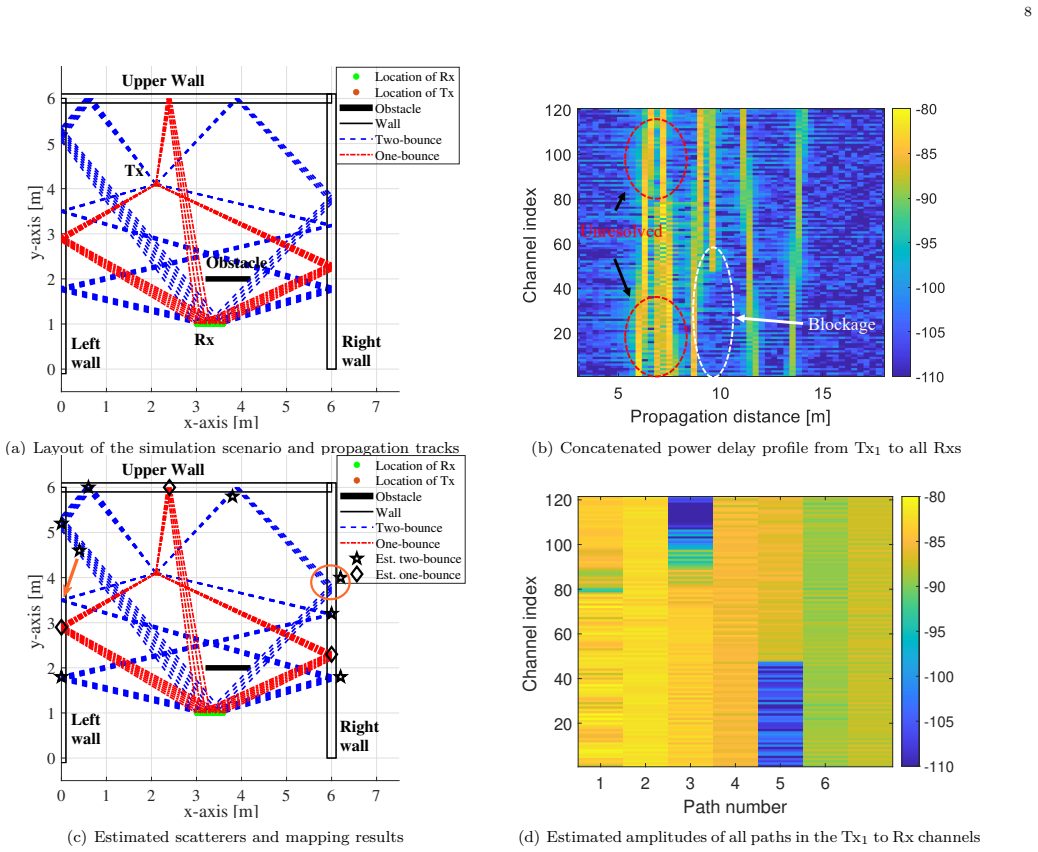
We propose a unified parametric sensing channel model that represents the SNS phenomenon through spatially varying visibility and amplitude of each multipath across the array. To regularize the spatially varying delays caused by propagation mechanisms, we incorporate geometric constraints based on environmental interaction points, embedding them into the model as absolute propagation delays. We then develop a GC-SAGE algorithm to estimate near-field channel parameters and locate environment scatterers/reflectors, calculating per-antenna path amplitudes based on the delays determined by the coordinates of scatterers/reflectors and transceivers.
What carries the argument
The GC-SAGE algorithm, which alternates updates of channel parameters and scatterer locations while enforcing geometric constraints on delays and deriving per-antenna amplitudes from physical coordinates.
If this is right
- The model accounts for partial array visibility due to blockage and hybrid propagation mechanisms.
- Per-antenna amplitudes are obtained directly from delays fixed by scatterer and transceiver coordinates.
- Environment mapping of scatterers and reflectors occurs as a direct output of the channel estimation process.
- The method supports multi-bounce paths and diffraction in near-field settings.
- Validation on both simulations and real measurements confirms the joint estimation and mapping capability.
Where Pith is reading between the lines
- The geometric regularization may reduce pilot overhead needed for large arrays by embedding physical structure.
- Extending the model to track moving scatterers over time could support dynamic environment mapping.
- The approach might improve object localization accuracy when communication signals are reused for sensing.
- Applying the same constraints in other large-array scenarios beyond ELAAs could reveal similar benefits.
Load-bearing premise
Geometric constraints from environmental interaction points can accurately regularize the spatially varying delays, and the parametric form with varying visibility and amplitude sufficiently captures blockage, diffraction, multi-bounce, and hybrid reflection-scattering effects.
What would settle it
Field measurements in which the scatterer locations estimated by the algorithm deviate substantially from independently measured ground-truth positions, or in which the reconstructed channel responses fail to match the observed signals after noise is accounted for.
Figures




read the original abstract
Extremely large aperture arrays (ELAAs) benefit the dual functions of integrated sensing and communication (ISAC) systems by enabling high-throughput data streams and high angular resolution with near-field spatial diversity. However, near-field spherical wavefront effects and spatial non-stationarity (SNS) bring challenges to both communication and sensing. This paper studies near-field spatially non-stationary channel estimation and environment mapping by jointly accounting for multi-bounce, blockage-induced partial visibility, and hybrid reflection-scattering propagation. We propose a unified parametric sensing channel model that represents the SNS phenomenon (due to partial array blockage, diffraction, and specular reflection) through spatially varying visibility and amplitude of each multipath across the array. To regularize the spatially varying delays caused by propagation mechanisms, we incorporate geometric constraints (GCs) based on environmental interaction points, embedding them into the model as absolute propagation delays. We then develop a GC-space-alternating generalized expectation-maximization (GC-SAGE) algorithm to estimate near-field channel parameters and locate environment scatterers/reflectors. Moreover, the GC-SAGE calculates per antenna path amplitudes based on the delays determined by the coordinates of scatterers/reflectors and transceivers, thereby effectively detecting channel SNS. Both ray-based simulation and field measurement are used to validate the proposed approach.
Editorial analysis
A structured set of objections, weighed in public.
Referee Report
Summary. The paper proposes a unified parametric sensing channel model for near-field spatially non-stationary (SNS) channels in extremely large aperture arrays (ELAAs) for ISAC. SNS effects from partial blockage, diffraction, and specular reflection are represented via spatially varying visibility and amplitude per multipath. Geometric constraints (GCs) derived from environmental interaction points are embedded as absolute propagation delays to regularize spatially varying delays. A GC-SAGE algorithm is developed for joint near-field channel parameter estimation and environment scatterer/reflector localization. Per-antenna path amplitudes are computed from scatterer coordinates to detect SNS. Validation uses ray-based simulations and field measurements.
Significance. If the central claims hold, the work could advance ISAC systems by enabling joint channel estimation and environment mapping under realistic near-field SNS conditions. The incorporation of propagation mechanisms (multi-bounce, blockage, hybrid reflection-scattering) into a parametric model with GC regularization is a potentially useful direction for handling the challenges of ELAAs, provided the model and algorithm scale without excessive parameter sensitivity.
major comments (2)
- [§III] §III (Channel Model): The assertion that spatially varying visibility and amplitude per multipath sufficiently captures diffraction, partial blockage, and multi-bounce effects lacks a concrete derivation or comparison to full-wave references. If multi-bounce paths require multiple interaction points or if diffraction yields non-parametric amplitude variations across the array, the SNS representation becomes under-specified, directly undermining the claim that GC-SAGE reliably detects channel SNS and maps the environment.
- [§IV] §IV (GC-SAGE Algorithm): The embedding of GCs as absolute delays assumes interaction points can be jointly estimated without circularity or strong initialization dependence. No analysis is provided on how the algorithm avoids local minima when scatterer locations are unknown a priori, which is load-bearing for the joint estimation and mapping performance claims.
minor comments (2)
- The abstract and introduction would benefit from a brief statement of the number of multipath components and array size used in the field measurements to allow readers to assess the scope of the SNS effects demonstrated.
- Notation for the spatially varying visibility function should be defined explicitly with its functional form (e.g., indicator or smooth transition) rather than left implicit.
Simulated Author's Rebuttal
We thank the referee for the constructive comments, which help improve the clarity and rigor of our work on the parametric SNS channel model and GC-SAGE algorithm. We address each major comment below and will revise the manuscript accordingly.
read point-by-point responses
-
Referee: [§III] §III (Channel Model): The assertion that spatially varying visibility and amplitude per multipath sufficiently captures diffraction, partial blockage, and multi-bounce effects lacks a concrete derivation or comparison to full-wave references. If multi-bounce paths require multiple interaction points or if diffraction yields non-parametric amplitude variations across the array, the SNS representation becomes under-specified, directly undermining the claim that GC-SAGE reliably detects channel SNS and maps the environment.
Authors: We agree that §III would benefit from greater explicitness. In the revised manuscript we will add a derivation subsection that starts from geometric-optics ray paths, shows how partial blockage produces a binary visibility mask across the array, and demonstrates that diffraction-induced amplitude tapering can be captured by a spatially varying per-path gain factor derived from the Fresnel diffraction integral evaluated at each antenna. For multi-bounce we will clarify that each additional interaction point is represented by an additional cascaded delay term whose absolute value is still constrained by the same GC embedding. While we do not perform full-wave comparisons (computational cost precludes this for ELAAs), the ray-tracing and measurement results already confirm that the parametric representation is sufficient for accurate SNS detection and scatterer localization. We therefore do not view the model as under-specified for the joint estimation task. revision: yes
-
Referee: [§IV] §IV (GC-SAGE Algorithm): The embedding of GCs as absolute delays assumes interaction points can be jointly estimated without circularity or strong initialization dependence. No analysis is provided on how the algorithm avoids local minima when scatterer locations are unknown a priori, which is load-bearing for the joint estimation and mapping performance claims.
Authors: The GC-SAGE procedure alternates between (i) updating path delays given current scatterer coordinates and (ii) refining scatterer locations given the updated delays; the absolute-delay GCs are enforced at each alternation, which breaks the circularity. The space-alternating structure of SAGE further reduces the risk of local minima by updating one parameter subset at a time. Nevertheless, we acknowledge the absence of a dedicated convergence analysis. In the revision we will insert a new subsection that (a) describes the two-stage initialization (coarse far-field delay estimates followed by a grid search over plausible scatterer depths) and (b) reports Monte-Carlo results showing that the algorithm converges to the same solution from widely different initializations, with failure rates below 3 % across the tested SNR range. These additions directly support the joint estimation and mapping claims. revision: yes
Circularity Check
No circularity: parametric model uses external physical GCs and joint estimation
full rationale
The paper introduces a unified parametric channel model that incorporates spatially varying visibility/amplitude to capture SNS effects and embeds geometric constraints (GCs) derived from environmental interaction points as absolute delays for regularization. It then presents the GC-SAGE algorithm to jointly estimate near-field parameters and scatterer locations. These steps constitute a standard model-based estimation procedure where the GCs serve as independent physical priors rather than outputs derived from the fitted parameters themselves. No self-definitional loops, fitted inputs renamed as predictions, or load-bearing self-citations appear in the provided description. External validation via ray-tracing simulations and field measurements further confirms the derivation chain remains self-contained against independent benchmarks.
Axiom & Free-Parameter Ledger
free parameters (1)
- spatially varying visibility and amplitude per multipath
axioms (1)
- domain assumption Geometric constraints from environmental interaction points can be used to determine absolute propagation delays
Reference graph
Works this paper leans on
-
[1]
K. V. Mishra, M. B. Shankar, B. Ottersten, and A. L. Swindle- hurst, Signal processing for joint radar communications. John Wiley & Sons, April 2024
2024
-
[2]
Toward multi-functional 6G wireless networks: Integrating sensing, communication, and security,
Z. Wei, F. Liu, C. Masouros, N. Su, and A. P. Petropulu, “Toward multi-functional 6G wireless networks: Integrating sensing, communication, and security,” IEEE Communications Magazine, vol. 60, no. 4, pp. 65–71, 2022
2022
-
[3]
6G-enabled vehicle-to-everything communica- tions: Current research trends and open challenges,
J. Rodríguez-Piñeiro, Z. Wei, J. Wang, C. A. Gutiérrez, and L. M. Correia, “6G-enabled vehicle-to-everything communica- tions: Current research trends and open challenges,” IEEE Open Journal of Vehicular Technology, vol. 6, pp. 2358–2391, 2025
2025
-
[4]
High-accuracy localization for assisted living: 5G systems will turn multipath channels from foe to friend,
K. Witrisal, P. Meissner, E. Leitinger, Y. Shen, C. Gustafson, F. Tufvesson, K. Haneda, D. Dardari, A. F. Molisch, A. Conti, and M. Z. Win, “High-accuracy localization for assisted living: 5G systems will turn multipath channels from foe to friend,” IEEE Signal Process. Mag., vol. 33, no. 2, pp. 59–70, 2016
2016
-
[5]
Doppler robust vortex wave- front design for integrated sensing and communication,
Y. Liu, W.-X. Long, M. R. Bhavani Shankar, M. Moretti, R. Chen, and B. Ottersten, “Doppler robust vortex wave- front design for integrated sensing and communication,” arXiv preprint arXiv:2512.03802, 2025
-
[6]
GPS-denied ISAC vehicle localization based on mmWave radar and identification,
W.-X. Long, W. Song, Y. Liu, Y. Liu, M. Moretti, and R. Chen, “GPS-denied ISAC vehicle localization based on mmWave radar and identification,” IEEE Open Journal of Vehicular Technol- ogy, vol. 6, pp. 2343–2357, 2025
2025
-
[7]
Radio localization and mapping with reconfigurable intelligent surfaces: Challenges, opportunities, and research directions,
H. Wymeersch, J. He, B. Denis, A. Clemente, and M. Juntti, “Radio localization and mapping with reconfigurable intelligent surfaces: Challenges, opportunities, and research directions,” IEEE Vehicular Technology Magazine, vol. 15, no. 4, pp. 52–61, 2020
2020
-
[8]
Joint channel parameter estimation and scatterers localization,
J. Hong, J. Rodríguez-Pineiro, X. Yin, and Z. Yu, “Joint channel parameter estimation and scatterers localization,” IEEE Transactions on Wireless Communications, vol. 22, no. 5, pp. 3324–3340, 2023
2023
-
[9]
Cross far- and near-field wireless communications in terahertz ultra- large antenna array systems,
C. Han, Y. Chen, L. Yan, Z. Chen, and L. Dai, “Cross far- and near-field wireless communications in terahertz ultra- large antenna array systems,” IEEE Wireless Communications, vol. 31, no. 3, pp. 148–154, 2024
2024
-
[10]
Toward millimeter-wave joint radar communications: A signal processing perspective,
K. V. Mishra, M. Bhavani Shankar, V. Koivunen, B. Otter- sten, and S. A. Vorobyov, “Toward millimeter-wave joint radar communications: A signal processing perspective,” IEEE Signal Processing Magazine, vol. 36, no. 5, pp. 100–114, 2019
2019
-
[11]
Near- field MMSE channel estimation for THz RIS-aided commu- nications with electromagnetic interference,
W.-X. Long, M. Moretti, G. Bacci, and L. Sanguinetti, “Near- field MMSE channel estimation for THz RIS-aided commu- nications with electromagnetic interference,” IEEE Wireless Communications Letters, vol. 14, no. 12, pp. 4152–4156, 2025
2025
-
[12]
Spherical-wave model for short- range MIMO,
J.-S. Jiang and M. Ingram, “Spherical-wave model for short- range MIMO,” IEEE Transactions on Communications, vol. 53, no. 9, pp. 1534–1541, 2005
2005
-
[13]
A tutorial on near-field XL-MIMO communications toward 6G,
H. Lu, Y. Zeng, C. You, Y. Han, J. Zhang, Z. Wang, Z. Dong, S. Jin, C.-X. Wang, T. Jiang, X. You, and R. Zhang, “A tutorial on near-field XL-MIMO communications toward 6G,” IEEE Communications Surveys & Tutorials, vol. 26, no. 4, pp. 2213– 2257, 2024
2024
-
[14]
Channel estimation for extremely large- scale MIMO: Far-field or near-field?
M. Cui and L. Dai, “Channel estimation for extremely large- scale MIMO: Far-field or near-field?” IEEE Transactions on Communications, vol. 70, no. 4, pp. 2663–2677, 2022
2022
-
[15]
A spherical-wavefront-based scatterer localization algorithm using large-scale antenna ar- rays,
J. Chen, S. Wang, and X. Yin, “A spherical-wavefront-based scatterer localization algorithm using large-scale antenna ar- rays,” IEEE Communications Letters, vol. 20, no. 9, pp. 1796– 1799, 2016
2016
-
[16]
The cost 2100 mimo channel model,
L. Liu, C. Oestges, J. Poutanen, K. Haneda, P. Vainikainen, F. Quitin, F. Tufvesson, and P. De Doncker, “The cost 2100 mimo channel model,” IEEE Wireless Communications, vol. 19, no. 6, pp. 92–99, 2012
2012
-
[17]
A non-stationary wideband channel model for massive mimo communication systems,
S. Wu, C.-X. Wang, H. Haas, e.-H. M. Aggoune, M. M. Alwakeel, and B. Ai, “A non-stationary wideband channel model for massive mimo communication systems,” IEEE Transactions on Wireless Communications, vol. 14, no. 3, pp. 1434–1446, 2015
2015
-
[18]
A complexity-efficient high resolution propagation parameter estimation algorithm for ultra-wideband large-scale uniform circular array,
X. Cai and W. Fan, “A complexity-efficient high resolution propagation parameter estimation algorithm for ultra-wideband large-scale uniform circular array,” IEEE Transactions on Com- munications, vol. 67, no. 8, pp. 5862–5874, 2019
2019
-
[19]
A novel SAGE algorithm for estimating parameters of wideband spatial nonstationary wireless channels 14 with antenna polarization,
Z. Zhou, C.-X. Wang, L. Zhang, J. Huang, L. Xin, E.-H. Aggoune, and Y. Miao, “A novel SAGE algorithm for estimating parameters of wideband spatial nonstationary wireless channels 14 with antenna polarization,” IEEE Transactions on Antennas and Propagation, vol. 71, no. 9, pp. 7457–7472, 2023
2023
-
[20]
Spatial non-stationary near-field channel modeling and validation for massive MIMO systems,
Z. Yuan, J. Zhang, Y. Ji, G. F. Pedersen, and W. Fan, “Spatial non-stationary near-field channel modeling and validation for massive MIMO systems,” IEEE Transactions on Antennas and Propagation, vol. 71, no. 1, pp. 921–933, 2023
2023
-
[21]
Near-field propagation and spatial non- stationarity channel model for 6–24 GHz (FR3) extremely large- scale MIMO: Adopted by 3GPP for 6G,
H. Xu, J. Zhang, P. Tang, H. Xing, H. Miao, N. Zhang, J. Li, J. Wu, W. Yang, Z. Zhang, W. Jiang, Z. He, A. Haghighat, Q. Wang, and G. Liu, “Near-field propagation and spatial non- stationarity channel model for 6–24 GHz (FR3) extremely large- scale MIMO: Adopted by 3GPP for 6G,” IEEE Journal on Selected Areas in Communications, pp. 1–1, 2026
2026
-
[22]
Channel parameter estimation in mobile radio environments using the SAGE algorithm,
B. H. Fleury, M. Tschudin, R. Heddergott, D. Dahlhaus, and K. I. Pedersen, “Channel parameter estimation in mobile radio environments using the SAGE algorithm,” IEEE Journal on selected areas in communications, vol. 17, no. 3, pp. 434–450, 1999
1999
-
[23]
Multidimensional high-resolution channel sounding in mo- bile radio,
R. Thoma, M. Landmann, G. Sommerkorn, and A. Richter, “Multidimensional high-resolution channel sounding in mo- bile radio,” in Proceedings of the 21st IEEE Instrumenta- tion and Measurement Technology Conference (IEEE Cat. No.04CH37510), vol. 1, 2004, pp. 257–262 Vol.1
2004
-
[24]
Signal recovery from random measurements via orthogonal matching pursuit,
J. A. Tropp and A. C. Gilbert, “Signal recovery from random measurements via orthogonal matching pursuit,” IEEE Trans- actions on Information Theory, vol. 53, no. 12, pp. 4655–4666, 2007
2007
-
[25]
Experimental characterization and multipath cluster modeling for 13-17 GHz indoor propagation channels,
C. Ling, X. Yin, H. Wang, and R. S. Thomä, “Experimental characterization and multipath cluster modeling for 13-17 GHz indoor propagation channels,” IEEE Transactions on antennas and propagation, vol. 65, no. 12, pp. 6549–6561, 2017
2017
-
[26]
Data fusion for multipath-based slam: Combining information from multiple propagation paths,
E. Leitinger, A. Venus, B. Teague, and F. Meyer, “Data fusion for multipath-based slam: Combining information from multiple propagation paths,” IEEE Transactions on Signal Processing, vol. 71, pp. 4011–4028, 2023
2023
-
[27]
Bistatic mmwave mapping in obstructed environments using double-bounce signals,
O. Kaltiokallio, Y. Ge, J. Talvitie, E. Rastorgueva-Foi, H. Wymeersch, and M. Valkama, “Bistatic mmwave mapping in obstructed environments using double-bounce signals,” in 2024 IEEE 25th International Workshop on Signal Processing Advances in Wireless Communications (SPA WC), 2024, pp. 106–110
2024
-
[28]
Multipath ghost recognition and joint target tracking with wall estimation for indoor MIMO radar,
R. Feng, E. De Greef, M. Rykunov, S. Pollin, A. Bourdoux, and H. Sahli, “Multipath ghost recognition and joint target tracking with wall estimation for indoor MIMO radar,” IEEE Transactions on Radar Systems, vol. 2, pp. 154–164, 2024
2024
-
[29]
Fundamental limits for near-field sensing - part ii: Wide-band systems,
T. Wei, K. V. Mishra, M. R. Bhavani Shankar, and B. Ottersten, “Fundamental limits for near-field sensing - part ii: Wide-band systems,” arXiv preprint arXiv:2512.24962, 2025
-
[30]
Channel parameter estimation and localization for near-field XL-MIMO communications,
P. Zhang, Y. Chen, J. Du, X. Li, G. Yang, and C. Yuen, “Channel parameter estimation and localization for near-field XL-MIMO communications,” IEEE Transactions on Vehicular Technology, vol. 74, no. 9, pp. 14 781–14 786, 2025
2025
-
[31]
Channel estimation for extremely large- scale massive MIMO: Far-field, near-field, or hybrid-field?
X. Wei and L. Dai, “Channel estimation for extremely large- scale massive MIMO: Far-field, near-field, or hybrid-field?” IEEE Communications Letters, vol. 26, no. 1, pp. 177–181, 2022
2022
-
[32]
Scatterer localization using large-scale antenna arrays based on a spherical wave-front parametric model,
X. Yin, S. Wang, N. Zhang, and B. Ai, “Scatterer localization using large-scale antenna arrays based on a spherical wave-front parametric model,” IEEE Transactions on Wireless Communi- cations, vol. 16, no. 10, pp. 6543–6556, 2017
2017
-
[33]
Graph-based multi-bounce modeling and channel parameter estimation for indoor sensing,
Y. Liu, L. Wu, X. Cai, and M. R. B. Shankar, “Graph-based multi-bounce modeling and channel parameter estimation for indoor sensing,” IEEE Transactions on Wireless Communica- tions, vol. 24, no. 5, pp. 4219–4234, 2025
2025
-
[34]
Measurement-based 3-d channel modeling with cluster-of- scatterers estimated under spherical-wave assumption,
G. Jing, J. Hong, X. Yin, J. Rodriguez-Pineiro, and Z. Yu, “Measurement-based 3-d channel modeling with cluster-of- scatterers estimated under spherical-wave assumption,” IEEE Transactions on Wireless Communications, vol. 22, no. 9, pp. 5828–5843, 2023
2023
-
[35]
Joint DOA estimation and distorted sensor detection under entangled low-rank and row-sparse constraints,
H. Huang, T. Zhang, F. Yin, B. Liao, and H. Wymeersch, “Joint DOA estimation and distorted sensor detection under entangled low-rank and row-sparse constraints,” in ICASSP 2024 - 2024 IEEE International Conference on Acoustics, Speech and Signal Processing (ICASSP), 2024, pp. 12 851–12 855
2024
-
[36]
Environment reconstruction in multi-bounce channels with array partial blockage,
Y. Liu, L. Wu, X. Cai, and M. R. B. Shankar, “Environment reconstruction in multi-bounce channels with array partial blockage,” in 2025 33rd European Signal Processing Conference (EUSIPCO), 2025, pp. 1208–1212
2025
-
[37]
Diffraction-aided wireless positioning,
G. Duggal, R. M. Buehrer, H. S. Dhillon, and J. H. Reed, “Diffraction-aided wireless positioning,” IEEE Transactions on Wireless Communications, 2025
2025
-
[38]
Partially-blocked near-field sensing: Joint source doa and blockage range estima- tion,
J. Xu, B. Ottersten, and A. L. Swindlehurst, “Partially-blocked near-field sensing: Joint source doa and blockage range estima- tion,” in 2024 58th Asilomar Conference on Signals, Systems, and Computers, 2024, pp. 1871–1875
2024
-
[39]
A 3D indoor localization approach based on spherical wave-front and channel spatial geometry,
Y. Liu, L. Wu, M. Alaee-Kerahroodi, and B. S. M. R, “A 3D indoor localization approach based on spherical wave-front and channel spatial geometry,” in 2022 IEEE 12th Sensor Array and Multichannel Signal Processing Workshop (SAM), 2022, pp. 101–105
2022
-
[40]
H. L. Bertoni, Radio Propagation for Modern Wireless Systems. Prentice Hall, 2001, chapters 4-5 focus on diffraction and scattering
2001
-
[41]
Joint visibility region and channel estimation for extremely large-scale MIMO systems,
A. Tang, J.-B. Wang, Y. Pan, W. Zhang, X. Zhang, Y. Chen, H. Yu, and R. C. de Lamare, “Joint visibility region and channel estimation for extremely large-scale MIMO systems,” IEEE Transactions on Communications, vol. 72, no. 10, pp. 6087– 6101, 2024
2024
-
[42]
A new look at the statistical model identification,
M. H. C. Weng and M. P. O’Rourke, “A new look at the statistical model identification,” IEEE Trans. Autom. Control, vol. AC-19, no. 6, pp. 716–723, Dec. 1974
1974
-
[43]
Debris sensing based on Leo constellation: An intersatellite channel parameter estimation approach,
Y. Liu, M. B. Shankar, L. Wu, and B. Ottersten, “Debris sensing based on Leo constellation: An intersatellite channel parameter estimation approach,” in ICASSP 2024-2024 IEEE International Conference on Acoustics, Speech and Signal Pro- cessing (ICASSP). IEEE, 2024, pp. 13 171–13 175
2024
-
[44]
A mmwave automotive joint radar-communications sys- tem,
S. H. Dokhanchi, B. S. Mysore, K. V. Mishra, and B. Otter- sten, “A mmwave automotive joint radar-communications sys- tem,” IEEE Transactions on Aerospace and Electronic Systems, vol. 55, no. 3, pp. 1241–1260, 2019
2019
-
[45]
Parameter estimation of super- imposed signals using the EM algorithm,
M. Feder and E. Weinstein, “Parameter estimation of super- imposed signals using the EM algorithm,” IEEE Transactions on acoustics, speech, and signal processing, vol. 36, no. 4, pp. 477–489, 1988
1988
-
[46]
Dynamic indoor mmwave mimo radar simu- lation: An image rendering-based approach,
Y. Liu, M. Ahmadi, J. Fuchs, M. Alaee-Kerahroodi, and M. R. Bhavani Shankar, “Dynamic indoor mmwave mimo radar simu- lation: An image rendering-based approach,” IEEE Transactions on Antennas and Propagation, vol. 73, no. 4, pp. 1984–1999, 2025
1984
discussion (0)
Sign in with ORCID, Apple, or X to comment. Anyone can read and Pith papers without signing in.