DeFed-GMM-DaDiL: A Decentralized Federated Framework for Domain Adaptation
Pith reviewed 2026-05-08 17:30 UTC · model grok-4.3
The pith
A fully decentralized method lets clients adapt to an unlabeled target domain by sharing learnable GMM atoms through labeled Wasserstein barycenters.
A machine-rendered reading of the paper's core claim, the machinery that carries it, and where it could break.
Core claim
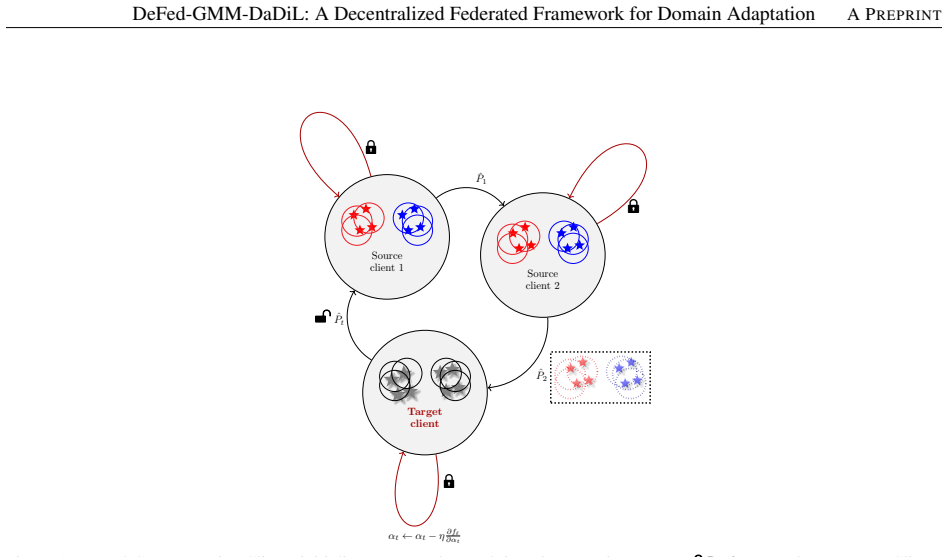
DeFed-GMM-DaDiL extends the GMM-DaDiL framework to a fully decentralized federated setting in which each client represents its dataset as a Gaussian mixture model and the federation jointly approximates these models via labeled Wasserstein barycenters of shared learnable GMM atoms, enabling adaptation to an unlabeled target domain without a central server while preserving privacy.
What carries the argument
Labeled Wasserstein barycenters of shared learnable GMM atoms that jointly approximate each client's local Gaussian mixture model in a decentralized manner.
Load-bearing premise
Jointly approximating client GMMs via labeled Wasserstein barycenters of shared learnable GMM atoms suffices for stable shared representations, effective adaptation, and reconstruction of missing classes without a central server.
What would settle it
Run the method on a benchmark where the target domain lacks several classes and measure whether the learned atoms produce inconsistent representations across clients or fail to recover competitive accuracy compared with centralized baselines.
Figures

read the original abstract
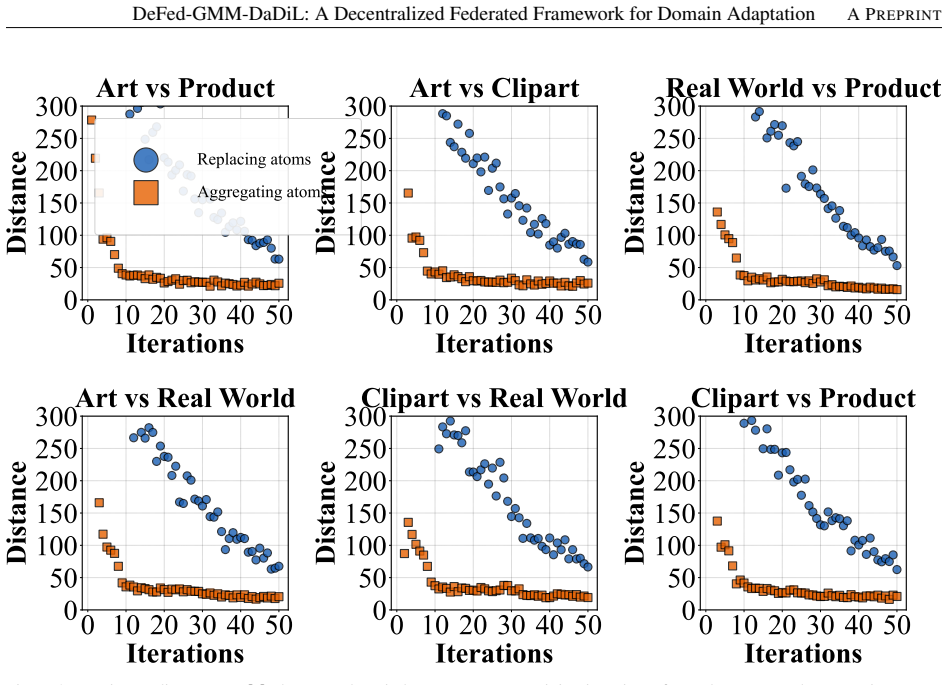
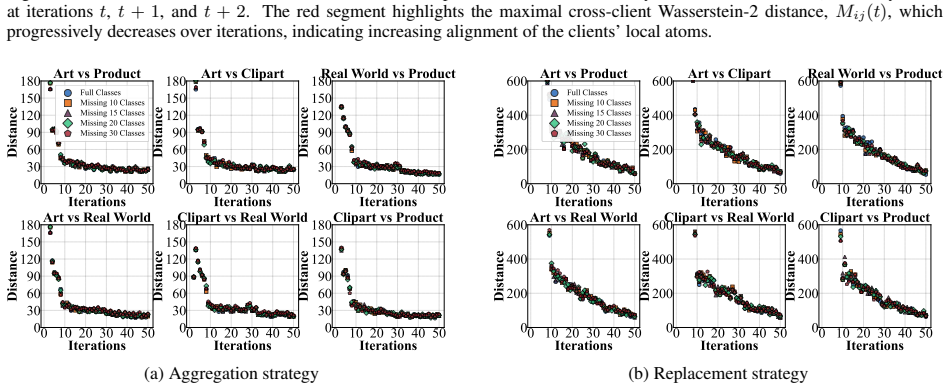
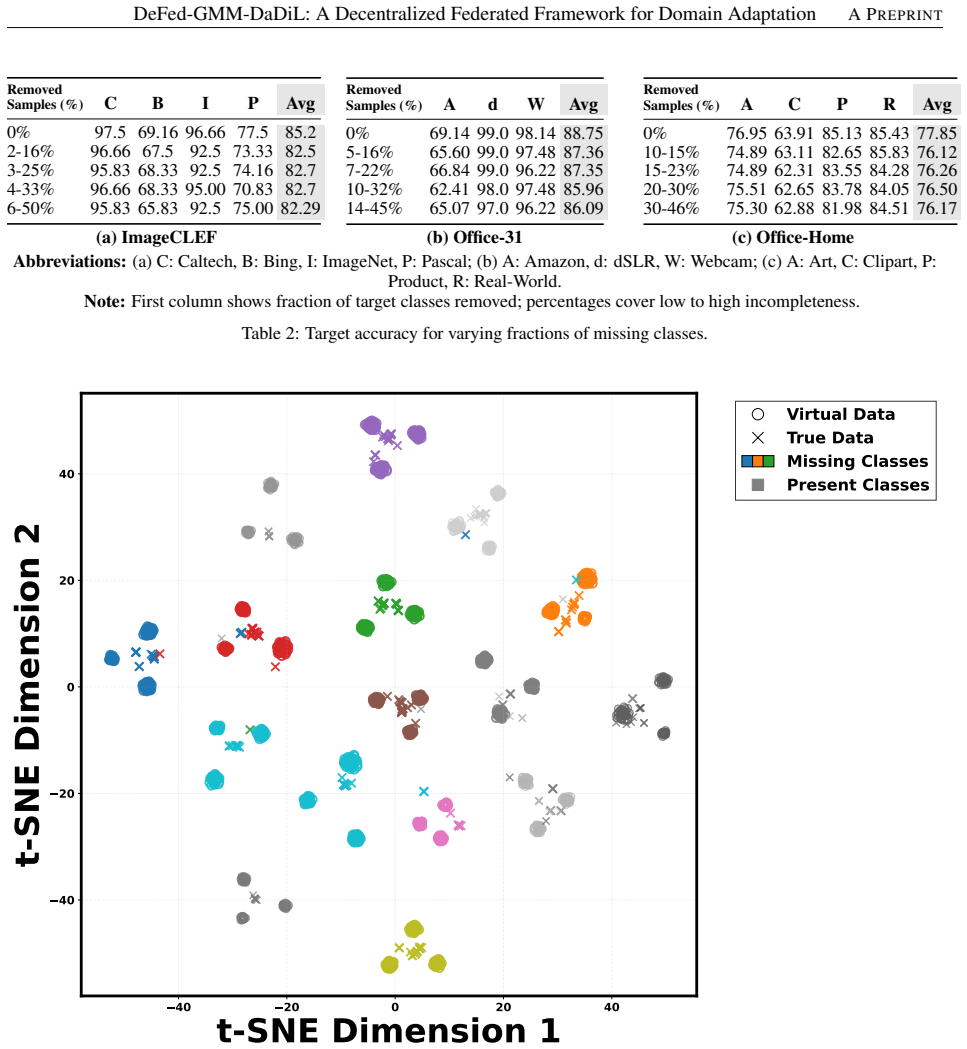
Decentralized multi-source domain adaptation seeks to transfer knowledge from multiple heterogeneous and related source domains to an unlabeled target domain in a decentralized setting. We address this challenge through a fully decentralized federated approach, DeFed-GMM-DaDiL, an extension of the GMM-Dataset Dictionary Learning (DaDiL) framework. Each client models its dataset as a Gaussian Mixture Model (GMM), and the federation jointly approximates them via labeled Wasserstein barycenters of shared, learnable GMM atoms. This design enables adaptation without a central server while preserving clients' privacy. We empirically study the stability of the learned representations in scenarios where the target domain has missing classes. Empirical results demonstrate that DeFed-GMM-DaDiL maintains stable and consistent shared representations across clients, effectively reconstructs missing classes, and achieves competitive performance on multi-source domain adaptation benchmarks.
Editorial analysis
A structured set of objections, weighed in public.
Referee Report
Summary. The manuscript proposes DeFed-GMM-DaDiL, a decentralized federated extension of the GMM-DaDiL framework for multi-source domain adaptation. Each client models its local data as a Gaussian mixture model, and clients jointly approximate these models through labeled Wasserstein barycenters computed over a set of shared, learnable GMM atoms. The design is presented as enabling knowledge transfer to an unlabeled target domain in a fully serverless setting while preserving privacy. Empirical evaluations focus on the stability of the resulting shared representations, the ability to reconstruct missing classes in the target domain, and competitive performance against existing multi-source domain adaptation methods on standard benchmarks.
Significance. If the decentralization mechanism can be shown to function without implicit central coordination and the reported empirical stability holds under varied conditions, the work would provide a structured, GMM-based approach to serverless domain adaptation that handles heterogeneous sources and missing classes. The use of labeled Wasserstein barycenters over learnable atoms offers a principled way to align distributions across clients, extending prior centralized GMM-DaDiL ideas to federated scenarios. This could be relevant for privacy-sensitive applications, though its impact depends on verifiable implementation of the peer-to-peer updates.
major comments (2)
- [§3] §3 (Method): The mathematical objective for jointly approximating client GMMs via labeled Wasserstein barycenters of shared learnable atoms is clearly stated, but the section provides no explicit description of the communication graph, synchronization protocol, or iterative update rules (e.g., gossip-style atom exchanges or consensus steps) required to compute the barycenters in a fully decentralized, serverless network. Standard Wasserstein barycenter solvers are iterative and typically assume a coordinator; without this protocol the central claim that the method 'enables adaptation without a central server' rests on an unverified assumption rather than demonstrated feasibility.
- [§4] §4 (Experiments): The reported results on representation stability and missing-class reconstruction are presented without details on the number of clients, network topology, number of communication rounds, or statistical measures such as standard deviations across runs. These omissions make it difficult to assess whether the 'stable and consistent shared representations' and 'effective reconstruction' claims are robust or sensitive to the decentralized setting.
minor comments (2)
- [Abstract] Abstract: The claim of 'competitive performance on multi-source domain adaptation benchmarks' would be strengthened by naming the specific datasets and baselines used, even at a high level.
- [Notation] Notation: The paper should ensure that symbols for GMM parameters (means, covariances, weights) and the labeled Wasserstein distance are introduced once and used consistently across equations and text.
Simulated Author's Rebuttal
We thank the referee for the constructive comments on our manuscript. We address each of the major comments below and will revise the manuscript to incorporate the suggested clarifications.
read point-by-point responses
-
Referee: [§3] §3 (Method): The mathematical objective for jointly approximating client GMMs via labeled Wasserstein barycenters of shared learnable atoms is clearly stated, but the section provides no explicit description of the communication graph, synchronization protocol, or iterative update rules (e.g., gossip-style atom exchanges or consensus steps) required to compute the barycenters in a fully decentralized, serverless network. Standard Wasserstein barycenter solvers are iterative and typically assume a coordinator; without this protocol the central claim that the method 'enables adaptation without a central server' rests on an unverified assumption rather than demonstrated feasibility.
Authors: We appreciate the referee highlighting this gap. Although the core mathematical objective is detailed, the manuscript does not explicitly outline the decentralized communication aspects. In the revised version, we will add a new paragraph or subsection in §3 that describes the peer-to-peer communication graph, the gossip-style iterative update rules for exchanging and updating the shared learnable atoms, and the synchronization protocol to compute the labeled Wasserstein barycenters without requiring a central server. This will make the serverless nature of the approach explicit and verifiable. revision: yes
-
Referee: [§4] §4 (Experiments): The reported results on representation stability and missing-class reconstruction are presented without details on the number of clients, network topology, number of communication rounds, or statistical measures such as standard deviations across runs. These omissions make it difficult to assess whether the 'stable and consistent shared representations' and 'effective reconstruction' claims are robust or sensitive to the decentralized setting.
Authors: We concur that these details are important for evaluating the claims. We will revise §4 to include the specific number of clients in the experiments, the network topologies employed, the number of communication rounds, and statistical measures including standard deviations across multiple runs. These additions will better demonstrate the robustness of the stability and missing-class reconstruction results in the decentralized federated setting. revision: yes
Circularity Check
No significant circularity detected
full rationale
The paper presents DeFed-GMM-DaDiL as an architectural extension of the prior GMM-DaDiL framework, using standard GMM modeling and labeled Wasserstein barycenters to enable decentralized adaptation. No derivation step reduces a claimed prediction or result to a fitted parameter or self-citation by construction; the central claims rest on empirical benchmarks and the mathematical definition of the objective rather than tautological re-labeling of inputs. The decentralization protocol is asserted as feasible without the method's validity depending on a self-referential loop or unverified uniqueness theorem imported from the authors' own prior work.
Axiom & Free-Parameter Ledger
Reference graph
Works this paper leans on
-
[1]
Dataset shift in machine learning , year=
Quinonero-Candela, Joaquin and Sugiyama, Masashi and Schwaighofer, Anton and Lawrence, Neil D , publisher=. Dataset shift in machine learning , year=
-
[2]
Computational optimal transport: With applications to data science , author=. Foundations and Trends. 2019 , publisher=
work page 2019
-
[3]
Proceedings of the Thirty-Eighth Conference on Uncertainty in Artificial Intelligence , pages =
Multi-source domain adaptation via weighted joint distributions optimal transport , author =. Proceedings of the Thirty-Eighth Conference on Uncertainty in Artificial Intelligence , pages =. 2022 , editor =
work page 2022
-
[4]
IEEE Transactions on Pattern Analysis and Machine Intelligence , volume=
Recent advances in optimal transport for machine learning , author=. IEEE Transactions on Pattern Analysis and Machine Intelligence , volume=. 2024 , publisher=
work page 2024
-
[5]
and Ngolè Mboula, Fred-Maurice , booktitle=
Montesuma, Eduardo F. and Ngolè Mboula, Fred-Maurice , booktitle=. Wasserstein Barycenter Transport for Acoustic Adaptation , year=
-
[6]
Wasserstein Barycenter for Multi-Source Domain Adaptation , year=
Montesuma, Eduardo Fernandes and Mboula, Fred Maurice Ngolè , booktitle=. Wasserstein Barycenter for Multi-Source Domain Adaptation , year=
-
[7]
ECAI 2023-European Conference on Artificial Intelligence , volume=
Multi-source domain adaptation through dataset dictionary learning in wasserstein space , author=. ECAI 2023-European Conference on Artificial Intelligence , volume=
work page 2023
-
[8]
Joint European Conference on Machine Learning and Knowledge Discovery in Databases , pages=
Lighter, better, faster multi-source domain adaptation with gaussian mixture models and optimal transport , author=. Joint European Conference on Machine Learning and Knowledge Discovery in Databases , pages=. 2024 , organization=
work page 2024
-
[9]
A Wasserstein-Type Distance in the Space of Gaussian Mixture Models , journal =
Delon, Julie and Desolneux, Agn\`. A Wasserstein-Type Distance in the Space of Gaussian Mixture Models , journal =. 2020 , doi =
work page 2020
-
[10]
Cresswell and Maksims Volkovs and Hamid R
Shivam Kalra and Junfeng Wen and Jesse C. Cresswell and Maksims Volkovs and Hamid R. Tizhoosh , journal =. ProxyFL: Decentralized Federated Learning through Proxy Model Sharing , volume =
-
[11]
Abhijit Guha Roy and Shayan Siddiqui and Sebastian Pölsterl and Nassir Navab and Christian Wachinger , title =
-
[12]
BACombo—Bandwidth-Aware Decentralized Federated Learning , volume =
Jingyan Jiang and Liang Hu and Chenghao Hu and Jiate Liu and Zhi Wang , journal =. BACombo—Bandwidth-Aware Decentralized Federated Learning , volume =
-
[13]
Peer-to-Peer Federated Learning on Software-Defined Optical Access Network , volume =
Andrew Fernando Pakpahan and I-Shyan Hwang , journal =. Peer-to-Peer Federated Learning on Software-Defined Optical Access Network , volume =
-
[14]
Optimal Transport for Domain Adaptation , year=
Courty, Nicolas and Flamary, Rémi and Tuia, Devis and Rakotomamonjy, Alain , journal=. Optimal Transport for Domain Adaptation , year=
-
[15]
Wasserstein Distance Guided Representation Learning for Domain Adaptation , volume =
Shen, Jian and Qu, Yanru and Zhang, Weinan and Yu, Yong , year =. Wasserstein Distance Guided Representation Learning for Domain Adaptation , volume =. Proceedings of the AAAI Conference on Artificial Intelligence , doi =
-
[16]
ImageCLEF 2014: Overview and analysis of the results , year=
Caputo, Barbara and M. ImageCLEF 2014: Overview and analysis of the results , year=. Information Access Evaluation. Multilinguality, Multimodality, and Interaction: 5th International Conference of the CLEF Initiative, CLEF 2014, Sheffield, UK, September 15-18, 2014. Proceedings 5 , organization=
work page 2014
-
[17]
Adapting visual category models to new domains , year=
Saenko, Kate and Kulis, Brian and Fritz, Mario and Darrell, Trevor , booktitle=. Adapting visual category models to new domains , year=
-
[18]
Deep hashing network for unsupervised domain adaptation , year=
Venkateswara, Hemanth and Eusebio, Jose and Chakraborty, Shayok and Panchanathan, Sethuraman , booktitle=. Deep hashing network for unsupervised domain adaptation , year=
-
[19]
Federated Dataset Dictionary Learning for Multi-Source Domain Adaptation , year =
Espinoza Castellon, Fabiola and Fernandes Montesuma, Eduardo and Mboula, Fred and Mayoue, Aurélien and Souloumiac, Antoine and Gouy-Pailler, Cédric , booktitle =. Federated Dataset Dictionary Learning for Multi-Source Domain Adaptation , year =
-
[20]
The journal of machine learning research , number=
Domain-adversarial training of neural networks , author=. The journal of machine learning research , number=
-
[21]
Wasserstein distance guided representation learning for domain adaptation , volume=
Shen, Jian and Qu, Yanru and Zhang, Weinan and Yu, Yong , booktitle=. Wasserstein distance guided representation learning for domain adaptation , volume=
-
[22]
Communication-efficient learning of deep networks from decentralized data , author=. Proceedings of the 20th International Conference on Artificial Intelligence and Statistics (AISTATS) , pages=. 2017 , organization=
work page 2017
-
[23]
Proceedings of Machine Learning and Systems (MLSys) , pages=
Federated optimization in heterogeneous networks , author=. Proceedings of Machine Learning and Systems (MLSys) , pages=
-
[24]
Transactions on Machine Learning Research , issn=
Optimal Transport for Domain Adaptation through Gaussian Mixture Models , author=. Transactions on Machine Learning Research , issn=. 2025 , url=
work page 2025
-
[25]
Domain adaptation for structural health monitoring via physics-informed and self-attention-enhanced generative adversarial learning , journal =. 2024 , issn =. doi:https://doi.org/10.1016/j.ymssp.2024.111236 , url =
- [26]
-
[27]
Co-MDA: Federated Multisource Domain Adaptation on Black-Box Models , volume=
Liu, Xinhui and Xi, Wei and Li, Wen and Xu, Dong and Bai, Gairui and Zhao, Jizhong , journal=. Co-MDA: Federated Multisource Domain Adaptation on Black-Box Models , volume=
-
[28]
KD3A: Unsupervised Multi-Source Decentralized Domain Adaptation via Knowledge Distillation
Feng, Haozhe and You, Zhaoyang and Chen, Minghao and Zhang, Tianye and Zhu, Minfeng and Wu, Fei and Wu, Chao and Chen, Wei , booktitle=. KD3A: Unsupervised Multi-Source Decentralized Domain Adaptation via Knowledge Distillation. , year=
-
[29]
Decentralized Federated Dataset Dictionary Learning for Multi-Source Domain Adaptation , author=. ICASSP 2025-2025 IEEE International Conference on Acoustics, Speech and Signal Processing (ICASSP) , pages=. 2025 , organization=
work page 2025
-
[30]
Missing-Class-Robust Domain Adaptation by Unilateral Alignment , volume =
Wang, Qin and Michau, Gabriel and Fink, Olga , year =. Missing-Class-Robust Domain Adaptation by Unilateral Alignment , volume =. IEEE Transactions on Industrial Electronics , doi =
-
[31]
Partially Zero-shot Domain Adaptation from Incomplete Target Data with Missing Classes , year=
Ishii, Masato and Takenouchi, Takashi and Sugiyama, Masashi , booktitle=. Partially Zero-shot Domain Adaptation from Incomplete Target Data with Missing Classes , year=
-
[32]
2021 IEEE/CVF International Conference on Computer Vision (ICCV) , year=
Towards Novel Target Discovery Through Open-Set Domain Adaptation , author=. 2021 IEEE/CVF International Conference on Computer Vision (ICCV) , year=
work page 2021
discussion (0)
Sign in with ORCID, Apple, or X to comment. Anyone can read and Pith papers without signing in.