Local elastic perturbation of colloidal suspensions near the colloidal glass transition
Pith reviewed 2026-05-08 16:12 UTC · model grok-4.3
The pith
Rotating magnetic probes show that colloidal suspensions near the glass transition behave as homogeneous viscoelastic continua down to the particle diameter.
A machine-rendered reading of the paper's core claim, the machinery that carries it, and where it could break.
Core claim
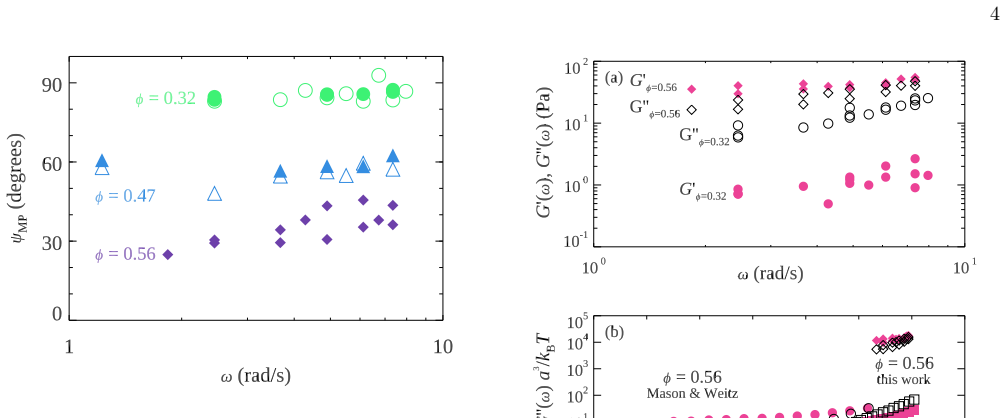
Isolated magnetic particles are rotated in dense colloidal suspensions using an external magnet, with confocal microscopy tracking the probe's circular motion and the responses of adjacent colloidal particles. The known external force and measured amplitude and phase of the probe motion enable calculation of the storage and loss moduli at various volume fractions, showing qualitative agreement with conventional rheology. Further, the oscillatory amplitude of colloidal particles decreases as 1/r with distance from the probe, matching the prediction for a homogeneous viscoelastic continuum. These results establish that continuum models describe the colloidal samples effectively down to scales
What carries the argument
The rotating magnetic probe particle that applies a localized torque, combined with spatial mapping of particle displacements to verify the 1/r amplitude decay characteristic of continuum elasticity.
If this is right
- The storage and loss moduli can be determined locally from probe motion without relying on bulk sample measurements.
- The 1/r decay in oscillation amplitude confirms the validity of homogeneous linear viscoelastic models at microscopic scales.
- Continuum descriptions apply to colloidal suspensions near the glass transition despite potential particle-scale heterogeneities.
- Local elastic perturbations provide a method to probe viscoelastic properties in situ in dense suspensions.
Where Pith is reading between the lines
- This technique might enable mapping of local mechanical properties in heterogeneous or flowing glassy systems.
- Similar local probe methods could test continuum validity in other particulate materials like emulsions or foams.
- The success at particle scales suggests that effective continuum theories could describe dynamics in colloidal glasses more broadly.
Load-bearing premise
The local mechanical response can be modeled using the equations of a homogeneous linear viscoelastic continuum, allowing direct extraction of moduli from probe motion and assuming no dominant boundary or discreteness effects.
What would settle it
A failure to observe the 1/r decay in particle oscillation amplitudes or a mismatch between locally inferred moduli and bulk rheology results at high volume fractions would disprove the effectiveness of continuum descriptions at these scales.
Figures


read the original abstract
Isolated microscopic magnetic particles are used to induce local perturbations in dense colloidal suspensions by rotating an external magnet. Confocal microscopy enables tracking of both the magnetic probe particle and adjacent colloidal particles. A probe particle moves with a circular trajectory. Knowing the external force and measuring the amplitude and phase of the probe motion allows us to infer the storage and loss moduli of colloidal suspensions at various volume fractions. These measurements are in qualitative agreement with previous results from conventional rheology. To further analyze the system's response, the oscillatory amplitude of colloidal particles is evaluated as a function of distance from the probe, revealing a 1/r decay in amplitude, consistent with a homogeneous viscoelastic material. These observations confirm that continuum descriptions of the colloidal samples are effective down to length scales comparable to the particle diameter.
Editorial analysis
A structured set of objections, weighed in public.
Referee Report
Summary. The manuscript presents an experimental study using isolated microscopic magnetic probe particles rotated by an external magnet to induce local perturbations in dense colloidal suspensions near the glass transition. Confocal microscopy tracks both the probe's circular trajectory and the oscillatory displacements of adjacent colloidal particles. Storage and loss moduli are inferred from the probe's measured amplitude and phase under the known external force, yielding results in qualitative agreement with conventional bulk rheology. The amplitude of colloidal particle oscillations is reported to decay as 1/r with distance from the probe, interpreted as evidence that continuum viscoelastic descriptions remain effective down to length scales comparable to the particle diameter.
Significance. If the central claim is substantiated with quantitative validation, the work would provide direct microscopic support for the applicability of linear continuum mechanics in colloidal glasses at scales approaching the particle size. This would help bridge particle-level dynamics and macroscopic rheology in soft glassy systems. The magnetic probe approach for non-contact local forcing is a methodological strength that could be extended to other heterogeneous soft materials.
major comments (2)
- [Abstract] Abstract (modulus inference and 1/r decay): The storage and loss moduli are extracted from the probe particle's amplitude and phase assuming the response follows the Green's function of a homogeneous linear viscoelastic continuum. The observed 1/r decay in surrounding particle amplitudes is then cited to confirm the validity of this continuum description. This creates a potential circularity because any deviations from homogeneity (e.g., due to finite probe size, packing discreteness, or dynamic heterogeneities) would affect both the inferred moduli and the measured decay in a correlated manner. A quantitative test is needed, such as using the extracted moduli to predict absolute amplitudes and phases at multiple distances and comparing residuals to the data, especially at r comparable to one particle diameter.
- [Abstract] Abstract (scale claim): The conclusion that continuum descriptions hold 'down to length scales comparable to the particle diameter' rests on the 1/r decay being 'consistent with' the homogeneous model. However, 1/r is necessary but not sufficient; without the probe-to-colloid size ratio, volume-fraction values, or fit residuals (e.g., deviation from 1/r at small r), it is not possible to evaluate whether the continuum approximation is actually tested at the claimed microscopic scales or whether boundary effects dominate.
minor comments (1)
- The abstract would be clearer if it specified the range of volume fractions examined, the number of independent trials, and any error analysis or statistical measures on the 1/r fits and modulus values.
Simulated Author's Rebuttal
We thank the referee for their careful reading of the manuscript and for the constructive comments on the abstract. We have revised the manuscript to strengthen the presentation of our results and to address the concerns regarding validation of the continuum description.
read point-by-point responses
-
Referee: [Abstract] Abstract (modulus inference and 1/r decay): The storage and loss moduli are extracted from the probe particle's amplitude and phase assuming the response follows the Green's function of a homogeneous linear viscoelastic continuum. The observed 1/r decay in surrounding particle amplitudes is then cited to confirm the validity of this continuum description. This creates a potential circularity because any deviations from homogeneity (e.g., due to finite probe size, packing discreteness, or dynamic heterogeneities) would affect both the inferred moduli and the measured decay in a correlated manner. A quantitative test is needed, such as using the extracted moduli to predict absolute amplitudes and phases at multiple distances and comparing residuals to the data, especially at r comparable to one particle diameter.
Authors: We appreciate the referee highlighting this potential circularity. The storage and loss moduli are obtained exclusively from the probe particle's measured amplitude and phase under the known external torque, using the Green's function for a point torque in a homogeneous viscoelastic continuum. The spatial decay of colloidal particle amplitudes is measured independently via confocal tracking of the surrounding particles. To eliminate any ambiguity, we have added a quantitative comparison in the revised manuscript: the inferred moduli are used to predict absolute displacement amplitudes and phases at multiple distances, which are then compared directly to the measured colloidal particle data. The residuals remain small down to r comparable to the particle diameter, confirming consistency with the continuum model. revision: yes
-
Referee: [Abstract] Abstract (scale claim): The conclusion that continuum descriptions hold 'down to length scales comparable to the particle diameter' rests on the 1/r decay being 'consistent with' the homogeneous model. However, 1/r is necessary but not sufficient; without the probe-to-colloid size ratio, volume-fraction values, or fit residuals (e.g., deviation from 1/r at small r), it is not possible to evaluate whether the continuum approximation is actually tested at the claimed microscopic scales or whether boundary effects dominate.
Authors: We agree that the length-scale claim requires more supporting details for full substantiation. In the revised manuscript we now explicitly state the probe-to-colloid size ratio, list the specific volume fractions examined, and report the residuals from the 1/r fits to the amplitude-versus-distance data. These additions show that systematic deviations from 1/r remain negligible at distances approaching the particle diameter, with any small residuals consistent with experimental noise rather than boundary or discreteness effects. revision: yes
Circularity Check
No significant circularity in the derivation chain
full rationale
The paper infers storage and loss moduli directly from the known external force combined with measured probe amplitude and phase under the continuum assumption, then separately reports an observed 1/r decay in colloidal particle amplitudes as a function of distance. This decay form is the expected spatial dependence from the Green's function of a homogeneous viscoelastic continuum and is presented as an independent consistency check rather than a re-use or redefinition of the fitted moduli values. No equations or steps in the provided text reduce the central claim (continuum validity down to particle scales) to a parameter defined by the same data or to a self-citation chain; the comparison to conventional rheology provides an external benchmark. The derivation is therefore self-contained.
Axiom & Free-Parameter Ledger
axioms (2)
- domain assumption The colloidal suspension responds as a linear viscoelastic continuum to small-amplitude oscillatory forcing.
- domain assumption The material is spatially homogeneous on the scale of the probe-particle motion.
Reference graph
Works this paper leans on
-
[1]
Phase behaviour of con- centrated suspensions of nearly hard colloidal spheres
P. N. Pusey & W. van Megen. “Phase behaviour of con- centrated suspensions of nearly hard colloidal spheres.” Nature,320, 340–342 (1986)
work page 1986
-
[2]
Observation of a glass 7 transition in suspensions of spherical colloidal particles
P. N. Pusey & W. van Megen. “Observation of a glass 7 transition in suspensions of spherical colloidal particles.” Phys. Rev. Lett.,59, 2083–2086 (1987)
work page 2083
-
[3]
Dynamic light-scattering study of the glass transition in a colloidal suspension
W. van Megen & P. N. Pusey. “Dynamic light-scattering study of the glass transition in a colloidal suspension.” Phys. Rev. A,43, 5429–5441 (1991)
work page 1991
-
[4]
Glass transition in colloidal hard spheres: Mode-coupling theory analysis
W. van Megen & S. M. Underwood. “Glass transition in colloidal hard spheres: Mode-coupling theory analysis.” Phys. Rev. Lett.,70, 2766–2769 (1993)
work page 1993
-
[5]
W. van Megen & S. M. Underwood. “Glass transition in colloidal hard spheres: Measurement and mode-coupling- theory analysis of the coherent intermediate scattering function.”Phys. Rev. E,49, 4206–4220 (1994)
work page 1994
-
[6]
Linear viscoelasticity of colloidal hard sphere suspensions near the glass transi- tion
T. G. Mason & D. A. Weitz. “Linear viscoelasticity of colloidal hard sphere suspensions near the glass transi- tion.”Phys. Rev. Lett.,75, 2770–2773 (1995)
work page 1995
-
[7]
Nonergodicity transitions in colloidal suspensions with attractive interactions
J. Bergenholtz & M. Fuchs. “Nonergodicity transitions in colloidal suspensions with attractive interactions.”Phys. Rev. E,59, 5706–5715 (1999)
work page 1999
-
[8]
Jamming phase diagram for attractive particles
V. Trappe, V. Prasad, L. Cipelletti, P. N. Segr` e, & D. A. Weitz. “Jamming phase diagram for attractive particles.” Nature,411, 772–775 (2001)
work page 2001
-
[9]
Multiple glassy states in a simple model system
K. N. Pham, A. M. Puertas, J. Bergenholtz, S. U. Egel- haaf, A. Moussa¨ ıd, P. N. Pusey, A. B. Schofield, M. E. Cates, M. Fuchs, & W. C. K. Poon. “Multiple glassy states in a simple model system.”Science,296, 104–106 (2002)
work page 2002
-
[10]
Entropic barriers, activated hopping, and the glass transition in colloidal suspensions
K. S. Schweizer & E. J. Saltzman. “Entropic barriers, activated hopping, and the glass transition in colloidal suspensions.”J. Chem. Phys.,119, 1181–1196 (2003)
work page 2003
-
[11]
The physics of the colloidal glass transition
G. L. Hunter & E. R. Weeks. “The physics of the colloidal glass transition.”Rep. Prog. Phys.,75, 066501 (2012)
work page 2012
-
[12]
Viscosity and structural relaxation in suspensions of hard-sphere colloids
P. N. Segr` e, S. P. Meeker, P. N. Pusey, & W. C. K. Poon. “Viscosity and structural relaxation in suspensions of hard-sphere colloids.”Phys. Rev. Lett.,75, 958–961 (1995)
work page 1995
-
[13]
W. van Megen, T. C. Mortensen, S. R. Williams, & J. M¨ uller. “Measurement of the self-intermediate scat- tering function of suspensions of hard spherical particles near the glass transition.”Phys. Rev. E,58, 6073–6085 (1998)
work page 1998
-
[14]
A. Kasper, E. Bartsch, & H. Sillescu. “Self-diffusion in concentrated colloid suspensions studied by digital video microscopy of core-shell tracer particles.”Langmuir,14, 5004–5010 (1998)
work page 1998
-
[15]
Equation of state for nonattracting rigid spheres
N. F. Carnahan & K. E. Starling. “Equation of state for nonattracting rigid spheres.”J. Chem. Phys.,51, 635–636 (1969)
work page 1969
-
[16]
Dynamics of supercooled liquids and the glass transition
U. Bengtzelius, W. G¨ otze, & A. Sj¨ olander. “Dynamics of supercooled liquids and the glass transition.”J. Phys. C: Solid State Phys.,17, 5915–5934 (1984)
work page 1984
-
[17]
Aspects of structural glass transitions
W. G¨ otze. “Aspects of structural glass transitions.” Liquids, Freezing and Glass Transition (Les Houches) (1991)
work page 1991
-
[18]
The rheological behavior of concentrated colloidal dispersions
J. F. Brady. “The rheological behavior of concentrated colloidal dispersions.”Journal of Chemical Physics,99, 567–581 (1993)
work page 1993
-
[19]
Theory of nonlinear rheology and yielding of dense colloidal suspensions
M. Fuchs & M. E. Cates. “Theory of nonlinear rheology and yielding of dense colloidal suspensions.”Physical Review Letters,89, 248304 (2002)
work page 2002
-
[20]
Real-space structure of colloidal hard-sphere glasses
A. van Blaaderen & P. Wiltzius. “Real-space structure of colloidal hard-sphere glasses.”Science,270, 1177–1179 (1995)
work page 1995
-
[21]
Methods of digital video microscopy for colloidal studies
J. C. Crocker & D. G. Grier. “Methods of digital video microscopy for colloidal studies.”J. Colloid Interface Sci.,179, 298–310 (1996)
work page 1996
-
[22]
Direct observation of dynamical heterogeneities in colloidal hard-sphere sus- pensions
W. K. Kegel & A. van Blaaderen. “Direct observation of dynamical heterogeneities in colloidal hard-sphere sus- pensions.”Science,287, 290–293 (2000)
work page 2000
-
[23]
Three-dimensional direct imaging of structural relaxation near the colloidal glass transition
E. R. Weeks, J. C. Crocker, A. C. Levitt, A. Schofield, & D. A. Weitz. “Three-dimensional direct imaging of structural relaxation near the colloidal glass transition.” Science,287, 627–631 (2000)
work page 2000
-
[24]
Growing dynamical facilitation on ap- proaching the random pinning colloidal glass transition
S. Gokhale, K. Hima Nagamanasa, R. Ganapathy, & A. K. Sood. “Growing dynamical facilitation on ap- proaching the random pinning colloidal glass transition.” Nature Comm.,5, 4685 (2014)
work page 2014
-
[25]
Anatomy of cage formation in a two-dimensional glass-forming liq- uid
B. Li, K. Lou, W. Kob, & S. Granick. “Anatomy of cage formation in a two-dimensional glass-forming liq- uid.”Nature,587, 225–229 (2020)
work page 2020
-
[26]
Response of a colloidal gel to a microscopic oscillatory strain
M. H. Lee & E. M. Furst. “Response of a colloidal gel to a microscopic oscillatory strain.”Physical Review E,77, 041408 (2008)
work page 2008
-
[27]
Forced motion of a probe particle near the colloidal glass transition
P. Habdas, D. Schaar, A. C. Levitt, & E. R. Weeks. “Forced motion of a probe particle near the colloidal glass transition.”Europhys. Lett.,67, 477–483 (2004)
work page 2004
-
[28]
Local elastic response mea- sured near the colloidal glass transition
D. Anderson, D. Schaar, H. G. E. Hentschel, J. Hay, P. Habdas, & E. R. Weeks. “Local elastic response mea- sured near the colloidal glass transition.”J. Chem. Phys., 138, 12A520 (2013)
work page 2013
-
[29]
Stirring supercooled colloidal liquids at the particle scale
P. Habdas & E. R. Weeks. “Stirring supercooled colloidal liquids at the particle scale.”Phys. Rev. E,111, 065415 (2025)
work page 2025
-
[30]
Laser tweezer microrheology of a colloidal suspension
A. J. Mason & J. F. Brady. “Laser tweezer microrheology of a colloidal suspension.”J. Rheol.,50, 77–92 (2006)
work page 2006
-
[31]
Active and nonlinear microrheology in dense colloidal suspensions
I. Gazuz, A. M. Puertas, T. Voigtmann, & M. Fuchs. “Active and nonlinear microrheology in dense colloidal suspensions.”Phys. Rev. Lett.,102, 248302 (2009)
work page 2009
-
[32]
Active microrheology in a colloidal glass
M. Gruber, G. C. Abade, A. M. Puertas, & M. Fuchs. “Active microrheology in a colloidal glass.”Phys. Rev. E,94, 042602 (2016)
work page 2016
-
[33]
Linear rheology of viscoelastic emulsions with interfacial tension
J.-F. Palierne. “Linear rheology of viscoelastic emulsions with interfacial tension.”Rheologica Acta,29, 204–214 (1990)
work page 1990
-
[34]
Two-point microrheology of inhomogeneous soft materials
J. C. Crocker, M. T. Valentine, E. R. Weeks, T. Gisler, P. D. Kaplan, A. G. Yodh, & D. A. Weitz. “Two-point microrheology of inhomogeneous soft materials.”Phys. Rev. Lett.,85, 888–891 (2000)
work page 2000
-
[35]
One- and two-particle microrheology
A. J. Levine & T. C. Lubensky. “One- and two-particle microrheology.”Phys. Rev. Lett.,85, 1774–1777 (2000)
work page 2000
-
[36]
Two-point microrhe- ology and the electrostatic analogy
A. J. Levine & T. C. Lubensky. “Two-point microrhe- ology and the electrostatic analogy.”Phys. Rev. E,65, 011501 (2001)
work page 2001
-
[37]
F. Ziemann, J. R¨ adler, & E. Sackmann. “Local measure- ments of viscoelastic moduli of entangled actin networks using an oscillating magnetic bead micro-rheometer.” Biophys. J.,66, 2210–2216 (1994)
work page 1994
-
[38]
Particle tracking microrheology of complex fluids
T. G. Mason, K. Ganesan, J. H. van Zanten, D. Wirtz, & S. C. Kuo. “Particle tracking microrheology of complex fluids.”Phys. Rev. Lett.,79, 3282–3285 (1997)
work page 1997
-
[39]
Microrheology of complex fluids
T. A. Waigh. “Microrheology of complex fluids.”Rep. Prog. Phys.,68, 685–742 (2005)
work page 2005
-
[40]
On mea- suring colloidal volume fractions
W. C. K. Poon, E. R. Weeks, & C. P. Royall. “On mea- suring colloidal volume fractions.”Soft Matter,8, 21–30 (2012)
work page 2012
-
[41]
Fluid mechanics and rhe- ology of dense suspensions
J. J. Stickel & R. L. Powell. “Fluid mechanics and rhe- ology of dense suspensions.”Ann. Rev. Fluid Mech.,37, 129–149 (2005)
work page 2005
-
[42]
R. A. L. Jones.Soft Condensed Matter (Oxford Mas- 8 ter Series in Condensed Matter Physics, Vol. 6)(Oxford University Press), 1st edition (2002). ISBN 0198505892
work page 2002
-
[43]
T. Athanasiou, B. Mei, K. S. Schweizer, & G. Petekidis. “Probing cage dynamics in concentrated hardsphere sus- pensions and glasses with high frequency rheometry.” Soft Matter,21, 2607–2622 (2025)
work page 2025
-
[44]
M. L. Gardel, M. T. Valentine, & D. A. Weitz.Microrhe- ology(Springer-Verlag, New York) (2005)
work page 2005
-
[45]
M. Caggioni, V. Trappe, & P. T. Spicer. “Variations of the Herschel–Bulkley exponent reflecting cont ribu- tions of the viscous continuous phase to the shear rate- dependent stress of soft glassy materials.”J. Rheo.,64, 413 (2020)
work page 2020
-
[46]
The equilibrium intrinsic crystal-liquid interface of colloids
J. Hern´ andez-Guzm´ an & E. R. Weeks. “The equilibrium intrinsic crystal-liquid interface of colloids.”Proc. Nat. Acad. Sci.,106, 15198–15202 (2009)
work page 2009
-
[47]
Experimental study of random-close-packed colloidal particles
R. Kurita & E. R. Weeks. “Experimental study of random-close-packed colloidal particles.”Physical Re- view E,82, 011403 (2010)
work page 2010
-
[48]
In search of colloidal hard spheres
C. P. Royall, W. C. K. Poon, & E. R. Weeks. “In search of colloidal hard spheres.”Soft Matter,9, 17–27 (2013)
work page 2013
-
[49]
Dynamical fluctuation effects in glassy colloidal suspensions
K. S. Schweizer. “Dynamical fluctuation effects in glassy colloidal suspensions.”Curr. Opin. Colloid Interface Sci.,12, 297–306 (2007)
work page 2007
-
[50]
Sound propagation in colloidal systems
L. Ye, J. Liu, P. Sheng, J. Huang, & D. A. Weitz. “Sound propagation in colloidal systems.”Journal de Physique IV Proceedings,03, 183–196 (1993)
work page 1993
-
[51]
Sound propagation in suspensions of colloidal spheres with viscous coupling
D. O. Riese & G. H. Wegdam. “Sound propagation in suspensions of colloidal spheres with viscous coupling.” Physical Review Letters,82, 1676–1679 (1999)
work page 1999
-
[52]
The role of sound propaga- tion in concentrated colloidal suspensions
A. F. Bakker & C. P. Lowe. “The role of sound propaga- tion in concentrated colloidal suspensions.”The Journal of Chemical Physics,116, 5867–5876 (2002)
work page 2002
discussion (0)
Sign in with ORCID, Apple, or X to comment. Anyone can read and Pith papers without signing in.