A preliminary exploration of the effects of baseline length for the LIFE space mission
Pith reviewed 2026-06-30 23:09 UTC · model grok-4.3
The pith
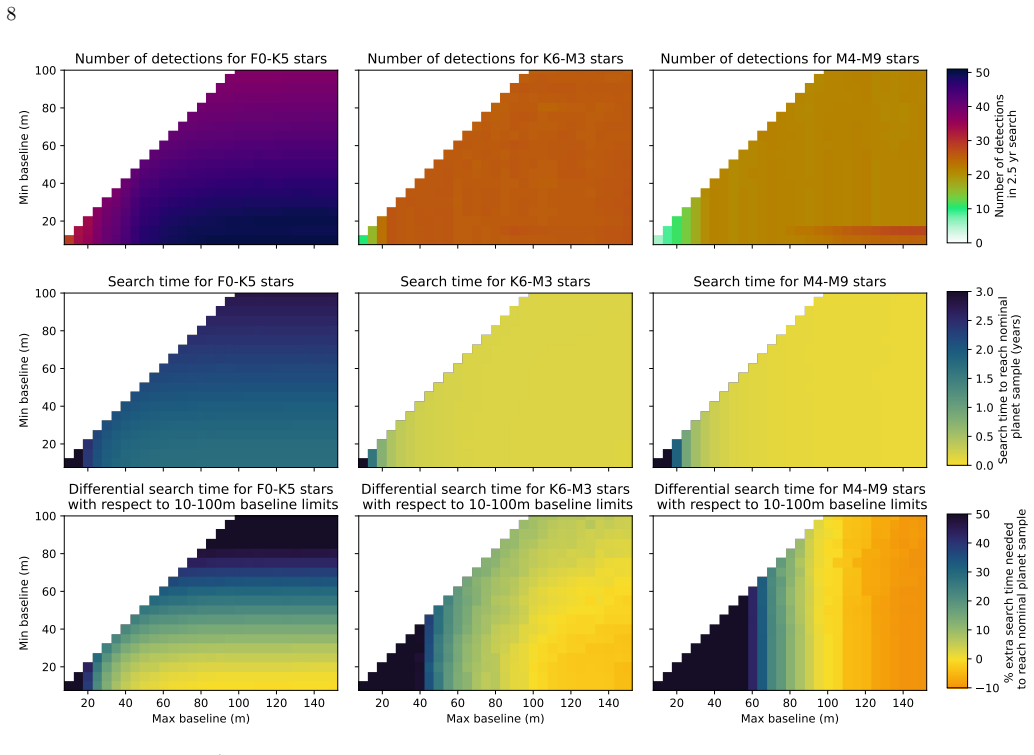
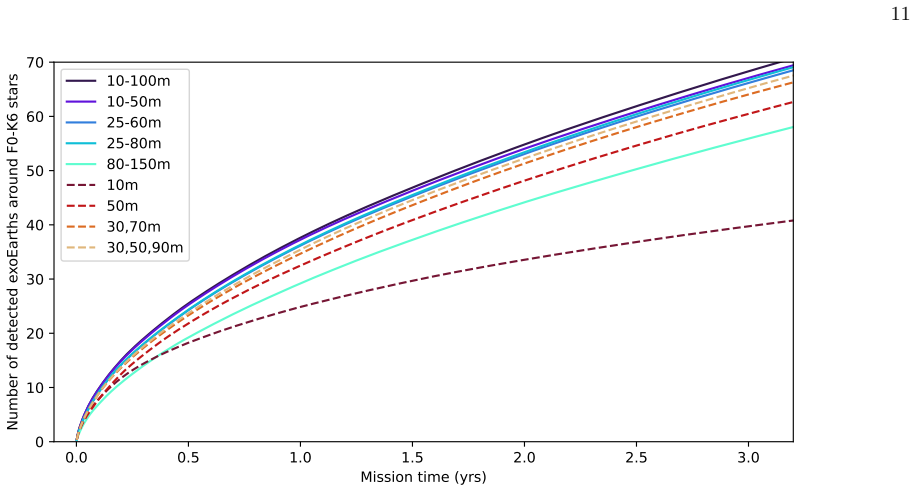
LIFE mission can restrict nulling baselines to 25-80m with under 10% loss in planet yield.
A machine-rendered reading of the paper's core claim, the machinery that carries it, and where it could break.
Core claim
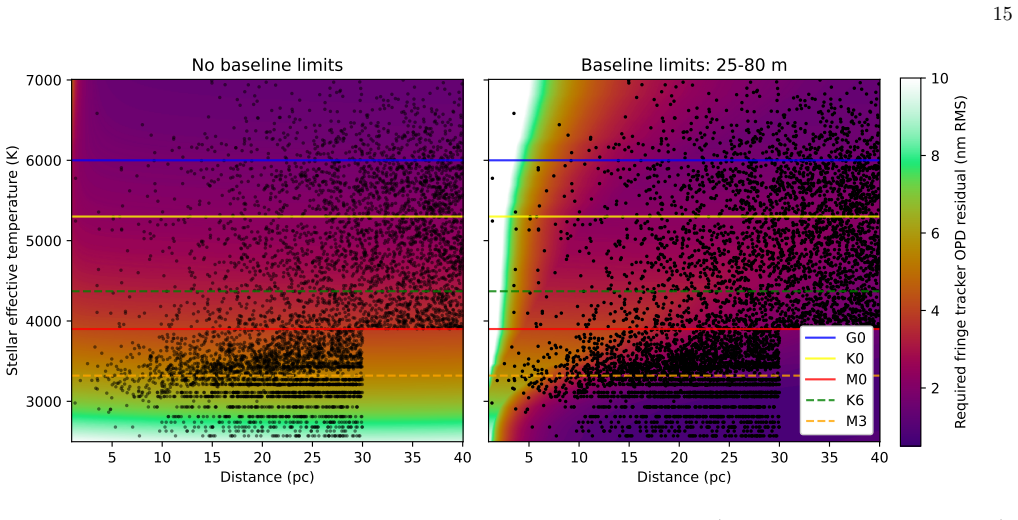
The authors determine that LIFE could utilise a considerably shorter range of baselines, such as 25-80m, or even discrete baselines without much (<10%) loss of performance, while also developing a new astrophysically motivated technique for choosing optimal baselines for a given science target.
What carries the argument
LIFEsim mission simulator used to quantify planet yield and fringe tracking performance across baseline length ranges.
If this is right
- A baseline range of 25-80m delivers planet yields and tracking performance within 10 percent of the wider 10-100m range.
- Discrete baseline sets can replace continuous ranges with comparable overall results.
- Spectral weighting requirements and target-specific optimization introduce necessary performance trade-offs.
- Mission implementation can prioritize fewer baseline options without major science loss.
Where Pith is reading between the lines
- Fewer baseline options could reduce the number of spacecraft or formation-keeping requirements.
- The target-selection technique might apply to other nulling interferometry concepts beyond LIFE.
- Incorporating measured noise spectra from prototype hardware would test the discrete-baseline claim directly.
Load-bearing premise
The LIFEsim simulator together with the revised planet occurrence statistics accurately capture real instrument performance and exoplanet populations across the parameter space explored.
What would settle it
Comparison of actual exoplanet detection counts from a deployed LIFE instrument against the simulated yields for 25-80m baselines, showing deviation beyond 10 percent.
Figures








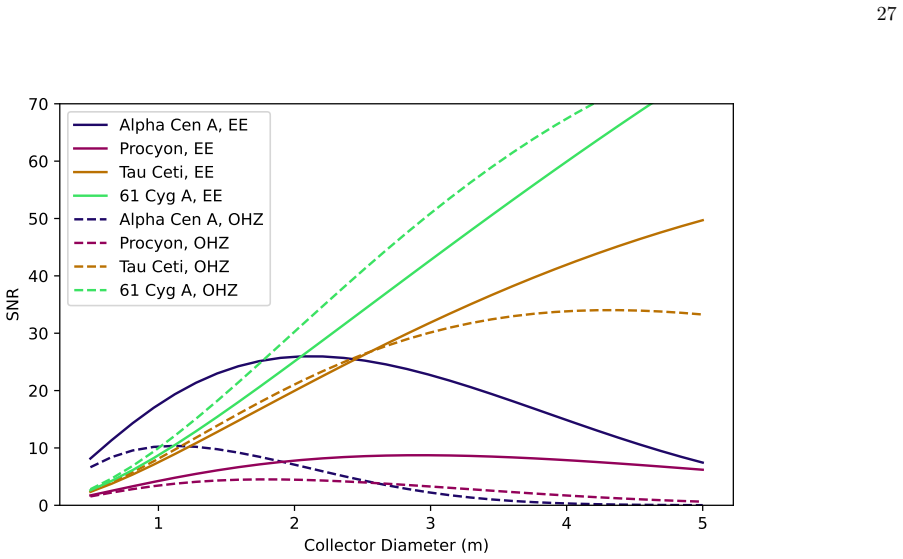


read the original abstract
By aiming to find and characterise dozens of habitable exoplanets through the technique of nulling interferometry, the LIFE space mission will produce transformational science. One of the key parameters for such an interferometric mission is the nulling baseline length - the distance between nulled apertures, which past studies have assumed to be 10-100m. Advances in planet occurrence statistics and simulation tools allow us now to revisit this key assumption with significantly more detail, particularly with the intention to reduce the range of baselines considered due to mission implementation concerns. We utilise the LIFEsim mission simulator along with revised mathematical tools to identify whether the range of baselines could be reduced without significantly affecting planet yield and fringe tracking performance. Along the way, we also determine a new astrophysically motivated technique for choosing which baselines are optimal for a given science target. We find that indeed, LIFE could utilise a considerably shorter range of baselines, such as 25-80m, or even discrete baselines without much (<10%) loss of performance. Nevertheless, careful trade-offs between performance and implementation simplification must be made, especially considering any spectral weighting that may be required by the scientific goals, and the potential loss of target-specific baseline optimisation.
Editorial analysis
A structured set of objections, weighed in public.
Referee Report
Summary. The paper explores optimizing the nulling baseline length range for the LIFE space mission using the LIFEsim simulator and updated planet occurrence statistics. It concludes that restricting to 25-80 m (or discrete baselines) yields planet detection and fringe-tracking performance within <10% of the conventional 10-100 m range, while introducing an astrophysically motivated method for selecting target-specific optimal baselines.
Significance. If the simulation results hold under scrutiny, the finding could ease mission implementation constraints on baseline hardware without major scientific penalty. The use of revised occurrence rates and the simulator constitutes a clear update over prior studies; the new baseline-selection technique is a potentially reusable contribution if its derivation is made explicit.
major comments (2)
- [Methods / Simulation setup] The central <10% loss claim rests on LIFEsim outputs whose configuration (wavelength coverage, noise model, planet exclusion criteria, and error propagation) is not detailed enough to allow independent verification or sensitivity tests; this directly affects reproducibility of the yield tables.
- [Results] The post-hoc narrowing to 25-80 m (or discrete sets) is presented as performance-neutral, yet no quantitative comparison is shown for the full original range versus the restricted range across the same target sample; without this, the magnitude of any selection bias cannot be assessed.
minor comments (2)
- [Section 3] Notation for the new baseline-selection technique should be defined with an explicit equation or algorithm box rather than descriptive text only.
- [Figures 4-6] Figure captions should state the exact baseline sets compared and the number of simulated targets in each panel.
Simulated Author's Rebuttal
We thank the referee for their thoughtful review and constructive comments, which have helped improve the clarity and reproducibility of our manuscript. We address each major comment below.
read point-by-point responses
-
Referee: [Methods / Simulation setup] The central <10% loss claim rests on LIFEsim outputs whose configuration (wavelength coverage, noise model, planet exclusion criteria, and error propagation) is not detailed enough to allow independent verification or sensitivity tests; this directly affects reproducibility of the yield tables.
Authors: We agree with the referee that more detailed information on the LIFEsim configuration is required to ensure reproducibility. In the revised version of the manuscript, we have substantially expanded the Methods section (Section 2) to include explicit details on the wavelength coverage (3-20 μm in 20 channels), the noise model (including photon noise, read noise, and background contributions), planet exclusion criteria (SNR > 5 for detection and characterization), and the error propagation methods used for yield calculations. We have also included a table summarizing the key simulation parameters and made the configuration files available as supplementary material. revision: yes
-
Referee: [Results] The post-hoc narrowing to 25-80 m (or discrete sets) is presented as performance-neutral, yet no quantitative comparison is shown for the full original range versus the restricted range across the same target sample; without this, the magnitude of any selection bias cannot be assessed.
Authors: The referee correctly notes that a direct quantitative comparison would be beneficial. Although our simulations inherently compared yields across different baseline ranges on the same target sample to derive the <10% loss figure, this was not presented explicitly in the original submission. We have now added a dedicated subsection in the Results (Section 3.2) with a new table and figure that directly compares the planet detection yields and fringe-tracking performance for the full 10-100 m range against the restricted 25-80 m range and discrete baseline sets, using the identical target list. These additions confirm the loss remains below 10% and allow assessment of any potential biases. revision: yes
Circularity Check
No significant circularity identified
full rationale
The paper reports simulation-based results from the external LIFEsim tool and revised occurrence statistics to assess baseline ranges and performance loss. No equations, derivations, or self-citation chains are shown that reduce the reported yields or <10% loss figures to quantities defined by the authors' own fitted parameters or prior ansatzes. The central claims rest on external simulator outputs rather than internal reductions, making the derivation self-contained against the provided text.
Axiom & Free-Parameter Ledger
axioms (2)
- domain assumption Updated planet occurrence statistics accurately reflect reality
- domain assumption LIFEsim correctly models nulling interferometry performance and fringe tracking
Reference graph
Works this paper leans on
-
[1]
Stellar types of F through M (2500 K to 7000 K) 2.−1≤[F eH]≤1, chosen due to our targets lying in the solar neighbourhood (see e.g. M. Haywood (2001))
2001
-
[2]
Log(g)≥3.5, derived from our stars being main sequence and the above stellar type range
-
[3]
outer working angle
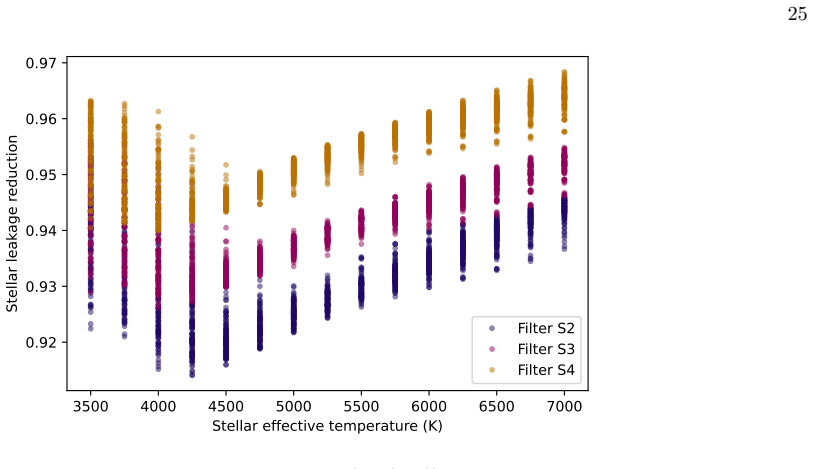
Microturbulence below 2 km/s, again from our stellar cut being relatively cool main sequence stars (see M. Steffen et al. (2013)) For the following analysis, we assume a parameterisation based on a quadratic relation as given in eq. (A6): LD(θ) = 1−a 1(1−µ)−a 2(1−µ) 2, µ= p 1−(2θ/δ s)2, θ≤δ s/2. To start with the limb darkening dependence on stellar leaka...
2013
discussion (0)
Sign in with ORCID, Apple, or X to comment. Anyone can read and Pith papers without signing in.