The structure of multi-axion solutions to the strong CP problem
Pith reviewed 2026-05-11 01:08 UTC · model grok-4.3
The pith
A general sum rule for N-axion systems classifies all possible mass-photon coupling patterns arising from arbitrary Peccei-Quinn breaking and anomaly alignments.
A machine-rendered reading of the paper's core claim, the machinery that carries it, and where it could break.
Core claim
The structure of Peccei-Quinn symmetry breaking and the relative alignment between the QCD and electromagnetic anomalies determine the locations of axions in the mass-coupling plane for multi-axion solutions to the strong CP problem. These two ingredients are combined into a general sum rule for N-axion systems that incorporates both arbitrary PQ breaking and non-universal anomaly coefficients. The framework is applied to the two-axion system and to general multi-axion setups, with explicit UV-complete theories shown to realize each qualitative regime naturally.
What carries the argument
The general sum rule for N-axion systems that incorporates both general PQ breaking and non-universal anomaly coefficients.
If this is right
- Axions can sit to the right of the standard QCD axion band in the mass-coupling plane.
- Axions can appear in experimentally accessible regions to the left of the usual band.
- The QCD axion band itself can be displaced from its canonical position.
- UV-complete models exist that naturally produce each of these distinct regimes.
Where Pith is reading between the lines
- Axion search programs should target the full set of patterns allowed by the sum rule rather than restricting to the single-axion band.
- Detection of multiple axion signals could be cross-checked against the sum rule to test whether they belong to the same multi-axion system.
- The sum rule may help discriminate among candidate ultraviolet completions by matching low-energy axion properties to high-scale symmetry breaking patterns.
- Future precision measurements of axion-photon couplings could directly test the non-universal anomaly coefficients assumed in the framework.
Load-bearing premise
The structure of Peccei-Quinn symmetry breaking and the relative alignment between QCD and electromagnetic anomalies are the dominant ingredients that control the phenomenological patterns of axion masses and couplings.
What would settle it
Observation of a collection of axion masses and photon couplings whose values violate the derived sum rule for their total number N would falsify the classification.
Figures

read the original abstract
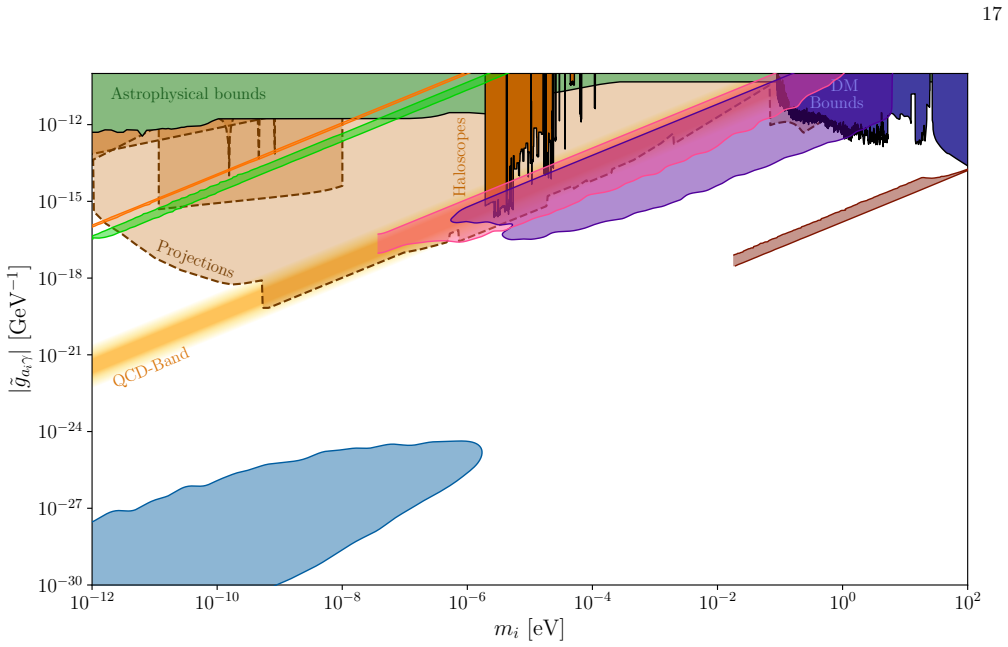
A broad experimental program is targeting the QCD axion band predicted by single-axion solutions to the strong CP problem. Multi-axion theories provide a well-motivated departure from this canonical picture, since additional states generically modify the mass-photon-coupling relation. We investigate the general structure of multi-axion solutions to the strong CP problem and study the different qualitative mass-coupling patterns that arise, including axions to the right of the QCD band, axions in the experimentally accessible region to its left, and scenarios in which the QCD axion band itself is displaced. This general treatment reveals a broad set of phenomenological possibilities that are not captured by more restrictive assumptions. In particular, we identify the structure of Peccei-Quinn symmetry breaking and the relative alignment between the QCD and electromagnetic anomalies as key ingredients determining the location of the axions in parameter space. Combining these ingredients, we derive a general sum rule for $N$-axion systems that incorporates both general PQ breaking and non-universal anomaly coefficients. We apply the framework to the two-axion system and to general multi-axion setups, identifying UV-complete theories in which the different phenomenological regimes arise naturally. Our results motivate an extended axion search program and have implications for our understanding of fundamental physics and the ultraviolet completion of the Standard Model.
Editorial analysis
A structured set of objections, weighed in public.
Referee Report
Summary. The paper derives a general sum rule relating axion masses and photon couplings in N-axion systems that solve the strong CP problem. The sum rule incorporates arbitrary Peccei-Quinn symmetry breaking and non-universal anomaly coefficients for QCD and electromagnetism. It analyzes the resulting mass-photon coupling patterns, including axions to the right or left of the standard QCD band and displacements of the band itself, and illustrates the framework with explicit two-axion examples and UV-complete realizations for the identified regimes.
Significance. If the derivation holds, the result provides a useful organizing principle for multi-axion phenomenology that goes beyond the restrictive assumptions of single-axion or universal-charge models. It identifies the structure of PQ breaking and the relative alignment of anomalies as the dominant controls on observable patterns, supplies existence proofs via UV completions, and motivates an expanded experimental search program outside the canonical QCD axion band.
minor comments (2)
- The abstract states that the sum rule 'incorporates both general PQ breaking and non-universal anomaly coefficients,' but a one-sentence reminder of the precise trace or determinant identity used to obtain the sum rule would help readers immediately see the algebraic origin.
- In the discussion of UV completions, the paper could add a short table or bullet list contrasting the anomaly coefficients and breaking scales across the three regimes (right of band, left of band, displaced band) to make the mapping from ingredients to phenomenology more immediate.
Simulated Author's Rebuttal
We thank the referee for their positive summary of our work, their assessment of its significance, and their recommendation to accept the manuscript.
Circularity Check
Derivation of sum rule is self-contained algebraic identity
full rationale
The paper constructs the effective potential from the anomaly structure, PQ-breaking terms, and non-universal coefficients, then minimizes it to obtain the mass matrix. The sum rule follows directly from trace identities or determinant relations on the eigenvalues and eigenvectors of that matrix. This algebraic step is a direct consequence of the EFT setup and does not reduce to a fitted parameter, self-definition, or self-citation chain. UV-complete realizations are presented only as existence proofs for the identified regimes and do not enter the sum-rule derivation itself. No load-bearing step collapses to its own inputs by construction.
Axiom & Free-Parameter Ledger
axioms (1)
- domain assumption Existence of a Peccei-Quinn symmetry whose breaking solves the strong CP problem
discussion (0)
Sign in with ORCID, Apple, or X to comment. Anyone can read and Pith papers without signing in.