Recognition: no theorem link
Localization phase diagram of the Hexagonal Lattice with irrational magnetic flux
Pith reviewed 2026-05-12 03:11 UTC · model grok-4.3
The pith
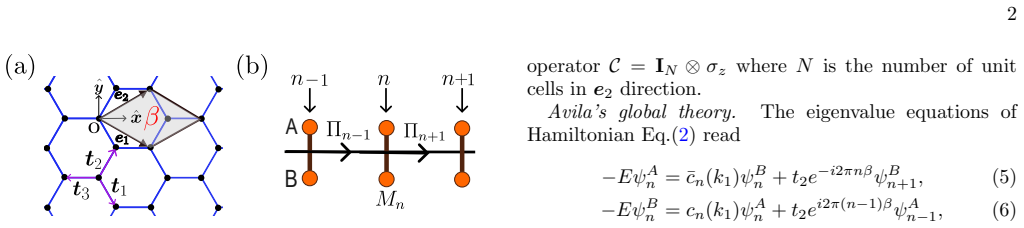
The Hofstadter model on the hexagonal lattice with irrational flux reduces exactly to a 2x2 transfer matrix solvable by Avila's global theory, yielding a phase diagram of three pure phases with no mobility edge.
A machine-rendered reading of the paper's core claim, the machinery that carries it, and where it could break.
Core claim
For the nearest-neighbor Hofstadter Hamiltonian on the hexagonal lattice with irrational flux, the system reduces exactly to a 2x2 transfer matrix that lies within the scope of Avila's global theory. The theory then determines the Lyapunov exponents and therefore the localization properties everywhere in the spectrum. The phase diagram consists of three pure phases—extended, localized, and critical—whose boundaries are given analytically. The chiral symmetry of the model survives the reduction and forbids mobility edges.
What carries the argument
Exact 2x2 transfer-matrix representation of the hexagonal Hofstadter Hamiltonian, to which Avila's global theory applies directly to fix the localization phases.
If this is right
- Phase boundaries are fixed analytically for all energies and fluxes without fitting parameters.
- Chiral symmetry keeps the three phases pure and eliminates mobility edges throughout the diagram.
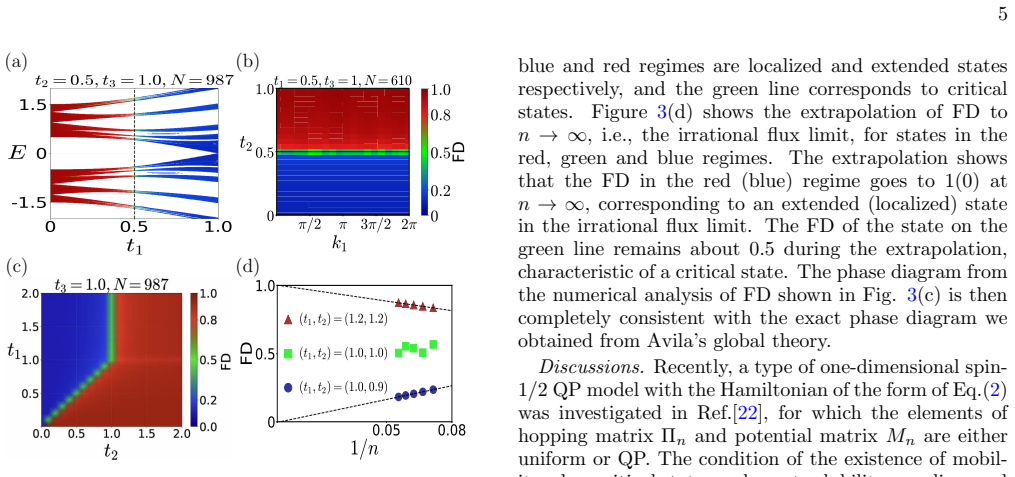
- Renormalization-group flows and fractal-dimension calculations match the analytically predicted regions.
- The critical phase occupies a finite region in the energy-flux plane rather than isolated points.
Where Pith is reading between the lines
- The same reduction technique may apply to other bipartite lattices that preserve chiral symmetry under quasiperiodic flux.
- Experimental measurements of localization length in cold-atom or photonic realizations could directly test the predicted sharp boundaries.
- The absence of mobility edges highlights chiral symmetry as a general protector against mixed phases in quasiperiodic systems.
Load-bearing premise
The nearest-neighbor hexagonal lattice Hamiltonian with irrational flux permits an exact reduction to a 2x2 transfer matrix that falls within Avila's global theory without approximations or loss of chiral symmetry.
What would settle it
A high-precision numerical computation of the Lyapunov exponent or localization length at an irrational flux value where the theory predicts a pure critical phase would falsify the claim if it instead revealed a mobility edge or mixed phases.
Figures

read the original abstract
We study the Hofstadter model on a hexagonal lattice with irrational magnetic flux in this work. The Hofstadter model of the square lattice with irrational flux has been solved mathematically by Avila in his Fields medal work. However, this theory is usually not applicable to lattices with internal degrees of freedom, such as spin or sub-lattices. In this work, we show that for the hexagonal lattice with only nearest neighbor hopping, the system can still be characterized by a 2*2 transfer matrix and solved exactly by Avila$'$s global theory of Avila although this lattice has two sub-lattices. We obtained the exact localization phase diagram of the hexagonal lattice with irrational flux by this theory, which reveals three pure phases, that is, the extended, localized and critical states but no mobility edge due to the chiral symmetry. We used the renormalization group (RG) theory to verify these results, which can determine part of the phase diagram. We then computed the fractal dimension of the remaining part numerically. The results from both the RG theory and numerical analysis confirmed the phase diagram we get from Avila$'$s global theory.
Editorial analysis
A structured set of objections, weighed in public.
Referee Report
Summary. The manuscript claims that the nearest-neighbor Hofstadter model on the hexagonal lattice with irrational flux reduces exactly to a 2x2 transfer matrix (SL(2,R) cocycle) despite the two sublattices, permitting direct application of Avila's global theory. This yields an exact localization phase diagram consisting of three pure phases—extended, localized, and critical—with no mobility edge, protected by chiral symmetry. The analytic result is cross-checked by renormalization-group analysis for part of the diagram and by numerical computation of fractal dimensions for the remainder.
Significance. If the claimed reduction holds without approximation, the work would extend Avila's theory from the square lattice to a bipartite lattice with internal degrees of freedom, supplying one of the few exact phase diagrams for a quasiperiodic system beyond the almost-Mathieu operator. The independent RG and numerical verifications add value by providing falsifiable checks on the analytic boundaries.
major comments (1)
- [Transfer-matrix reduction (main derivation section)] The central claim rests on an exact reduction of the 4-component wavefunction (arising from the two sublattices) to a 2x2 transfer matrix while preserving the precise quasiperiodic flux term required by Avila's theorem and the chiral symmetry that forbids a mobility edge. The manuscript must supply the explicit mapping (including the form of the cocycle and verification that no additional approximations are introduced) in the section deriving the transfer matrix; without this step the applicability of the global theory and the resulting three-phase diagram remain unestablished.
minor comments (3)
- [Abstract] Abstract contains the LaTeX artifact 'Avila$'$s global theory of Avila'; correct to 'Avila's global theory'.
- [RG and numerical sections] The RG verification determines only part of the diagram; the manuscript should state explicitly which intervals of the flux or energy are covered by RG versus those requiring numerics.
- [Numerical results] Fractal-dimension plots should include error bars or convergence checks with system size to substantiate the distinction between critical and localized/extended regimes.
Simulated Author's Rebuttal
We thank the referee for their careful reading of our manuscript and for recognizing the potential significance of extending Avila's theory to the hexagonal lattice. We address the major comment below and will revise the manuscript to strengthen the presentation of the central derivation.
read point-by-point responses
-
Referee: [Transfer-matrix reduction (main derivation section)] The central claim rests on an exact reduction of the 4-component wavefunction (arising from the two sublattices) to a 2x2 transfer matrix while preserving the precise quasiperiodic flux term required by Avila's theorem and the chiral symmetry that forbids a mobility edge. The manuscript must supply the explicit mapping (including the form of the cocycle and verification that no additional approximations are introduced) in the section deriving the transfer matrix; without this step the applicability of the global theory and the resulting three-phase diagram remain unestablished.
Authors: We agree that an explicit, self-contained derivation of the reduction from the 4-component wavefunction on the hexagonal lattice to the 2x2 SL(2,R) cocycle is essential to rigorously justify the application of Avila's global theory. In the revised manuscript we will expand the main derivation section to provide the full step-by-step mapping: we will start from the tight-binding equations on the two sublattices, introduce the quasiperiodic phase factors arising from the irrational flux, eliminate the redundant components using the nearest-neighbor structure and chiral symmetry, and arrive at the explicit 2x2 transfer matrix whose off-diagonal entries contain the precise quasiperiodic term required by Avila's theorem. We will also include a direct verification that no additional approximations are introduced and that the chiral symmetry (which precludes a mobility edge) is preserved exactly. This expanded derivation will make the applicability of the three-phase diagram fully transparent. revision: yes
Circularity Check
No circularity: external Avila theory plus independent RG/numerical verification
full rationale
The paper's central step is an explicit reduction of the nearest-neighbor hexagonal Hofstadter Hamiltonian to a 2x2 transfer matrix (SL(2,R) cocycle) that falls under Avila's global theory, an external Fields-medal result with no author overlap. The resulting three-phase diagram (extended, localized, critical; no mobility edge) is then cross-checked by separate renormalization-group analysis on part of the diagram and by numerical fractal-dimension computations on the remainder. Neither verification re-uses fitted parameters from the Avila-derived boundaries, nor does any equation rename a fitted quantity as a prediction. No self-citation is load-bearing; the derivation chain remains self-contained against external mathematical and numerical benchmarks.
Axiom & Free-Parameter Ledger
axioms (1)
- domain assumption The hexagonal lattice with nearest-neighbor hopping and irrational flux admits an exact 2x2 transfer-matrix representation that falls within the hypotheses of Avila's global theory.
Reference graph
Works this paper leans on
-
[1]
D. R. Hofstadter,Energy levels and wave functions of Bloch electrons in rational and irrational magnetic fields, Phys. Rev. B14, 2239 (1976)
work page 1976
-
[2]
K. v. Klitzing, G. Dorda, and M. Pepper,New Method for High-Accuracy Determination of the Fine-Structure Con- stant Based on Quantized Hall Resistance, Phys. Rev. Lett.45, 494 (1980)
work page 1980
-
[3]
J. Herzog-Arbeitman, Z.-D. Song, N. Regnault, and B. A. Bernevig,Hofstadter Topology: Noncrystalline Topologi- cal Materials at High Flux, Phys. Rev. Lett.125, 236804 (2020)
work page 2020
-
[5]
X. G. Wen and A. Zee,Winding number, family index theorem, and electron hopping in a magnetic field, Nucl. Phys. B316, 641 (1989)
work page 1989
-
[6]
R. Xiao and Y. X. Zhao,Revealing the spatial nature of sublattice symmetry, Nat. Commun.15, 3787 (2024)
work page 2024
- [7]
-
[8]
Y. Hatsugai and M. Kohmoto,Energy spectrum and the quantum Hall effect on the square lattice with next- nearest-neighbor hopping, Phys. Rev. B42, 8282 (1990)
work page 1990
-
[9]
M. Kohmoto,Zero modes and the quantized Hall conduc- tance of the two-dimensional lattice in a magnetic field, Phys. Rev. B39, 11943 (1989)
work page 1989
-
[10]
Y. Fang and J. Cano,Symmetry indicators in commen- surate magnetic flux, Phys. Rev. B107, 245108 (2023)
work page 2023
-
[11]
A. Lau, C. Ortix, and J. van den Brink,Topological Edge States with Zero Hall Conductivity in a Dimerized Hofs- tadter Model, Phys. Rev. Lett.115, 216805 (2015)
work page 2015
-
[12]
J. Herzog-Arbeitman, Z.-D. Song, L. Elcoro, and B. A. Bernevig,Hofstadter Topology with Real Space Invariants and Reentrant Projective Symmetries, Phys. Rev. Lett. 130, 236601 (2023)
work page 2023
-
[13]
Zak,Magnetic Translation Group, Phys
J. Zak,Magnetic Translation Group, Phys. Rev.134, A1602 (1964)
work page 1964
-
[14]
A. Matsugatani, Y. Ishiguro, K. Shiozaki, and H. Watan- abe,Universal Relation among the Many-Body Chern Number, Rotation Symmetry, and Filling, Phys. Rev. Lett.120, 096601 (2018)
work page 2018
-
[15]
D. J. Thouless,Bandwidths for a quasiperiodic tight- binding model, Phys. Rev. B28, 4272 (1983)
work page 1983
-
[16]
D. J. Thouless,Scaling for the discrete Mathieu equation, Commun. Math. Phys.127, 187 (1990)
work page 1990
-
[17]
D. J. Thouless and Y. Tan,Total bandwidth for the Harper equation. III. Corrections to scaling, J. Phys. A: Math. Gen.24, 4055 (1991)
work page 1991
-
[18]
J. H. Han, D. J. Thouless, H. Hiramoto, and M. Kohmoto,Critical and bicritical properties of Harper’s equation with next-nearest-neighbor coupling, Phys. Rev. B50, 11365 (1994)
work page 1994
-
[19]
R. del Rio, S. Jitomirskaya, Y. Last, and B. Simon,What is Localization?, Phys. Rev. Lett.75, 117 (1995)
work page 1995
-
[20]
S. Ya. Jitomirskaya and Y. Last,Dimensional Hausdorff Properties of Singular Continuous Spectra, Phys. Rev. Lett.76, 1765 (1996)
work page 1996
-
[21]
S. Aubry and G. Andr´ e,Analyticity breaking and An- derson localization in incommensurate lattices, Proc. Int. Colloq. Group-Theor. Methods Phys.3, (1980)
work page 1980
-
[22]
X. C. Zhou, B. C. Yao, Y. Wang, et al.,The fundamen- tal localization phases in quasiperiodic systems: a unified framework and exact results, Sci. Bull. (2026)
work page 2026
-
[23]
S. Jitomirskaya and C. A. Marx,Analytic Quasi-Perodic Cocycles with Singularities and the Lyapunov Exponent of Extended Harper’s Model, Commun. Math. Phys.316, 237 (2012)
work page 2012
- [24]
-
[25]
Avila,Global theory of one-frequency Schr¨ odinger op- erators, Acta Math.215, 1 (2015)
A. Avila,Global theory of one-frequency Schr¨ odinger op- erators, Acta Math.215, 1 (2015)
work page 2015
- [26]
-
[27]
Y. E. Kraus and O. Zilberberg,Topological Equiva- lence between the Fibonacci Quasicrystal and the Harper Model, Phys. Rev. Lett.109, 116404 (2012)
work page 2012
-
[28]
M. Gon¸ calves, B. Amorim, E. V. Castro, and P. Ribeiro,Renormalization group theory of one- dimensional quasiperiodic lattice models with commensu- rate approximants, Phys. Rev. B108, L100201 (2023)
work page 2023
-
[29]
M. Gon¸ calves, B. Amorim, E. V. Castro, and P. Ribeiro,Critical Phase Dualities in 1D Exactly Solv- able Quasiperiodic Models, Phys. Rev. Lett.131, 186303 (2023)
work page 2023
-
[30]
C. R. Dean, L. Wang, P. Maher, C. Forsythe, F. Ghahari, Y. Gao, J. Katoch, M. Ishigami, P. Moon, M. Koshino, T. Taniguchi, K. Watanabe, K. L. Shepard, J. Hone, and P. Kim,Hofstadter’s butterfly and the fractal quantum Hall effect in moir´ e superlattices, Nature497, 598 (2013)
work page 2013
-
[31]
L. A. Ponomarenko, R. V. Gorbachev, G. L. Yu, D. C. Elias, R. Jalil, A. A. Patel, A. Mishchenko, A. S. Mayorov, C. R. Woods, J. R. Wallbank, M. Mucha- Kruczynski, B. A. Piot, M. Potemski, I. V. Grigorieva, K. S. Novoselov, F. Guinea, V. I. Fal’ko, and A. K. Geim, Cloning of Dirac fermions in graphene superlattices, Na- ture497, 594 (2013)
work page 2013
-
[32]
B. Hunt, J. D. Sanchez-Yamagishi, A. F. Young, M. Yankowitz, B. J. LeRoy, K. Watanabe, T. Taniguchi, P. Moon, M. Koshino, P. Jarillo-Herrero, and R. C. Ashoori, Massive Dirac Fermions and Hofstadter Butterfly in a van der Waals Heterostructure, Science340, 1427 (2013)
work page 2013
-
[33]
J. Wang and L. H. Santos,Classification of Topologi- cal Phase Transitions and van Hove Singularity Steering Mechanism in Graphene Superlattices, Phys. Rev. Lett. 125, 236805 (2020)
work page 2020
-
[34]
T. Liu, X. Xia, S. Longhi, and L. Sanchez-Palencia, Anomalous mobility edges in one-dimensional quasiperi- 9 odic models, SciPost Phys.12, 027 (2022)
work page 2022
-
[35]
Y. Wang, X. Xia, L. Zhang, H. Yao, S. Chen, J. You, Q. Zhou, and X.-J. Liu,One-Dimensional Quasiperiodic Mosaic Lattice with Exact Mobility Edges, Phys. Rev. Lett.125, 196604 (2020)
work page 2020
-
[36]
X.-C. Zhou, Y. Wang, T.-F. J. Poon, Q. Zhou, and X.- J. Liu,Exact New Mobility Edges between Critical and Localized States, Phys. Rev. Lett.131, 176401 (2023)
work page 2023
-
[37]
M. Aidelsburger, M. Atala, M. Lohse, J. T. Barreiro, B. Paredes, and I. Bloch,Realization of the Hofstadter Hamiltonian with Ultracold Atoms in Optical Lattices, Phys. Rev. Lett.111, 185301 (2013)
work page 2013
- [38]
-
[39]
Y. E. Kraus, Y. Lahini, Z. Ringel, M. Verbin, and O. Zilberberg,Topological States and Adiabatic Pumping in Quasicrystals, Phys. Rev. Lett.109, 106402 (2012)
work page 2012
- [40]
-
[41]
The plots of fractal dimension analysis in Fig.3 in this manuscript can be produced by the code at https://doi.org/10.5281/zenodo.19756007
discussion (0)
Sign in with ORCID, Apple, or X to comment. Anyone can read and Pith papers without signing in.