REVIEW 1 major objections 2 minor 24 references
A Fast and Energy-Efficient Latch-Based Memristive Analog Content-Addressable Memory
T0 review · 1 major / 2 minor · reviewed 2026-05-13 · grok-4.3
Pith's one-line read A latched memristor cell cuts read energy by 33 percent while removing the scaling barriers of prior analog search designs.
desk verdict SALM gives a workable circuit fix for aCAM energy and scaling limits, but the gains sit on an unverified behavioral model. read the letter →
The pith
A machine-rendered reading of the paper's core claim, the machinery that carries it, and where it could break.
The reading
What carries the argument
The SALM aCAM cell, which replaces static voltage division with a dynamic current-race comparator to deliver high regenerative gain and near-zero static power during analog search.
What would settle it
Fabricate a multi-row SALM array, run it on a high-dimensional decision-tree workload, and compare measured energy, latency, and accuracy against the model's predictions.
Extended reading notes
Core claim
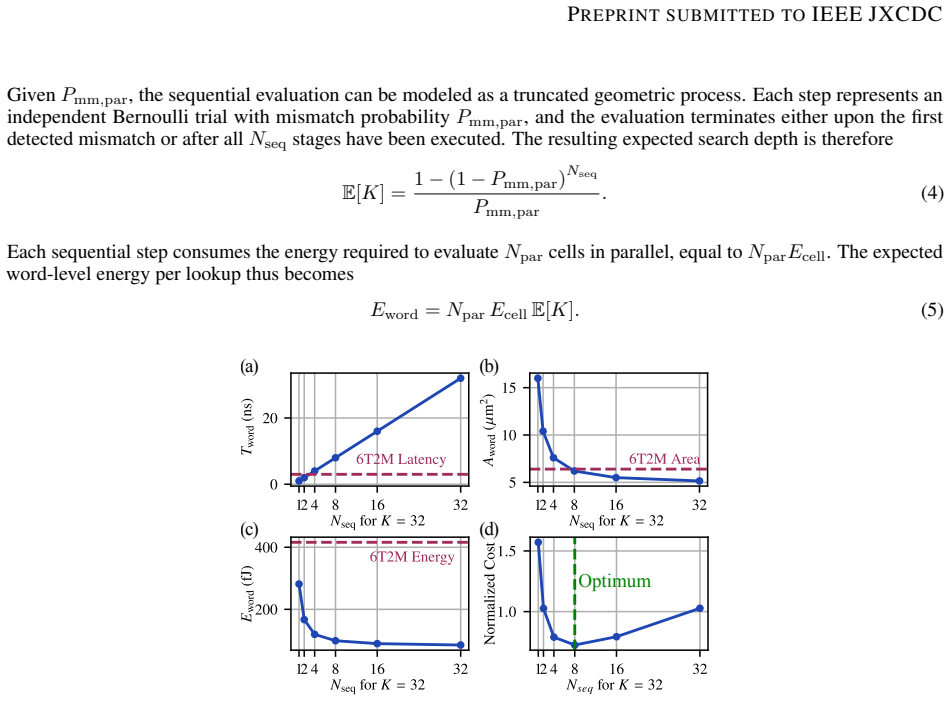
The paper introduces the strong-arm latched memristor (SALM) aCAM cell, which uses a dynamic current-race comparator instead of static voltage division. This provides high regenerative gain, intrinsic result latching, and near-zero static search power. Compared to the 6T2M architecture, it reduces read energy by 33 percent at identical latency, eliminates gain and crosstalk limitations that block large arrays, supports scalable sequential and parallel latch sharing, and includes a dataset-aware optimization framework that achieves up to 50 percent energy reduction at 3x latency. A circuit-accurate behavioral model derived from SPICE lookup tables in 22 nm FD-SOI technology confirms that SALM
Load-bearing premise
The SPICE-derived behavioral model correctly predicts match-line dynamics and crosstalk when the design is scaled to large fabricated arrays.
Signed reviews
Editorial analysis
A structured set of objections, weighed in public.
Referee Report
Summary. The paper introduces a strong-arm latched memristor (SALM) aCAM cell that replaces static voltage division in conventional 6T2M designs with a dynamic current-race comparator. This enables high regenerative gain, intrinsic latching, near-zero static power, and reduced crosstalk. The work reports a 33% read-energy reduction versus 6T2M at iso-latency, scalable sequential/parallel latch sharing, and a dataset-aware optimization framework that achieves up to 50% energy savings at 3x latency. A circuit-accurate behavioral model derived from SPICE lookup tables in 22 nm FD-SOI technology is integrated with the X-TIME decision-tree compiler to demonstrate maintained near-software accuracy on high-dimensional datasets while baseline designs degrade.
Significance. If the behavioral model is shown to be accurate, the SALM approach could meaningfully advance scalable analog CAMs for edge-AI decision-tree inference by removing key gain and crosstalk barriers that limit prior memristive aCAMs. The manuscript earns credit for constructing a reusable SPICE-derived behavioral model, exposing an explicit energy-latency tradeoff via dataset-aware optimization, and providing direct comparisons to an external 6T2M baseline.
major comments (1)
- [Behavioral model description and simulation results] The headline claims (33% energy reduction at iso-latency, elimination of crosstalk scaling barriers, up to 50% energy reduction at 3x latency, and preserved accuracy) are generated exclusively by feeding the SPICE-derived behavioral model into the X-TIME compiler. The manuscript asserts that this model captures match-line dynamics and cumulative crosstalk for large arrays, yet provides no explicit large-array SPICE validation, sensitivity analysis, or error bars on the reported metrics. This validation gap is load-bearing for the central scalability and accuracy assertions.
minor comments (2)
- [Abstract] The abstract states specific quantitative claims (33% energy reduction, 50% energy reduction) without accompanying error bars, number of Monte-Carlo runs, or statistical details on the underlying simulations.
- Clarify the exact definition and sizing of the 6T2M baseline used for comparison, including whether the same memristor technology and array dimensions were employed.
Simulated Author's Rebuttal
We thank the referee for the constructive review and positive assessment of the SALM aCAM approach. We address the single major comment below and will revise the manuscript to strengthen the behavioral model validation section.
read point-by-point responses
-
Referee: [Behavioral model description and simulation results] The headline claims (33% energy reduction at iso-latency, elimination of crosstalk scaling barriers, up to 50% energy reduction at 3x latency, and preserved accuracy) are generated exclusively by feeding the SPICE-derived behavioral model into the X-TIME compiler. The manuscript asserts that this model captures match-line dynamics and cumulative crosstalk for large arrays, yet provides no explicit large-array SPICE validation, sensitivity analysis, or error bars on the reported metrics. This validation gap is load-bearing for the central scalability and accuracy assertions.
Authors: We agree that the manuscript would benefit from more explicit validation details. The behavioral model was constructed from SPICE lookup tables generated via cell-level and small-array (up to 32x32) simulations that directly capture the strong-arm latch dynamics, regenerative gain, match-line discharge, and cumulative crosstalk. Full SPICE simulation of large arrays is computationally prohibitive, which is the motivation for developing the reusable behavioral model. In the revision we will add: (1) quantitative comparisons of the behavioral model versus SPICE for all feasible array sizes, including RMS error on energy and latency; (2) a sensitivity analysis sweeping memristor variability, supply voltage, and temperature; and (3) error bars on the headline metrics obtained from Monte Carlo runs inside the model. These additions will directly support the scalability and accuracy claims. revision: yes
Circularity Check
No significant circularity; claims rest on independent SPICE-derived simulations
full rationale
The paper derives performance numbers (33% energy reduction, scalability claims, energy-latency tradeoffs) from a behavioral model built on SPICE lookup tables in 22 nm FD-SOI, then feeds those into the external X-TIME compiler for workload evaluation. No equation, parameter fit, or self-citation reduces any headline result to the claimed output by construction; the model is presented as an independent abstraction of circuit dynamics, benchmarked against a distinct 6T2M baseline, and the accuracy assertion is externally falsifiable via SPICE. This is a standard simulation-based evaluation chain with no self-definitional, fitted-prediction, or load-bearing self-citation steps.
Assumptions & free parameters
free parameters (1)
- Energy-latency tradeoff parameters
assumptions (1)
- domain assumption SPICE lookup tables in 22 nm FD-SOI faithfully reproduce match-line dynamics and crosstalk for large arrays
invented entities (1)
-
SALM aCAM cell
Cite this review
Pith. "Pith review of A Fast and Energy-Efficient Latch-Based Memristive Analog Content-Addressable Memory." pith.science (2026). https://pith.science/paper/2605.11847
@misc{pith2026260511847,
  author       = {Pith},
  title        = {Pith review of: A Fast and Energy-Efficient Latch-Based Memristive Analog Content-Addressable Memory},
  year         = {2026},
  howpublished = {\url{https://pith.science/paper/2605.11847}},
  note         = {Machine review of arXiv:2605.11847}
}
read the original abstract
Analog content-addressable memories (aCAMs) based on memristors provide a promising pathway toward energy-efficient large-scale associative computing for Edge AI and embedded intelligence applications. They have been successfully applied to decision-tree inference and extend the capabilities of compute-in-memory (CIM) architectures beyond conventional vector-matrix multiplication. However, conventional designs such as the 6T2M architecture suffer from static search power, limited voltage gain, and pronounced match-line crosstalk, constraining analog precision and scalability. We introduce a strong-arm latched memristor (SALM) aCAM cell that replaces static voltage division with a dynamic current-race comparator, enabling high regenerative gain, intrinsic result latching, and near-zero static search power. Compared to 6T2M, SALM reduces read energy by 33% at identical latency while eliminating the gain and crosstalk limitations that prevent 6T2M from scaling to large arrays. SALM further enables scalable sequential and parallel latch sharing, and a dataset-aware optimization framework exposes an explicit energy-latency tradeoff, achieving up to 50% energy reduction at 3x latency across representative workloads. To enable architectural exploration, we develop a circuit-accurate behavioral model derived from SPICE lookup tables in 22 nm FD-SOI technology, capturing match-line dynamics and crosstalk. Integrated into the X-TIME decision-tree compiler, this framework demonstrates that SALM maintains near-software accuracy for high-dimensional datasets, whereas baseline designs degrade due to limited gain and cumulative crosstalk.
Figures


Figures from the paper (3 more)


Reference graph
Works this paper leans on
-
[1]
Memory devices and applications for in-memory computing,
A. Sebastian, M. Le Gallo, R. Khaddam-Aljameh, and E. Eleftheriou, “Memory devices and applications for in-memory computing,”Nature nanotechnology, vol. 15, no. 7, pp. 529–544, 2020
work page 2020
-
[2]
A compute-in-memory chip based on resistive random-access memory,
W. Wan, R. Kubendran, C. Schaefer, S. B. Eryilmaz, W. Zhang, D. Wu, S. Deiss, P. Raina, H. Qian, B. Gaoet al., “A compute-in-memory chip based on resistive random-access memory,”Nature, vol. 608, no. 7923, pp. 504–512, 2022
work page 2022
-
[3]
Analog in-memory computing attention mechanism for fast and energy-efficient large language models,
N. Leroux, P.-P. Manea, C. Sudarshan, J. Finkbeiner, S. Siegel, J. P. Strachan, and E. Neftci, “Analog in-memory computing attention mechanism for fast and energy-efficient large language models,”Nature Computational Science, vol. 5, pp. 544–556, 2025. [Online]. Available: https://www.nature.com/articles/s43588-025-00854-1
work page 2025
-
[4]
D. B. Strukov, G. S. Snider, D. R. Stewart, and R. S. Williams, “The missing memristor found,”nature, vol. 453, no. 7191, pp. 80–83, 2008
work page 2008
-
[5]
Redox-based resistive switching memories-nanoionic mecha- nisms, prospects, and challenges
R. Waser, R. Dittmann, G. Staikov, and K. Szot, “Redox-based resistive switching memories-nanoionic mecha- nisms, prospects, and challenges.”Advanced Materials (Deerfield Beach, Fla.), vol. 21, no. 25-26, pp. 2632–2663, 2009
work page 2009
-
[6]
Content-addressable memory (cam) circuits and architectures: a tutorial and survey,
K. Pagiamtzis and A. Sheikholeslami, “Content-addressable memory (cam) circuits and architectures: a tutorial and survey,”IEEE Journal of Solid-State Circuits, vol. 41, no. 3, pp. 712–727, 2006
work page 2006
-
[7]
Vlsi implementation of routing tables: tries and cams,
T.-B. Pei and C. Zukowski, “Vlsi implementation of routing tables: tries and cams,” inIEEE INFCOM’91. The conference on Computer Communications. Tenth Annual Joint Comference of the IEEE Computer and Communications Societies Proceedings. IEEE, 1991, pp. 515–524
work page 1991
-
[8]
Analog content-addressable memories with memristors,
C. Li, C. E. Graves, X. Sheng, D. Miller, M. Foltin, G. Pedretti, and J. P. Strachan, “Analog content-addressable memories with memristors,”Nature Communications, vol. 11, no. 1, apr 2020
work page 2020
Show all 24 references
-
[9]
Advancements in content-addressable memory (cam) circuits: State-of-the-art, applications, and future directions in the ai domain,
T. Molom-Ochir, B. Taylor, H. Li, and Y . Chen, “Advancements in content-addressable memory (cam) circuits: State-of-the-art, applications, and future directions in the ai domain,”IEEE Transactions on Circuits and Systems I: Regular Papers, vol. 72, no. 8, pp. 3971–3982, 2025
2025
-
[10]
Tree-based machine learning performed in-memory with memristive analog cam,
G. Pedretti, C. E. Graves, S. Serebryakov, R. Mao, X. Sheng, M. Foltin, C. Li, and J. P. Strachan, “Tree-based machine learning performed in-memory with memristive analog cam,”Nature communications, vol. 12, no. 1, p. 5806, 2021
2021
-
[11]
C. E. Graves, C. Li, G. Pedretti, and J. P. Strachan,In-Memory Computing with Non-volatile Memristor CAM Circuits. Cham: Springer International Publishing, 2022, pp. 105–139. [Online]. Available: https://doi.org/10.1007/978-3-030-90582-8_6
2022 doi
-
[12]
Shiftcam: A time-domain content addressable memory utilizing shifted hamming distance for robust genome analysis,
P. He, R. Mao, K. Shan, Y . Tong, Z. Xu, M. Peng, R. Luo, and C. Li, “Shiftcam: A time-domain content addressable memory utilizing shifted hamming distance for robust genome analysis,” inProceedings of the 43rd IEEE/ACM International Conference on Computer-Aided Design, 2024, pp. 1–9
2024
-
[13]
Gain cell-based analog content addressable memory for dynamic associative tasks in ai,
P.-P. Manea, N. Leroux, E. Neftci, and J. P. Strachan, “Gain cell-based analog content addressable memory for dynamic associative tasks in ai,” in2025 IEEE International Symposium on Circuits and Systems (ISCAS), 2025, pp. 1–5
2025
-
[14]
Race-it: A reconfigurable analog cam-crossbar engine for in-memory transformer acceleration,
L. Zhao, L. Buonanno, R. M. Roth, S. Serebryakov, A. Gajjar, J. Moon, J. Ignowski, and G. Pedretti, “Race-it: A reconfigurable analog cam-crossbar engine for in-memory transformer acceleration,”ArXiv, vol. abs/2312.06532,
-
[15]
Available: https://api.semanticscholar.org/CorpusID:266162489
[Online]. Available: https://api.semanticscholar.org/CorpusID:266162489
-
[16]
Efficient analog cam design,
J. Bazzi, J. Sweidan, M. E. Fouda, R. Kanj, and A. M. Eltawil, “Efficient analog cam design,” 2022. [Online]. Available: https://arxiv.org/abs/2203.02500
2022
-
[17]
A current-controlled latch sense amplifier and a static power-saving input buffer for low-power architecture,
T. Kobayashi, K. Nogami, T. Shirotori, and Y . Fujimoto, “A current-controlled latch sense amplifier and a static power-saving input buffer for low-power architecture,”IEEE Journal of Solid-State Circuits, vol. 28, no. 4, pp. 523–527, 1993. 10 PREPRINT SUBMITTED TOIEEE JXCDC
1993
-
[18]
X-time: Accelerating large tree ensembles inference for tabular data with analog cams,
G. Pedretti, J. Moon, P. Bruel, S. Serebryakov, R. M. Roth, L. Buonanno, A. Gajjar, L. Zhao, T. Ziegler, C. Xu, M. Foltin, P. Faraboschi, J. Ignowski, and C. E. Graves, “X-time: Accelerating large tree ensembles inference for tabular data with analog cams,”IEEE Journal on Expl...
2024
-
[19]
Churn modelling,
R. Sharma, “Churn modelling,” n.d., kaggle dataset, uploaded by user sharmaroshan. [Online]. Available: https://www.kaggle.com/datasets/shrutimechlearn/churn-modelling
-
[20]
Optical recognition of handwritten digits,
E. Alpaydin and C. Kaynak, “Optical recognition of handwritten digits,”UCI Machine Learning Repository, 1998
1998
-
[21]
Comparative accuracies of artificial neural networks and discriminant analysis in predicting forest cover types,
J. A. Blackard, “Comparative accuracies of artificial neural networks and discriminant analysis in predicting forest cover types,” Ph.D. dissertation, Colorado State University, 1999
1999
-
[22]
Chemical gas sensor drift compensation using classifier ensembles,
A. Vergara, J. Fonollosa, R. Huertaet al., “Chemical gas sensor drift compensation using classifier ensembles,” Sensors and Actuators B: Chemical, vol. 166, pp. 320–329, 2012
2012
-
[23]
The use of multiple measurements in taxonomic problems,
R. A. Fisher, “The use of multiple measurements in taxonomic problems,”Annals of Eugenics, vol. 7, no. 2, pp. 179–188, 1936
1936
-
[24]
Wine recognition dataset,
M. Forina, C. Armanino, S. Lanteri, and E. Tiscornia, “Wine recognition dataset,” University of Genoa, Tech. Rep., 1991. 11
1991
Reviewed May 13, 2026 · model on record in the stance chip above.
Discussion (0). Continue with ORCID to comment.