Discriminating Planck Reionisation Histories with the kSZ Effect
Pith reviewed 2026-06-30 22:10 UTC · model grok-4.3
The pith
The kSZ effect can separate Planck-consistent reionisation histories into late and early classes even after marginalizing over modeling uncertainties.
A machine-rendered reading of the paper's core claim, the machinery that carries it, and where it could break.
Core claim
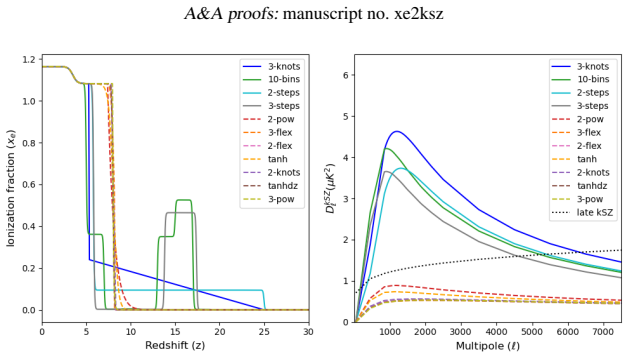
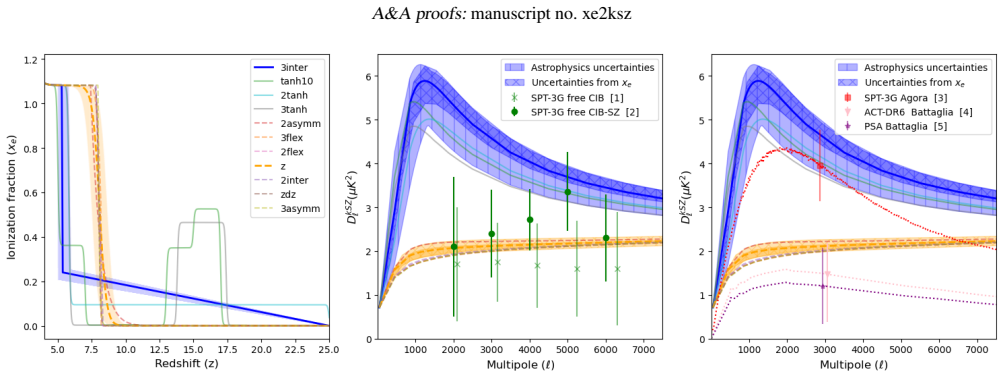
Reionisation histories derived from Planck data fall into 'late' and 'early' start classes that produce distinct kSZ angular power spectra. These signatures remain clearly separable even when accounting for modelling uncertainties in both the reionisation scenario x_e(z) and the properties of early galaxies. Current kSZ measurements (∼0-3 μK²) tend to favour late reionisation models but are not yet sensitive enough to definitely distinguish between the scenarios. A measurement of the kSZ power spectrum at ℓ ∼ 2000 with ∼0.4 μK² sensitivity will be sufficient to do so. CMB data alone can constrain the reionisation midpoint z_re with extremely narrow error bars (7.94 < z_re < 8.17) even when e
What carries the argument
Analytical computation of the kSZ angular power spectrum from Planck-derived reionisation histories x_e(z) classified into late and early start classes.
If this is right
- Current kSZ measurements of order 0-3 μK² already favor late reionisation models.
- A kSZ spectrum at ℓ ∼ 2000 with 0.4 μK² sensitivity will separate the two classes.
- The reionisation midpoint z_re is constrained to 7.94 < z_re < 8.17 using CMB data alone.
- The two classes produce clearly separable kSZ signatures after marginalizing over modeling uncertainties.
Where Pith is reading between the lines
- Tighter z_re bounds from this method could help test whether reionisation timing aligns with direct observations of early galaxies.
- The separability suggests that combining kSZ with other CMB-derived quantities may reduce reliance on external reionisation probes.
- If the late class continues to be preferred, it would imply a more extended or delayed end to reionisation than some theoretical models assume.
Load-bearing premise
The reionisation histories consistent with Planck data fall into two broad classes whose kSZ signatures stay separable after marginalizing over x_e(z) modeling uncertainties and early-galaxy properties.
What would settle it
A kSZ power spectrum measurement at ℓ ∼ 2000 reaching 0.4 μK² sensitivity that shows no separation between the late and early model predictions.
Figures
read the original abstract
The epoch of reionisation is a key phase in cosmic history, but its detailed evolution remains poorly constrained by current cosmic microwave background (CMB) observations. We investigate whether the kinetic Sunyaev-Zel'dovich (kSZ) effect can discriminate among reionisation histories consistent with current large-scale CMB constraints. Using histories derived from \textit{Planck} data, we compute the corresponding kSZ angular power spectra within an analytical framework. The allowed histories fall into two broad classes, 'late' and 'early' start, yielding distinct kSZ signatures, which remain clearly separable even when accounting for modelling uncertainties in both the reionisation scenario, $x_e(z)$, and the properties of early galaxies. Current kSZ measurements ($\sim$0-3 $\mu$K$^2$) tend to favour `late' reionisation models but are not yet sensitive enough to definitely distinguish between the scenarios - a measurement of the kSZ power spectrum at $\ell \sim 2000$ with $\sim$0.4 $\mu$K$^2$ sensitivity, achievable in the coming years, will be sufficient to do so. This work demonstrates that CMB data alone can constrain the reionisation midpoint $z_\mathrm{re}$ with extremely narrow error bars ($7.94<z_\mathrm{re}<8.17$), even when effectively marginalising over modelling uncertainties.
Editorial analysis
A structured set of objections, weighed in public.
Referee Report
Summary. The paper claims that reionisation histories consistent with Planck CMB data fall into two broad classes ('late' and 'early' start) whose kSZ angular power spectra at ℓ ∼ 2000 remain distinct and separable after marginalizing over uncertainties in the x_e(z) parametrization and early-galaxy properties. Current kSZ measurements (∼0–3 μK²) favor late models but lack the sensitivity to discriminate; a future measurement with ∼0.4 μK² sensitivity at ℓ ∼ 2000 would suffice. The work also reports that CMB data alone can constrain the reionisation midpoint to the narrow interval 7.94 < z_re < 8.17 even after effective marginalization over modelling uncertainties.
Significance. If the claimed separability survives a complete marginalization, the result would be significant because it supplies a concrete, near-term observational target for kSZ experiments and shows that the reionisation midpoint can be tightly bounded from CMB data alone. The forecast of required sensitivity is useful for experimental planning. The analytical framework is a strength insofar as it permits rapid exploration of multiple histories, but the significance is limited by the extent to which the model captures all relevant covariances between ionization and velocity fields.
major comments (2)
- [§3 (analytical kSZ framework) and §4 (results)] The central separability result after marginalization over x_e(z) and galaxy properties is load-bearing for both the discrimination forecast and the narrow z_re interval. The analytical kSZ framework must be shown to include the full covariance between patchy ionization fluctuations and the velocity field; if this covariance is underestimated, the separation at ℓ ∼ 2000 can fall below the quoted 0.4 μK² threshold.
- [§2 (Planck-derived histories) and abstract] The classification into 'late' and 'early' start histories is taken from the Planck posterior; the paper must demonstrate that this partition exhausts the space of histories allowed by other reionisation observables (e.g., Lyman-α forest or 21 cm constraints). Any incompleteness directly undermines the quoted z_re bounds (7.94 < z_re < 8.17) and the separability claim.
minor comments (2)
- [Abstract] The abstract states that signatures 'remain clearly separable even when accounting for modelling uncertainties' but does not list the specific parameters varied in the marginalization; the main text should provide an explicit table or equation for the nuisance parameters and their priors.
- Notation for the kSZ power spectrum (e.g., C_ℓ^{kSZ}) should be defined at first use and kept consistent with standard CMB literature.
Simulated Author's Rebuttal
We thank the referee for their careful reading of the manuscript and for the constructive comments provided. We respond to each major comment below.
read point-by-point responses
-
Referee: [§3 (analytical kSZ framework) and §4 (results)] The central separability result after marginalization over x_e(z) and galaxy properties is load-bearing for both the discrimination forecast and the narrow z_re interval. The analytical kSZ framework must be shown to include the full covariance between patchy ionization fluctuations and the velocity field; if this covariance is underestimated, the separation at ℓ ∼ 2000 can fall below the quoted 0.4 μK² threshold.
Authors: The analytical framework employed in the paper is designed to capture the covariance between ionization and velocity fields through the standard kSZ power spectrum calculation that integrates over the correlated fluctuations. The marginalization is performed consistently within this model. To strengthen the presentation, we will revise the manuscript in §3 to include an explicit discussion and verification of the covariance treatment, confirming that the separability at ℓ ∼ 2000 remains robust. revision: yes
-
Referee: [§2 (Planck-derived histories) and abstract] The classification into 'late' and 'early' start histories is taken from the Planck posterior; the paper must demonstrate that this partition exhausts the space of histories allowed by other reionisation observables (e.g., Lyman-α forest or 21 cm constraints). Any incompleteness directly undermines the quoted z_re bounds (7.94 < z_re < 8.17) and the separability claim.
Authors: We clarify that the 'late' and 'early' classification and the associated z_re interval are strictly based on the Planck CMB posterior, as described in §2. The manuscript does not assert that these histories exhaust the possibilities allowed by all reionisation observables; the results are presented as constraints from CMB data alone. We will update the abstract and §2 to make this scope explicit and add a brief note on how other observables might provide complementary constraints in future analyses. revision: yes
Circularity Check
z_re constraint reduces to span of Planck-derived input histories
specific steps
-
fitted input called prediction
[Abstract]
"This work demonstrates that CMB data alone can constrain the reionisation midpoint z_re with extremely narrow error bars (7.94<z_re<8.17), even when effectively marginalising over modelling uncertainties."
The z_re bounds are the span of the Planck-derived reionisation histories supplied as input; the 'demonstration' of the narrow constraint after marginalization is therefore the input range restated as an output result.
full rationale
The paper takes reionisation histories fitted to Planck data as direct input, classifies them into 'late'/'early' classes, and computes kSZ spectra. The quoted narrow z_re interval is the range spanned by those input histories after the paper's marginalization; presenting it as a 'demonstration' that CMB data alone yields such tight bounds is equivalent to reporting the input span. The kSZ separability calculation itself is a forward computation on those histories and does not reduce by construction, so the circularity is partial and does not invalidate the full discrimination forecast. No self-citation chains or ansatz smuggling are evident.
Axiom & Free-Parameter Ledger
axioms (1)
- domain assumption Reionisation histories consistent with Planck large-scale CMB constraints fall into two broad classes whose kSZ signatures remain distinct after marginalization.
Reference graph
Works this paper leans on
-
[1]
2013, ApJ, 776, 83
Battaglia, N., Natarajan, A., Trac, H., Cen, R., & Loeb, A. 2013, ApJ, 776, 83
2013
-
[2]
M., Hill, J
Beringue, B., Surrao, K. M., Hill, J. C., et al. 2025, J. Cosmology Astropart. Phys., 2025, 082
2025
-
[3]
2026, https://arxiv.org/abs/2601.20551
Chaubal, P., Huang, N., Reichardt, C. L., et al. 2026, arXiv e-prints, arXiv:2601.20551
-
[4]
2022, Astronomy & Astro- physics, 659, A99
Douspis, M., Salvati, L., Gorce, A., & Aghanim, N. 2022, Astronomy & Astro- physics, 659, A99
2022
-
[5]
2026, arXiv e-prints, arXiv:2603.22454
Genesini, V ., Galloni, G., Pagano, L., Campeti, P., & Lattanzi, M. 2026, arXiv e-prints, arXiv:2603.22454
-
[6]
2022, A&A, 662, A122
Gorce, A., Douspis, M., & Salvati, L. 2022, A&A, 662, A122
2022
-
[7]
2020, A&A, 640, A90
Gorce, A., Ili´c, S., Douspis, M., Aubert, D., & Langer, M. 2020, A&A, 640, A90
2020
-
[8]
R., Millman, K
Harris, C. R., Millman, K. J., van der Walt, S. J., et al. 2020, Nature, 585, 357
2020
-
[9]
Hunter, J. D. 2007, Computing in Science & Engineering, 9, 90 Ili´c, S., Tristram, M., Douspis, M., et al. 2025, A&A, 700, A26
2007
-
[10]
2000, ApJ, 538, 473
Lewis, A., Challinor, A., & Lasenby, A. 2000, ApJ, 538, 473
2000
-
[11]
Louis, T., La Posta, A., Atkins, Z., et al. 2025, J. Cosmology Astropart. Phys., 2025, 062
2025
-
[12]
2025, arXiv e-prints, arXiv:2511.22309
McBride, L., Gorce, A., Douspis, M., et al. 2025, arXiv e-prints, arXiv:2511.22309
-
[13]
& Semelin, B
Meriot, R. & Semelin, B. 2024, A&A, 683, A24
2024
-
[14]
2025, A&A, 698, A80
Meriot, R., Semelin, B., & Cornu, D. 2025, A&A, 698, A80
2025
-
[15]
2024, MNRAS, 530, 5030
Omori, Y . 2024, MNRAS, 530, 5030
2024
-
[16]
M., Mottet, S., Puget, J
Pagano, L., Delouis, J. M., Mottet, S., Puget, J. L., & Vibert, L. 2020, A&A, 635, A99
2020
-
[17]
Paradiso, S., Colombo, L. P. L., Andersen, K. J., et al. 2023, A&A, 675, A12
2023
-
[18]
A., & Bond, J
Park, H., Alvarez, M. A., & Bond, J. R. 2018, ApJ, 853, 121 Planck Collaboration VI. 2020, A&A, 641, A6 Planck Collaboration Int. XLVII. 2016, A&A, 596, A108 Planck Collaboration Int. LVII. 2020, A&A, 643, A42
2018
-
[19]
2021, The Astrophysical Journal, 908, 199
Reichardt, C., Patil, S., Ade, P., et al. 2021, The Astrophysical Journal, 908, 199
2021
-
[20]
D., Rudd, D
Shaw, L. D., Rudd, D. H., & Nagai, D. 2012, ApJ, 756, 15
2012
-
[21]
& Zeldovich, Y
Sunyaev, R. & Zeldovich, Y . B. 1980, Monthly Notices of the Royal Astronomi- cal Society, vol. 190, Feb. 1980, p. 413-420., 190, 413
1980
-
[22]
2026, A&A in press, 0
Tristram, M., Douspis, M., Gorce, A., et al. 2026, A&A in press, 0
2026
-
[23]
L., Shaw, L., et al
Zahn, O., Reichardt, C. L., Shaw, L., et al. 2012, ApJ, 756, 65
2012
-
[24]
Zeldovich, Y . B. & Sunyaev, R. A. 1969, Ap&SS, 4, 301 Article number, page 4
1969
discussion (0)
Sign in with ORCID, Apple, or X to comment. Anyone can read and Pith papers without signing in.