ChannelAgent-Empowered Electromagnetic Space World Model: A Case Study on Agent-Driven Channel Generation for 6G AI-Native Air Interface
Pith reviewed 2026-05-20 21:09 UTC · model grok-4.3
The pith
ChannelAgent organizes 6G wireless intelligence into a closed-loop electromagnetic space world model for adaptive channel generation.
A machine-rendered reading of the paper's core claim, the machinery that carries it, and where it could break.
Core claim
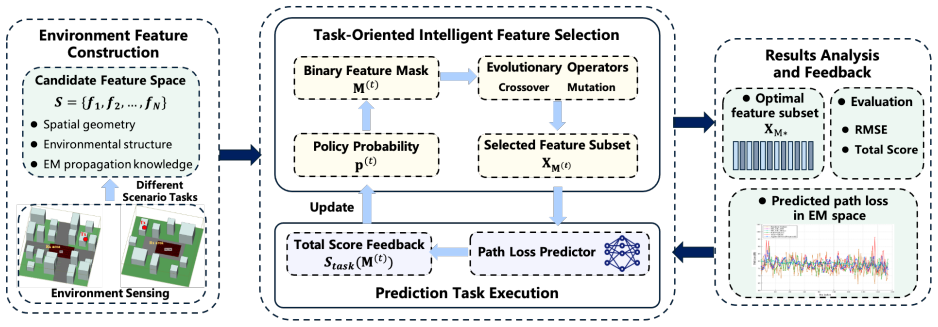
By placing ChannelAgent at the center of an electromagnetic space world model, the system creates a closed-loop process for wireless intelligence. For the specific task of channel generation, the agent employs a task-oriented feature selection that combines reinforcement-learning-inspired policy adaptation with evolutionary search, allowing it to derive suitable feature subsets according to the current scenario and ongoing performance feedback, resulting in improved path loss prediction.
What carries the argument
The task-oriented intelligent feature selection mechanism, which integrates reinforcement-learning-inspired policy adaptation with evolutionary search to iteratively derive compact feature subsets suited to the current scenario and performance feedback.
If this is right
- Channel generation for 6G can become more adaptive to varying scenarios and tasks through agent-driven feature selection.
- The closed-loop design supports continuous improvement via feedback updates without external intervention.
- Superior performance in multi-scenario tasks suggests better handling of heterogeneous 6G requirements.
- Task-oriented intelligence reduces reliance on fixed, general-purpose models for air interface functions.
Where Pith is reading between the lines
- This agent-driven structure could extend to other wireless tasks such as beamforming or resource allocation by redefining the agent's performance objectives and sensing inputs.
- Real deployment would likely require additional mechanisms to handle measurement noise and incomplete data not fully tested in the current simulations.
- The closed-loop world model pattern might transfer to related domains like integrated sensing and communication systems.
Load-bearing premise
The task-oriented intelligent feature selection mechanism can reliably derive compact and task-suitable feature subsets that generalize to real-world wireless conditions beyond the simulated scenarios.
What would settle it
A direct comparison showing that the selected feature subsets produce significantly lower path loss prediction accuracy on real measured channel data from environments outside the training simulations would falsify the generalization of the autonomous adaptation.
Figures



read the original abstract
As sixth-generation (6G) wireless networks evolve toward increasingly heterogeneous scenarios, tasks, and service requirements, conventional artificial intelligence (AI) models remain limited in task-aware decision-making and autonomous adaptation. To address this issue, this paper first proposes a ChannelAgent-empowered electromagnetic space world model, in which wireless intelligence is organized into a closed-loop process consisting of multi-modal sensing, ChannelAgent as the intelligent core, and execution with feedback update. As a case study, agent-driven channel generation is instantiated through path loss prediction. Specifically, a task-oriented intelligent feature selection mechanism is designed by integrating reinforcement-learning-inspired policy adaptation with evolutionary search, enabling the agent to iteratively derive compact and task-suitable feature subsets according to the current scenario and performance feedback. Simulation results demonstrate superior performance in both single-scenario and multi-scenario tasks, highlighting the potential of the proposed model for autonomous, adaptive, task-oriented, and closed-loop wireless intelligence.
Editorial analysis
A structured set of objections, weighed in public.
Referee Report
Summary. The manuscript proposes a ChannelAgent-empowered electromagnetic space world model that organizes 6G wireless intelligence into a closed-loop process of multi-modal sensing, an intelligent ChannelAgent core, and execution with feedback updates. As a case study, it instantiates agent-driven channel generation for path-loss prediction via a task-oriented intelligent feature selection mechanism that integrates reinforcement-learning-inspired policy adaptation with evolutionary search to iteratively derive compact, scenario-adaptive feature subsets. Simulation results are presented to demonstrate superior performance in both single-scenario and multi-scenario tasks.
Significance. If the simulation results are reproducible and the feature selector generalizes, the work could contribute to autonomous and adaptive AI-native air interfaces by showing how agent-based models enable task-oriented channel modeling. The closed-loop framing and combination of RL policy adaptation with evolutionary search are potentially useful ideas, but the significance is limited by the simulation-only setting and absence of tests against distribution shifts.
major comments (3)
- [Simulation Results / Abstract] The central claim of superior performance in single- and multi-scenario path-loss prediction rests on simulation results whose support cannot be verified: the abstract and simulation section provide no information on the baselines, exact metrics (e.g., RMSE or MAE), error bars, number of Monte-Carlo runs, or data-exclusion rules. This directly undermines the headline assertion that the ChannelAgent model outperforms existing approaches.
- [Task-oriented Intelligent Feature Selection Mechanism] The task-oriented feature selection mechanism (RL-inspired policy adaptation + evolutionary search) selects subsets using performance feedback from the same prediction task; this creates a circularity risk in which the selected features are tuned to the outcomes they are meant to predict. No explicit equations or pseudocode are shown that would allow assessment of whether the procedure avoids overfitting to the training distribution.
- [Simulation Results] The evaluation is confined to idealized channel models inside the simulator. No experiments address generalization when propagation statistics deviate (unmodeled shadowing, hardware nonlinearities, or mobility patterns absent from the training scenarios), leaving the weakest assumption—that the derived feature subsets remain effective in real-world conditions—untested.
minor comments (2)
- [Abstract] The abstract states 'superior performance' without any quantitative comparison or reference to the competing methods.
- [Proposed Model] Notation for the electromagnetic space world model components (e.g., how multi-modal sensing maps to ChannelAgent inputs) is introduced without a clear diagram or equation set in the early sections.
Simulated Author's Rebuttal
We thank the referee for the constructive and detailed comments on our manuscript. We have addressed each major comment point by point below, indicating where revisions have been made to improve clarity, rigor, and completeness. Our responses focus on substance and aim to strengthen the presentation of the work without overstating its scope.
read point-by-point responses
-
Referee: [Simulation Results / Abstract] The central claim of superior performance in single- and multi-scenario path-loss prediction rests on simulation results whose support cannot be verified: the abstract and simulation section provide no information on the baselines, exact metrics (e.g., RMSE or MAE), error bars, number of Monte-Carlo runs, or data-exclusion rules. This directly undermines the headline assertion that the ChannelAgent model outperforms existing approaches.
Authors: We agree that additional details are necessary to substantiate the performance claims. In the revised manuscript, we have updated the abstract to reference the key metrics and expanded the simulation results section with explicit information on the baselines (including conventional ML regressors and prior feature selection techniques), exact metrics (RMSE and MAE), error bars computed as standard deviation over 20 Monte-Carlo runs, and the data exclusion rules applied during dataset preparation. These additions directly support the reported superiority in both single- and multi-scenario tasks. revision: yes
-
Referee: [Task-oriented Intelligent Feature Selection Mechanism] The task-oriented feature selection mechanism (RL-inspired policy adaptation + evolutionary search) selects subsets using performance feedback from the same prediction task; this creates a circularity risk in which the selected features are tuned to the outcomes they are meant to predict. No explicit equations or pseudocode are shown that would allow assessment of whether the procedure avoids overfitting to the training distribution.
Authors: We acknowledge the concern regarding potential circularity. To resolve this, the revised manuscript now includes the full set of equations governing the RL policy adaptation and evolutionary search components, along with pseudocode for the iterative feature selection loop. Performance feedback is drawn exclusively from a held-out validation partition within each scenario, and we have added a new analysis subsection demonstrating feature subset stability across independent runs to indicate that overfitting to the training distribution is mitigated. revision: yes
-
Referee: [Simulation Results] The evaluation is confined to idealized channel models inside the simulator. No experiments address generalization when propagation statistics deviate (unmodeled shadowing, hardware nonlinearities, or mobility patterns absent from the training scenarios), leaving the weakest assumption—that the derived feature subsets remain effective in real-world conditions—untested.
Authors: This comment correctly identifies a scope limitation of the current evaluation. The work is presented as a case study within simulated environments to illustrate the agent-based framework. In the revised manuscript we have inserted a new paragraph in the discussion section that explicitly acknowledges the idealized nature of the channel models and outlines planned extensions to distribution shifts and real-world measurements. New experiments of that scale lie outside the present study but are noted as necessary future validation. revision: partial
Circularity Check
No significant circularity in derivation chain
full rationale
The paper proposes a ChannelAgent world model and instantiates it via a task-oriented feature selection mechanism that combines RL-inspired policy adaptation with evolutionary search driven by performance feedback. No equations or self-citations are exhibited that reduce any claimed prediction or first-principles result to its own inputs by construction. The reported superior performance rests on simulation results for path-loss prediction tasks, which constitute external evaluation rather than a fitted quantity renamed as a prediction. The closed-loop description is a design choice, not a definitional tautology. The derivation remains self-contained against the stated simulation benchmarks.
Axiom & Free-Parameter Ledger
axioms (1)
- domain assumption Wireless intelligence can be organized into a closed-loop process of multi-modal sensing, agent core, and feedback update.
invented entities (1)
-
ChannelAgent
no independent evidence
Lean theorems connected to this paper
-
IndisputableMonolith/Cost/FunctionalEquation.leanwashburn_uniqueness_aczel unclear?
unclearRelation between the paper passage and the cited Recognition theorem.
task-oriented intelligent feature selection mechanism is designed by integrating reinforcement-learning-inspired policy adaptation with evolutionary search
-
IndisputableMonolith/Foundation/RealityFromDistinction.leanreality_from_one_distinction unclear?
unclearRelation between the paper passage and the cited Recognition theorem.
Simulation results demonstrate superior performance in both single-scenario and multi-scenario tasks
What do these tags mean?
- matches
- The paper's claim is directly supported by a theorem in the formal canon.
- supports
- The theorem supports part of the paper's argument, but the paper may add assumptions or extra steps.
- extends
- The paper goes beyond the formal theorem; the theorem is a base layer rather than the whole result.
- uses
- The paper appears to rely on the theorem as machinery.
- contradicts
- The paper's claim conflicts with a theorem or certificate in the canon.
- unclear
- Pith found a possible connection, but the passage is too broad, indirect, or ambiguous to say the theorem truly supports the claim.
Reference graph
Works this paper leans on
-
[1]
J. Zhang, L. Yu, S. Liu, et al., “Wireless Environmental Information Theory: A New Paradigm Toward 6G Online and Proactive Environment Intelligence Communication,” Engineering, vol. 56, pp. 186–200, 2026
work page 2026
-
[2]
Digital Twin Channel for 6G: Concepts, Architectures and Potential Applications,
H. Wang, J. Zhang, G. Nie, et al., “Digital Twin Channel for 6G: Concepts, Architectures and Potential Applications,” IEEE Commun. Mag., vol. 63, no. 3, pp. 24–30, 2025
work page 2025
-
[3]
Channel Characteristics and Modeling Research for 6G: Challenges, Progress, and Prospects,
J. Zhang, H. Wang, Y . Zhang, et al., “Channel Characteristics and Modeling Research for 6G: Challenges, Progress, and Prospects,” Sci. China Inf. Sci., vol. 54, pp. 1114–1143, 2024
work page 2024
-
[4]
E2ENet: An End-to-End Channel Prediction Neural Network Based on Uplink Pilot for FDD Systems,
S. Fan, H. Li, X. Liang, et al., “E2ENet: An End-to-End Channel Prediction Neural Network Based on Uplink Pilot for FDD Systems,” IEEE Wirel. Commun. Lett., vol. 13, no. 5, pp. 1285–1289, May 2024
work page 2024
-
[5]
Big AI Models for 6G Wireless Networks: Opportunities, Challenges, and Research Directions,
Z. Chen, Z. Zhang, and Z. Yang, “Big AI Models for 6G Wireless Networks: Opportunities, Challenges, and Research Directions,” IEEE Wirel. Commun., vol. 31, no. 5, pp. 164–172, Oct. 2024
work page 2024
-
[6]
L. Yu, L. Shi, J. Zhang, et al., “ChannelGPT: A Large Model Toward Real-World Channel Foundation Model for 6G Environment Intelligence Communication,” IEEE Commun. Mag., vol. 63, no. 10, pp. 68–74, Oct. 2025
work page 2025
-
[7]
A Survey of Beam Management for mmWave and THz Communications Towards 6G,
Q. Xue, C. Ji, S. Ma, et al., “A Survey of Beam Management for mmWave and THz Communications Towards 6G,” IEEE Commun. Surv. Tutor., vol. 26, no. 3, pp. 1520–1559, 2024
work page 2024
-
[8]
RadioDiff: An Effective Generative Diffusion Model for Sampling-Free Dynamic Radio Map Construction,
X. Wang, K. Tao, N. Cheng, et al., “RadioDiff: An Effective Generative Diffusion Model for Sampling-Free Dynamic Radio Map Construction,” IEEE Trans. Cogn. Commun. Netw., vol. 11, no. 2, pp. 738–750, 2025
work page 2025
-
[9]
N. Cheng, X. Wang, Z. Li, et al., “Toward Enhanced Reinforcement Learning-Based Resource Management via Digital Twin: Opportunities, Applications, and Challenges,” IEEE Netw., vol. 39, no. 1, pp. 189–196, 2025
work page 2025
-
[10]
J. Zhang, Y . Yang, and P. Zhang, “Method for Determining Intelligent Base Stations Location, Intelligent Base Stations, and Storage Media,” Chinese Patent CN109302712, Oct. 10, 2018
work page 2018
-
[11]
AI-Agent Communication Network for 6G: Vision, Architecture, and Key Technologies,
X. Duan, Z. Huang, S. Liang, et al., “AI-Agent Communication Network for 6G: Vision, Architecture, and Key Technologies,” Front. Inf. Technol. Electron. Eng., vol. 26, no. 11, pp. 2065–2080, 2025
work page 2065
-
[12]
From Large AI Models to Agentic AI: A Tutorial on Future Intelligent Communications,
F. Jiang, C. Pan, K. Wang, et al., “From Large AI Models to Agentic AI: A Tutorial on Future Intelligent Communications,” IEEE J. Sel. Areas Commun., vol. 44, pp. 3507–3540, 2026
work page 2026
-
[13]
Radio Environment Knowledge Pool for 6G Digital Twin Channel,
J. Wang, J. Zhang, Y . Zhang, et al., “Radio Environment Knowledge Pool for 6G Digital Twin Channel,” IEEE Commun. Mag., vol. 63, no. 5, pp. 158-164, May 2025
work page 2025
-
[14]
Environment Features-Based Model for Path Loss Prediction,
Y . Sun, J. Zhang, Y . Zhang, et al., “Environment Features-Based Model for Path Loss Prediction,” IEEE Wirel. Commun. Lett., vol. 11, no. 9, pp. 2010–2014, 2022
work page 2010
-
[15]
Multidimensional Wireless Environment Features Based Zero-Shot Path Loss Prediction,
L. Shi, L. Yu, J. Zhang, et al., “Multidimensional Wireless Environment Features Based Zero-Shot Path Loss Prediction,” IEEE Antennas Wirel. Propag. Lett., vol. 25, no. 2, pp. 496–500, 2026
work page 2026
discussion (0)
Sign in with ORCID, Apple, or X to comment. Anyone can read and Pith papers without signing in.