Disorder-driven symmetry suppression by van der Waals planar defects in a magnetic topological insulator
Pith reviewed 2026-05-20 20:03 UTC · model grok-4.3
The pith
Ion irradiation creates van der Waals planar defects that suppress magnetic anisotropy and reduce the anomalous Hall response by over an order of magnitude in MnBi2Te4 while preserving antiferromagnetic order.
A machine-rendered reading of the paper's core claim, the machinery that carries it, and where it could break.
Core claim
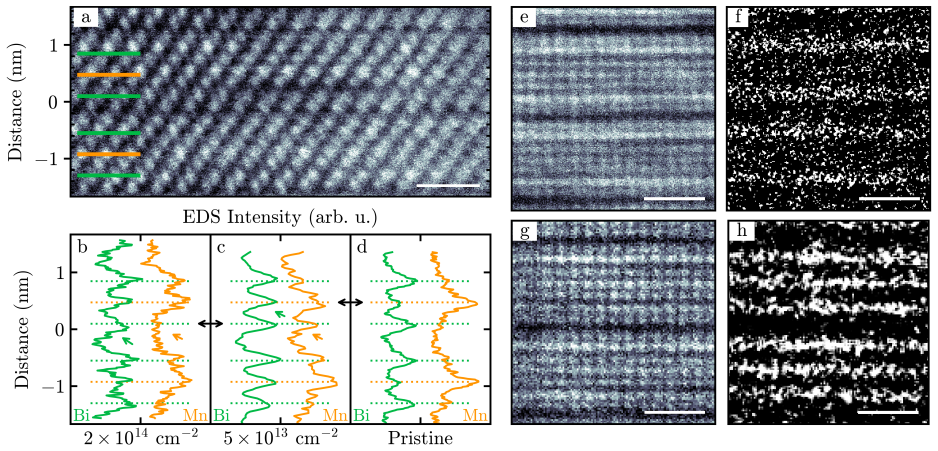
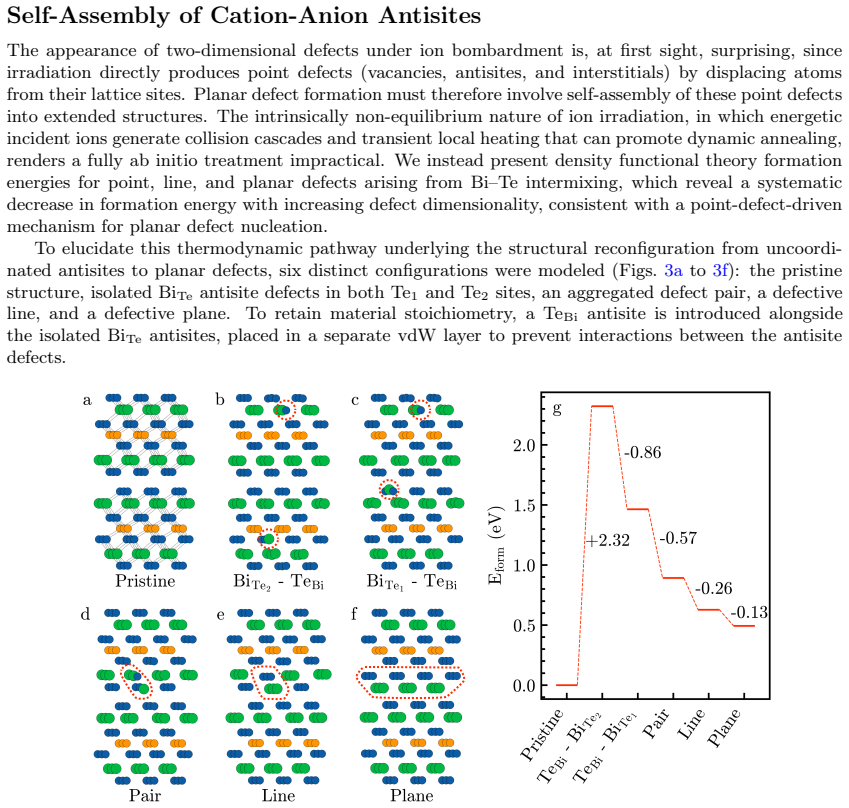
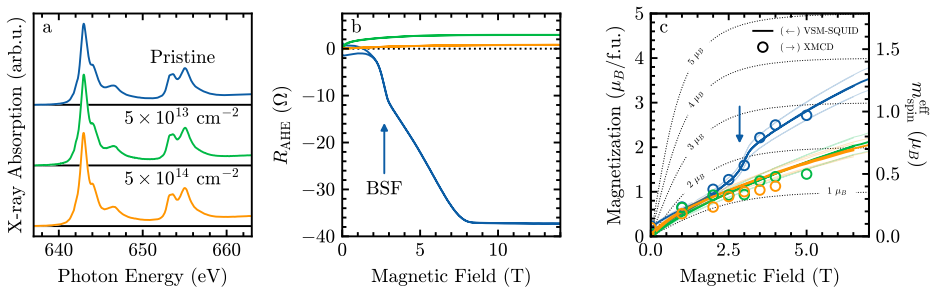
High-fluence ion irradiation induces cation-anion intermixing that forms a previously unreported layer-disordered phase in MnBi2Te4 characterized by a high density of van der Waals planar defects, including swapped bilayers. Long-range crystallographic order is largely lost yet partial periodicity remains. The Mn high-spin state and antiferromagnetic interactions persist, but magnetic anisotropy is strongly reduced. At the same time the anomalous Hall response is suppressed by more than an order of magnitude, exceeding the change in magnetization and indicating a direct modification of Berry curvature.
What carries the argument
Van der Waals-specific planar defects (swapped bilayers) generated by ion-induced cation-anion intermixing, which break symmetry and thereby reduce magnetic anisotropy while altering Berry curvature.
If this is right
- Low-fluence irradiation produces cation antisite disorder that redistributes Bi and drives a p-type to n-type transport transition while preserving long-range order.
- The material retains partial periodic order even at high displacement-per-atom levels.
- Magnetic anisotropy and topological response can be tuned separately from the overall magnetization through defect density.
- Ion irradiation provides a chemical-doping-free route to modify electronic topology in van der Waals magnetic materials.
Where Pith is reading between the lines
- The same planar-defect strategy could be applied to other van der Waals magnets to decouple magnetic anisotropy from topological invariants.
- Reduced anisotropy combined with preserved antiferromagnetic order may simplify domain-wall motion or enable new low-field switching protocols in devices.
- Annealing experiments that selectively remove the planar defects would test whether the Berry-curvature change is reversible.
- The approach suggests a general method for creating mixed ordered-disordered regions that host spatially varying topological properties.
Load-bearing premise
The large drop in anomalous Hall response arises specifically from symmetry breaking by the planar defects rather than from carrier scattering, Fermi-level shifts, or other irradiation side-effects.
What would settle it
Observation that the anomalous Hall conductivity scales directly with the density of swapped bilayers or with the measured reduction in magnetic anisotropy across samples with varying defect concentrations, independent of total magnetization.
Figures



read the original abstract
Magnetic topological insulators offer a platform to control electronic topology through magnetic order, yet reliable routes to tune their properties remain limited. Here, we show that ion irradiation allows to modify the magnetic and the topological properties of the van der Waals magnetic topological insulator MnBi$_2$Te$_4$. Using inert ion beams, intrinsic defects are introduced via collision cascades without chemical doping. We identify two distinct regimes. At low fluence, cation antisite disorder leads to a near-complete redistribution of Bi over cation sites while preserving long-range crystallographic order, accompanied by a transition from $p$-type to $n$-type transport. At high fluence, cation-anion intermixing drives the formation of a previously unreported layer-disordered phase characterized by a high density of van der Waals-specific planar defects, including swapped bilayers. Despite significant structural disorder, the system retains partial periodic order up to high displacement levels. Magnetometry and X-ray spectroscopy show that the Mn high-spin state and antiferromagnetic interactions persist, while magnetic anisotropy is strongly reduced. At the same time, the anomalous Hall conductivity is suppressed fivefold, far exceeding the change in magnetization, indicating a direct modification of Berry curvature. These results establish ion irradiation as a means to tune topology through defect engineering and reveal a disorder-driven approach to control symmetry and electronic structure in van der Waals magnetic materials.
Editorial analysis
A structured set of objections, weighed in public.
Referee Report
Summary. The paper reports that inert-ion irradiation of the van der Waals magnetic topological insulator MnBi₂Te₄ produces two regimes of disorder: low-fluence cation antisite mixing that drives a p-to-n transport transition while preserving long-range order, and high-fluence cation-anion intermixing that generates a high density of van der Waals planar defects (swapped bilayers and layer intermixing). Magnetometry and X-ray spectroscopy indicate that the Mn high-spin state and antiferromagnetic interactions survive, but magnetic anisotropy is strongly reduced. The anomalous Hall response drops by more than an order of magnitude, exceeding the reduction in magnetization, which the authors interpret as a direct modification of Berry curvature arising from symmetry breaking by the planar defects.
Significance. If the central interpretation holds, the work supplies a defect-engineering route to tune topology and symmetry in magnetic topological insulators without chemical substitution. The multi-technique data set (magnetometry, X-ray absorption, transport) and the identification of a previously unreported layer-disordered phase constitute a concrete experimental advance in controlling van der Waals magnetic materials.
major comments (2)
- [Transport measurements and discussion of anomalous Hall effect] The central claim that the >10× suppression of anomalous Hall response arises specifically from Berry-curvature modification by van der Waals planar defects (rather than from Fermi-level shifts or extrinsic scattering) is load-bearing. The low-fluence data already demonstrate a p-to-n transition, proving that irradiation moves the Fermi level. At high fluence the same collision cascades produce both antisite and planar defects; without an explicit extraction of anomalous Hall conductivity σ_AH (after correcting for the measured carrier density and longitudinal resistivity) it remains possible that the observed drop in ρ_AH is dominated by changes in the ordinary Hall term or skew-scattering contributions. This point must be addressed quantitatively in the transport analysis section.
- [Magnetometry results] The manuscript states that magnetic anisotropy is strongly reduced while Mn high-spin state and AF order persist, yet provides no quantitative comparison (e.g., anisotropy field or energy) between pristine and high-fluence samples that would allow the reader to judge whether the anisotropy reduction is sufficient to explain the observed Hall suppression via altered domain structure or canting.
minor comments (2)
- [Abstract and figure captions] Fluence values, displacement-per-atom estimates, and error bars on key quantities (Hall resistivity, magnetization) are not reported in the abstract or figure captions; these should be added for reproducibility.
- [Transport section] Notation for the anomalous Hall resistivity versus conductivity is used interchangeably in places; consistent use of σ_AH when discussing intrinsic contributions would improve clarity.
Simulated Author's Rebuttal
We thank the referee for the careful and constructive review of our manuscript. The comments raise important points about the quantitative support for our central claims regarding the anomalous Hall effect and magnetic anisotropy. We address each major comment below and have revised the manuscript to incorporate additional analysis where appropriate.
read point-by-point responses
-
Referee: [Transport measurements and discussion of anomalous Hall effect] The central claim that the >10× suppression of anomalous Hall response arises specifically from Berry-curvature modification by van der Waals planar defects (rather than from Fermi-level shifts or extrinsic scattering) is load-bearing. The low-fluence data already demonstrate a p-to-n transition, proving that irradiation moves the Fermi level. At high fluence the same collision cascades produce both antisite and planar defects; without an explicit extraction of anomalous Hall conductivity σ_AH (after correcting for the measured carrier density and longitudinal resistivity) it remains possible that the observed drop in ρ_AH is dominated by changes in the ordinary Hall term or skew-scattering contributions. This point must be addressed quantitatively in the transport analysis section.
Authors: We agree that quantitative extraction of the anomalous Hall conductivity is required to strengthen our interpretation. In the revised manuscript we have added an explicit analysis in the transport section. Using the high-field ordinary Hall slope to determine carrier density, we subtract the ordinary contribution and compute σ_AH = ρ_AH / (ρ_xx² + ρ_AH²). The corrected σ_AH remains suppressed by more than an order of magnitude relative to the pristine sample, even after accounting for the measured changes in carrier density and longitudinal resistivity. We also include a direct comparison of the low-fluence (antisite-only) and high-fluence (planar-defect) regimes to isolate the additional effect of the van der Waals planar defects on Berry curvature. revision: yes
-
Referee: [Magnetometry results] The manuscript states that magnetic anisotropy is strongly reduced while Mn high-spin state and AF order persist, yet provides no quantitative comparison (e.g., anisotropy field or energy) between pristine and high-fluence samples that would allow the reader to judge whether the anisotropy reduction is sufficient to explain the observed Hall suppression via altered domain structure or canting.
Authors: We appreciate the request for quantitative detail. In the revised manuscript we have extracted the anisotropy field from the difference between in-plane and out-of-plane magnetization loops. The anisotropy field drops from ~2 T in the pristine crystals to <0.5 T at high fluence, corresponding to a reduction in anisotropy energy by a factor of approximately four. We discuss how this decrease can modify domain structure and canting, yet note that the observed Hall suppression exceeds what would be expected from these magnetic changes alone, consistent with an intrinsic Berry-curvature modification driven by the planar defects. revision: yes
Circularity Check
No circularity: experimental comparisons are self-contained
full rationale
The paper reports direct experimental measurements (magnetometry, X-ray spectroscopy, transport) showing persistence of Mn high-spin state and AF order alongside reduced anisotropy and >10× AHE suppression. The interpretation that this indicates Berry curvature modification rests on comparing the magnitude of AHE change to the magnetization change, without any derivation that reduces to fitted parameters, self-citations, or ansatzes. No equations or theoretical steps are presented that loop back to inputs by construction. The claims are supported by observable data contrasts and remain falsifiable against independent Hall-effect benchmarks in related compounds.
Axiom & Free-Parameter Ledger
Lean theorems connected to this paper
-
IndisputableMonolith/Foundation/RealityFromDistinction.leanreality_from_one_distinction unclear?
unclearRelation between the paper passage and the cited Recognition theorem.
At high fluence, cation–anion intermixing drives the formation of a previously unreported layer-disordered phase characterized by a high density of van der Waals–specific planar defects, including swapped bilayers... the anomalous Hall response is suppressed by over an order of magnitude, far exceeding the change in magnetization, indicating a direct modification of Berry curvature.
What do these tags mean?
- matches
- The paper's claim is directly supported by a theorem in the formal canon.
- supports
- The theorem supports part of the paper's argument, but the paper may add assumptions or extra steps.
- extends
- The paper goes beyond the formal theorem; the theorem is a base layer rather than the whole result.
- uses
- The paper appears to rely on the theorem as machinery.
- contradicts
- The paper's claim conflicts with a theorem or certificate in the canon.
- unclear
- Pith found a possible connection, but the passage is too broad, indirect, or ambiguous to say the theorem truly supports the claim.
discussion (0)
Sign in with ORCID, Apple, or X to comment. Anyone can read and Pith papers without signing in.