Re-acceleration of Energetic Ions via Small-Scale Reconnection in Magnetic Fusion Plasmas
Pith reviewed 2026-05-19 16:09 UTC · model grok-4.3
The pith
Small-scale magnetic reconnection re-accelerates NBI ions to 2.5 times injection energy without large MHD bursts.
A machine-rendered reading of the paper's core claim, the machinery that carries it, and where it could break.
Core claim
The central claim is that small-scale magnetic reconnection mediated by multiple magnetic islands fails to accelerate bulk thermal ions but efficiently energizes seed fast ions injected by neutral beams, producing energy gains up to 2.5 times the injection energy. This occurs stably in the EXL-50U spherical torus without significant large-scale MHD bursts, and the mechanism is presented as ubiquitous in magnetic confinement devices while preserving core confinement.
What carries the argument
Small-scale magnetic reconnection mediated by multiple magnetic islands, which transfers energy selectively to fast ions through repeated interactions in the plasma.
If this is right
- Small-scale reconnection offers a novel channel for auxiliary ion heating in future fusion reactors.
- The process is ubiquitous in magnetic confinement devices and does not degrade core confinement.
- Re-acceleration of energetic ions can occur stably during routine operation without large MHD events.
- The mechanism selectively affects fast ions while leaving thermal ions largely unchanged.
Where Pith is reading between the lines
- Similar energy gains may appear in other NBI-heated spherical tori or tokamaks whenever small-scale islands are present.
- Correlating measured ion energy spectra with detected magnetic island activity could test the mechanism in additional devices.
Load-bearing premise
The observed energy increase in fast ions results from the small-scale reconnection process modeled in the simulations rather than from other unmodeled mechanisms or diagnostic artifacts.
What would settle it
An experiment or simulation in which fast-ion energy gains disappear when multiple small-scale magnetic islands are suppressed or absent would show the mechanism is not responsible.
Figures


read the original abstract
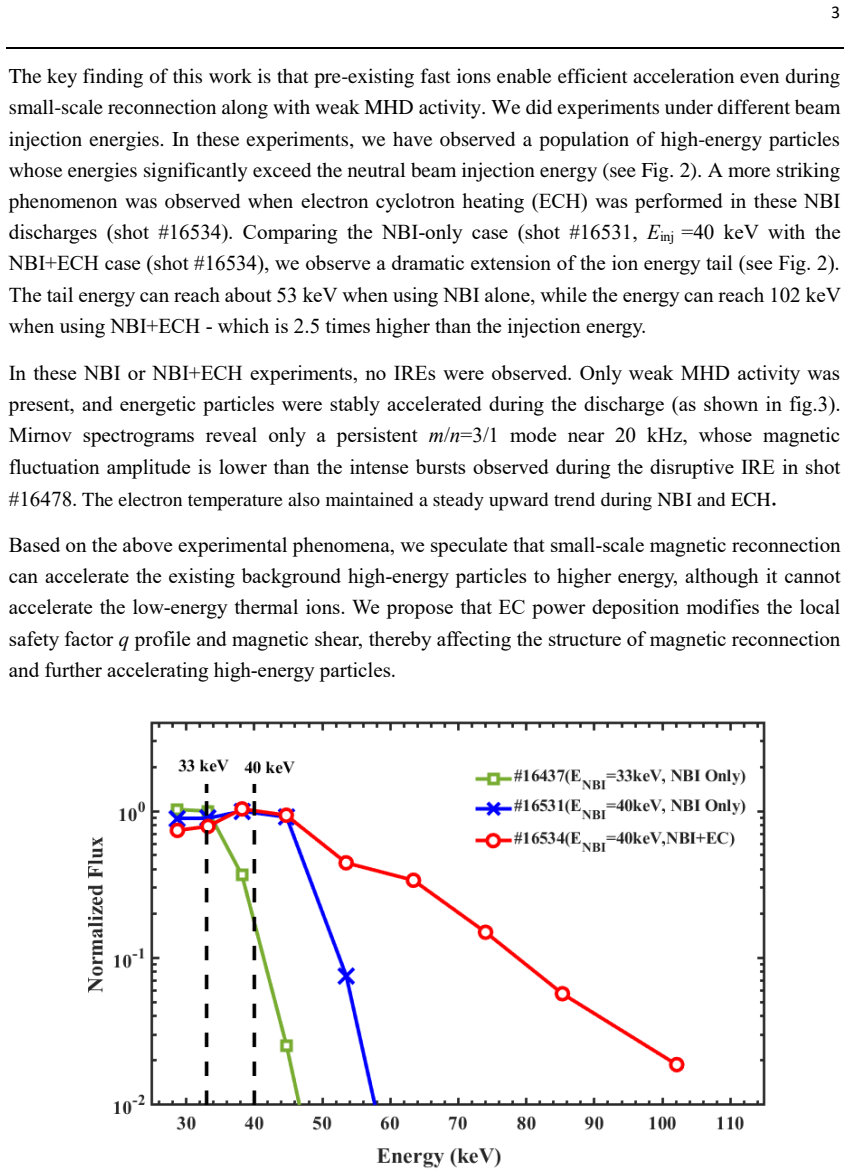
We report the first observation on the EXL-50U spherical torus that energetic particles injected by neutral beam injection (NBI) can be stably accelerated to significantly higher energies - reaching up to 2.5 times the injection energy, occurring without significant large-scale magnetohydrodynamic (MHD) bursts. Simulations based on EXL-50U parameters indicate that small-scale magnetic reconnection, mediated by multiple magnetic islands, fails to accelerate bulk thermal ions but efficiently energizes seed fast ions. Unlike global MHD events, such small-scale reconnection is ubiquitous in magnetic confinement devices and does not degrade core confinement. This mechanism offers a novel and potentially universal channel for auxiliary ion heating in future fusion reactors.
Editorial analysis
A structured set of objections, weighed in public.
Referee Report
Summary. The manuscript reports the first observation on the EXL-50U spherical torus that neutral beam injected energetic ions are re-accelerated to up to 2.5 times the injection energy without significant large-scale MHD bursts. Simulations using EXL-50U parameters indicate that small-scale magnetic reconnection mediated by multiple magnetic islands selectively energizes seed fast ions while failing to accelerate bulk thermal ions, proposing this as a novel ubiquitous channel for auxiliary ion heating in fusion plasmas.
Significance. If substantiated, the result identifies a potentially important small-scale mechanism for selective ion energization that avoids confinement degradation associated with global MHD activity. The device-specific simulations provide a concrete link to experiment, which strengthens the case for relevance to future reactors, though the overall significance hinges on resolving current gaps in experimental detail and model validation.
major comments (3)
- [Abstract and Experimental Results] The abstract and experimental results section state an observation of energy gain reaching 2.5 times injection energy but lack details on data selection criteria, error analysis, statistical significance, and explicit checks against alternative explanations such as diagnostic artifacts or other heating mechanisms. This leaves the central experimental claim only moderately supported.
- [Simulations] The simulations section claims selective energization of fast ions to 2.5x injection energy via small-scale islands while leaving thermal ions unaffected. The manuscript should specify whether test-particle, hybrid, or fully kinetic methods are used and demonstrate that island width relative to fast-ion gyroradius and reconnection rate relative to ion transit time are resolved sufficiently to support the reported selectivity, as under-resolved MHD-plus-test-particle models can produce artificially coherent E-fields.
- [Discussion and Conclusions] A direct quantitative comparison between simulated and measured energy spectra, including parameter sensitivity tests, is required to establish that the modeled reconnection process reproduces the observed energy gain rather than other unmodeled effects.
minor comments (3)
- [Simulations] Define 'seed fast ions' explicitly and describe their initialization in the simulations relative to the NBI distribution.
- [Figures] Add error bars to energy distribution figures and include baseline cases without reconnection for comparison.
- [References] Expand references to include prior studies on small-scale reconnection and energetic particle dynamics in spherical tori.
Simulated Author's Rebuttal
We thank the referee for the constructive and detailed review of our manuscript. The comments identify areas where additional clarity and supporting material will strengthen the presentation of both the experimental observations and the supporting simulations. We address each major comment below and indicate the revisions we will make in the next version of the manuscript.
read point-by-point responses
-
Referee: [Abstract and Experimental Results] The abstract and experimental results section state an observation of energy gain reaching 2.5 times injection energy but lack details on data selection criteria, error analysis, statistical significance, and explicit checks against alternative explanations such as diagnostic artifacts or other heating mechanisms. This leaves the central experimental claim only moderately supported.
Authors: We agree that the experimental section would benefit from expanded methodological detail. In the revised manuscript we will add a dedicated paragraph describing the data selection criteria applied to the neutral-beam-injected ion population, the statistical significance of the observed energy gains (including the fraction of shots showing the 2.5× increase), and quantitative error estimates derived from the diagnostic calibration. We will also explicitly discuss why diagnostic artifacts and competing heating mechanisms are inconsistent with the timing and spatial localization of the measured spectra relative to the small-scale reconnection signatures. revision: yes
-
Referee: [Simulations] The simulations section claims selective energization of fast ions to 2.5x injection energy via small-scale islands while leaving thermal ions unaffected. The manuscript should specify whether test-particle, hybrid, or fully kinetic methods are used and demonstrate that island width relative to fast-ion gyroradius and reconnection rate relative to ion transit time are resolved sufficiently to support the reported selectivity, as under-resolved MHD-plus-test-particle models can produce artificially coherent E-fields.
Authors: The present simulations employ a hybrid MHD plus test-particle approach in which the magnetic geometry is evolved with resistive MHD and energetic ions are integrated as test particles. We will revise the methods section to state this explicitly and to report the numerical resolution parameters. Specifically, we will demonstrate that the smallest island widths are resolved by at least four grid cells and exceed the fast-ion gyroradius by a factor of approximately three, while the reconnection electric-field rise time is captured on timescales shorter than the ion transit time across an island. These checks confirm that the reported selectivity arises from physical orbit dynamics rather than numerical artifacts. revision: yes
-
Referee: [Discussion and Conclusions] A direct quantitative comparison between simulated and measured energy spectra, including parameter sensitivity tests, is required to establish that the modeled reconnection process reproduces the observed energy gain rather than other unmodeled effects.
Authors: We concur that a side-by-side quantitative comparison is necessary to strengthen the link between simulation and experiment. The revised manuscript will include a new figure that overlays the simulated fast-ion energy spectra (obtained from the hybrid model) with the experimentally measured spectra from EXL-50U. We will also present results from a parameter scan in which island width, reconnection rate, and seed-ion energy are varied within the range consistent with the device diagnostics; the scan shows that the 2.5× energy gain remains robust across this parameter space, supporting the interpretation that small-scale reconnection is the dominant mechanism. revision: yes
Circularity Check
No significant circularity: experimental observation and parameter-based simulations remain independent
full rationale
The paper reports a direct experimental observation of NBI ion re-acceleration to 2.5× injection energy on EXL-50U without large-scale MHD activity. Simulations initialized with EXL-50U parameters are invoked only to identify a plausible mechanism (small-scale islands), not to generate or fit the reported energy gain itself. No equations, self-citations, or ansatzes are shown that would make the central energy-increase claim equivalent to a model input by construction. The derivation therefore rests on external experimental data and does not reduce to self-definition or fitted prediction.
Axiom & Free-Parameter Ledger
axioms (1)
- domain assumption Small-scale magnetic reconnection mediated by multiple islands occurs ubiquitously in magnetic confinement devices and does not degrade core confinement.
Lean theorems connected to this paper
-
IndisputableMonolith/Foundation/AlexanderDuality.leanalexander_duality_circle_linking unclear?
unclearRelation between the paper passage and the cited Recognition theorem.
Simulations based on EXL-50U parameters indicate that small-scale magnetic reconnection, mediated by multiple magnetic islands, fails to accelerate bulk thermal ions but efficiently energizes seed fast ions, reaching up to 2.5 times the injection energy
What do these tags mean?
- matches
- The paper's claim is directly supported by a theorem in the formal canon.
- supports
- The theorem supports part of the paper's argument, but the paper may add assumptions or extra steps.
- extends
- The paper goes beyond the formal theorem; the theorem is a base layer rather than the whole result.
- uses
- The paper appears to rely on the theorem as machinery.
- contradicts
- The paper's claim conflicts with a theorem or certificate in the canon.
- unclear
- Pith found a possible connection, but the passage is too broad, indirect, or ambiguous to say the theorem truly supports the claim.
Reference graph
Works this paper leans on
-
[1]
Fisch N J and Rax J M, Interaction of energetic alpha particles with intense lower hybrid waves, Phys Rev Lett 69, 612 (1992)
work page 1992
-
[2]
Herrmann M C and Fisch N J, Cooling Energetic α Particles in a Tokamak with Waves, Phys Rev Lett 79, 1495 (1997)
work page 1997
-
[3]
Fisch N J and Herrmann M C, A tutorial on α-channelling, Plasma Phys Control Fusion 41, A221 (1999)
work page 1999
-
[4]
Ochs I E and Fisch N J, Nonresonant Diffusion in Alpha Channeling, Phys Rev Lett 127, 025003 (2021)
work page 2021
-
[5]
Gryaznevich M and Sykes A, Merging -compression formation of high temperature tokamak plasma, Nucl Fusion 57, 072002 (2017)
work page 2017
-
[6]
Takase Y et al., Plasma Startup by Magnetic Merging in the MAST Experiment, Nucl Fusion 41, 1543 (2001)
work page 2001
-
[7]
Takase Y et al., Initial Results from the TST-2 Spherical Tokamak, Nucl Fusion 41, 1543 (2001)
work page 2001
-
[8]
Inomoto M et al., Centre-solenoid-free merging start-up of spherical tokamak plasmas in UTST, Nucl Fusion 55, 033013 (2015)
work page 2015
-
[9]
Ono Y et al., High-power Heating of Magnetic Reconnection in Tokamak Merging Startup, Phys Plasmas 26, 052504 (2019)
work page 2019
-
[10]
Helander P et al., Ion Acceleration during Reconnection in MAST, Phys Rev Lett 89, 235002 (2002)
work page 2002
-
[11]
Park J Y , Yoon Y D, and Hwang Y S, Kinetic turbulence drives MHD equilibrium change via 3D reconnection, Nature 644, 59 (2025)
work page 2025
-
[12]
Shi Y J et al., Strategy and experimental progress of the EXL-50U spherical torus in support of the EHL-2 project, Plasma Sci Technol 27, 024003 (2025)
work page 2025
-
[13]
Shi Y J et al., Achievement of 1 MA discharges in hydrogen -boron plasmas on EXL -50U, Plasma Sci Technol 27, 09200 (2025). 7 7
work page 2025
-
[14]
Zang L et al., Design of the strippi ng unit and the electromagnetic analysis unit for the E//B NPA on HL-2A/2M tokamak, Plasma Sci Technol 24, 064002 (2022)
work page 2022
-
[15]
Wang Y et al., Calibration of an E//B Neutral Particle Analyzer and novel data analysis for its first experiment on the HL-3 tokamak, J Instrum 20, P03030 (2025)
work page 2025
-
[16]
K. J. Bowers, B. Albright , L. Yin , B. Bergen , and T. Kwan , Ultrahigh performance three- dimensional electromagnetic relativistic kinetic plasma simulation, Phys. Plasmas 15, 055703 (2008)
work page 2008
-
[17]
GitHub - lanl/vpic-kokkos at hybridVPIC · GitHub
-
[18]
Yangchun Liu, Hairong Huang, Dong Wu, et ai., Energization of Proton via Beam-Driven Ion Bernstein Waves in p11B Plasmas, https://arxiv.org/pdf/2603.02728 End Matter EXL-50U The EXL-50U spherical tokamak (R₀ = 0.7 m, a = 0.4 m, Bₜ =1.2 T) operated in hydrogen –boron plasmas with Iₚ = 500 kA and nₑ =1 × 10¹⁹ m-3. For the EXL-5U experiment presented in this...
discussion (0)
Sign in with ORCID, Apple, or X to comment. Anyone can read and Pith papers without signing in.