Differentiable Mixture-of-Agents Incentivizes Swarm Intelligence of Large Language Models
Pith reviewed 2026-05-20 19:49 UTC · model grok-4.3
The pith
Differentiable Mixture-of-Agents lets large language models dynamically route and activate agents at each reasoning step without pre-defined communication topologies.
A machine-rendered reading of the paper's core claim, the machinery that carries it, and where it could break.
Core claim
DMoA is a self-evolving multi-agent framework that enables elastic and adaptive agent collaboration during inference by dynamically routing and activating agents at each reasoning step. It relies on a differentiable, context-aware routing mechanism with recurrent structures to incorporate historical and contextual information and produce sparse activations. Predictive entropy serves as a self-supervised signal to optimize the routing process, allowing the system to implicitly simulate diverse communication topologies and adapt to evolving task demands without external annotations.
What carries the argument
Differentiable context-aware routing mechanism with recurrent structures that produces sparse agent activations in a step-wise manner.
If this is right
- The system can adapt its collaboration pattern to changing task demands during a single inference run.
- Sparse activations improve efficiency while maintaining or improving accuracy across benchmarks.
- Ensembling emerges naturally from the dynamic routing without requiring pre-compiled workflows.
- Test-time adaptation occurs using only internal model signals rather than labeled data.
Where Pith is reading between the lines
- The same routing idea could be tested on non-language tasks such as planning or code generation where agent roles shift mid-process.
- If the entropy signal proves sufficient, it may reduce reliance on human-designed agent graphs in other multi-model setups.
- Extending the recurrent memory to longer horizons might reveal limits in how well the system tracks evolving demands.
Load-bearing premise
Predictive entropy alone, without external annotations, can guide a differentiable routing process to discover effective and adaptable agent collaboration patterns.
What would settle it
A controlled comparison on the same nine benchmarks where the recurrent context or entropy optimization is removed and performance falls to the level of static multi-agent baselines.
Figures





read the original abstract
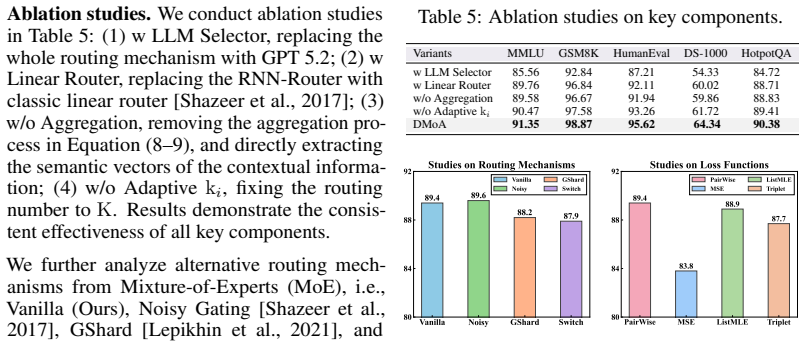
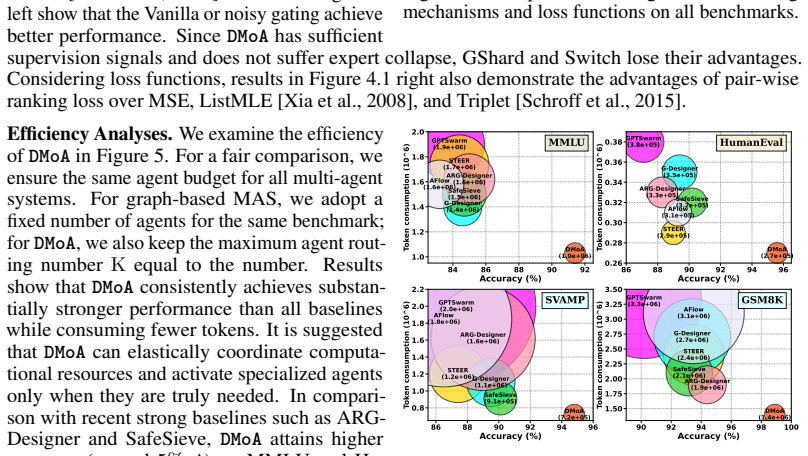
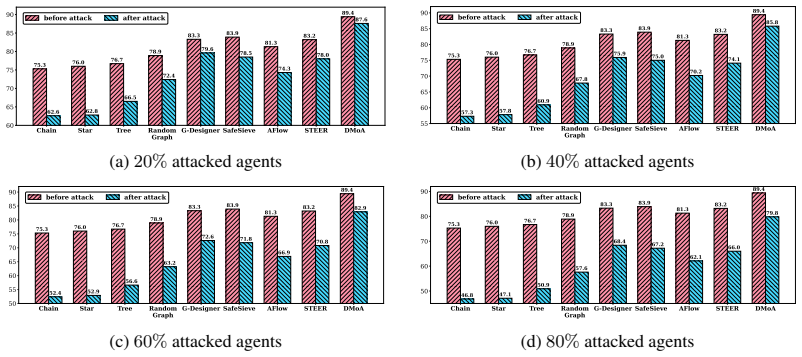
Recent advances in Large Language Models (LLMs) have catalyzed the development of multi-agent systems (MAS) for complex reasoning tasks. However, existing MAS typically rely on pre-defined or pre-compiled communication topologies, which limits their flexibility and adaptability to dynamic task requirements. In this work, we propose Differentiable Mixture-of-Agents (DMoA), a self-evolving multi-agent framework that enables elastic and adaptive agent collaboration during inference. Instead of statically constructing workflows, DMoA dynamically routes and activates agents at each reasoning step, allowing the system to implicitly simulate diverse communication topologies and adapt to evolving demands. To achieve this, we design a differentiable, context-aware routing mechanism that leverages recurrent structures to incorporate historical and contextual information, producing sparse agent activations in a step-wise manner. Furthermore, we introduce predictive entropy as self-supervised signals to optimize the routing process, enabling efficient test-time adaptation without external annotations. Extensive experiments across 9 benchmarks demonstrate that DMoA achieves state-of-the-art performance while exhibiting strong efficiency, robustness, and ensembling capabilities.
Editorial analysis
A structured set of objections, weighed in public.
Referee Report
Summary. The manuscript proposes Differentiable Mixture-of-Agents (DMoA), a multi-agent LLM framework that replaces static communication topologies with a differentiable, context-aware router using recurrent structures to produce sparse, step-wise agent activations. Routing parameters are optimized at test time solely via predictive entropy on agent outputs as a self-supervised objective, allowing the system to implicitly discover diverse collaboration patterns and adapt to task demands without external labels. Experiments across nine benchmarks are reported to establish state-of-the-art performance together with gains in efficiency, robustness, and ensembling.
Significance. If the central mechanism is shown to produce genuinely distinct activation topologies rather than merely sparse but topologically similar selections, the approach would offer a practical route to annotation-free, adaptive multi-agent reasoning. The idea of using predictive entropy directly as a routing objective is conceptually clean and could generalize beyond the specific LLM agents tested.
major comments (2)
- [§3.2] §3.2 (recurrent router and entropy loss): the claim that predictive entropy alone supplies a gradient signal sufficient to discover and switch among qualitatively different communication topologies (sequential, parallel, hierarchical) is not yet supported by direct evidence. Entropy quantifies output uncertainty but does not explicitly penalize or reward particular activation graphs; without an ablation that measures topological diversity (e.g., graph-edit distance or activation-pattern clustering across tasks), it remains possible that the reported gains arise from sparse but structurally similar selections.
- [§4] §4 (experiments): the abstract asserts SOTA results and robustness across nine benchmarks, yet the manuscript supplies neither per-benchmark accuracy tables with error bars, nor ablation studies isolating the recurrent state versus the entropy objective, nor dataset descriptions. These omissions make it impossible to assess whether the performance delta is load-bearing or reducible to the fitted routing parameters themselves.
minor comments (2)
- [§3.1] Notation for the recurrent hidden state and the precise form of the entropy loss should be introduced with an equation number in §3.1 so that readers can trace the gradient path without ambiguity.
- [Figure 2] Figure 2 (activation heatmaps) would benefit from an additional panel showing the same tasks under a non-recurrent baseline to visually demonstrate the claimed topological diversity.
Simulated Author's Rebuttal
We thank the referee for the constructive and detailed feedback. We address each major comment below and describe the revisions planned for the next version of the manuscript.
read point-by-point responses
-
Referee: [§3.2] §3.2 (recurrent router and entropy loss): the claim that predictive entropy alone supplies a gradient signal sufficient to discover and switch among qualitatively different communication topologies (sequential, parallel, hierarchical) is not yet supported by direct evidence. Entropy quantifies output uncertainty but does not explicitly penalize or reward particular activation graphs; without an ablation that measures topological diversity (e.g., graph-edit distance or activation-pattern clustering across tasks), it remains possible that the reported gains arise from sparse but structurally similar selections.
Authors: We agree that explicit quantification of topological diversity would strengthen the central claim. The predictive entropy objective is intended to drive the router toward lower-uncertainty outputs, which in our framework encourages selection of agent combinations that produce qualitatively different collaboration patterns. Nevertheless, the current manuscript does not include direct measurements such as activation-pattern clustering or graph-edit distances. In the revision we will add an analysis that clusters routing decisions across tasks and reports the diversity of emergent topologies to address this point. revision: yes
-
Referee: [§4] §4 (experiments): the abstract asserts SOTA results and robustness across nine benchmarks, yet the manuscript supplies neither per-benchmark accuracy tables with error bars, nor ablation studies isolating the recurrent state versus the entropy objective, nor dataset descriptions. These omissions make it impossible to assess whether the performance delta is load-bearing or reducible to the fitted routing parameters themselves.
Authors: We acknowledge that the experimental section would benefit from greater detail. The revised manuscript will include full per-benchmark accuracy tables with means and standard deviations from multiple runs, ablation studies that separately disable the recurrent state and the entropy objective, and expanded dataset descriptions with references and statistics. These additions will make the source of the reported gains clearer. revision: yes
Circularity Check
No significant circularity; empirical gains on external benchmarks are independent of routing optimization
full rationale
The paper introduces a differentiable recurrent router optimized at test time via predictive entropy as a self-supervised loss on agent outputs. This is a standard self-supervised training step whose objective is defined on the model's own predictions. The load-bearing claims (SOTA performance, implicit simulation of diverse topologies, robustness) are supported by direct evaluation on 9 held-out benchmarks whose labels and metrics are external to the entropy signal. No equation or derivation reduces a reported result to a quantity that is definitionally identical to the fitted router parameters; the benchmarks serve as an independent falsification test. Self-citations, if present, are not load-bearing for the central empirical result.
Axiom & Free-Parameter Ledger
axioms (1)
- domain assumption Differentiable context-aware routing with recurrent structures can simulate diverse communication topologies and adapt without external labels
Lean theorems connected to this paper
-
IndisputableMonolith/Cost/FunctionalEquation.leanwashburn_uniqueness_aczel unclear?
unclearRelation between the paper passage and the cited Recognition theorem.
we design a differentiable, context-aware routing mechanism that leverages recurrent structures ... predictive entropy as self-supervised signals
What do these tags mean?
- matches
- The paper's claim is directly supported by a theorem in the formal canon.
- supports
- The theorem supports part of the paper's argument, but the paper may add assumptions or extra steps.
- extends
- The paper goes beyond the formal theorem; the theorem is a base layer rather than the whole result.
- uses
- The paper appears to rely on the theorem as machinery.
- contradicts
- The paper's claim conflicts with a theorem or certificate in the canon.
- unclear
- Pith found a possible connection, but the passage is too broad, indirect, or ambiguous to say the theorem truly supports the claim.
discussion (0)
Sign in with ORCID, Apple, or X to comment. Anyone can read and Pith papers without signing in.