Long-range magnetic ordering and structural phase transition in disordered high-entropy spinel chromites
Pith reviewed 2026-05-20 16:55 UTC · model grok-4.3
The pith
High-entropy spinel chromites (Mn0.2Co0.2Ni0.2Cu0.2Zn0.2)Cr2O4 and (Mg0.2Co0.2Ni0.2Cu0.2Zn0.2)Cr2O4 exhibit long-range antiferromagnetic order below 49 K and 35 K respectively and a structural transition to orthorhombic Fddd symmetry at 55 K and 85 K despite A-site disorder.
A machine-rendered reading of the paper's core claim, the machinery that carries it, and where it could break.
Core claim
Notably, despite the significant chemical disorder at the A site, both systems undergo transitions analogous to those observed in low entropy spinel systems. This behavior suggests that high configurational entropy may promote global structural stabilization despite local chemical disorder, thereby preserving long-range orderings and the characteristic symmetry-breaking transitions of the pristine spinel systems.
Load-bearing premise
The interpretation that the observed long-range order and symmetry-breaking transitions are promoted by high configurational entropy rather than by the specific choice of the five A-site cations or by undetected local ordering or phase segregation within the samples.
Figures



read the original abstract
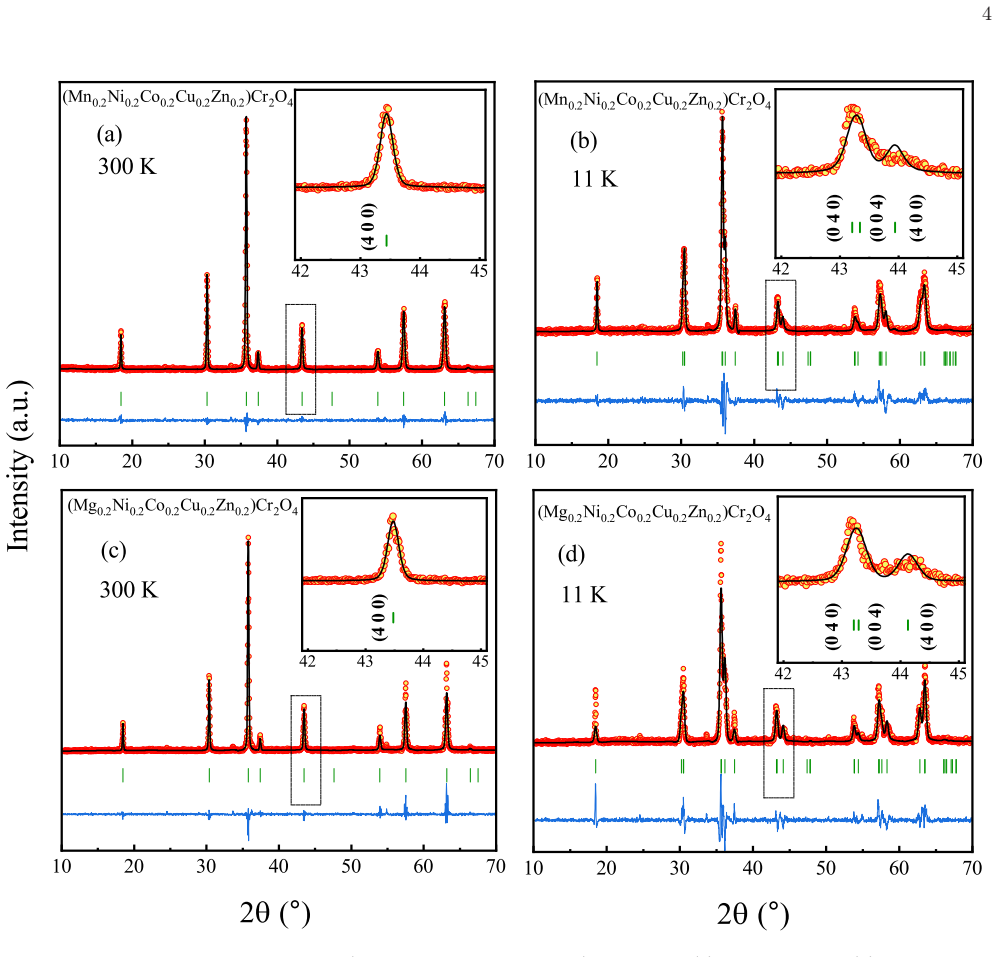
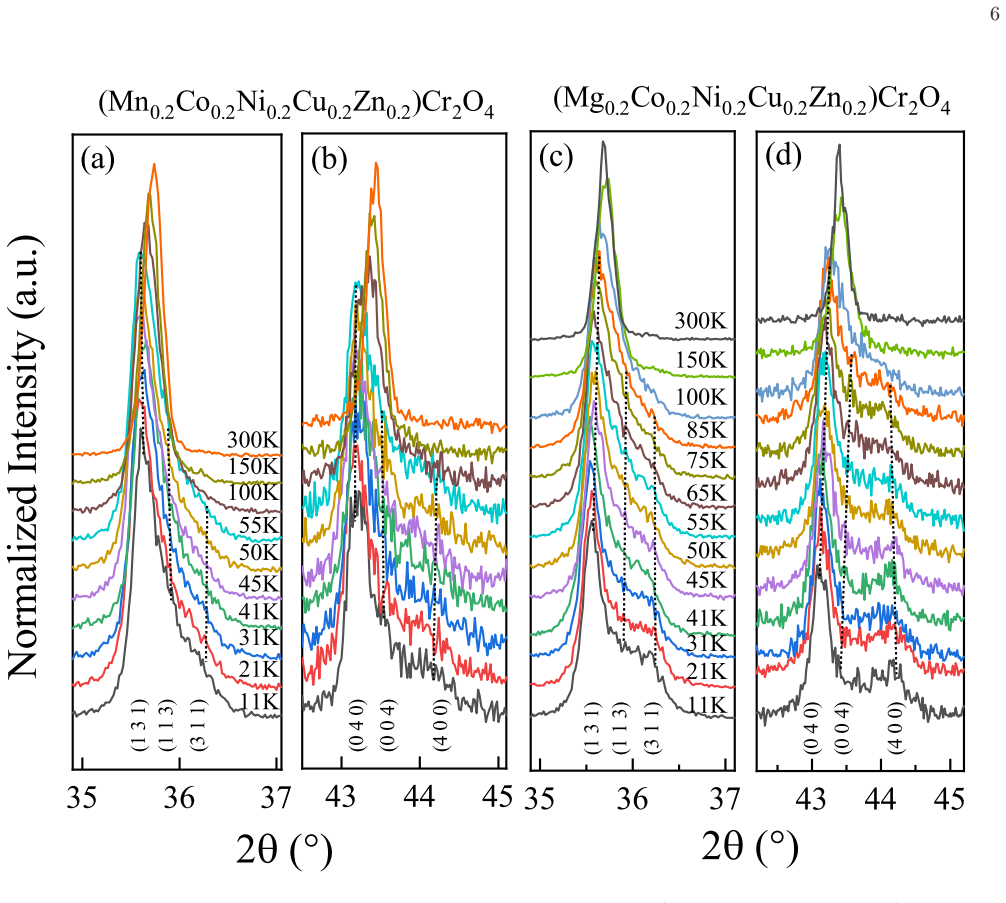
High-entropy spinel oxides provide an excellent platform for investigating entropy-stabilized correlated systems with strong configurational disorder. In this work, we systematically study the temperature evolution of the structural and magnetic properties of Cr-based high-entropy spinels with compositions $(Mn_{0.2}Co_{0.2}Ni_{0.2}Cu_{0.2}Zn_{0.2})Cr_2O_4$ and $(Mg_{0.2}Co_{0.2}Ni_{0.2}Cu_{0.2}Zn_{0.2})Cr_2O_4$. Our results reveal that both systems crystallize in cubic structure with space group \textit{$Fd\overline{3}m$} at room temperature. Each system undergoes antiferromagnetic ordering below the N\'eel temperatures $ T_N$ = 49 K and 35 K, respectively. Neutron diffraction measurements confirm the emergence of long-range magnetic order with spiral spin arrangement. Both systems exhibit a structural phase transition from cubic \textit{$Fd\overline{3}m$} to orthorhombic \textit{Fddd} symmetry at approximately 55 K and 85 K, respectively. Notably, despite the significant chemical disorder at the A site, both systems undergo transitions analogous to those observed in low entropy spinel systems. This behavior suggests that high configurational entropy may promote global structural stabilization despite local chemical disorder, thereby preserving long-range orderings and the characteristic symmetry-breaking transitions of the pristine spinel systems.
Editorial analysis
A structured set of objections, weighed in public.
Referee Report
Summary. The manuscript investigates the structural and magnetic properties of two high-entropy spinel chromites with compositions (Mn_{0.2}Co_{0.2}Ni_{0.2}Cu_{0.2}Zn_{0.2})Cr_2O_4 and (Mg_{0.2}Co_{0.2}Ni_{0.2}Cu_{0.2}Zn_{0.2})Cr_2O_4. Both systems crystallize in the cubic Fd-3m structure at room temperature. They undergo antiferromagnetic ordering below T_N = 49 K and 35 K, respectively, with neutron diffraction confirming long-range spiral spin order. Each exhibits a structural phase transition to orthorhombic Fddd symmetry near 55 K and 85 K. The authors note that these transitions are analogous to those in low-entropy spinels and suggest that high configurational entropy promotes global structural stabilization despite A-site chemical disorder, thereby preserving long-range order and symmetry-breaking transitions.
Significance. If the interpretation holds, the work shows that high-entropy stabilization can preserve the characteristic magnetic and structural transitions of spinel chromites even with substantial A-site disorder. This could inform the design of entropy-stabilized correlated materials with robust long-range order. The neutron diffraction confirmation of spiral antiferromagnetic order provides direct microscopic evidence that strengthens the claims beyond bulk magnetization data alone.
major comments (1)
- [Discussion] Discussion section (and abstract): The central interpretation that high configurational entropy promotes global structural stabilization and preserves long-range order despite local disorder is not load-bearing supported by the data. Neutron diffraction establishes average long-range order below T_N but supplies no local-structure constraint (e.g., via pair-distribution function or EXAFS) on A-site randomness or to exclude nanoscale phase segregation or short-range cation order. The manuscript does not compare against specific low-entropy mixtures using the same five-cation set to isolate entropy effects from chemistry-specific behavior.
minor comments (2)
- [Abstract] Ensure consistent formatting of space-group symbols (Fd-3m with overline) across abstract, main text, and figures.
- [Results] Table or figure reporting transition temperatures: include uncertainty estimates or error bars on T_N and structural transition temperatures to allow quantitative assessment of the reported values.
Simulated Author's Rebuttal
We thank the referee for their careful reading of the manuscript and for the constructive comments. We address the major point raised below.
read point-by-point responses
-
Referee: Discussion section (and abstract): The central interpretation that high configurational entropy promotes global structural stabilization and preserves long-range order despite local disorder is not load-bearing supported by the data. Neutron diffraction establishes average long-range order below T_N but supplies no local-structure constraint (e.g., via pair-distribution function or EXAFS) on A-site randomness or to exclude nanoscale phase segregation or short-range cation order. The manuscript does not compare against specific low-entropy mixtures using the same five-cation set to isolate entropy effects from chemistry-specific behavior.
Authors: We agree that the neutron diffraction data establish long-range order on the average structure but do not furnish local-structure information such as pair-distribution functions or EXAFS that would directly constrain A-site randomness or rule out nanoscale segregation. The persistence of a sharp structural transition to Fddd symmetry and well-defined magnetic Bragg peaks nevertheless indicates that any local disorder does not destroy global coherence. We have drawn analogies to the well-documented transitions in binary spinel chromites (MnCr2O4, CoCr2O4, etc.) reported in the literature; these comparisons highlight that the high-entropy compositions retain the same sequence of transitions. A controlled low-entropy counterpart using precisely the same five cations at non-equimolar ratios or with enforced ordering is experimentally non-trivial and lies outside the scope of the present study. We will revise the discussion and abstract to frame the entropy-stabilization argument as an inference drawn from the observed analogies rather than a definitive claim, and we will explicitly note the absence of local probes. revision: partial
Circularity Check
No circularity: experimental measurements with interpretive suggestion
full rationale
This is a purely experimental study reporting neutron diffraction, magnetization, and structural data on two high-entropy spinel compositions. The central observation—that both systems exhibit cubic-to-orthorhombic transitions and long-range spiral antiferromagnetic order analogous to low-entropy chromites—is presented as a direct experimental result. The suggestion that high configurational entropy promotes global stabilization is offered as an interpretation of the data, not as a derived quantity obtained from equations, fitted parameters, or self-citations. No load-bearing step reduces to a definition, a fit, or a prior self-citation by construction. The paper therefore contains no circular derivation chain.
Axiom & Free-Parameter Ledger
axioms (2)
- standard math Standard interpretation of neutron diffraction peaks as evidence of long-range magnetic order with spiral spin arrangement
- domain assumption Cubic Fd-3m to orthorhombic Fddd symmetry change is a characteristic transition of spinel chromites
Lean theorems connected to this paper
-
IndisputableMonolith/Cost/FunctionalEquation.leanwashburn_uniqueness_aczel unclear?
unclearRelation between the paper passage and the cited Recognition theorem.
Notably, despite the significant chemical disorder at the A site, both systems undergo transitions analogous to those observed in low entropy spinel systems. This behavior suggests that high configurational entropy may promote global structural stabilization despite local chemical disorder
-
IndisputableMonolith/Foundation/DimensionForcing.leanalexander_duality_circle_linking unclear?
unclearRelation between the paper passage and the cited Recognition theorem.
Both systems exhibit a structural phase transition from cubic Fd-3m to orthorhombic Fddd symmetry at approximately 55 K and 85 K
What do these tags mean?
- matches
- The paper's claim is directly supported by a theorem in the formal canon.
- supports
- The theorem supports part of the paper's argument, but the paper may add assumptions or extra steps.
- extends
- The paper goes beyond the formal theorem; the theorem is a base layer rather than the whole result.
- uses
- The paper appears to rely on the theorem as machinery.
- contradicts
- The paper's claim conflicts with a theorem or certificate in the canon.
- unclear
- Pith found a possible connection, but the passage is too broad, indirect, or ambiguous to say the theorem truly supports the claim.
Reference graph
Works this paper leans on
-
[1]
investigated the magnetic ordering of Cr and Fe- based high entropy spinel oxides. The Cr-based com- pounds exhibited antiferromagnetic (AFM) ordering at low temperatures, whereas the Fe-based samples exhib- ited ferrimagnetic (FiM) ordering at comparatively high temperatures. It has been realized from previous studies that in typi- cal chromite spinels, ...
work page internal anchor Pith review Pith/arXiv arXiv 2026
-
[2]
in the orthorhombic phase. (b) The (4 0 0) reflection in the c ubic phase splits into (0 4 0), (0 0 4), and (4 0 0) in the orthorhombic phase of (M n0.2Co 0.2N i0.2Cu 0.2Zn0.2)Cr 2O4 . Similar peak splitting for (M g0.2Co 0.2N i0.2Cu 0.2Zn0.2)Cr 2O4 is shown in (c) and (d). cation. In our case, Mn is Jahn-Teller active in the (M n0. 2Co0. 2N i0. 2Cu 0. 2Zn...
work page 2021
-
[3]
T. Garg, M. Saleem, N. Kaurav, P. Choudhary, and A. Yadav, Materials Today: Proceedings 89, 4 (2023)
work page 2023
-
[4]
Y. Shi, E. Hu, A. Sumboja, I. T. Anggraningrum, A. Z. Syahrial, and Q. Yan, Advanced Functional Materials 35, 2413078 (2025)
work page 2025
-
[5]
M. A. Halcrow, Chemical Society Reviews 42, 1784 (2013)
work page 2013
- [6]
-
[7]
D. Malavekar, S. Pujari, S. Jang, S. Bachankar, and J. H. Kim, Small 20, 2312179 (2024)
work page 2024
- [8]
- [9]
- [10]
-
[11]
D. I. Khomskii, Transition metal compounds (Cambridge University Press, 2014)
work page 2014
- [12]
- [13]
-
[14]
C. M. Rost, E. Sachet, T. Borman, A. Moballegh, E. C. 10 Dickey, D. Hou, J. L. Jones, S. Curtarolo, and J.-P. Maria, Nature communications 6, 8485 (2015)
work page 2015
-
[15]
D. Bérardan, S. Franger, A. Meena, and N. Dragoe, Jour- nal of Materials Chemistry A 4, 9536 (2016)
work page 2016
- [16]
-
[17]
M. R. Suchomel, D. P. Shoemaker, L. Ribaud, M. C. Kemei, and R. Seshadri, Physical Review B 86, 054406 (2012)
work page 2012
-
[18]
H. Ishibashi and T. Yasumi, Journal of Magnetism and Magnetic Materials 310, e610 (2007)
work page 2007
-
[19]
L. Ortega-San-Martin, A. Williams, C. Gordon, S. Klemme, and J. Attfield, Journal of Physics: Con- densed Matter 20, 104238 (2008)
work page 2008
-
[20]
M. C. Kemei, P. T. Barton, S. L. Moffitt, M. W. Gaultois, J. A. Kurzman, R. Seshadri, M. R. Suchomel, and Y.-I. Kim, Journal of Physics: Condensed Matter 25, 326001 (2013)
work page 2013
- [21]
-
[22]
Carvajal, Toulouse: France International Union of Crystallography p
J. Carvajal, Toulouse: France International Union of Crystallography p. 127 (1990)
work page 1990
-
[23]
A. Balagurov, I. Bobrikov, M. Maschenko, D. Sangaa, and V. Simkin, Crystallography Reports 58, 710 (2013)
work page 2013
-
[24]
P. Mohanty, A. Venter, C. Sheppard, and A. Prinsloo, Journal of Magnetism and Magnetic Materials 498, 166217 (2020)
work page 2020
- [25]
-
[26]
K. Tomiyasu and I. Kagomiya, Journal of the Physical Society of Japan 73, 2539 (2004)
work page 2004
- [27]
discussion (0)
Sign in with ORCID, Apple, or X to comment. Anyone can read and Pith papers without signing in.