Constellation-Independent Range Estimation in Payload-Based OFDM-ISAC
Pith reviewed 2026-05-19 20:32 UTC · model grok-4.3
pith:RCM5KJXO Add to your LaTeX paper
What is a Pith Number?\usepackage{pith}
\pithnumber{RCM5KJXO}
Prints a linked pith:RCM5KJXO badge after your title and writes the identifier into PDF metadata. Compiles on arXiv with no extra files. Learn more
The pith
A region-specific mismatched filter lets OFDM-ISAC systems estimate range accurately no matter which data constellation is used for payload.
A machine-rendered reading of the paper's core claim, the machinery that carries it, and where it could break.
Core claim
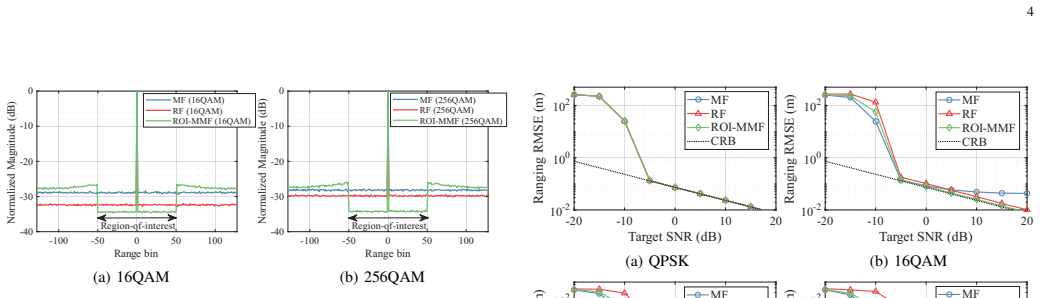
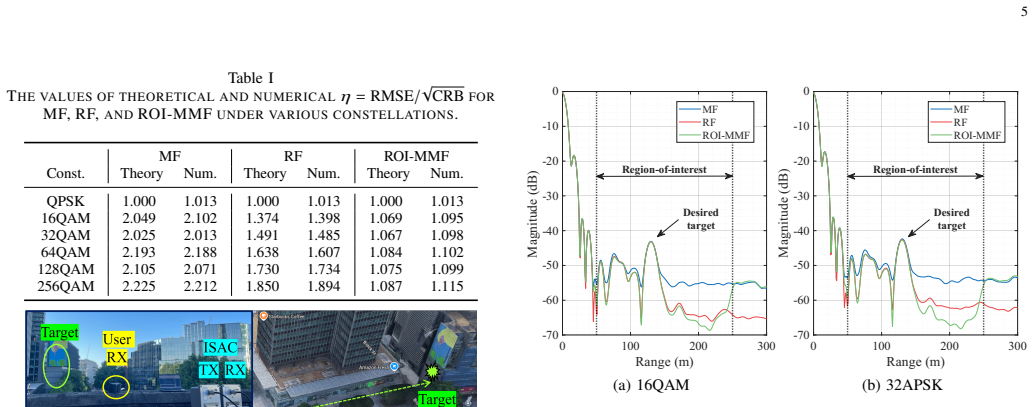
By constructing a mismatched filter whose response is forced to match the ideal mainlobe only inside a prescribed delay region of interest, sidelobe levels caused by arbitrary payload symbols can be lowered without distorting the peak used for ranging. The design is realized efficiently through the Woodbury matrix identity, and its ranging mean-square error is derived in closed form to show improvement over conventional receivers while remaining close to the theoretical bound even when the constellation varies.
What carries the argument
Region-of-interest mismatched filter (ROI-MMF) that suppresses sidelobes inside a chosen delay interval while preserving the mainlobe for targets inside it, computed via the Woodbury identity.
If this is right
- Ranging mean-square error improves on both matched filtering and reciprocal filtering for any payload constellation.
- The mean-square error approaches the Cramér-Rao bound, confirming near-optimal ranging is retained.
- Implementation cost scales with the size of the chosen delay region rather than the total number of subcarriers.
- The same receiver structure works for multiple constellations without redesign.
- Over-the-air measurements on a real OFDM-ISAC testbed reproduce the simulated performance.
Where Pith is reading between the lines
- Systems could safely employ high-order constellations for communication while still obtaining reliable range estimates inside monitored delay windows.
- If the region of interest must be updated on the fly, a low-overhead method to select or adapt the window would become the next practical requirement.
- The same sidelobe-control idea might be applied to other sensing dimensions such as angle or Doppler once the delay filter is in place.
Load-bearing premise
The delay region containing the targets must be known accurately in advance so that suppression can be applied only there without altering the mainlobe response.
What would settle it
Place a single target at a known delay inside the prescribed region, transmit with a non-constant-modulus constellation, and check whether the measured range mean-square error stays within a few decibels of the Cramér-Rao bound; a large gap would falsify the performance claim.
Figures

read the original abstract
Orthogonal frequency division multiplexing (OFDM) is a key waveform for integrated sensing and communication (ISAC) due to its spectral efficiency and compatibility with modern wireless standards. In multi-target and clutter-rich environments, however, payload-based OFDM-ISAC can suffer from data-dependent sidelobes induced by non-constant-modulus modulation symbols. To overcome these limitations, this paper proposes a region-of-interest mismatched filter (ROI-MMF) that suppresses sidelobes within a prescribed delay region while preserving the mainlobe response. By leveraging the Woodbury identity, the proposed design admits an efficient closed-form implementation whose complexity scales with the ROI size rather than the number of subcarriers. We theoretically provide the ranging mean-square error (MSE) of the designed ROI-MMF, which shows the superior performance compared to conventional matched filtering (MF) and reciprocal filtering (RF) sensing receivers. Simulations across various constellations show that the proposed sensing receiver achieves a ranging MSE approaching the Cram\'er-Rao bound (CRB), which notably confirms that our design preserves the target ranging performance even under the non-constant-modulus constellation. Finally, the framework is experimentally validated with our over-the-air OFDM-ISAC testbed.
Editorial analysis
A structured set of objections, weighed in public.
Referee Report
Summary. The paper proposes a region-of-interest mismatched filter (ROI-MMF) for payload-based OFDM-ISAC to suppress data-dependent sidelobes induced by non-constant-modulus constellations within a prescribed delay region while preserving the mainlobe response. Leveraging the Woodbury identity yields a closed-form implementation whose complexity scales with ROI size. A theoretical ranging MSE expression is derived and shown to outperform conventional matched filtering (MF) and reciprocal filtering (RF). Simulations across constellations demonstrate MSE approaching the Cramér-Rao bound (CRB), and the approach is validated experimentally with an over-the-air testbed.
Significance. If the central performance claims hold under the stated assumptions, the work provides a practical, low-complexity method for constellation-independent ranging in ISAC systems, which is significant for multi-target and clutter-rich environments. The closed-form Woodbury implementation, explicit MSE derivation, and experimental validation are notable strengths that support reproducibility and practical relevance.
major comments (1)
- [Theoretical MSE derivation and simulation setup] The theoretical MSE derivation and the claim that performance approaches the CRB (Abstract and simulation results) rest on the assumption that the prescribed delay ROI exactly matches the support of possible target delays. The Woodbury-based optimization trades sidelobe energy inside the ROI against mainlobe gain at the design delay; mismatch between the chosen ROI and actual target locations would either distort the mainlobe or leave data-dependent sidelobes unsuppressed, directly affecting whether the MSE-to-CRB result holds. No sensitivity analysis or adaptive ROI selection is indicated.
minor comments (2)
- [Method description] Notation for the ROI size and the design delay point could be introduced earlier and used consistently to improve readability of the closed-form filter expression.
- [Simulations] The abstract states that the design 'preserves the target ranging performance even under the non-constant-modulus constellation'; a brief comparison table of MSE values versus MF/RF/CRB in the simulation section would make this quantitative claim easier to verify at a glance.
Simulated Author's Rebuttal
We thank the referee for the constructive feedback and for highlighting an important aspect of our assumptions. We address the major comment below with clarifications and indicate planned revisions to strengthen the manuscript.
read point-by-point responses
-
Referee: [Theoretical MSE derivation and simulation setup] The theoretical MSE derivation and the claim that performance approaches the CRB (Abstract and simulation results) rest on the assumption that the prescribed delay ROI exactly matches the support of possible target delays. The Woodbury-based optimization trades sidelobe energy inside the ROI against mainlobe gain at the design delay; mismatch between the chosen ROI and actual target locations would either distort the mainlobe or leave data-dependent sidelobes unsuppressed, directly affecting whether the MSE-to-CRB result holds. No sensitivity analysis or adaptive ROI selection is indicated.
Authors: We agree that the theoretical MSE derivation in Section IV and the near-CRB performance claims assume the prescribed ROI covers the support of possible target delays; this is stated in the system model and simulation setup, where the ROI is selected based on expected target ranges in multi-target ISAC scenarios. The Woodbury optimization indeed performs a trade-off to suppress sidelobes inside the ROI while preserving mainlobe gain. We acknowledge that mismatch could degrade performance by leaving unsuppressed sidelobes or distorting the mainlobe. To address this, we have revised the manuscript to explicitly restate the assumption, added a new paragraph discussing ROI mismatch effects, and included additional simulation results (new Figure) showing MSE sensitivity under controlled mismatch levels. These results confirm that performance remains close to the CRB when the ROI reasonably encompasses targets, as is feasible with coarse prior information in practice. Adaptive ROI selection is noted as a potential future extension but lies outside the scope of this work, which focuses on efficient fixed-ROI design. The experimental validation uses an ROI matched to the testbed geometry, supporting the claims under the stated conditions. revision: partial
Circularity Check
Derivation chain is self-contained; MSE expression and CRB comparison are independent of fitted inputs
full rationale
The paper derives a closed-form ranging MSE for the ROI-MMF via Woodbury identity applied to the prescribed delay region, then compares this expression directly to the standard Cramér-Rao bound and to MF/RF baselines. No equation reduces by construction to a fitted parameter, self-citation, or renamed empirical pattern; the CRB serves as an external benchmark independent of the design. The ROI prescription is an explicit modeling assumption rather than a hidden tautology, and simulations are presented only as validation, not as the source of the theoretical claim. The derivation therefore remains non-circular.
Axiom & Free-Parameter Ledger
Reference graph
Works this paper leans on
-
[1]
Prasad,OFDM for wireless communications systems
R. Prasad,OFDM for wireless communications systems. Artech House, 2004, vol. 2
work page 2004
-
[2]
CP-OFDM achieves the lowest average ranging sidelobe under QAM/PSK constellations,
F. Liu, Y . Zhang, Y . Xiong, S. Li, W. Yuan, F. Gao, S. Jin, and G. Caire, “CP-OFDM achieves the lowest average ranging sidelobe under QAM/PSK constellations,”IEEE Trans. Inf. Theory, 2025
work page 2025
-
[3]
C. Sturm and W. Wiesbeck, “Waveform design and signal processing aspects for fusion of wireless communications and radar sensing,”Proc. IEEE, vol. 99, no. 7, pp. 1236–1259, 2011
work page 2011
-
[4]
Fundamental trade-offs in monostatic ISAC: A holistic investigation towards 6G,
M. F. Keskin, M. M. Mojahedian, J. O. Lacruz, C. Marcus, O. Eriksson, A. Giorgetti, J. Widmer, and H. Wymeersch, “Fundamental trade-offs in monostatic ISAC: A holistic investigation towards 6G,”IEEE Trans. Wireless Commun., 2025
work page 2025
-
[5]
F. Liu, Y . Xiong, S. Lu, S. Li, W. Yuan, C. Masouros, S. Jin, and G. Caire, “Uncovering the iceberg in the sea: Fundamentals of pulse shaping and modulation design for random ISAC signals,”IEEE Trans- actions on Signal Processing, 2025
work page 2025
-
[6]
Constellation Design in OFDM-ISAC over Data Payloads: From MSE Analysis to Experimentation,
K. Han, K. Meng, A. Chatzicharistou, and C. Masouros, “Constellation Design in OFDM-ISAC over Data Payloads: From MSE Analysis to Experimentation,”to appear in 2026 IEEE International Conference on Communications, 2026
work page 2026
-
[7]
K. Han, C. Masouros, T. Riihonen, and M. G. Amin, “Next- Generation MIMO Transceivers for Integrated Sensing and Communi- cations: Unique Security Vulnerabilities and Solutions,”arXiv preprint arXiv:2511.20309, 2025
-
[8]
Constellation Shaping for OFDM-ISAC Systems: From Theoretical Bounds to Practical Implementation,
B. Geiger, F. Liu, S. Lu, A. Rode, D. G. Gaviria, C. Muth, and L. Schmalen, “Constellation Shaping for OFDM-ISAC Systems: From Theoretical Bounds to Practical Implementation,”IEEE Transactions on Communications, 2026
work page 2026
-
[9]
Probabilistic constellation shaping for OFDM ISAC signals under temporal-frequency filtering,
Z. Du, J. Xu, Y . Xiong, J. Wang, M. F. Keskin, H. Wymeersch, F. Liu, and S. Jin, “Probabilistic constellation shaping for OFDM ISAC signals under temporal-frequency filtering,”IEEE Transactions on Wireless Communications, 2026
work page 2026
-
[10]
Reshaping the ISAC tradeoff under OFDM signaling: A probabilistic constellation shaping approach,
Z. Du, F. Liu, Y . Xiong, T. X. Han, Y . C. Eldar, and S. Jin, “Reshaping the ISAC tradeoff under OFDM signaling: A probabilistic constellation shaping approach,”IEEE Trans. Signal Process., 2024
work page 2024
-
[11]
Constellation Selection and Power Control for OFDM-based ISAC: From Theory to Prototype,
K. Meng, K. Han, C. Masouros, and F. Liu, “Constellation Selection and Power Control for OFDM-based ISAC: From Theory to Prototype,” arXiv preprint arXiv:2603.03895, 2026
-
[12]
Using the matrix pencil method to estimate the parameters of a sum of complex exponentials,
T. K. Sarkar and O. Pereira, “Using the matrix pencil method to estimate the parameters of a sum of complex exponentials,”IEEE Antennas and propagation Magazine, vol. 37, no. 1, pp. 48–55, 1995
work page 1995
discussion (0)
Sign in with ORCID, Apple, or X to comment. Anyone can read and Pith papers without signing in.