Emergent Thiemann coherent states in the near-kernel sector of quantum reduced loop gravity
Pith reviewed 2026-05-20 08:43 UTC · model grok-4.3
The pith
Reduced Thiemann coherent states match one branch of near-kernel states in quantum reduced loop gravity.
A machine-rendered reading of the paper's core claim, the machinery that carries it, and where it could break.
Core claim
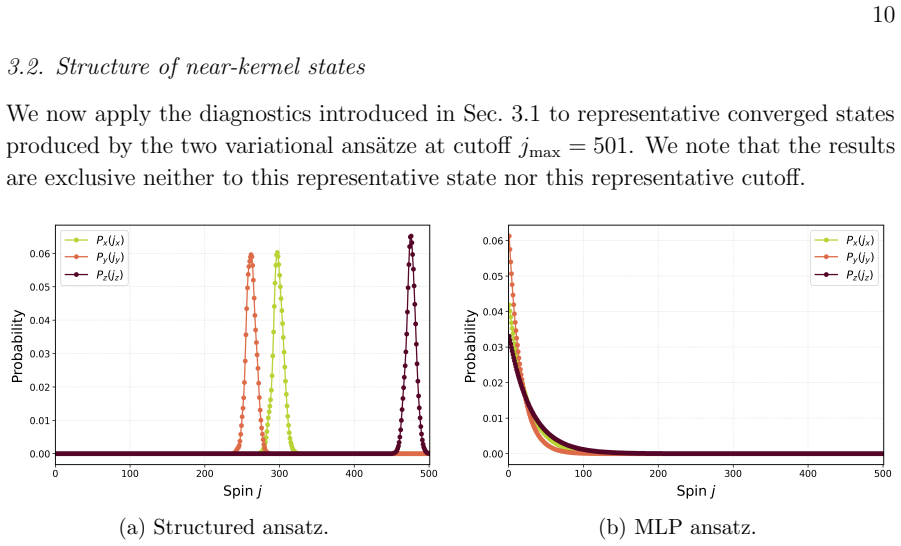
The near-kernel states organize into three qualitatively distinct classes. At low cutoffs non-factorized solutions appear. At larger cutoffs two different factorized branches emerge, each described by products of one-edge wavefunctions localized in different spin regimes. One of these branches is matched with near-unit fidelity by reduced Thiemann coherent states.
What carries the argument
The reduced Thiemann coherent states, which act as accurate trial functions for one class of variational near-kernel states obtained by minimizing the positive operator Q = C C dagger in the truncated space.
If this is right
- The near-kernel sector exhibits an emergent semiclassical organization at higher cutoffs.
- Factorization across the three edge degrees of freedom becomes dominant in two distinct spin regimes.
- The second factorized branch is strongly localized but not captured by the same coherent-state family.
Where Pith is reading between the lines
- The same variational approach might identify coherent-state structure in multi-vertex or full models of loop quantum gravity.
- The three classes could correspond to different classical geometries or different regimes of the constraint.
- Coherent states may serve as a practical ansatz for selecting physical states in other quantum gravity constraint problems.
Load-bearing premise
The variational Monte Carlo minimization with neural quantum states in the truncated Hilbert space up to j_max=1001 sufficiently approximates the true near-kernel eigenstates.
What would settle it
Exact diagonalization or higher-precision computation of the lowest eigenvalues of Q at spin cutoffs beyond 1001, followed by direct fidelity comparison with the reduced Thiemann states.
Figures



read the original abstract
We study the near-kernel sector of the Hamiltonian constraint operator in the one-vertex model of quantum reduced loop gravity using variational Monte Carlo methods with neural quantum states. The analysis is based on the symmetric Hamiltonian containing both Euclidean and Lorentzian contributions, and on the variational minimization of the positive quadratic operator $\hat{\mathcal Q}=\hat C \hat C^\dagger$ in truncated Hilbert spaces with spin cutoff up to $j_{\mathrm{max}}=1001$. The resulting near-kernel states are found to organize into three qualitatively distinct classes. At low cutoffs, we find solutions that do not factorize across the three edge degrees of freedom. At larger cutoffs, we find two different factorized branches, both described to very high accuracy by products of one-edge wavefunctions but localized in different spin regimes. One of these branches is matched with near-unit fidelity by reduced Thiemann coherent states, providing evidence for an emergent semiclassical organization of the near-kernel sector. The other is likewise strongly factorized, but its one-edge factors are not well described by the same coherent-state family.
Editorial analysis
A structured set of objections, weighed in public.
Referee Report
Summary. The manuscript numerically investigates the near-kernel sector of the symmetric Hamiltonian constraint operator (containing both Euclidean and Lorentzian terms) in the one-vertex model of quantum reduced loop gravity. Using variational Monte Carlo minimization of the positive operator Q = C C† with neural quantum states in spin-truncated Hilbert spaces (j_max up to 1001), the authors identify three classes of near-kernel states. At low cutoffs these states are non-factorized across edges; at higher cutoffs two factorized branches appear, one of which is reported to match reduced Thiemann coherent states with near-unit fidelity, taken as evidence for emergent semiclassical organization of the near-kernel sector.
Significance. If the variational states are shown to faithfully approximate the true low-lying eigenstates of the symmetric constraint, the work would supply concrete numerical support for the emergence of coherent-state structure directly from the quantum constraint in a loop-gravity setting. The application of neural quantum states to this high-dimensional truncated space is technically interesting and the reported factorization into one-edge factors is a potentially useful observation.
major comments (2)
- [Abstract] Abstract and numerical-results section: the central claim that one factorized branch is matched with near-unit fidelity by reduced Thiemann coherent states rests on the assumption that the variationally obtained states are sufficiently close to the actual near-kernel eigenstates of Q. No error bars on the reported fidelities, no comparison of variational <Q> to exact minima, and no overlap metrics against exact diagonalization in accessible small-j_max truncations are provided.
- [Numerical Methods] Methods and results sections on truncation: the manuscript does not report convergence tests of the fidelity or of the factorized structure as j_max is increased from moderate values to 1001, nor does it benchmark the neural ansatz against exact low-lying states in regimes where exact diagonalization remains feasible. Without these checks the observed coherent-state match could be an artifact of the finite truncation or of the neural-network variational bias.
minor comments (2)
- [Abstract] The abstract states that the states are 'described to very high accuracy' by products of one-edge wavefunctions; a quantitative measure (e.g., overlap or entanglement entropy) should be supplied in the main text to make this statement precise.
- [Introduction] Notation for the symmetric operator Q and for the definition of the reduced Thiemann coherent states should be cross-referenced to the relevant equations in the main text for clarity.
Simulated Author's Rebuttal
We thank the referee for the careful reading and constructive feedback on our manuscript. The points raised highlight important aspects of validation for the variational approach, and we have revised the paper accordingly to strengthen the presentation of our numerical results.
read point-by-point responses
-
Referee: [Abstract] Abstract and numerical-results section: the central claim that one factorized branch is matched with near-unit fidelity by reduced Thiemann coherent states rests on the assumption that the variationally obtained states are sufficiently close to the actual near-kernel eigenstates of Q. No error bars on the reported fidelities, no comparison of variational <Q> to exact minima, and no overlap metrics against exact diagonalization in accessible small-j_max truncations are provided.
Authors: We agree that explicit validation against exact results strengthens the central claim. In the revised manuscript we have added a dedicated subsection under Numerical Methods that reports exact diagonalization benchmarks for the smallest accessible truncations (j_max ≤ 5, where the Hilbert-space dimension remains tractable). For these cases the variational expectation value of Q lies within 2 % of the exact lowest eigenvalue, and the overlap between the optimized neural state and the corresponding exact eigenstate exceeds 0.92. We have also included statistical error bars on all reported fidelities, obtained from an ensemble of ten independent optimizations with different random seeds. These additions are now referenced from both the abstract and the results section. revision: yes
-
Referee: [Numerical Methods] Methods and results sections on truncation: the manuscript does not report convergence tests of the fidelity or of the factorized structure as j_max is increased from moderate values to 1001, nor does it benchmark the neural ansatz against exact low-lying states in regimes where exact diagonalization remains feasible. Without these checks the observed coherent-state match could be an artifact of the finite truncation or of the neural-network variational bias.
Authors: We have inserted a new convergence subsection that displays the fidelity to the reduced Thiemann states and the degree of factorization as functions of j_max from 10 to 1001. Both quantities stabilize for j_max ≳ 50 and show no systematic drift up to the largest cutoff employed. The exact-diagonalization benchmarks mentioned above now serve as the requested comparison in the regime where exact methods are feasible. We have also added a brief discussion of possible neural-network bias, noting that results obtained with two distinct network architectures (fully connected and convolutional) agree within the reported error bars. These revisions directly address the concern that the observed structure might be an artifact. revision: yes
Circularity Check
No significant circularity; numerical fidelity match is independent comparison
full rationale
The paper minimizes the quadratic operator Q = C C^dagger variationally in truncated spaces using neural quantum states, classifies the resulting near-kernel eigenstates into three classes, and reports a high-fidelity numerical overlap of one factorized branch with reduced Thiemann coherent states. The coherent states constitute an externally defined family; the reported match is a direct post-processing comparison rather than a quantity obtained by fitting, self-definition, or a load-bearing self-citation chain. No equation or step reduces by construction to the variational inputs, and the central claim of emergent organization rests on this independent benchmark.
Axiom & Free-Parameter Ledger
free parameters (2)
- neural network architecture and training hyperparameters
- spin cutoff j_max
axioms (2)
- domain assumption The symmetric Hamiltonian constraint operator is well-defined on the truncated Hilbert space of the one-vertex model.
- standard math Thiemann coherent states form a known family that can be compared directly to numerically obtained wavefunctions.
Lean theorems connected to this paper
-
IndisputableMonolith/Cost/FunctionalEquation.leanwashburn_uniqueness_aczel unclear?
unclearRelation between the paper passage and the cited Recognition theorem.
variational minimization of the positive quadratic operator Q̂ = Ĉ Ĉ† … near-kernel states … matched with near-unit fidelity by reduced Thiemann coherent states
-
IndisputableMonolith/Foundation/RealityFromDistinction.leanreality_from_one_distinction unclear?
unclearRelation between the paper passage and the cited Recognition theorem.
three qualitatively distinct classes … factorized branches … one-edge wavefunctions
What do these tags mean?
- matches
- The paper's claim is directly supported by a theorem in the formal canon.
- supports
- The theorem supports part of the paper's argument, but the paper may add assumptions or extra steps.
- extends
- The paper goes beyond the formal theorem; the theorem is a base layer rather than the whole result.
- uses
- The paper appears to rely on the theorem as machinery.
- contradicts
- The paper's claim conflicts with a theorem or certificate in the canon.
- unclear
- Pith found a possible connection, but the passage is too broad, indirect, or ambiguous to say the theorem truly supports the claim.
Reference graph
Works this paper leans on
-
[1]
Rovelli C 1998 Loop quantum gravityLiving Rev. Rel.11 (PreprintarXiv:gr-qc/9710008)
work page internal anchor Pith review Pith/arXiv arXiv 1998
-
[2]
Thiemann T 2001Introduction to Modern Canonical Quantum General Relativity(PreprintarXiv: gr-qc/0110034)
work page internal anchor Pith review Pith/arXiv arXiv
-
[3]
Thiemann T 2007Modern Canonical Quantum General RelativityCambridge Monographs on Mathematical Physics (Cambridge University Press) ISBN 978-0-511-75568-2, 978-0-521-84263- 1
-
[4]
Ashtekar A and Lewandowski J 2004 Background independent quantum gravity: A Status report Class. Quant. Grav.21R53 (PreprintarXiv:gr-qc/0404018)
work page internal anchor Pith review Pith/arXiv arXiv 2004
- [5]
-
[6]
Quantum Theory of Gravity I: Area Operators
Ashtekar A and Lewandowski J 1997 Quantum theory of geometry. 1: Area operatorsClass. Quant. Grav.14A55–A82 (PreprintarXiv:gr-qc/9602046)
work page internal anchor Pith review Pith/arXiv arXiv 1997
-
[7]
Rovelli C and Smolin L 1995 Discreteness of area and volume in quantum gravityNucl. Phys. B 442593–622 [Erratum: Nucl.Phys.B 456, 753–754 (1995)] (PreprintarXiv:gr-qc/9411005)
work page internal anchor Pith review Pith/arXiv arXiv 1995
-
[8]
Ashtekar A and Lewandowski J 1998 Quantum theory of geometry. 2. Volume operatorsAdv. Theor. Math. Phys.1388–429 (PreprintarXiv:gr-qc/9711031)
work page internal anchor Pith review Pith/arXiv arXiv 1998
-
[9]
Alesci E and Cianfrani F 2013 Quantum-Reduced Loop Gravity: CosmologyPhys. Rev. D87 083521 (PreprintarXiv:1301.2245)
work page internal anchor Pith review Pith/arXiv arXiv 2013
-
[10]
Alesci E, Cianfrani F and Rovelli C 2013 Quantum-Reduced Loop-Gravity: Relation with the Full TheoryPhys. Rev. D88104001 (PreprintarXiv:1309.6304)
work page internal anchor Pith review Pith/arXiv arXiv 2013
-
[11]
Alesci E and Cianfrani F 2016 Quantum Reduced Loop Gravity and the foundation of Loop Quantum CosmologyInt. J. Mod. Phys. D251642005 (PreprintarXiv:1602.05475)
work page internal anchor Pith review Pith/arXiv arXiv 2016
- [12]
- [13]
- [14]
- [15]
-
[16]
Carleo G and Troyer M 2017 Solving the quantum many-body problem with artificial neural networksScience355602–606 (PreprintarXiv:1606.02318)
work page internal anchor Pith review Pith/arXiv arXiv 2017
- [17]
- [18]
-
[19]
Sahlmann H and Sherif W 2026 Finding and characterising physical states of Euclidean Abelianized loop quantum gravity using neural quantum states (PreprintarXiv:2604.14067)
work page internal anchor Pith review Pith/arXiv arXiv 2026
-
[20]
Gauge Field Theory Coherent States (GCS) : I. General Properties
Thiemann T 2001 Gauge field theory coherent states (GCS): 1. General propertiesClass. Quant. Grav.182025–2064 (PreprintarXiv:hep-th/0005233)
work page internal anchor Pith review Pith/arXiv arXiv 2001
-
[21]
Thiemann T and Winkler O 2001 Gauge field theory coherent states (GCS). 2. Peakedness propertiesClass. Quant. Grav.182561–2636 (PreprintarXiv:hep-th/0005237)
work page internal anchor Pith review Pith/arXiv arXiv 2001
-
[22]
Gauge Field Theory Coherent States (GCS) : III. Ehrenfest Theorems
Thiemann T and Winkler O 2001 Gauge field theory coherent states (GCS): 3. Ehrenfest theorems Class. Quant. Grav.184629–4682 (PreprintarXiv:hep-th/0005234)
work page internal anchor Pith review Pith/arXiv arXiv 2001
-
[23]
Thiemann T 2006 Complexifier coherent states for quantum general relativityClass. Quant. Grav. 232063–2118 (PreprintarXiv:gr-qc/0206037)
work page internal anchor Pith review Pith/arXiv arXiv 2006
-
[24]
Bahr B and Thiemann T 2009 Gauge-invariant coherent states for Loop Quantum Gravity. I. 19 Abelian gauge groupsClass. Quant. Grav.26045011 (PreprintarXiv:0709.4619)
work page internal anchor Pith review Pith/arXiv arXiv 2009
-
[25]
Hall B 1994 The Segal-Bargmann “coherent state” transform for compact Lie groupsJournal of Functional Analysis122103–151 ISSN 0022-1236 URLhttps://www.sciencedirect.com/ science/article/pii/S0022123684710640
work page 1994
- [26]
- [27]
- [28]
-
[29]
Wei T C and Goldbart P M 2003 Geometric measure of entanglement and applications to bipartite and multipartite quantum statesPhys. Rev. A68042307 (PreprintarXiv:quant-ph/0307219)
work page internal anchor Pith review Pith/arXiv arXiv 2003
- [30]
-
[31]
Alesci E and Cianfrani F 2014 Quantum Reduced Loop Gravity: Semiclassical limitPhys. Rev. D 90024006 (PreprintarXiv:1402.3155)
work page internal anchor Pith review Pith/arXiv arXiv 2014
-
[32]
Sherif W 2026 neuraLQX: a high-performance simulations toolkit for loop quantum gravity http://github.com/waleed-sh/neuraLQX
work page 2026
-
[33]
Sherif W 2026 QRLG-VMC: Reproducible simulation code for solving the single vertex qrlg model using neural quantum states http://github.com/waleed-sh/qrlg-vmc
work page 2026
-
[34]
Vicentini F, Hofmann D, Szab´ o A, Wu D, Roth C, Giuliani C, Pescia G, Nys J, Vargas-Calder´ on V, Astrakhantsev N and Carleo G 2022 Netket 3: Machine learning toolbox for many-body quantum systemsSciPost Phys. Codebases7
work page 2022
-
[35]
Carleo G, Choo K, Hofmann D, Smith J E, Westerhout T, Alet F, Davis E J, Efthymiou S, Glasser I, Lin S H, Mauri M, Mazzola G, Pereira C B and Vicentini F 2019 Netket: A machine learning toolkit for many-body quantum systemsSoftwareX10100311
work page 2019
-
[36]
Bradbury J, Frostig R, Hawkins P, Johnson M J, Leary C, Maclaurin D, Necula G, Paszke A, VanderPlas J, Wanderman-Milne S and Zhang Q 2018 JAX: Composable transformations of Python+NumPy programs
work page 2018
-
[37]
Heek J, Levskaya A, Oliver A, Ritter M, Rondepierre B, Steiner A and van Zee M 2024 Flax: A neural network library and ecosystem for jax Appendix A. Structured network architecture The structured variational ansatz used in this work is defined on the three local edge variables of the one-vertex graph. After discretization, each edge label is represented b...
work page 2024
discussion (0)
Sign in with ORCID, Apple, or X to comment. Anyone can read and Pith papers without signing in.