Verification of Configurable SRA Systems
Pith reviewed 2026-05-21 02:52 UTC · model grok-4.3
The pith
Contract-based verification proves correctness for every legal configuration of scheduler-restricted asynchronous systems.
A machine-rendered reading of the paper's core claim, the machinery that carries it, and where it could break.
Core claim
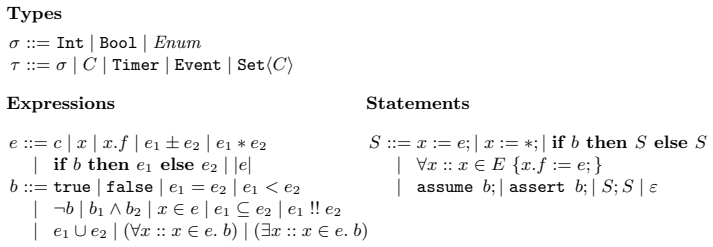
A contract-based deductive verification approach for configurable SRA combines compositional proof rules that abstract the scheduler to prove top-level invariant properties, automatic summarizations of the methods invoked by the scheduler, and simplification with respect to the nature of the space of configurations. The approach is grounded in object-oriented first-order logic, requires reasoning over quantified statements, and leverages Dafny as a backend to establish that every legal instantiation is correct.
What carries the argument
Contract-based abstraction of the scheduler via compositional proof rules, together with automatic method summarizations and configuration-space simplifications, to prove invariants across the entire family of instantiations.
If this is right
- Top-level invariants are established once for the whole unbounded family of configurations rather than case by case.
- Verification reduces to reasoning about abstract scheduler contracts and summarized methods instead of full process-scheduler interactions.
- Simplification rules that depend on the structure of the configuration space make parameterized proofs feasible.
- The resulting quantified statements in first-order logic can be discharged automatically by Dafny for industrial-scale examples.
Where Pith is reading between the lines
- The same contract-and-summarization pattern could be tried on other parameterized concurrent systems whose behavior is constrained by an orchestrating component.
- If configuration constraints themselves can be analyzed statically, the simplification step might be made fully automatic from the constraint description.
- The approach suggests a route to verify systems whose configurations are chosen at runtime by treating the runtime choice as an additional quantified variable.
Load-bearing premise
The scheduler abstraction via contracts and the automatic summarizations remain sound when applied to the full range of legal configuration instantiations.
What would settle it
A specific legal configuration together with a violating trace for a claimed top-level invariant that the proof rules accepted would show the approach fails to guarantee correctness for all instantiations.
Figures
read the original abstract
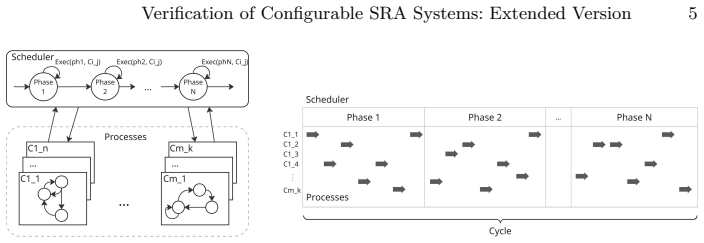
Many digital systems are designed as collections of asynchronous processes orchestrated by a domain-specific scheduler. The verification of such scheduler-restricted asynchronous systems (SRA) is challenging due to process-process and process-scheduler interactions. In this paper, we tackle the problem of verifying configurable SRA. A configurable SRA describes an unbounded family of possible SRA, each resulting from an instantiation satisfying given configuration constraints; our goal is proving at once that every legal instantiation of a configurable SRA is correct. We propose a contract-based, deductive verification approach that combines (i) compositional proof rules that abstract the scheduler to prove top-level invariant properties, (ii) automatic summarizations of the methods invoked by the scheduler, (iii) simplification with respect to the nature of the space of configurations. The approach is grounded in (object-oriented) first order logic, requires reasoning over quantified statements, and leverages the Dafny software verifier as a backend. An experimental evaluation on industrial case studies demonstrates that the framework scales effectively and enables practical reasoning about complex parameterized behaviors.
Editorial analysis
A structured set of objections, weighed in public.
Referee Report
Summary. The manuscript proposes a contract-based deductive verification approach for configurable Scheduler-Restricted Asynchronous (SRA) systems. It aims to prove top-level invariant properties that hold for every legal instantiation of a configurable SRA by combining (i) compositional proof rules that abstract the scheduler, (ii) automatic summarizations of methods invoked by the scheduler, and (iii) simplifications with respect to the configuration space. The framework is formalized in first-order logic, implemented using the Dafny verifier, and evaluated on industrial case studies to demonstrate scalability for complex parameterized behaviors.
Significance. If the soundness of the scheduler abstraction and automatic summarizations is established across the full space of legal configurations, the work would provide a practical means to verify families of asynchronous systems at once rather than instance-by-instance. The use of machine-checked proofs in Dafny and the focus on industrial case studies are strengths that support applicability in domains requiring configurable scheduler-orchestrated systems.
major comments (2)
- [§3.2] §3.2 (Scheduler Abstraction via Contracts): The central claim requires that the contract-based abstraction of the scheduler remains sound for every legal configuration instantiation. The manuscript states this holds by construction in first-order logic, but provides no explicit lemma or machine-checked argument showing that the abstraction preserves all behaviors under arbitrary configuration constraints; without this, the universal quantification over instantiations is not fully supported.
- [§5] §5 (Experimental Evaluation): The evaluation demonstrates successful verification on selected industrial case studies, yet the universal claim that the approach proves correctness for every legal instantiation is load-bearing. No independent soundness check or counterexample search over the configuration space is reported to confirm that summarizations do not introduce spurious invariants for some admissible configurations.
minor comments (2)
- [§4] The description of automatic summarization in §4 would benefit from a small concrete example showing how a method summary is generated and simplified with respect to a configuration constraint.
- [§2] Notation for quantified statements over configurations is introduced late; moving a brief definition to §2 would improve readability for readers unfamiliar with the configuration space.
Simulated Author's Rebuttal
We thank the referee for their constructive and detailed comments on our manuscript. We address each major comment below and have revised the paper to strengthen the presentation of soundness where appropriate.
read point-by-point responses
-
Referee: [§3.2] §3.2 (Scheduler Abstraction via Contracts): The central claim requires that the contract-based abstraction of the scheduler remains sound for every legal configuration instantiation. The manuscript states this holds by construction in first-order logic, but provides no explicit lemma or machine-checked argument showing that the abstraction preserves all behaviors under arbitrary configuration constraints; without this, the universal quantification over instantiations is not fully supported.
Authors: We agree that an explicit lemma would improve clarity. The contracts are defined as sound over-approximations in first-order logic that do not depend on specific configuration values, ensuring the abstraction holds for any legal instantiation. In the revised manuscript we have added Lemma 3.1 in §3.2 that states this soundness property formally, together with a machine-checked Dafny proof of the lemma. revision: yes
-
Referee: [§5] §5 (Experimental Evaluation): The evaluation demonstrates successful verification on selected industrial case studies, yet the universal claim that the approach proves correctness for every legal instantiation is load-bearing. No independent soundness check or counterexample search over the configuration space is reported to confirm that summarizations do not introduce spurious invariants for some admissible configurations.
Authors: We acknowledge the value of additional checks. Because the verification is deductive and the proofs are parametric over configurations, exhaustive counterexample search is not required for soundness and is often infeasible for large or infinite configuration spaces. In the revised version we have added a paragraph in §5 explaining why the summarizations cannot introduce spurious invariants and have included a brief manual check on a representative finite subset of configurations as supporting evidence. revision: partial
Circularity Check
No circularity: verification method is self-contained with external soundness from Dafny and FOL
full rationale
The paper proposes a contract-based deductive verification framework for configurable SRA systems that combines compositional proof rules abstracting the scheduler, automatic method summarizations, and configuration-space simplifications, all grounded in object-oriented first-order logic and implemented via the Dafny verifier. No self-definitional equations, fitted parameters renamed as predictions, or load-bearing self-citations appear in the derivation; the central claim of proving invariants for every legal configuration instantiation rests on the soundness of Dafny and standard FOL reasoning rather than reducing to the paper's own inputs by construction. The industrial case studies serve as empirical validation, not as a statistical fit that forces the result. The approach is therefore independent and self-contained against external benchmarks.
Axiom & Free-Parameter Ledger
axioms (2)
- standard math First-order logic is sufficient to express the contracts and invariants for SRA systems
- domain assumption Dafny can discharge the quantified statements arising from the compositional rules
Lean theorems connected to this paper
-
IndisputableMonolith/Foundation/RealityFromDistinction.leanreality_from_one_distinction unclear?
unclearRelation between the paper passage and the cited Recognition theorem.
We propose a contract-based, deductive verification approach that combines (i) compositional proof rules that abstract the scheduler to prove top-level invariant properties, (ii) automatic summarizations of the methods invoked by the scheduler, (iii) simplification with respect to the nature of the space of configurations.
What do these tags mean?
- matches
- The paper's claim is directly supported by a theorem in the formal canon.
- supports
- The theorem supports part of the paper's argument, but the paper may add assumptions or extra steps.
- extends
- The paper goes beyond the formal theorem; the theorem is a base layer rather than the whole result.
- uses
- The paper appears to rely on the theorem as machinery.
- contradicts
- The paper's claim conflicts with a theorem or certificate in the canon.
- unclear
- Pith found a possible connection, but the passage is too broad, indirect, or ambiguous to say the theorem truly supports the claim.
discussion (0)
Sign in with ORCID, Apple, or X to comment. Anyone can read and Pith papers without signing in.