Topological cell-openness index for porous materials
Pith reviewed 2026-06-30 15:38 UTC · model grok-4.3
The pith
Betti numbers from the pore network yield an index τ estimating the fraction of open versus closed cells.
A machine-rendered reading of the paper's core claim, the machinery that carries it, and where it could break.
Core claim
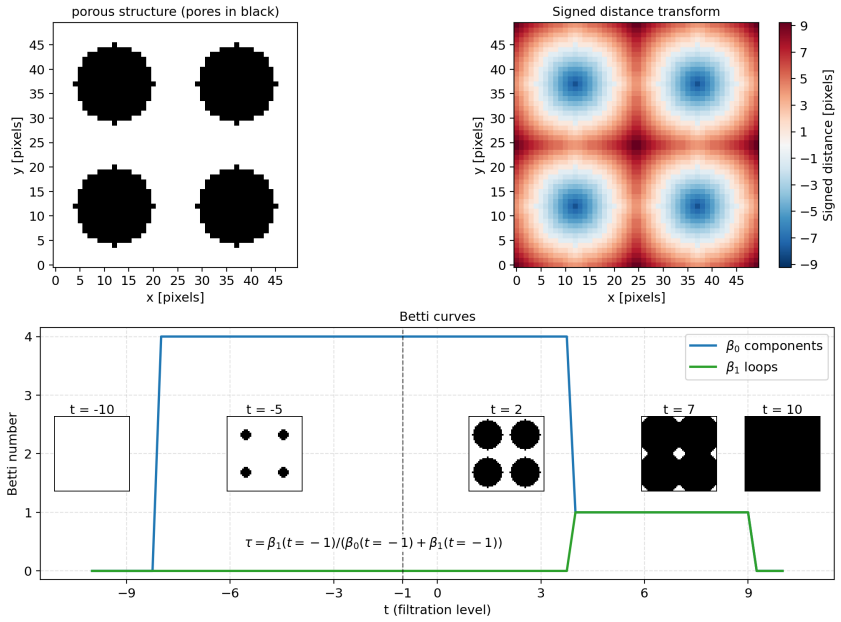
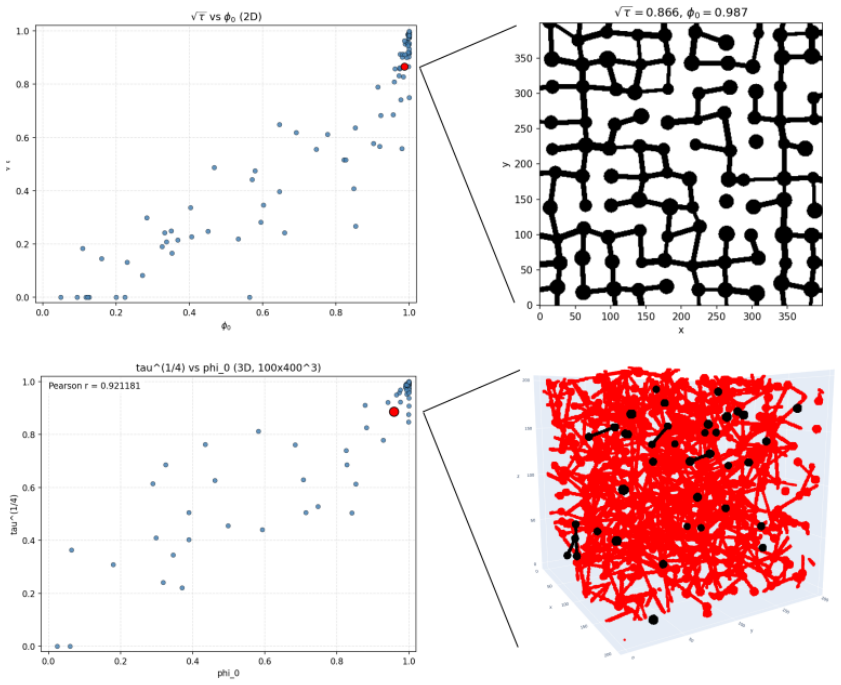
The authors define a cell-openness index τ from Betti numbers measured on the pore network or solid skeleton; this index estimates the proportion of open versus closed cells and supplies structural information that differs from the volume fraction reported by gas pycnometry, with demonstrated correlations to physical quantities in numerical and experimental cases.
What carries the argument
The cell-openness index τ, obtained by mapping Betti numbers (counts of connected components, loops and voids) to a proportion of open cells.
If this is right
- τ supplies a complement to the open-celled volume fraction obtained from gas pycnometry.
- Mismatches between τ and pycnometry results carry additional information about the material structure.
- τ exhibits significant correlations with measurable physical quantities in both numerical and experimental porous structures.
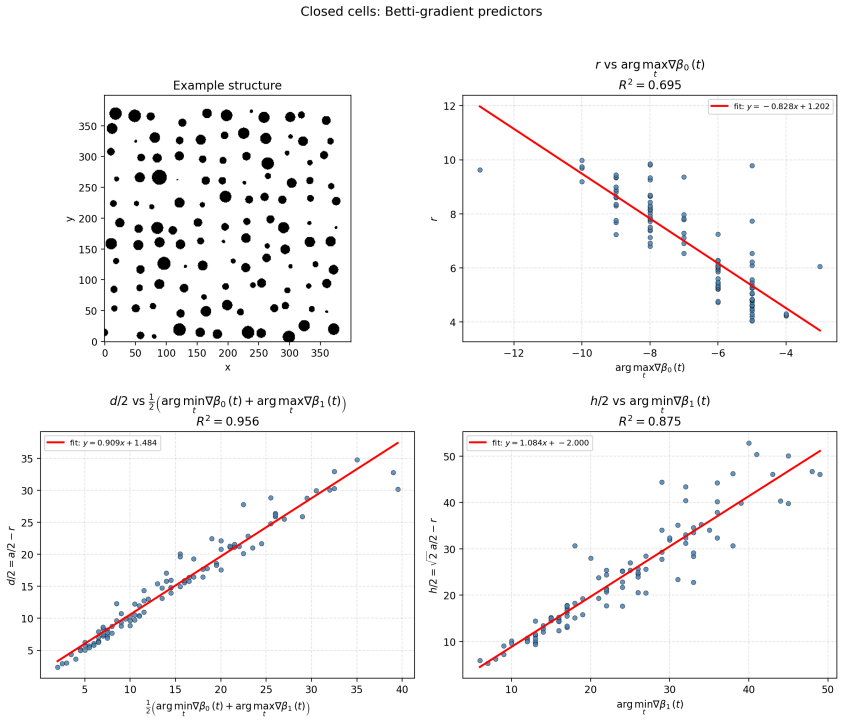
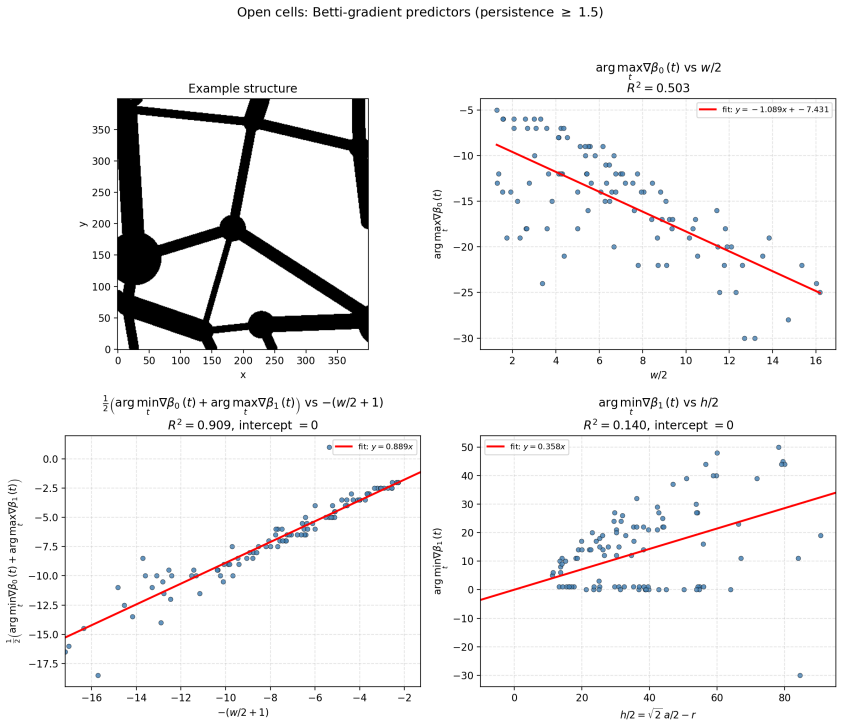
- Betti curves derived from the same data can be used to estimate characteristic feature sizes inside the pores.
Where Pith is reading between the lines
- If the mapping holds, τ could guide the design of porous materials whose openness is tuned for specific transport or mechanical roles.
- Application to image data at varying resolutions would need explicit checks that the same τ values retain the same physical meaning.
- Systematic comparison of τ across chemically different porous solids might expose topological patterns that are independent of material chemistry.
Load-bearing premise
Betti numbers computed on the pore network or solid skeleton can be translated into a physically meaningful fraction of open versus closed cells that remains consistent across different materials and imaging resolutions.
What would settle it
A collection of porous samples whose open-cell fractions have been measured independently by a non-topological method, yet show no systematic relation to the τ values computed from their Betti numbers.
Figures


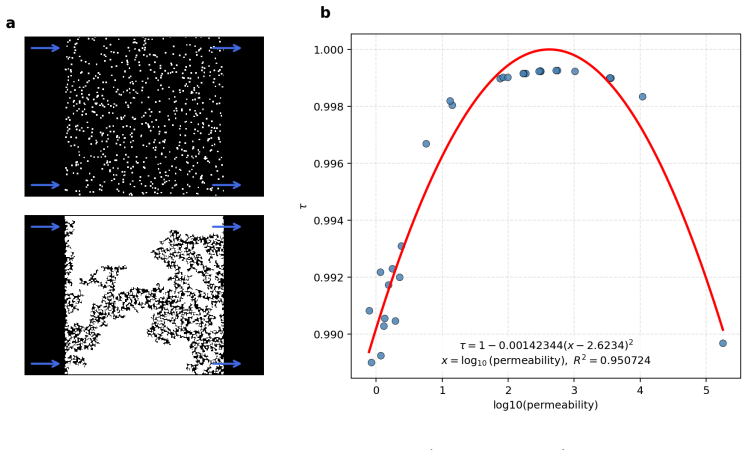
read the original abstract
We propose a method of estimating and parametrising the proportion of open and closed cells in a porous material based on measuring Betti numbers on the structures. We define a cell-openness index {\tau} which can be used to complement the proportion of open-celled volume reported by gas pycnometry, which is the current gold standard for pore type characterization. We discuss in what types of structures mismatches between the two measures can occur and how such mismatches convey additional information about the structure. We demonstrate examples of significant correlations between {\tau} and measurable physical quantities in both numerical and experimental structures. We also discuss how Betti curves can be used to estimate characteristic feature sizes in porous structures.
Editorial analysis
A structured set of objections, weighed in public.
Referee Report
Summary. The paper proposes a topological method to estimate the proportion of open versus closed cells in porous materials by defining a cell-openness index τ derived from Betti numbers computed on the pore network or solid skeleton. It positions τ as a complement to the open-celled volume fraction from gas pycnometry, discusses structural mismatches between the two measures and their implications, reports correlations between τ and other physical quantities in numerical and experimental cases, and suggests using Betti curves to estimate characteristic feature sizes.
Significance. If the mapping from Betti numbers to a physically meaningful open/closed cell proportion can be shown to be robust, the index would provide a useful topological complement to volume-based characterization methods in porous materials, potentially revealing connectivity information not captured by pycnometry alone. The reported correlations with measurable quantities indicate possible practical relevance, but the absence of direct validation against known ground-truth fractions limits the immediate impact.
major comments (2)
- Abstract: the central claim that τ estimates the proportion of open and closed cells requires an explicit mapping rule from Betti numbers, yet none is supplied; without it, the index remains an untested definition whose physical interpretability cannot be assessed.
- Abstract (discussion of mismatches and correlations): the reported correlations with physical quantities in numerical/experimental structures do not include direct comparisons to synthetic structures whose true open/closed cell fractions are known by construction (e.g., controlled foams), leaving the required robustness across resolutions, cell-size distributions, and connectivity patterns unverified.
Simulated Author's Rebuttal
We thank the referee for their constructive feedback on our manuscript. We address each major comment point by point below.
read point-by-point responses
-
Referee: Abstract: the central claim that τ estimates the proportion of open and closed cells requires an explicit mapping rule from Betti numbers, yet none is supplied; without it, the index remains an untested definition whose physical interpretability cannot be assessed.
Authors: The explicit mapping rule from Betti numbers to the cell-openness index τ is defined in Section 2.2 of the manuscript. To make the central claim immediately interpretable from the abstract alone, we will revise the abstract to include a concise statement of this mapping. revision: yes
-
Referee: Abstract (discussion of mismatches and correlations): the reported correlations with physical quantities in numerical/experimental structures do not include direct comparisons to synthetic structures whose true open/closed cell fractions are known by construction (e.g., controlled foams), leaving the required robustness across resolutions, cell-size distributions, and connectivity patterns unverified.
Authors: We agree that direct comparisons against synthetic structures with known ground-truth open/closed fractions by construction would strengthen the validation of τ. Our current numerical examples use controlled generation parameters but do not prescribe exact openness fractions a priori. In the revised manuscript we will add a dedicated subsection presenting simple synthetic test cases (e.g., periodic lattices with deliberately introduced closed cells) to enable direct comparison of τ against the known fractions and to examine robustness to resolution and connectivity variations. revision: yes
Circularity Check
Cell-openness index τ introduced as explicit definition from Betti numbers; no fitted predictions or self-referential reductions
full rationale
The paper defines τ directly from Betti numbers computed on pore networks or skeletons and reports empirical correlations in numerical and experimental cases. No equations are presented that fit parameters to data subsets and then relabel the fit as a prediction, nor does any load-bearing step reduce to a self-citation chain or ansatz smuggled from prior work by the same authors. The mapping rule itself is presented as a new definition rather than derived from first principles that presuppose the target proportion, so the derivation chain remains self-contained.
Axiom & Free-Parameter Ledger
invented entities (1)
-
cell-openness index τ
no independent evidence
Reference graph
Works this paper leans on
-
[1]
Armstrong, James E
Ryan T. Armstrong, James E. McClure, Vanessa Robins, Zhishang Liu, Christoph H. Arns, Steffen Schlüter, and Steffen Berg. Porous media characterization using Minkowski functionals: Theories, applications and future directions.Transport in Porous Media, 130(1):305–335, 2019
2019
-
[2]
C. H. Arns, M. A. Knackstedt, and K. Mecke. 3D structural analysis: sensitivity of Minkowski functionals.Journal of Microscopy, 240(3):181–196, 2010
2010
-
[3]
A persistence landscapes toolbox for topological statistics.Journal of Symbolic Computation, 78:91–114, 2017
Peter Bubenik and Paweł Dłotko. A persistence landscapes toolbox for topological statistics.Journal of Symbolic Computation, 78:91–114, 2017
2017
-
[4]
Topology and data.Bulletin of the American Mathematical Society, 46(2):255–308, 2009
Gunnar Carlsson. Topology and data.Bulletin of the American Mathematical Society, 46(2):255–308, 2009
2009
-
[5]
Cnudde and M
V. Cnudde and M. N. Boone. High-resolution X-ray computed tomography in geosciences: A review of the current technology and applications.Earth-Science Reviews, 123:1–17, 2013
2013
-
[6]
Computational and applied topology, tutorial, 2018
Paweł Dłotko. Computational and applied topology, tutorial, 2018. arXiv preprint
2018
-
[7]
Cubical complex
Paweł Dłotko. Cubical complex. InGUDHI User and Reference Manual. GUDHI Editorial Board, 3.12.0 edition, 2026
2026
-
[8]
Harer.Computational Topology: An Introduction
Herbert Edelsbrunner and John L. Harer.Computational Topology: An Introduction. American Mathematical Society, Providence, RI, 2010
2010
-
[9]
K. M. Graczyk and M. Matyka. Predicting porosity, permeability, and tortuosity of porous media from images by deep learning.Scientific Reports, 10:21488, 2020
2020
-
[10]
Escolar, Kaname Matsue, and Yasumasa Nishiura
Yasuaki Hiraoka, Takenobu Nakamura, Akihiko Hirata, Emerson G. Escolar, Kaname Matsue, and Yasumasa Nishiura. Hierarchical structures of amorphous solids char- acterized by persistent homology.Proceedings of the National Academy of Sciences, 113(26):7035–7040, 2016
2016
-
[11]
Lautensack, M
C. Lautensack, M. Giertzsch, M. Godehardt, and K. Schladitz. Modelling a ceramic foam using locally adaptable morphology.Journal of Microscopy, 230(3):396–404, 2008
2008
-
[12]
Barthel, Paweł Dłotko, S
Yongjin Lee, Senja D. Barthel, Paweł Dłotko, S. Mohamad Moosavi, Kathryn Hess, and Berend Smit. Quantifying similarity of pore-geometry in nanoporous materials.Nature Communications, 8:15396, 2017
2017
-
[13]
LeVeque.Finite Difference Methods for Ordinary and Partial Differential Equations
Randall J. LeVeque.Finite Difference Methods for Ordinary and Partial Differential Equations. Society for Industrial and Applied Mathematics, 2007
2007
-
[14]
Maire and P
E. Maire and P. J. Withers. Quantitative X-ray tomography.International Materials Reviews, 59(1):1–43, 2014. 17
2014
-
[15]
Persistent cohomology
Clément Maria. Persistent cohomology. InGUDHI User and Reference Manual. GUDHI Editorial Board, 3.12.0 edition, 2026
2026
-
[16]
Axel Zeitler
Daniel Markl, Alexa Strobel, Rüdiger Schlossnikl, Johan Bøtker, Prince Bawuah, Cathy Ridgway, Jukka Rantanen, Thomas Rades, Patrick Gane, Kai-Erik Peiponen, and J. Axel Zeitler. Characterisation of pore structures of pharmaceutical tablets: A review. International Journal of Pharmaceutics, 538:188–214, 3 2018
2018
-
[17]
Klaus R. Mecke. Additivity, convexity, and beyond: Applications of Minkowski func- tionals in statistical physics. In Klaus R. Mecke and Dietrich Stoyan, editors,Statistical Physics and Spatial Statistics: The Art of Analyzing and Modeling Spatial Structures and Pattern Formation, volume 554 ofLecture Notes in Physics, pages 111–184. Springer, Berlin, Hei...
2000
-
[18]
Nguyen, Jarod C
Huong Giang T. Nguyen, Jarod C. Horn, Matthew Bleakney, Daniel W. Siderius, and Laura Espinal. Understanding material characteristics through signature traits from helium pycnometry.Langmuir, 35:2115–2122, 2 2019
2019
-
[19]
Robins, M
V. Robins, M. Saadatfar, O. Delgado-Friedrichs, and A. P. Sheppard. Percolating length scales from topological persistence analysis of micro-CT images of porous materials. Water Resources Research, 52(1):315–329, 2016
2016
-
[20]
Rouquerol, D
J. Rouquerol, D. Avnir, C. W. Fairbridge, D. H. Everett, J. H. Haynes, N. Pernicone, J. D. F. Ramsay, K. S. W. Sing, and K. K. Unger. Recommendations for the charac- terization of porous solids (IUPAC Technical Report).Pure and Applied Chemistry, 66(8):1739–1758, 1994
1994
-
[21]
Saadatfar, H
M. Saadatfar, H. Takeuchi, V. Robins, N. Francois, and Y. Hiraoka. Pore configuration landscape of granular crystallization.Nature Communications, 8:15082, 2017
2017
-
[22]
Scholz, F
C. Scholz, F. Wirner, J. Götz, U. Rüde, G. E. Schröder-Turk, K. Mecke, and C. Bechinger. Permeability of porous materials determined from the Euler characteristic.Physical Review Letters, 109(26):264504, 2012
2012
-
[23]
Sereno, Maria A
Alberto M. Sereno, Maria A. Silva, and Luis Mayor. Determination of particle density and porosity in foods and porous materials with high moisture content.International Journal of Food Properties, 10:455–469, 7 2007
2007
-
[24]
GUDHI Editorial Board, 3.12.0 edition, 2026
The GUDHI Project.GUDHI User and Reference Manual. GUDHI Editorial Board, 3.12.0 edition, 2026
2026
-
[25]
Vogel, U
H.-J. Vogel, U. Weller, and S. Schlüter. Quantification of soil structure based on Minkowski functions.Computers & Geosciences, 36(10):1236–1245, 2010
2010
-
[26]
Paul A. Webb. Volume and density determinations for particle technologies. Technical report, Micromeritics Instrument Corp., Norcross, GA, USA, 2001. 18
2001
discussion (0)
Sign in with ORCID, Apple, or X to comment. Anyone can read and Pith papers without signing in.