Anomalous Decay of Quantum Resources: The Entanglement Sudden Death Mpemba Effect
Pith reviewed 2026-06-30 16:30 UTC · model grok-4.3
The pith
More strongly entangled qubit pairs can reach separability sooner than weaker ones under amplitude damping.
A machine-rendered reading of the paper's core claim, the machinery that carries it, and where it could break.
Core claim
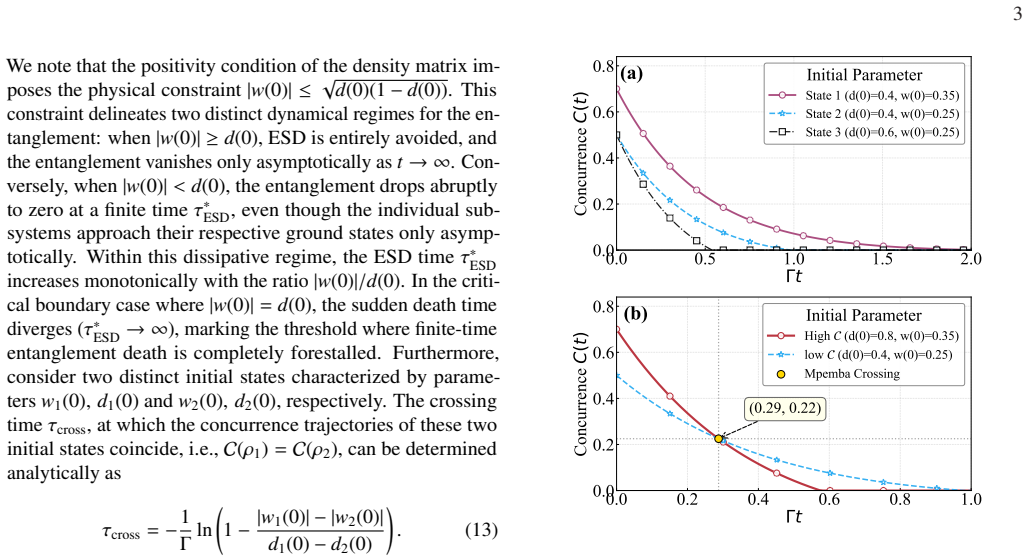
In two-qubit systems evolving under independent local amplitude-damping channels, there exist pairs of initial states belonging to a two-parameter family such that the state with larger initial entanglement reaches a separable state in shorter time than the state with smaller initial entanglement. The anomalous ordering is produced by the competition in which the difference in excited-state population acts as a catalyst that can dominate the protective effect of initial coherence, yielding an exact crossover time before both states undergo entanglement sudden death.
What carries the argument
The two-parameter family of initial states together with the analytic crossover condition on concurrence (or negativity) under identical local amplitude-damping channels.
If this is right
- Entanglement lifetime can be lengthened or shortened by tuning initial population at fixed entanglement.
- A phase diagram in the initial-state parameter space separates the normal decay regime from the anomalous Mpemba regime.
- Closed-form expressions give the precise entanglement sudden death time for every member of the two-parameter family.
Where Pith is reading between the lines
- Population engineering could serve as an additional control knob for protecting or destroying quantum correlations in open-system protocols.
- Analogous reversal effects may appear for other resource measures such as coherence or discord under the same noise model.
- The phenomenon invites checking whether unequal damping rates or added dephasing terms preserve or destroy the crossover.
Load-bearing premise
The qubits evolve under identical independent local amplitude-damping channels and the initial states belong to a two-parameter family in which entanglement and excited-state population can be varied separately.
What would settle it
Direct computation or laboratory measurement of the entanglement measure as a function of time for two concrete initial states, one more entangled but carrying higher excited population, to check whether that state reaches zero entanglement earlier than the less entangled state.
Figures



read the original abstract
In classical thermodynamics, the Mpemba effect refers to the counterintuitive observation that hot water can freeze faster than cold water, manifesting as an anomalous crossing of dynamical trajectories. While analogues of this phenomenon have been explored in open quantum systems and spin-chain entanglement asymmetry, its connection to the finite-time decoupling of quantum correlations remains elusive. In this Letter, we uncover a distinct quantum Mpemba effect associated with entanglement sudden death (ESD). By analyzing two qubits interacting with local amplitude damping reservoirs, we demonstrate that a more strongly entangled initial state can experience a faster collapse into a separable state than a more weakly entangled one. This anomalous decay stems from the competition between initial coherence and excited-state population, where the latter acts as a catalyst for entanglement sudden death. We provide exact analytical derivations for the trajectory crossover and ESD time, and map the phase diagram to precisely identify the parameter regime where the effect occurs. Our results offer a new strategy for controlling the lifetime of quantum resources in dissipative environments.
Editorial analysis
A structured set of objections, weighed in public.
Referee Report
Summary. The manuscript claims that two qubits undergoing independent local amplitude-damping channels exhibit an entanglement sudden death (ESD) Mpemba effect: for initial states drawn from a two-parameter family, a more strongly entangled state can reach separability faster than a less entangled one because the excited-state population acts as a catalyst. Exact analytical expressions are derived for the entanglement-trajectory crossover time and the ESD time, and a phase diagram is constructed to delineate the parameter regime in which the anomalous ordering occurs.
Significance. The provision of exact analytical derivations for the crossover and ESD times, together with the explicit phase diagram, is a clear strength that permits direct verification of the claimed effect without numerical fitting. If the central claim holds under the stated model (equal-rate local amplitude damping and the indicated initial-state family), the work supplies a concrete strategy for controlling the lifetime of quantum resources by tuning the competition between coherence and population.
minor comments (2)
- [Abstract] Abstract: the two-parameter initial-state family is referenced but the angle that controls entanglement versus excited-state population is not named; adding the explicit parametrization would improve immediate readability.
- The manuscript would benefit from a brief statement confirming that the reported crossover and ESD times remain valid when the two damping rates differ by a small amount, even if the main analysis assumes equality.
Simulated Author's Rebuttal
We thank the referee for the positive assessment of our manuscript, the recognition of the exact analytical derivations and phase diagram as strengths, and the recommendation for minor revision. No specific major comments were raised in the report.
Circularity Check
No significant circularity detected
full rationale
The paper derives the entanglement sudden death times and trajectory crossovers analytically from the standard two-qubit amplitude damping master equation applied to a two-parameter family of initial states. The central claim of the Mpemba-like effect arises directly from comparing these exact expressions for different initial entanglement and population parameters, without reduction to fitted quantities or self-citations. The derivations rest on the independent local damping channels and do not invoke uniqueness theorems or ansatze from prior self-work in a load-bearing way.
Axiom & Free-Parameter Ledger
free parameters (2)
- initial-state angle
- damping rate gamma
axioms (1)
- domain assumption The joint evolution obeys the Markovian master equation for independent local amplitude-damping channels
Reference graph
Works this paper leans on
-
[1]
E. B. Mpemba and D. G. Osborne, Cool?, Phys. Educ.4, 172 (1969)
1969
-
[2]
Lu and O
Z. Lu and O. Raz, Nonequilibrium thermodynamics of the markovian mpemba effect and its inverse, Proc. Natl. Acad. Sci. U.S.A.114, 5083 (2017)
2017
-
[3]
N. Beato and G. Teza, Relaxation Control of Open Quantum Systems, Phys. Rev. Lett.136, 070401 (2026), arXiv:2507.15948 [quant-ph]
-
[4]
Bao, Initial-State Typicality in Quantum Relaxation, Phys
R. Bao, Initial-State Typicality in Quantum Relaxation, Phys. Rev. Lett.136, 070402 (2026), arXiv:2511.01709 [quant-ph]
-
[5]
A. Nava and R. Egger, Pontus-Mpemba Effects, Phys. Rev. Lett. 135, 140404 (2025), arXiv:2505.14622 [quant-ph]
-
[6]
F. Carollo, A. Lasanta, and I. Lesanovsky, Exponentially accel- erated approach to stationarity in Markovian open quantum sys- tems through the Mpemba effect, Phys. Rev. Lett.127, 060401 (2021), arXiv:2103.05020 [quant-ph]
-
[7]
Longhi, Photonic Mpemba effect, Opt
S. Longhi, Photonic Mpemba effect, Opt. Lett.49, 5188 (2024), arXiv:2408.03296 [physics.optics]
-
[8]
T. Van Vu and H. Hayakawa, Thermomajorization Mpemba Effect, Phys. Rev. Lett.134, 107101 (2025), arXiv:2410.06686 [cond-mat.stat-mech]
- [9]
-
[10]
X. Wang and J. Wang, Mpemba effects in nonequilibrium open quantum systems, Phys. Rev. Res.6, 033330 (2024), arXiv:2401.14259 [quant-ph]
- [11]
-
[12]
M. Moroder, O. Culhane, K. Zawadzki, and J. Goold, Thermo- dynamics of the Quantum Mpemba Effect, Phys. Rev. Lett.133, 140404 (2024), arXiv:2403.16959 [quant-ph]
- [13]
-
[14]
Torrente, M
A. Torrente, M. A. L ´opez-Casta˜no, A. Lasanta, F. V . Reyes, A. Prados, and A. Santos, Large mpemba-like effect in a gas of inelastic rough hard spheres, Phys. Rev. E99, 060901(R) (2019)
2019
-
[15]
Kumar and J
A. Kumar and J. Bechhoefer, Exponentially faster cooling in a colloidal system, Nature584, 64 (2020)
2020
-
[16]
S. Aharony Shapira, Y . Shapira, J. Markov, G. Teza, N. Akerman, O. Raz, and R. Ozeri, Inverse Mpemba Effect Demonstrated on a Single Trapped Ion Qubit, Phys. Rev. Lett.133, 010403 (2024), arXiv:2401.05830 [quant-ph]
-
[17]
J. Zhanget al., Observation of quantum strong Mpemba effect, Nature Commun.16, 301 (2025), arXiv:2401.15951 [quant-ph]
- [18]
- [19]
-
[20]
Bechhoefer, A
J. Bechhoefer, A. Kumar, and R. Ch´etrite, A fresh understanding of the mpemba effect, Nat. Rev. Phys.3, 534 (2021)
2021
- [21]
- [22]
-
[23]
H. Yu, J. Hu, and S.-X. Zhang, Quantum pontus-Mpemba effects in real- and imaginary-time dynamics, Phys. Rev. B113, 134304 (2026), arXiv:2509.01960 [quant-ph]
work page internal anchor Pith review Pith/arXiv arXiv 2026
- [24]
- [25]
- [26]
- [27]
- [28]
-
[29]
A. Foligno, P. Calabrese, and B. Bertini, Nonequilibrium Dynam- ics of Charged Dual-Unitary Circuits, PRX Quantum6, 010324 (2025), arXiv:2407.21786 [cond-mat.stat-mech]
-
[30]
B. Bertini, P. Calabrese, M. Collura, K. Klobas, and C. Ry- lands, Nonequilibrium Full Counting Statistics and Symmetry- Resolved Entanglement from Space-Time Duality, Phys. Rev. Lett.131, 140401 (2023), arXiv:2212.06188 [cond-mat.stat- mech]
-
[31]
S. Yamashika, F. Ares, and P. Calabrese, Entanglement asymme- 6 try and quantum Mpemba effect in two-dimensional free-fermion systems, Phys. Rev. B110, 085126 (2024), arXiv:2403.04486 [cond-mat.stat-mech]
-
[32]
S. Murciano, F. Ares, I. Klich, and P. Calabrese, Entanglement asymmetry and quantum Mpemba effect in the XY spin chain, J. Stat. Mech.2401, 013103 (2024), arXiv:2310.07513 [cond- mat.stat-mech]
- [33]
-
[34]
C. Rylands, K. Klobas, F. Ares, P. Calabrese, S. Murciano, and B. Bertini, Microscopic Origin of the Quantum Mpemba Effect in Integrable Systems, Phys. Rev. Lett.133, 010401 (2024), arXiv:2310.04419 [cond-mat.stat-mech]
-
[35]
Observation and Modulation of the Quantum Mpemba Effect on a Superconducting Quantum Processor
Y . Xuet al., Observation and Modulation of the Quantum Mpemba Effect on a Superconducting Quantum Processor, (2025), arXiv:2508.07707 [quant-ph]
work page internal anchor Pith review Pith/arXiv arXiv 2025
- [36]
- [37]
-
[38]
X. Turkeshi, P. Calabrese, and A. De Luca, Quantum Mpemba Effect in Random Circuits, Phys. Rev. Lett.135, 040403 (2025), arXiv:2405.14514 [quant-ph]
- [39]
-
[40]
S. Yamashika and F. Ares, Quantum Mpemba Effect in Long- Range Spin Systems, Phys. Rev. Lett.136, 090402 (2026), arXiv:2507.06636 [cond-mat.stat-mech]
- [41]
- [42]
-
[43]
Y . Li, W. Li, and X. Li, Ergotropic mpemba effect in non- markovian quantum systems, Phys. Rev. A112, 032209 (2025)
2025
- [44]
-
[45]
Finite-Time Disentanglement via Spontaneous Emission
T. Yu and J. H. Eberly, Finite-Time Disentanglement Via Spontaneous Emission, Phys. Rev. Lett.93, 140404 (2004), arXiv:quant-ph/0404161
work page internal anchor Pith review Pith/arXiv arXiv 2004
-
[46]
M. P. Almeida, F. de Melo, M. Hor-Meyll, A. Salles, S. P. Wal- born, P. H. S. Ribeiro, and L. Davidovich, Environment-Induced Sudden Death of Entanglement, Science316, 1139892 (2007), arXiv:quant-ph/0701184
work page internal anchor Pith review Pith/arXiv arXiv 2007
- [47]
- [48]
-
[49]
K. Gallock-Yoshimura and R. B. Mann, Entangled detectors nonperturbatively harvest mutual information, Phys. Rev. D104, 125017 (2021), arXiv:2109.07495 [quant-ph]
-
[50]
Entanglement dynamics of two independent qubits in environments with and without memory
B. Bellomo, R. L. Franco, and G. Compagno, Entanglement dy- namics of two independent qubits in environments with and with- out memory, Phys. Rev. A77, 032342 (2008), arXiv:0711.4799 [quant-ph]
work page internal anchor Pith review Pith/arXiv arXiv 2008
-
[51]
Non-Markovian effects on the dynamics of entanglement
B. Bellomo, R. L. Franco, and G. Compagno, Non-Markovian Effects on the Dynamics of Entanglement, Phys. Rev. Lett.99, 160502 (2007), arXiv:0804.2377 [quant-ph]
work page internal anchor Pith review Pith/arXiv arXiv 2007
- [52]
- [53]
-
[54]
K. Nakamura and J. Ankerhold, Entanglement dynamics and performance of two-qubit gates for superconducting qubits un- der non-Markovian effects, Phys. Rev. Res.8, 013337 (2026), arXiv:2510.05872 [quant-ph]
work page internal anchor Pith review Pith/arXiv arXiv 2026
-
[55]
A. R. P. Rau, Algebraic characterization of X-states in quantum information, J. Phys. A42, 412002 (2009), arXiv:0906.4716 [quant-ph]
work page internal anchor Pith review Pith/arXiv arXiv 2009
-
[56]
Evolution from Entanglement to Decoherence of Bipartite Mixed "X" States
T. Yu and J. H. Eberly, Evolution from entanglement to decoher- ence of bipartite mixed ”X” states, Quant. Inf. Comput.7, 459 (2007), arXiv:quant-ph/0503089
work page internal anchor Pith review Pith/arXiv arXiv 2007
-
[57]
Entanglement of a Pair of Quantum Bits
S. Hill and W. K. Wootters, Entanglement of a pair of quantum bits, Phys. Rev. Lett.78, 5022 (1997), arXiv:quant-ph/9703041
work page internal anchor Pith review Pith/arXiv arXiv 1997
- [58]
-
[59]
Klich, O
I. Klich, O. Raz, O. Hirschberg, and M. Vucelja, Mpemba index and anomalous relaxation, Phys. Rev. X9, 021060 (2019)
2019
-
[60]
Kumar, R
A. Kumar, R. Ch ´etrite, and J. Bechhoefer, Anomalous heat- ing in a colloidal system, Proc. Natl. Acad. Sci. U.S.A.119, e2118484119 (2022). Appendix In this Appendix, we provide the explicit derivation steps for the asymmetric dissipation framework and present supple- mentary analysis regarding the geometric boundaries of the phase diagrams. WhenΓ A , ΓB...
2022
discussion (0)
Sign in with ORCID, Apple, or X to comment. Anyone can read and Pith papers without signing in.