FMCW-Based Integrated Sensing and Communication System: Design, Implementation, and Experimental Measurements
Pith reviewed 2026-06-30 15:07 UTC · model grok-4.3
The pith
FMCW chirps modulated with phase and index layers transmit data at 25-50 Mbps while radar sensing remains the primary function.
A machine-rendered reading of the paper's core claim, the machinery that carries it, and where it could break.
Core claim
Joint phase and index modulation applied to FMCW chirps, together with a mitigation technique in the radar receiver chain, enables communication throughputs of 25 Mbps in the 2.4 GHz band and 50 Mbps in the 24 GHz band under Doppler while preserving the radar's primary sensing capability, as demonstrated in simulation and loopback hardware tests.
What carries the argument
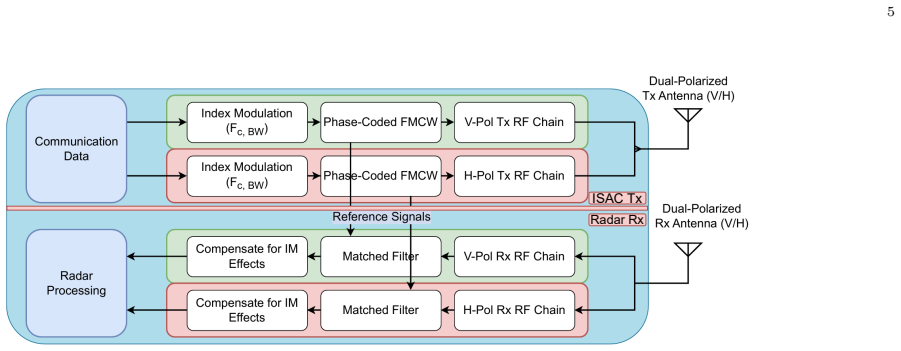
Two-layer modulation (phase modulation plus index modulation) on FMCW chirps combined with a radar signal processing mitigation step that removes modulation-induced distortions from sensing measurements.
Load-bearing premise
The mitigation processing fully removes the effects of index and phase modulation on sensing measurements under all relevant operational conditions.
What would settle it
An over-the-air vehicular test that records measurable degradation in range or velocity accuracy when the modulation layers are active would show that the mitigation step does not fully preserve sensing performance.
Figures






read the original abstract
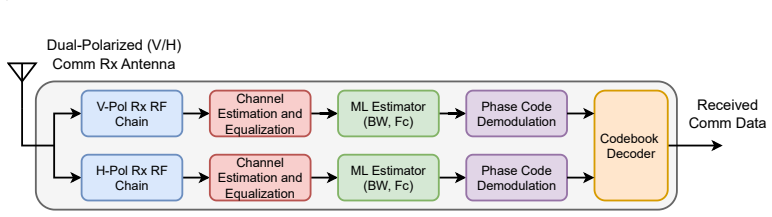
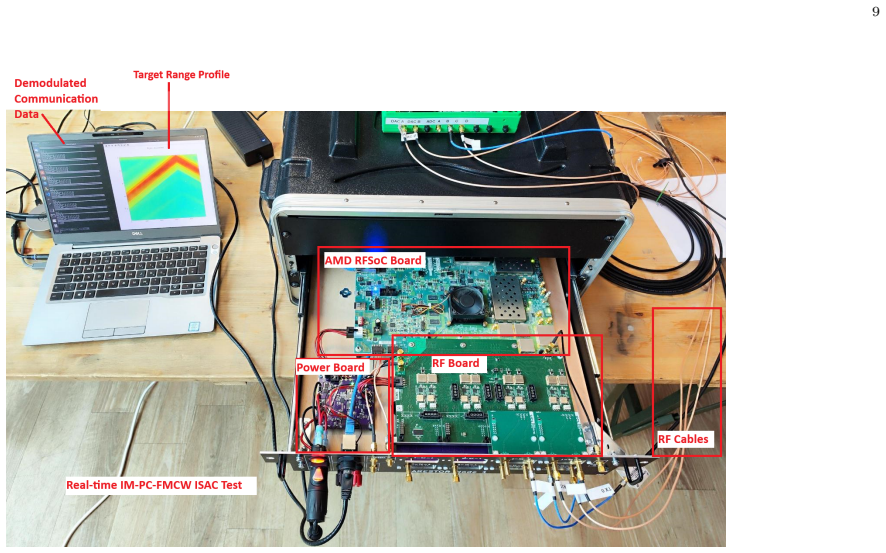
This study proposes a radar-centric integrated sensing and communication (ISAC) system utilizing a two-layer modulation scheme for vehicular networks. Frequency-modulated continuous wave (FMCW) chirps are jointly modulated via phase modulation (PM) and index modulation (IM) to transmit data while maintaining sensing as the primary function. To support this, a novel radar signal processing technique is developed to mitigate the impacts of IM and PM on sensing accuracy, alongside a communication receiver architecture designed to successfully demodulate IM and PM data within FMCW chirps. System performance is evaluated through simulations in the 2.4 GHz and 24 GHz bands under Doppler effects, achieving communication throughputs of 25 Mbps and 50 Mbps, respectively. Furthermore, a proof-of-concept hardware implementation is realized, and experimental measurements via a loopback cable are performed to verify the feasibility of the architecture. Finally, it evaluates the fundamental trade-off between communication throughput, sensing accuracy, and out-of-band emission, demonstrating the system's flexibility to dynamically adjust waveform parameters to meet varying operational requirements.
Editorial analysis
A structured set of objections, weighed in public.
Referee Report
Summary. The paper proposes a radar-centric ISAC system for vehicular networks that applies two-layer modulation (phase modulation and index modulation) to FMCW chirps to enable data transmission while keeping sensing as the primary function. A novel radar signal processing technique is developed to mitigate modulation-induced degradation in sensing accuracy, paired with a communication receiver for demodulating the IM/PM data. Simulations at 2.4 GHz and 24 GHz under Doppler effects report throughputs of 25 Mbps and 50 Mbps; a hardware proof-of-concept is implemented and validated via loopback-cable measurements. The work also examines trade-offs among throughput, sensing accuracy, and out-of-band emissions, showing parameter flexibility.
Significance. If the mitigation technique is shown to restore sensing metrics under realistic propagation, the approach would offer a practical, parameter-tunable framework for radar-primary ISAC waveforms that achieve Mbps-scale communication without dedicated spectrum, directly relevant to vehicular networks.
major comments (3)
- [Experimental Measurements] Experimental Measurements section: hardware validation is performed exclusively via loopback cable, which omits wireless propagation, target-motion Doppler spread, multipath, and interference present in the claimed 2.4/24 GHz vehicular scenarios; this leaves untested whether the novel radar processing fully restores range/Doppler accuracy to simulated levels when IM/PM are active.
- [Simulation results] Simulation results (abstract and performance evaluation): reported throughputs of 25 Mbps and 50 Mbps lack accompanying quantitative sensing-error metrics (e.g., RMSE in range/Doppler) with versus without the mitigation technique, and no error bars or statistical significance are provided, weakening the claim that sensing remains primary.
- [Radar signal processing technique] Description of the novel radar signal processing technique: the manuscript states that a mitigation method is developed but supplies neither the explicit equations nor the algorithmic steps showing how IM/PM effects are removed from the range-Doppler map, making independent verification of the central mitigation claim impossible from the given material.
minor comments (2)
- [Abstract] Abstract: the phrase 'maintaining sensing as the primary function' is repeated without a quantitative definition (e.g., maximum allowable degradation in RMSE); a single clarifying sentence would improve precision.
- [System model] Notation: the two-layer modulation scheme is described at a high level; a compact table listing the exact mapping of data bits to chirp index and phase values would aid reproducibility.
Simulated Author's Rebuttal
We thank the referee for the constructive comments, which help improve the clarity and completeness of the manuscript. We address each major comment point by point below.
read point-by-point responses
-
Referee: [Experimental Measurements] Experimental Measurements section: hardware validation is performed exclusively via loopback cable, which omits wireless propagation, target-motion Doppler spread, multipath, and interference present in the claimed 2.4/24 GHz vehicular scenarios; this leaves untested whether the novel radar processing fully restores range/Doppler accuracy to simulated levels when IM/PM are active.
Authors: The loopback-cable experiment is presented as a hardware proof-of-concept to confirm that the two-layer modulation can be generated and that the basic transmit/receive chain functions as designed. The simulations separately incorporate Doppler spread to evaluate performance under vehicular conditions. We agree that the loopback setup does not capture wireless propagation effects and will revise the Experimental Measurements section to explicitly state this limitation and clarify the scope of the hardware validation. revision: partial
-
Referee: [Simulation results] Simulation results (abstract and performance evaluation): reported throughputs of 25 Mbps and 50 Mbps lack accompanying quantitative sensing-error metrics (e.g., RMSE in range/Doppler) with versus without the mitigation technique, and no error bars or statistical significance are provided, weakening the claim that sensing remains primary.
Authors: The current manuscript emphasizes communication throughput but does not present the requested side-by-side sensing-error metrics. We will add range and Doppler RMSE values (with and without mitigation) together with any available variability measures from the Monte-Carlo runs in the revised Performance Evaluation section to strengthen the claim that sensing accuracy is preserved. revision: yes
-
Referee: [Radar signal processing technique] Description of the novel radar signal processing technique: the manuscript states that a mitigation method is developed but supplies neither the explicit equations nor the algorithmic steps showing how IM/PM effects are removed from the range-Doppler map, making independent verification of the central mitigation claim impossible from the given material.
Authors: We acknowledge that the description of the mitigation technique is currently at a high level. In the revision we will insert the explicit mathematical formulation and the step-by-step algorithmic procedure used to suppress the IM/PM-induced artifacts in the range-Doppler map, enabling independent verification. revision: yes
Circularity Check
No circularity in derivation chain
full rationale
The paper is a design-and-experiment study that proposes a two-layer IM/PM modulation on FMCW chirps, introduces a mitigation processing technique, and reports throughputs from simulations (under Doppler) plus loopback-cable hardware measurements. No equations, fitted parameters, or predictions are presented that reduce by construction to the inputs; performance numbers are obtained directly from the described simulations and measurements rather than from any self-referential derivation or self-citation chain. The central claims therefore remain independent of the patterns that would produce circularity scores above 2.
Axiom & Free-Parameter Ledger
axioms (1)
- domain assumption The developed radar signal processing technique successfully removes the effects of IM and PM on sensing accuracy
Reference graph
Works this paper leans on
-
[1]
Joint radar and communication design: Applications, state-of-the-art, and the road ahead,
F. Liu, C. Masouros, A. P. Petropulu, H. Griffiths, and L. Hanzo, “Joint radar and communication design: Applications, state-of-the-art, and the road ahead,” IEEE Transactions on Communications, vol. 68, pp. 3834–3862, June 2020
2020
-
[2]
Integrated sensing and communication signals toward 5G-A and 6G: a survey,
Z. Wei, H. Qu, Y. Wang, X. Yuan, H. Wu, Y. Du, K. Han, N. Zhang, and Z. Feng, “Integrated sensing and communication signals toward 5G-A and 6G: a survey,” IEEE Internet of Things Journal, vol. 10, no. 13, pp. 11068–11092, 2023
2023
-
[3]
Joint coverage and detection performance metrics for inte- grated sensing and communication in automotive scenarios,
F. D. S. Moulin, C. Wiame, L. Vandendorpe, and C. Oestges, “Joint coverage and detection performance metrics for inte- grated sensing and communication in automotive scenarios,” IEEE Transactions on Vehicular Technology, vol. 73, pp. 16758– 16773, Nov 2024
2024
-
[4]
Predictive beamforming in integrated sensing and communication-enabled vehicular networks,
W. Liang, Y. Wang, J. Zhang, L. Li, and Z. Han, “Predictive beamforming in integrated sensing and communication-enabled vehicular networks,” IEEE Transactions on Vehicular Technol- ogy, vol. 74, pp. 4539–4553, March 2025. 16
2025
-
[5]
Adaptive waveform design for automotive joint radar-communication systems,
S. H. Dokhanchi, M. R. B. Shankar, M. Alaee-Kerahroodi, and B. Ottersten, “Adaptive waveform design for automotive joint radar-communication systems,” IEEE Transactions on Vehicular Technology, vol. 70, pp. 4273–4290, May 2021
2021
-
[6]
Waveform design for joint sensing and commu- nications in millimeter-wave and low terahertz bands,
T. Mao, J. Chen, Q. Wang, C. Han, Z. Wang, and G. K. Karagiannidis, “Waveform design for joint sensing and commu- nications in millimeter-wave and low terahertz bands,” IEEE Transactions on Communications, vol. 70, pp. 7023–7039, Oct 2022
2022
-
[7]
Joint radar-communication systems: Modulation schemes and system design,
L. Giroto de Oliveira, B. Nuss, M. B. Alabd, A. Diewald, M. Pauli, and T. Zwick, “Joint radar-communication systems: Modulation schemes and system design,” IEEE Transactions on Microwave Theory and Techniques, vol. 70, pp. 1521–1551, March 2022
2022
-
[8]
Full-duplex OFDM radar with LTE and 5G NR waveforms: Challenges, solutions, and measurements,
C. Baquero Barneto, T. Riihonen, M. Turunen, L. Anttila, M. Fleischer, K. Stadius, J. Ryynänen, and M. Valkama, “Full-duplex OFDM radar with LTE and 5G NR waveforms: Challenges, solutions, and measurements,” IEEE Transactions on Microwave Theory and Techniques, vol. 67, pp. 4042–4054, Oct 2019
2019
-
[9]
A dual-functional massive MIMO OFDM communication and radar transmitter architecture,
M. Temiz, E. Alsusa, and M. W. Baidas, “A dual-functional massive MIMO OFDM communication and radar transmitter architecture,” IEEE Transactions on Vehicular Technology, vol. 69, pp. 14974–14988, Dec 2020
2020
-
[10]
An experimental proof of concept for integrated sensing and communications waveform design,
T. Xu, F. Liu, C. Masouros, and I. Darwazeh, “An experimental proof of concept for integrated sensing and communications waveform design,” IEEE Open Journal of the Communications Society, vol. 3, pp. 1643–1655, 2022
2022
-
[11]
Optimized precoders for massive MIMO OFDM dual radar-communication systems,
M. Temiz, E. Alsusa, and M. W. Baidas, “Optimized precoders for massive MIMO OFDM dual radar-communication systems,” IEEE Transactions on Communications, vol. 69, pp. 4781–4794, July 2021
2021
-
[12]
Analysis and design for pilot power allocation and placement in OFDM based integrated radar and communication in auto- mobile systems,
H.-W. Hsu, M.-C. Lee, M.-X. Gu, Y.-C. Lin, and T.-S. Lee, “Analysis and design for pilot power allocation and placement in OFDM based integrated radar and communication in auto- mobile systems,” IEEE Transactions on Vehicular Technology, vol. 71, pp. 1519–1535, Feb 2022
2022
-
[13]
Cross-domain dual-functional OFDM waveform design for accurate sensing/positioning,
F. Zhang, T. Mao, R. Liu, Z. Han, S. Chen, and Z. Wang, “Cross-domain dual-functional OFDM waveform design for accurate sensing/positioning,” IEEE Journal on Selected Areas in Communications, vol. 42, pp. 2259–2274, Sep. 2024
2024
-
[14]
AFDM-enabled integrated sensing and communication: Theoretical framework and pilot design,
F. Zhang, Z. Wang, T. Mao, T. Jiao, Y. Zhuo, M. Wen, W. Xiang, S. Chen, and G. K. Karagiannidis, “AFDM-enabled integrated sensing and communication: Theoretical framework and pilot design,” IEEE Journal on Selected Areas in Commu- nications, vol. 44, pp. 310–324, 2026
2026
-
[15]
Communications via frequency-modulated continuous-wave radar in millimeter wave band,
Y. Fan, J. Bao, M. S. Aljumaily, and H. Li, “Communications via frequency-modulated continuous-wave radar in millimeter wave band,” in 2019 IEEE Global Communications Conference (GLOBECOM), pp. 1–7, Dec 2019
2019
-
[16]
An experimental study of radar-centric transmission for integrated sensing and communications,
M. Temiz, C. Horne, N. J. Peters, M. A. Ritchie, and C. Ma- souros, “An experimental study of radar-centric transmission for integrated sensing and communications,” IEEE Transactions on Microwave Theory and Techniques, vol. 71, no. 7, pp. 3203–3216, 2023
2023
-
[17]
FRaC: FMCW-based joint radar-communications system via index modulation,
D. Ma, N. Shlezinger, T. Huang, Y. Liu, and Y. C. Eldar, “FRaC: FMCW-based joint radar-communications system via index modulation,” IEEE Journal of Selected Topics in Signal Processing, vol. 15, pp. 1348–1364, Nov 2021
2021
-
[18]
MA- JoRCom: a dual-function radar communication system using index modulation,
T. Huang, N. Shlezinger, X. Xu, Y. Liu, and Y. C. Eldar, “MA- JoRCom: a dual-function radar communication system using index modulation,” IEEE Transactions on Signal Processing, vol. 68, pp. 3423–3438, 2020
2020
-
[19]
D. Ma, T. Huang, N. Shlezinger, Y. Liu, and Y. C. Eldar, Index Modulation Based ISAC, pp. 241–268. Singapore: Springer Nature Singapore, 2023
2023
-
[20]
Index modulation with circularly-shifted chirps for dual-function radar and com- munications,
A. Şahin, S. S. M. Hoque, and C.-Y. Chen, “Index modulation with circularly-shifted chirps for dual-function radar and com- munications,” IEEE Transactions on Wireless Communications, pp. 1–1, 2021
2021
-
[21]
An overview of signal process- ing techniques for joint communication and radar sensing,
J. A. Zhang, F. Liu, C. Masouros, R. W. Heath, Z. Feng, L. Zheng, and A. Petropulu, “An overview of signal process- ing techniques for joint communication and radar sensing,” IEEE Journal of Selected Topics in Signal Processing, vol. 15, pp. 1295–1315, Nov 2021
2021
-
[22]
Joint radar-communication system design based on FDA-MIMO via frequency index modulation,
M. Li and W.-Q. Wang, “Joint radar-communication system design based on FDA-MIMO via frequency index modulation,” IEEE Access, vol. 11, pp. 67722–67736, 2023
2023
-
[23]
Optimized mod- ulation order for V2V communication over index-modulated radar signals,
M. Kafafy, A. S. Ibrahim, and M. H. Ismail, “Optimized mod- ulation order for V2V communication over index-modulated radar signals,” Vehicular Communications, vol. 36, p. 100492, 2022
2022
-
[24]
Design of frequency index modulated waveforms for integrated SAR and communi- cation on high-altitude platforms (HAPs),
B. Huang, S. Ahmed, and M.-S. Alouini, “Design of frequency index modulated waveforms for integrated SAR and communi- cation on high-altitude platforms (HAPs),” IEEE Transactions on Communications, pp. 1–1, 2025
2025
-
[25]
Dual-function MIMO radar communications system design via sparse array optimization,
X. Wang, A. Hassanien, and M. G. Amin, “Dual-function MIMO radar communications system design via sparse array optimization,” IEEE Transactions on Aerospace and Electronic Systems, vol. 55, pp. 1213–1226, June 2019
2019
-
[26]
Dual- use baseband signal design for RadCom with position index and phase modulation,
X. Yao, Y. Liu, H. Qiu, Z. Zhang, X. Yu, and G. Cui, “Dual- use baseband signal design for RadCom with position index and phase modulation,” Signal Processing, vol. 209, p. 109015, 2023
2023
-
[27]
Hybrid index modulation for dual-functional radar communications systems,
J. Xu, X. Wang, E. Aboutanios, and G. Cui, “Hybrid index modulation for dual-functional radar communications systems,” IEEE Transactions on Vehicular Technology, vol. 72, pp. 3186– 3200, March 2023
2023
-
[28]
Design and analysis of frequency hopping-aided FMCW-based integrated radar and communication systems,
M.-X. Gu, M.-C. Lee, Y.-S. Liu, and T.-S. Lee, “Design and analysis of frequency hopping-aided FMCW-based integrated radar and communication systems,” IEEE Transactions on Communications, vol. 70, pp. 8416–8432, Dec 2022
2022
-
[29]
Receiver design in full-duplex joint radar-communication systems,
Z. Ni, J. A. Zhang, K. Wu, K. Yang, and R. P. Liu, “Receiver design in full-duplex joint radar-communication systems,” IEEE Transactions on Communications, vol. 71, pp. 4234–4246, July 2023
2023
-
[30]
Index modulation techniques for next-generation wireless networks,
E. Basar, M. Wen, R. Mesleh, M. Di Renzo, Y. Xiao, and H. Haas, “Index modulation techniques for next-generation wireless networks,” IEEE Access, vol. 5, pp. 16693–16746, 2017
2017
-
[31]
Novel index mod- ulation techniques: A survey,
T. Mao, Q. Wang, Z. Wang, and S. Chen, “Novel index mod- ulation techniques: A survey,” IEEE Communications Surveys Tutorials, vol. 21, pp. 315–348, Firstquarter 2019
2019
-
[32]
On the capacity of index modulation,
B. Shamasundar and A. Nosratinia, “On the capacity of index modulation,” IEEE Transactions on Wireless Communications, vol. 21, pp. 9114–9126, Nov 2022
2022
-
[33]
Radar-centric ISAC through index modulation: Over- the-air experimentation and trade-offs,
M. Temiz, N. J. Peters, C. Horne, M. A. Ritchie, and C. Ma- souros, “Radar-centric ISAC through index modulation: Over- the-air experimentation and trade-offs,” in 2023 IEEE Radar Conference (RadarConf23), pp. 1–6, May 2023
2023
-
[34]
Phase-coded FMCW automotive radar: System design and interference mitigation,
F. Uysal, “Phase-coded FMCW automotive radar: System design and interference mitigation,” IEEE Transactions on Vehicular Technology, vol. 69, pp. 270–281, Jan 2020
2020
-
[35]
Performance analysis of uncoordinated interference mitigation for automotive radar,
Y. Wang, Q. Zhang, Z. Wei, L. Kui, F. Liu, and Z. Feng, “Performance analysis of uncoordinated interference mitigation for automotive radar,” IEEE Transactions on Vehicular Tech- nology, vol. 72, pp. 4222–4235, April 2023
2023
-
[36]
Phase- coded FMCW for coherent MIMO radar,
U. Kumbul, N. Petrov, C. S. Vaucher, and A. Yarovoy, “Phase- coded FMCW for coherent MIMO radar,” IEEE Transactions on Microwave Theory and Techniques, vol. 71, pp. 2721–2733, June 2023
2023
-
[37]
Range, radial velocity, and accel- eration MLE using radar LFM pulse train,
T. Abatzoglou and G. Gheen, “Range, radial velocity, and accel- eration MLE using radar LFM pulse train,” IEEE Transactions on Aerospace and Electronic Systems, vol. 34, pp. 1070–1083, Oct 1998
1998
-
[38]
Influence of radar targets on the accuracy of FMCW radar dis- tance measurements,
S. Scherr, R. Afroz, S. Ayhan, S. Thomas, T. Jaeschke, S. Marahrens, A. Bhutani, M. Pauli, N. Pohl, and T. Zwick, “Influence of radar targets on the accuracy of FMCW radar dis- tance measurements,” IEEE Transactions on Microwave Theory and Techniques, vol. 65, pp. 3640–3647, Oct 2017
2017
-
[39]
An all-programmable 16-nm RFSoC for Digital-RF communications,
B. Farley, J. McGrath, and C. Erdmann, “An all-programmable 16-nm RFSoC for Digital-RF communications,” IEEE Micro, vol. 38, pp. 61–71, Mar 2018
2018
-
[40]
Allan, E
D. Allan, E. Atimati, K. W. Barlee, L. J. Brown, J. Craig, G. Fitzpatrick, J. Goldsmith, A. Maclellan, L. D. McLaughlin, B. McTaggart, et al., Software Defined Radio with Zynq Ultra- scale+ RFSoC. No. 1st, Strathclyde Academic Media, 2023
2023
-
[41]
Arestor: A multi-role RF sensor based on the Xilinx RFSoC,
N. Peters, C. Horne, and M. A. Ritchie, “Arestor: A multi-role RF sensor based on the Xilinx RFSoC,” in 2021 18th European Radar Conference (EuRAD), pp. 102–105, April 2022
2021
-
[42]
Joint Active Passive Sensing using a Radio Frequency System-on-a-Chip Based Sensor,
M. A. Ritchie, N. Peters, and C. Horne, “Joint Active Passive Sensing using a Radio Frequency System-on-a-Chip Based Sensor,” in International Radar Symposium (IRS) 2022, 2022. 17
2022
-
[43]
UK radio interface requirement for wideband trans- mission systems operating in the 2.4 ghz ISM band,
Ofcom, “UK radio interface requirement for wideband trans- mission systems operating in the 2.4 ghz ISM band,” Jan 2018
2018
discussion (0)
Sign in with ORCID, Apple, or X to comment. Anyone can read and Pith papers without signing in.