Towards terahertz excitons in hydrogenated graphene superlattices
Pith reviewed 2026-06-30 17:08 UTC · model grok-4.3
The pith
Selective hydrogenation of graphene produces superlattices with strong isolated excitonic peaks in the far-infrared and terahertz range.
A machine-rendered reading of the paper's core claim, the machinery that carries it, and where it could break.
Core claim
Calculations demonstrate that chemical patterning of graphene by selective hydrogenation creates superlattices in which quasi-metallic and dielectric strips alternate; these structures support strong, well-isolated excitonic absorption peaks in the far-infrared and possibly terahertz frequencies.
What carries the argument
selectively hydrogenated graphene superlattices, in which first-principles methods track the formation of excitonic states from the alternating quasi-metallic and dielectric regions.
If this is right
- The patterned superlattices offer a monolithic integration path for carbon-based terahertz components that avoids substrate-induced property changes.
- Excitonic peaks can be positioned in the far-infrared by adjusting the width and arrangement of the hydrogenated and pristine strips.
- The same surface-engineering route may produce devices that operate at even lower terahertz frequencies.
Where Pith is reading between the lines
- The same hydrogenation pattern might be applied to other two-dimensional materials to shift their excitonic response into the terahertz window.
- Tuning the superlattice period could allow on-demand adjustment of the absorption frequency without changing the base material.
Load-bearing premise
The first-principles calculations correctly capture excitonic binding and optical absorption without large errors from the choice of exchange-correlation functional or from the finite size of the modeled supercells.
What would settle it
Fabrication and optical measurement of a hydrogenated graphene superlattice that shows no isolated far-infrared excitonic absorption peaks would falsify the central claim.
Figures

read the original abstract
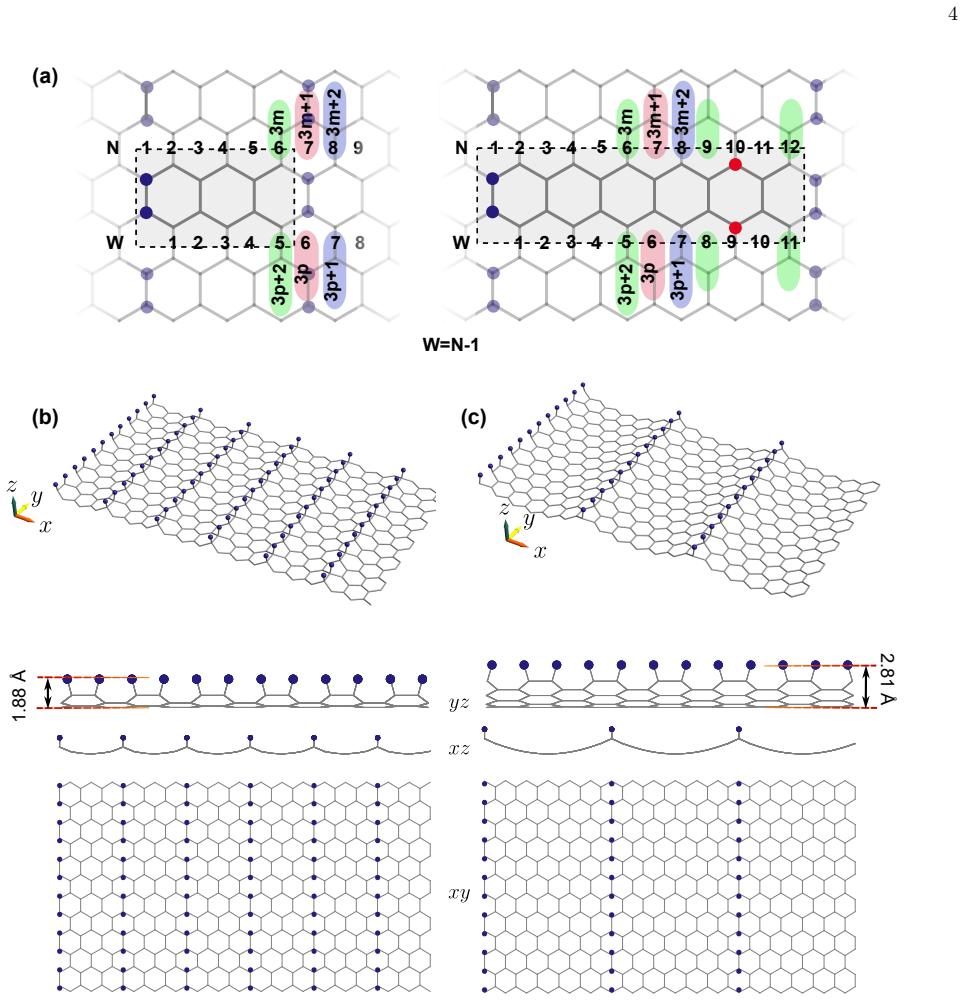
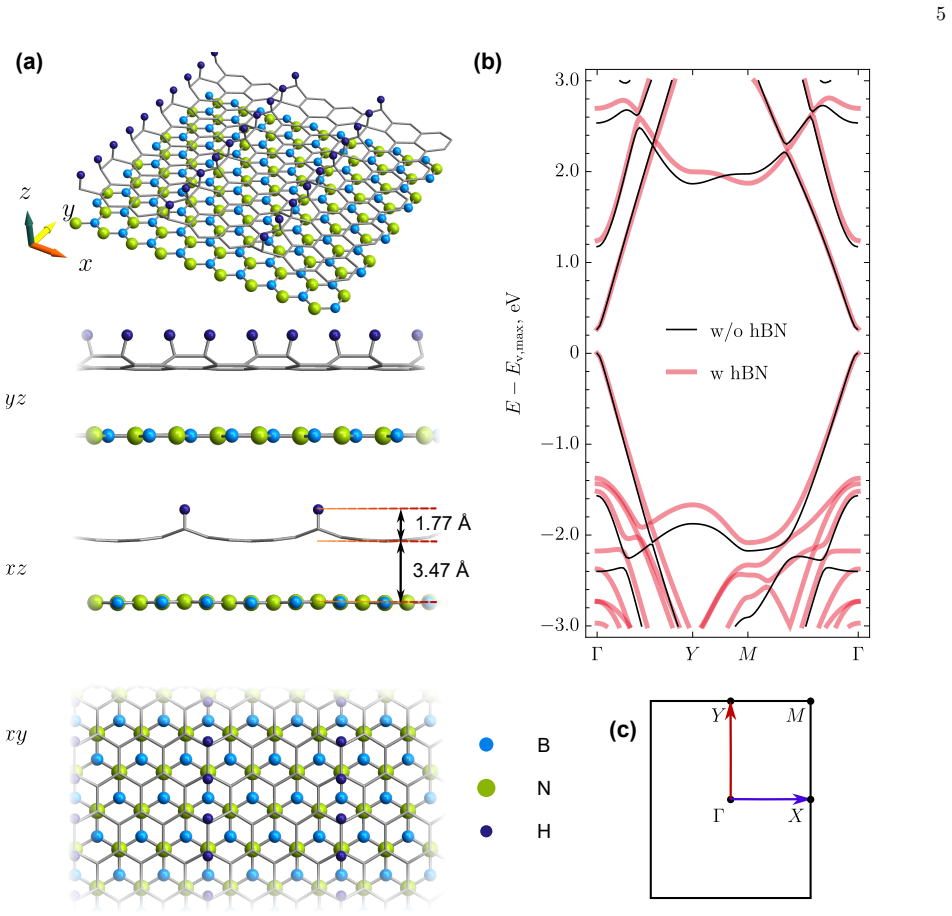
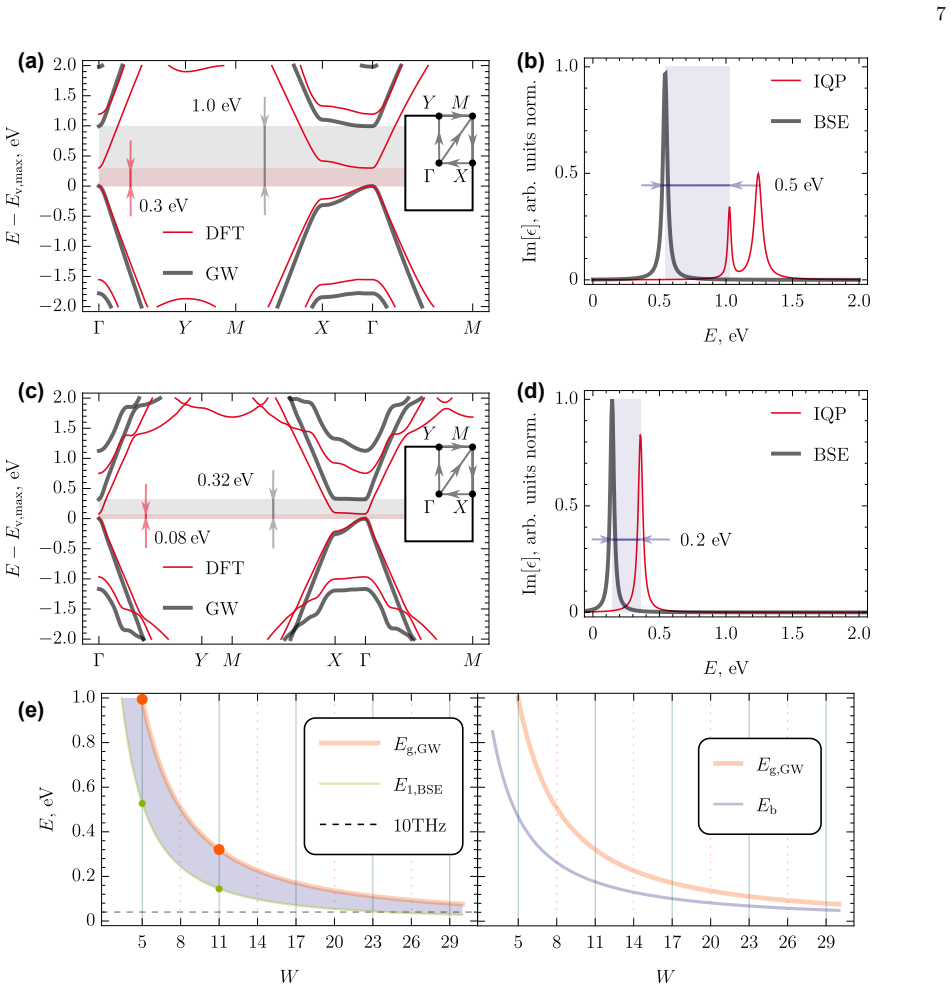
Carbon nanostructures, such as nanotubes and graphene nanoribbons, exhibit unique electronic and optical properties that make them very promising candidates for terahertz components. However, carbon nanotube and nanoribbon monolithic on-chip integration is challenging because it may results in significant change of their intrinsic properties after an embedment into a substrate. We investigate with first principles theoretical methods the successful routes of such integration and calculate electronic and optical properties of the integrated structures -- two-dimensional graphene superlattices, where quasi-metallic and dielectric regions alternate by selective hydrogenation of graphene. It is shown that chemical engineering of the graphene surface can lead to strong and well-isolated excitonic absorption peaks in the far-infrared and possibly even terahertz frequencies.
Editorial analysis
A structured set of objections, weighed in public.
Referee Report
Summary. The manuscript investigates two-dimensional graphene superlattices formed by selective hydrogenation, creating alternating quasi-metallic and dielectric regions. Using first-principles theoretical methods, it calculates the electronic and optical properties of these integrated structures and claims that chemical engineering of the graphene surface produces strong and well-isolated excitonic absorption peaks in the far-infrared and possibly terahertz frequency ranges. This is positioned as a route to on-chip integration of carbon nanostructures for THz components that avoids property changes upon substrate embedding.
Significance. If the computational predictions are robust, the work would be significant for suggesting a tunable chemical approach to engineer low-energy excitons in graphene-based systems, potentially enabling THz applications while addressing integration challenges with nanotubes and nanoribbons. The focus on periodic superlattices as a monolithic platform is a clear strength, though the absence of validation details leaves the practical impact conditional on the accuracy of the underlying spectra.
major comments (2)
- [Abstract] Abstract: The central claim that selective hydrogenation yields well-isolated excitonic peaks at FIR/THz energies rests entirely on unspecified first-principles calculations. No information is given on the treatment of excitonic effects (GW+BSE, TDDFT, etc.), the exchange-correlation functional, supercell dimensions, or k-point sampling, all of which are load-bearing at meV-scale energies where small shifts can move peaks out of the THz window or into the continuum.
- [Results] The manuscript provides no convergence tests, error bars, or comparisons to known limits (pristine graphene or graphane). At THz frequencies, quasiparticle gaps and exciton binding energies are sensitive to finite-size effects in the supercell (which control dielectric screening) and to the starting point of the calculation; without these data the isolation and positioning of the predicted peaks cannot be assessed.
minor comments (2)
- [Abstract] Abstract, sentence 3: grammatical error ('may results in' should read 'may result in').
- [Abstract] The abstract refers to 'two-dimensional graphene superlattices' without specifying the hydrogenation patterns or periodicity; a brief schematic or parameter table would improve clarity.
Simulated Author's Rebuttal
We thank the referee for the careful reading of our manuscript and the constructive comments. We address each major point below and have revised the manuscript to provide the requested methodological details and validation data.
read point-by-point responses
-
Referee: The central claim that selective hydrogenation yields well-isolated excitonic peaks at FIR/THz energies rests entirely on unspecified first-principles calculations. No information is given on the treatment of excitonic effects (GW+BSE, TDDFT, etc.), the exchange-correlation functional, supercell dimensions, or k-point sampling, all of which are load-bearing at meV-scale energies where small shifts can move peaks out of the THz window or into the continuum.
Authors: We agree that the abstract did not contain sufficient methodological specifics. In the revised manuscript we have expanded the abstract to state that excitonic effects were included via the GW+BSE formalism starting from PBE, together with the supercell periodicities employed for the hydrogenated superlattices and the k-point meshes used. These parameters are now explicitly listed so that the meV-scale positioning of the peaks can be assessed directly from the abstract. revision: yes
-
Referee: The manuscript provides no convergence tests, error bars, or comparisons to known limits (pristine graphene or graphane). At THz frequencies, quasiparticle gaps and exciton binding energies are sensitive to finite-size effects in the supercell (which control dielectric screening) and to the starting point of the calculation; without these data the isolation and positioning of the predicted peaks cannot be assessed.
Authors: We accept that explicit convergence and validation data were missing. The revised manuscript now includes a dedicated subsection (and associated supplementary figures) that reports convergence of the quasiparticle gaps and exciton binding energies with respect to supercell size and k-point density, provides comparisons against the pristine-graphene and fully-hydrogenated-graphane limits, and supplies error estimates arising from finite-size dielectric screening. These additions directly address the sensitivity concerns at THz energies. revision: yes
Circularity Check
No circularity: ab initio prediction from first-principles methods
full rationale
The paper reports first-principles calculations of electronic and optical properties for selectively hydrogenated graphene superlattices, with the central claim being a computational prediction of isolated excitonic peaks at FIR/THz energies. No derivation chain reduces to self-definition, fitted inputs renamed as predictions, or load-bearing self-citations; the result is presented as an output of the methods rather than an input. The abstract and description contain no equations or steps that equate the claimed absorption features to prior fitted quantities or author-specific ansatze by construction.
Axiom & Free-Parameter Ledger
Reference graph
Works this paper leans on
-
[1]
S. S. Dhillon, M. S. Vitiello, E. H. Linfield, A. G. Davies, M. C. Hoffmann, J. Booske, C. Paoloni, M. Gen- sch, P. Weightman, G. P. Williams, E. Castro-Camus, 7 (b)(a) (d)(c) (e) FIG. 4: Towards THz excitons. (a) The electronic band structure of AGSL(5) at DFT and GW levels. The DFT and GW gaps are highlighted. Inset:k-path in the Brillouin zone. (b) The...
2017
-
[2]
Leitenstorfer, A
A. Leitenstorfer, A. S. Moskalenko, T. Kampfrath, J. Kono, E. Castro-Camus, K. Peng, N. Qureshi, D. Turchinovich, K. Tanaka, A. G. Markelz, M. Havenith, C. Hough, H. J. Joyce, W. J. Padilla, B. Zhou, K.-Y. Kim, X.-C. Zhang, P. U. Jepsen, S. Dhillon, M. Vitiello, E. Linfield, A. G. Davies, M. C. Hoffmann, R. Lewis, M. Tonouchi, P. Klarskov, T. S. Seifert, ...
2023
-
[3]
R. R. Hartmann, J. Kono, and M. E. Portnoi, Terahertz science and technology of carbon nanomaterials, Nan- otechnology25, 322001 (2014)
2014
-
[4]
L. V. Titova, C. L. Pint, Q. Zhang, R. H. Hauge, J. Kono, and F. A. Hegmann, Generation of terahertz radiation by optical excitation of aligned carbon nanotubes, Nano Lett.15, 3267 (2015)
2015
-
[5]
F. R. G. Bagsican, M. Wais, N. Komatsu, W. Gao, L. W. Weber, K. Serita, H. Murakami, K. Held, F. A. Heg- mann, M. Tonouchi, J. Kono, I. Kawayama, and M. Bat- tiato, Terahertz excitonics in carbon nanotubes: Exciton autoionization and multiplication, Nano Lett.20, 3098 (2020)
2020
-
[6]
Faist, F
J. Faist, F. Capasso, D. D. L. Sivco, C. Sirtori, A. L. Hutchinson, and A. A. Y. Cho, Quantum cascade laser, Science264, 553 (1994)
1994
-
[7]
Ouyang, J
M. Ouyang, J. L. Huang, C. L. Cheung, and C. M. Lieber, Energy gaps in “metallic’ single-walled carbon nanotubes, Science292, 702 (2001)
2001
-
[8]
Matsuda, J
Y. Matsuda, J. Tahir-Kheli, and W. A. Goddard, Defini- tive band gaps for single-wall carbon nanotubes, J. Phys. Chem. Lett.1, 2946 (2010)
2010
-
[9]
P. N. D’yachkov, Optical band gap energies in quasi- metal carbon nanotubes, Russ. J. Inorg. Chem.63, 55 (2018)
2018
-
[10]
C. L. Kane and E. J. Mele, Size, shape, and low en- ergy electronic structure of carbon nanotubes, Phys. Rev. Lett.78, 1932 (1997)
1932
-
[11]
Kleiner and S
A. Kleiner and S. Eggert, Band gaps of primary metallic carbon nanotubes, Phys. Rev. B63, 073408 (2000)
2000
-
[12]
Kleiner and S
A. Kleiner and S. Eggert, Curvature, hybridization, and STM images of carbon nanotubes, Phys. Rev. B64, 113402 (2001)
2001
-
[13]
M. E. Portnoi, C. A. Downing, R. R. Hartmann, and I. A. Shelykh, Excitons and interband terahertz transi- tions in narrow-gap carbon nanotubes, in2013 Interna- tional Conference on Electromagnetics in Advanced Ap- plications (ICEAA)(IEEE, 2013) pp. 231–234
2013
-
[14]
Maffucci, S
A. Maffucci, S. A. Maksimenko, and M. E. Portnoi, Carbon nanotubes and graphene nanoribbons for tera- hertz applications, inFundamental and Applied Nano- Electromagnetics, edited by A. Maffucci and S. A. Maksi- menko (Springer Netherlands, Dordrecht, 2016) pp. 103– 123
2016
-
[15]
V. A. Saroka, R. R. Hartmann, and M. E. Portnoi, Ter- ahertz transitions in narrow-gap carbon nanotubes and graphene nanoribbons, inPhysics, Chemistry and Ap- plication of Nanostructures, edited by V. E. Borisenko, S. V. Gaponenko, V. S. Gurin, and C. H. Kam (World Scientific, 2017) pp. 176–179
2017
-
[16]
V. A. Saroka, R. R. Hartmann, and M. E. Portnoi, Ter- ahertz transitions in carbon nanotubes and graphene nanoribbons, in2017 International Conference on Elec- tromagnetics in Advanced Applications (ICEAA)(IEEE,
-
[17]
V. A. Saroka, R. R. Hartmann, and M. E. Portnoi, Ter- ahertz transitions in narrow-gap carbon nanotubes and graphene nanoribbons, J. Phys.: Conf. Ser.1092, 012121 (2018)
2018
-
[18]
R. R. Hartmann, V. A. Saroka, and M. E. Portnoi, Interband transitions in narrow-gap carbon nanotubes and graphene nanoribbons, J. Appl. Phys.125, 151607 (2019)
2019
-
[19]
V. A. Saroka, R. Hartmann, and M. Portnoi, Inter- band transitions in narrow-gap carbon nanotubes and graphene nanoribbons, inCarbon-Based Nanoelectromag- netics, edited by A. Maffucci, S. Maksimenko, and Y. Svirko (Elsevier, Amsterdam, 2019) Chap. 4, pp. 99– 117
2019
-
[20]
Maffucci, S
A. Maffucci, S. Maksimenko, M. Portnoi, V. Saroka, and G. Slepyan, A graphene THz detector based on plasmon resonances and interband transitions, in2021 XXXIVth General Assembly and Scientific Symposium of the Inter- national Union of Radio Science (URSI GASS)(IEEE,
-
[21]
Y.-W. Son, M. L. Cohen, and S. G. Louie, Energy gaps in graphene nanoribbons, Phys. Rev. Lett.97, 216803 (2006)
2006
-
[22]
Zheng, Z
H. Zheng, Z. Wang, T. Luo, Q. Shi, and J. Chen, Ana- lytical study of electronic structure in armchair graphene nanoribbons, Phys. Rev. B75, 165414 (2007)
2007
-
[23]
Gunlycke and C
D. Gunlycke and C. T. White, Tight-binding energy dispersions of armchair-edge graphene nanostrips, Phys. Rev. B77, 115116 (2008)
2008
-
[24]
C. T. White, J. Li, D. Gunlycke, and J. W. Mintmire, Hidden one-electron interactions in carbon nanotubes re- vealed in graphene nanostrips, Nano Lett.7, 825 (2007)
2007
-
[25]
M. E. Portnoi, V. A. Saroka, R. R. Hartmann, and O. V. Kibis, Terahertz applications of carbon nanotubes and graphene nanoribbons, in2015 IEEE Computer Society Annual Symposium on VLSI(IEEE, 2015) pp. 456–459
2015
-
[26]
V. A. Saroka, M. V. Shuba, and M. E. Portnoi, Opti- cal selection rules of zigzag graphene nanoribbons, Phys. Rev. B95, 155438 (2017)
2017
-
[27]
Saroka, A
V. Saroka, A. Pushkarchuk, S. Kuten, and M. Portnoi, Hidden correlation between absorption peaks in achiral carbon nanotubes and nanoribbons, J. Saudi Chem. Soc. 22, 985 (2018)
2018
-
[28]
R. B. Payod and V. A. Saroka, Ab initio study of ab- sorption resonance correlations between nanotubes and nanoribbons of graphene and hexagonal boron nitride, Semiconductors53, 1929 (2019)
1929
-
[29]
R. B. Payod, D. Grassano, G. N. C. Santos, D. I. Levshov, O. Pulci, and V. A. Saroka, 2N+4-rule and an atlas of bulk optical resonances of zigzag graphene nanoribbons, Nat. Commun.11, 82 (2020)
2020
-
[30]
V. A. Saroka, R. R. Hartmann, and M. E. Portnoi, Mo- mentum alignment and the optical valley Hall effect in low-dimensional Dirac materials, J. Exp. Theor. Phys. 135, 513 (2022)
2022
-
[31]
A. A. Frost and B. Musulin, A mnemonic device for molecular orbital energies, J. Chem. Phys.21, 572 9 (1953)
1953
-
[32]
R. B. Payod, A. L. Pushkarchuk, D. L. Michels, D. A. Lyakhov, and V. A. Saroka, Comparative analy- sis of absorption resonances between carbynes and cy- clo[n]carbons, J. Phys.: Condens. Matter36, 425302 (2024)
2024
-
[33]
Ando, Theory of electronic states and transport in carbon nanotubes, J
T. Ando, Theory of electronic states and transport in carbon nanotubes, J. Phys. Soc. Jpn.74, 777 (2005)
2005
-
[34]
G. G. Samsonidze, R. Saito, A. Jorio, M. A. Pimenta, A. G. Souza Filho, A. Gr¨ uneis, G. Dresselhaus, and M. S. Dresselhausa, The concept of cutting lines in carbon nan- otube science, J. Nanosci. Nanotechnol.3, 431 (2003)
2003
-
[35]
Wakabayashi, K.-I
K. Wakabayashi, K.-I. Sasaki, T. Nakanishi, and T. Enoki, Electronic states of graphene nanoribbons and analytical solutions, Sci. Technol. Adv. Mater.11, 054504 (2010)
2010
-
[36]
L. A. Chernozatonskii, P. B. Sorokin, E. E. Belova, J. Br¨ uning, and A. S. Fedorov, Superlattices consisting of “lines” of adsorbed hydrogen atom pairs on graphene, JETP Lett.85, 77 (2007)
2007
-
[37]
L. A. Chernozatonskii and P. B. Sorokin, Nanoengi- neering structures on graphene with adsorbed hydrogen “lines”, J. Phys. Chem. C114, 3225 (2010)
2010
-
[38]
Withers, T
F. Withers, T. H. Bointon, M. Dubois, S. Russo, and M. F. Craciun, Nanopatterning of fluorinated graphene by electron beam irradiation, Nano Lett.11, 3912 (2011)
2011
-
[39]
J. J. Navarro, S. Leret, F. Calleja, D. Stradi, A. Black, R. Bernardo-Gavito, M. Garnica, D. Granados, A. L. V´ azquez De Parga, E. M. P´ erez, and R. Miranda, Organic covalent patterning of nanostructured graphene with se- lectivity at the atomic level, Nano Lett.16, 355 (2016)
2016
-
[40]
M. S. Dresselhaus, G. Dresselhaus, and R. Saito, Carbon fibers based on C60 and their symmetry, Phys. Rev. B 45, 6234 (1992)
1992
-
[41]
Ajiki and T
H. Ajiki and T. Ando, Electronic states of carbon nan- otubes, J. Phys. Soc. Jpn.62, 1255 (1993)
1993
-
[42]
J. W. Mintmire, D. H. Robertson, and C. T. White, Prop- erties of fullerene nanotubules, J. Phys. Chem. Solids54, 1835 (1993)
1993
-
[43]
C. L. Kane and E. J. Mele, Electronic properties of semiconducting graphitic microtubules, Phys. Rev. B50, 12203 (1994)
1994
-
[44]
Ajiki and T
H. Ajiki and T. Ando, Energy bands of carbon nanotubes in magnetic fields, J. Phys. Soc. Jpn.65, 505 (1996)
1996
-
[45]
Nakada, M
K. Nakada, M. Fujita, G. Dresselhaus, and M. S. Dressel- haus, Edge state in graphene ribbons: Nanometer size ef- fect and edge shape dependence, Phys. Rev. B54, 17954 (1996)
1996
-
[46]
Barone, O
V. Barone, O. Hod, and G. E. Scuseria, Electronic struc- ture and stability of semiconducting graphene nanorib- bons, Nano Lett.6, 2748 (2006)
2006
-
[47]
V. A. Saroka, K. G. Batrakov, and L. A. Chernozaton- skii, Edge-modified zigzag-shaped graphene nanoribbons: Structure and electronic properties, Phys. Solid State56, 2135 (2014)
2014
-
[48]
V. A. Saroka, K. G. Batrakov, V. A. Demin, and L. A. Chernozatonskii, Band gaps in jagged and straight graphene nanoribbons tunable by an external electric field, Phys. Condens. Matter27, 145305 (2015)
2015
-
[49]
V. A. Saroka and K. G. Batrakov, Zigzag-shaped super- lattices on the basis of graphene nanoribbons: Structure and electronic properties, Russ. Phys. J.59, 633 (2016)
2016
-
[50]
Giannozzi, S
P. Giannozzi, S. Baroni, N. Bonini, M. Calandra, R. Car, C. Cavazzoni, D. Ceresoli, G. L. Chiarotti, M. Cococ- cioni, I. Dabo,et al., Quantum espresso: a modular and open-source software project for quantumsimulations of materials, Journal of Physics: Condensed Matter21, 395502 (2009)
2009
-
[51]
D. R. Hamann, Optimized norm-conserving Vanderbilt pseudopotentials, Phys. Rev. B88, 085117 (2013)
2013
-
[52]
C. R. Dean, A. F. Young, I. Meric, C. Lee, L. Wang, S. Sorgenfrei, K. Watanabe, T. Taniguchi, P. Kim, K. L. Shepard, and J. Hone, Boron nitride substrates for high- quality graphene electronics, Nat. Nanotechnol.5, 722 (2010)
2010
-
[53]
Onodera, T
M. Onodera, T. Taniguchi, K. Watanabe, M. Isayama, S. Masubuchi, R. Moriya, and T. Machida, Hexagonal boron nitride synthesized at atmospheric pressure using netal alloy solvents: Evaluation as a substrate for 2D materials, Nano Lett.20, 735 (2020)
2020
-
[54]
Grimme, J
S. Grimme, J. Antony, S. Ehrlich, and H. Krieg, A con- sistent and accurateab initioparametrization of density functional dispersion correction (DFT-d) for the 94 ele- ments h-pu, J. Chem. Phys.132, 154104 (2010)
2010
-
[55]
Ahmed Adllan and A
A. Ahmed Adllan and A. Dal Corso, Ultrasoft pseudopo- tentials and projector augmented-wave data sets: appli- cation to diatomic molecules, J. Phys.: Condens. Matter 23, 425501 (2011)
2011
-
[56]
Bechstedt,Many-Body Approach to Electronic Ex- citations
F. Bechstedt,Many-Body Approach to Electronic Ex- citations. Concepts and Applications(Springer-Verlag, Berlin, 2015)
2015
-
[57]
Hedin, New method for calculating the one-particle Green’s function with application to the electron-gas problem, Phys
L. Hedin, New method for calculating the one-particle Green’s function with application to the electron-gas problem, Phys. Rev.139, A796 (1965)
1965
-
[58]
Sangalli, A
D. Sangalli, A. Ferretti, H. Miranda, C. Attaccalite, I. Marri, E. Cannuccia, P. Melo, M. Marsili, F. Paleari, A. Marrazzo, G. Prandini, P. Bonf´ a, M. O. Atambo, F. Affinito, M. Palummo, A. Molina-S´ anchez, C. Hogan, M. Gr¨ uning, D. Varsano, and A. Marini, Many-body per- turbation theory calculations using the YAMBO code, J. Phys.: Condens. Matter31, 3...
2019
-
[59]
Guandalini, P
A. Guandalini, P. D’Amico, A. Ferretti, and D. Varsano, Efficient gw calculations in two dimensional materials through a stochastic integration of the screened poten- tial, npj Computational Materials9, 44 (2023)
2023
-
[60]
See raw data in GitHub at https://github.com/marcodalessandro76/AGSL5
-
[61]
Jiang, Y
Z. Jiang, Y. Li, S. Zhang, and W. Duan, Realizing an in- trinsic excitonic insulator by decoupling exciton binding energy from the minimum band gap, Phys. Rev. B98, 081408 (2018)
2018
-
[62]
Jiang, Y
Z. Jiang, Y. Li, W. Duan, and S. Zhang, Half-excitonic insulator: A single-spin Bose-Einstein condensate, Phys. Rev. Lett.122, 236402 (2019)
2019
-
[63]
Varsano, M
D. Varsano, M. Palummo, E. Molinari, and M. Rontani, A monolayer transition-metal dichalcogenide as a topo- logical excitonic insulator, Nat. Nanotechnol.15, 367 (2020)
2020
-
[64]
Sethi, Y
G. Sethi, Y. Zhou, L. Zhu, L. Yang, and F. Liu, Flat- band-enabled triplet excitonic insulator in a diatomic kagome lattice, Phys. Rev. Lett.126, 196403 (2021)
2021
-
[65]
Varsano, M
D. Varsano, M. Palummo, E. Molinari, and M. Rontani, Scaling universality between band gap and exciton bind- ing energy of two-dimensional semiconductors, Phys. Rev. Lett.118, 266401 (2017)
2017
-
[66]
Pulci, P
O. Pulci, P. Gori, D. Grassano, M. D’Alessandro, and F. Bechstedt, Transitions in xenes between excitonic, topological and trivial insulator phases: Influence of 10 screening, band dispersion and external electric field, Sci- Post Physics15(2023)
2023
-
[67]
K. A. Bulashevich, R. A. Suris, and S. V. Rotkin, Exci- tons in single-wall carbon nanotubes, Int. J. Nanosci.02, 521 (2003)
2003
-
[68]
R. R. Hartmann, I. A. Shelykh, and M. E. Portnoi, Exci- tons in narrow-gap carbon nanotubes, Phys. Rev. B84, 035437 (2011)
2011
-
[69]
C. A. Downing and M. E. Portnoi, One-dimensional Coulomb problem in Dirac materials, Phys. Rev. A90, 052116 (2014)
2014
-
[70]
R. R. Hartmann and M. E. Portnoi, Pair states in one- dimensional Dirac systems, Phys. Rev. A95, 062110 (2017)
2017
-
[71]
Marsili, O
M. Marsili, O. Pulci, F. Bechstedt, and R. Del Sole, Electronic structure of the C(111) surface: Solution by self-consistent many-body calculations, Phys. Rev. B72, 115415 (2005)
2005
-
[72]
Marsili, O
M. Marsili, O. Pulci, F. Bechstedt, and R. Del Sole, Tight-binding calculations of quasiparticle wave func- tions for C(111) 2×1, Phys. Rev. B78, 205414 (2008)
2008
-
[73]
Kutrovskaya, A
S. Kutrovskaya, A. Osipov, S. Baryshev, A. Zasedatelev, V. Samyshkin, S. Demirchyan, O. Pulci, D. Gras- sano, L. Gontrani, R. R. Hartmann, M. E. Portnoi, A. Kucherik, P. G. Lagoudakis, and A. Kavokin, Exci- tonic fine structure in emission of linear carbon chains, Nano Lett.20, 6502 (2020)
2020
-
[74]
Kucherik, A
A. Kucherik, A. Osipov, V. Samyshkin, R. R. Hartmann, A. V. Povolotskiy, and M. E. Portnoi, Polarization- sensitive photoluminescence from aligned carbon chains terminated by gold clusters, Phys. Rev. Lett.132, 056902 (2024)
2024
-
[75]
R. A. Ng, A. Kucherik, M. E. Portnoi, and R. R. Hart- mann, Stark effect tunable terahertz transitions in finite carbon chains, Small Struct.6, e202500266 (2025)
2025
-
[76]
Kaiser, L
K. Kaiser, L. M. Scriven, F. Schulz, P. Gawel, L. Gross, and H. L. Anderson, An sp-hybridized molecular carbon allotrope, cyclo[18]carbon, Science365, 1299 (2019)
2019
-
[77]
Y. Gao, P. Gupta, I. Ronˇ cevi´ c, C. Mycroft, P. J. Gates, A. W. Parker, and H. L. Anderson, Solution-phase stabi- lization of a cyclocarbon by catenane formation, Science 389, 708 (2025)
2025
-
[78]
Ronˇ cevi´ c, F
I. Ronˇ cevi´ c, F. Paschke, Y. Gao, L.-A. Lieske, L. A. G¨ odde, S. Barison, S. Piccinelli, A. Baiardi, I. Tavernelli, J. Repp, F. Albrecht, H. L. Anderson, and L. Gross, A molecule with half-m¨ obius topology, Science , eaea3321 (2026)
2026
-
[79]
Grillo, O
S. Grillo, O. Pulci, and T. Giovannini, The optical re- sponse of aromatic cyclocarbons, Chemical Science16, 22465 – 22472 (2025)
2025
-
[80]
R. R. Hartmann, S. Kutrovskaya, A. Kucherik, A. V. Ka- vokin, and M. E. Portnoi, Terahertz transitions in finite carbon chains, Phys. Rev. Res.3, 033202 (2021)
2021
discussion (0)
Sign in with ORCID, Apple, or X to comment. Anyone can read and Pith papers without signing in.