Helical Rashba-exchange gauge field drives a uniaxial pair density wave in EuRbFe₄As₄
Pith reviewed 2026-06-30 12:47 UTC · model grok-4.3
The pith
Rashba spin-orbit coupling and helical Eu exchange together generate a layer-rotating gauge field that selects orbital-selective finite-momentum pairing and stabilizes a uniaxial Bloch pair density wave.
A machine-rendered reading of the paper's core claim, the machinery that carries it, and where it could break.
Core claim
The interplay of Rashba spin-orbit coupling induced by the locally non-centrosymmetric FeAs layers and the period-four helical Eu2+ exchange field generates a layer-rotating effective U(1) gauge field for the Cooper pairs. Because this gauge field shares the symmetry of the Fe 3d_xz/3d_yz orbital doublet, it drives an orbital-selective, finite-momentum pairing instability that stabilizes a strictly uniaxial Bloch superconducting state at the experimentally observed wavelength, accompanied by spontaneous interlayer loop currents.
What carries the argument
Layer-rotating effective U(1) gauge field generated by the Rashba-exchange interplay, which acts on Cooper pairs and selects orbital-selective finite-momentum pairing.
If this is right
- The superconducting modulation is strictly uniaxial and occurs at the period-four wavelength set by the Eu helix.
- The state carries spontaneous interlayer loop currents that break time-reversal symmetry locally.
- Pairing is orbital-selective to the Fe 3d_xz/3d_yz doublet rather than uniform across all orbitals.
- The mechanism requires the magnetic ordering temperature to lie below the superconducting transition so that the helical field can act on an already-formed condensate.
Where Pith is reading between the lines
- If the gauge-field mechanism is operative, similar PDW states could appear in other iron pnictides that combine local inversion breaking with a helical rare-earth sublattice.
- The same layer-rotating gauge field may produce measurable effects in the normal state above Tc, such as anisotropic magnetoresistance tied to the Eu helix.
- Engineering the Eu helix period through chemical substitution could tune the PDW wavelength in a controlled way.
Load-bearing premise
The generated gauge field shares the symmetry of the Fe 3d_xz/3d_yz orbital doublet and thereby selects the orbital-selective finite-momentum instability.
What would settle it
Absence of spontaneous interlayer loop currents detectable by muon-spin relaxation or scanning SQUID microscopy in the PDW phase would falsify the mechanism.
Figures

read the original abstract
The recent discovery of an intrinsic, zero-field pair density wave (PDW) in the iron-pnictide superconductor EuRbFe$_4$As$_4$ poses a fundamental puzzle: how does a unidirectional, nanometer-scale superconducting modulation arise spontaneously below the magnetic ordering temperature? Here we show that the interplay of Rashba spin-orbit coupling -- induced by the locally non-centrosymmetric FeAs layers -- and the period-four helical Eu$^{2+}$ exchange field generates a layer-rotating effective $U(1)$ gauge field for the Cooper pairs. Because this gauge field shares the symmetry of the Fe $3d_{xz}/3d_{yz}$ orbital doublet, it drives an orbital-selective, finite-momentum pairing instability. Using a Ginzburg-Landau theory on the magnetic unit cell, we demonstrate that this mechanism naturally stabilizes a strictly uniaxial Bloch superconducting state at the experimentally observed wavelength, accompanied by spontaneous interlayer loop currents accessible to muon-spin relaxation or scanning SQUID microscopy.
Editorial analysis
A structured set of objections, weighed in public.
Referee Report
Summary. The manuscript claims that in EuRbFe₄As₄ the combination of Rashba SOC (from locally non-centrosymmetric FeAs layers) and the period-four helical Eu²⁺ exchange field produces a layer-rotating effective U(1) gauge field for Cooper pairs. Because this gauge field transforms identically to the Fe 3d_xz/3d_yz orbital doublet, it selects an orbital-selective finite-momentum pairing instability. A Ginzburg-Landau theory formulated on the magnetic unit cell is asserted to minimize to a strictly uniaxial Bloch PDW state whose wavelength matches experiment and that is accompanied by spontaneous interlayer loop currents.
Significance. If the symmetry identification and subsequent GL minimization are rigorously established, the work supplies a microscopic route from the known magnetic structure to the observed zero-field PDW, emphasizing the role of composite Rashba-exchange gauge fields in multiorbital iron-based superconductors and predicting local current patterns accessible to μSR or scanning SQUID.
major comments (2)
- [Abstract] Abstract (sentence beginning 'Because this gauge field shares the symmetry...'): the central assertion that the generated gauge field belongs to the same irreducible representation as the Fe 3d_xz/3d_yz doublet is stated without an explicit operator construction, projection onto the orbital basis, or character-table verification. This step is load-bearing for the orbital-selective instability claim.
- [Ginzburg-Landau theory] Ginzburg-Landau section (the minimization on the magnetic unit cell): the demonstration that the theory 'naturally stabilizes' a PDW 'at the experimentally observed wavelength' must specify whether the period enters as a fixed input from the Eu helix or emerges as an output; if the former, the result is at risk of being tuned rather than predicted.
minor comments (2)
- [Abstract] The abstract introduces 'Bloch superconducting state' and 'interlayer loop currents' without a brief definition or symmetry label; a one-sentence clarification would aid readers unfamiliar with the magnetic unit cell.
- [Introduction] No explicit reference is given for the experimental PDW wavelength that is being matched; adding the relevant citation in the introduction would strengthen the comparison.
Simulated Author's Rebuttal
We thank the referee for their detailed reading and for identifying two points that require clarification. We address each major comment below and indicate the revisions we will make.
read point-by-point responses
-
Referee: [Abstract] Abstract (sentence beginning 'Because this gauge field shares the symmetry...'): the central assertion that the generated gauge field belongs to the same irreducible representation as the Fe 3d_xz/3d_yz doublet is stated without an explicit operator construction, projection onto the orbital basis, or character-table verification. This step is load-bearing for the orbital-selective instability claim.
Authors: We agree that an explicit construction strengthens the central claim. The full manuscript derives the effective gauge field from the product of the Rashba term (odd under layer inversion) and the helical Eu exchange (period-four modulation), then projects the resulting vector potential onto the Fe 3d_xz/3d_yz subspace. In the revised version we will insert a short subsection (or supplementary note) that (i) writes the explicit operator form of the composite gauge field, (ii) shows its matrix elements in the orbital basis, and (iii) verifies the transformation properties under the little group of the magnetic unit cell using the character table of the E irreducible representation. This addition makes the orbital selectivity fully traceable without altering any results. revision: yes
-
Referee: [Ginzburg-Landau theory] Ginzburg-Landau section (the minimization on the magnetic unit cell): the demonstration that the theory 'naturally stabilizes' a PDW 'at the experimentally observed wavelength' must specify whether the period enters as a fixed input from the Eu helix or emerges as an output; if the former, the result is at risk of being tuned rather than predicted.
Authors: The period-four magnetic unit cell is an experimentally fixed input taken from neutron diffraction on the Eu helix; it is independent of all superconducting parameters. The Ginzburg-Landau functional is written on this cell and minimized with respect to the superconducting order-parameter components. The minimization selects a strictly uniaxial Bloch PDW whose modulation wave-vector is locked to the magnetic reciprocal-lattice vector, together with the spontaneous interlayer loop currents. No additional tuning parameter is introduced to enforce the wavelength. We will add one clarifying sentence in the GL section and a footnote stating that the wavelength is set by the known magnetic structure while the uniaxial character and current pattern are genuine outputs of the free-energy minimization. revision: partial
Circularity Check
No significant circularity detected
full rationale
The derivation begins from the microscopic inputs of Rashba SOC in non-centrosymmetric FeAs layers plus the given period-four helical Eu exchange field, constructs a layer-rotating U(1) gauge field, asserts its symmetry match to the Fe 3d_xz/3d_yz doublet, and applies GL theory on the corresponding magnetic unit cell to obtain the uniaxial PDW state. The wavelength match to experiment follows directly from adopting the known magnetic period as the unit cell rather than from fitting a free parameter to PDW data and relabeling the output as a prediction. No self-definitional reductions, load-bearing self-citations, ansatz smuggling, or uniqueness theorems imported from the same authors appear in the provided text. The central steps remain independent of the target PDW result.
Axiom & Free-Parameter Ledger
free parameters (1)
- wavelength match
axioms (2)
- domain assumption Ginzburg-Landau theory remains valid on the magnetic unit cell of the helical Eu order
- domain assumption The generated gauge field shares the symmetry of the Fe 3d_xz/3d_yz doublet
invented entities (1)
-
layer-rotating effective U(1) gauge field
no independent evidence
Reference graph
Works this paper leans on
-
[1]
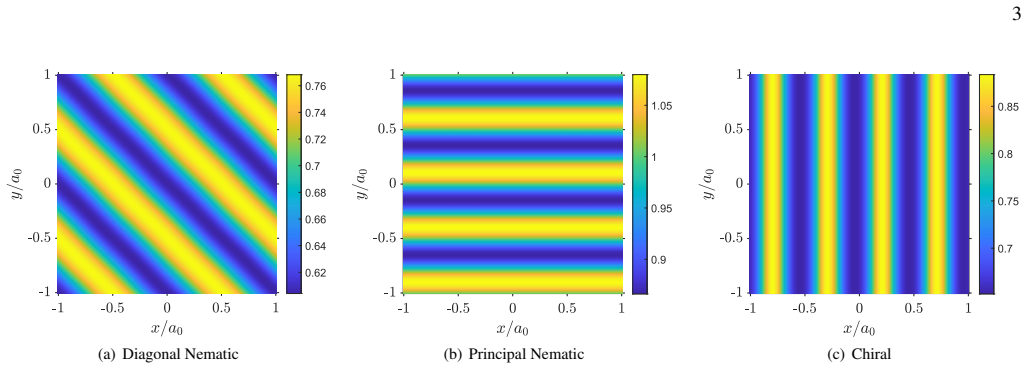
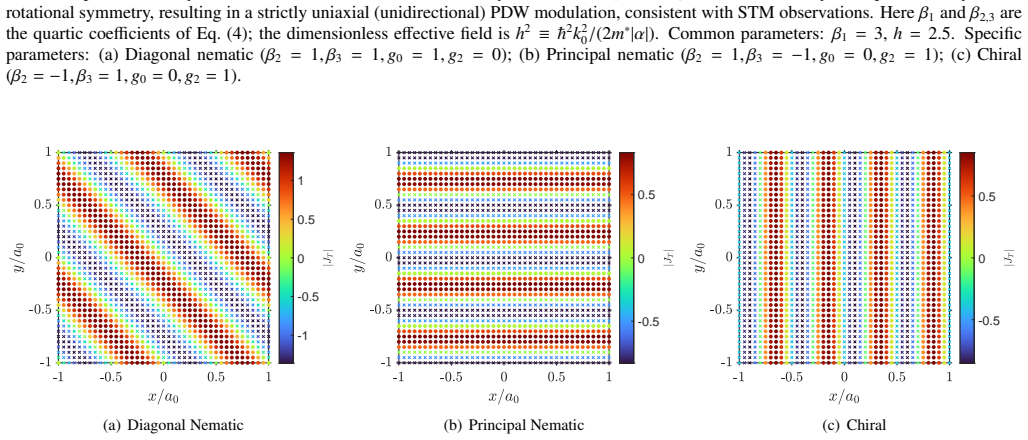
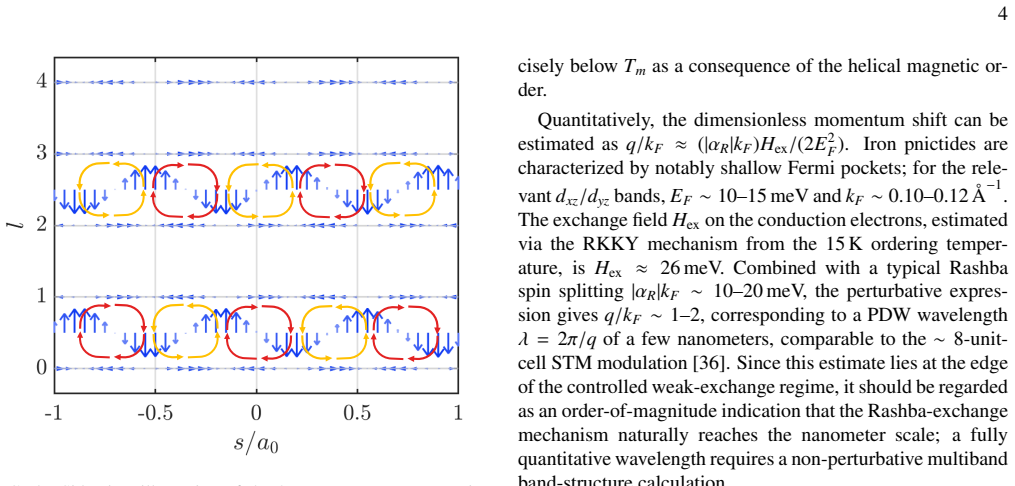
Here, the diagonal nematic state is depicted, which produces density modulations along the diagonal axes (correspond- ing to the Fe-Fe bond directions in the crystal), in excellent agree- ment with STM observations [36]. The spatially oscillating inter- layer phase difference drives alternating Josephson tunneling cur- rents, forming a periodic array of J...
-
[2]
E. Berg, E. Fradkin, E.-A. Kim, S. A. Kivelson, V . Oganesyan, J. M. Tranquada, and S. C. Zhang, Phys. Rev. Lett.99, 127003 (2007)
2007
-
[3]
Agterberg and H
D. Agterberg and H. Tsunetsugu, Nat. Phys.4, 639 (2008)
2008
-
[4]
E. Berg, E. Fradkin, S. A. Kivelson, and J. M. Tranquada, New J. Phys.11, 115004 (2009)
2009
-
[5]
E. Berg, E. Fradkin, and S. A. Kivelson, Phys. Rev. Lett.105, 146403 (2010)
2010
-
[6]
Jaefari and E
A. Jaefari and E. Fradkin, Phys. Rev. B85, 035104 (2012)
2012
-
[7]
G. Y . Cho, J. H. Bardarson, Y .-M. Lu, and J. E. Moore, Phys. Rev. B86, 214514 (2012)
2012
-
[8]
Soto-Garrido and E
R. Soto-Garrido and E. Fradkin, Phys. Rev. B89, 165126 (2014)
2014
-
[9]
P. A. Lee, Phys. Rev. X4, 031017 (2014)
2014
-
[10]
Maciejko and R
J. Maciejko and R. Nandkishore, Phys. Rev. B90, 035126 (2014)
2014
-
[11]
Y . Wang, D. F. Agterberg, and A. Chubukov, Phys. Rev. Lett. 114, 197001 (2015)
2015
-
[12]
Jian, Y .-F
S.-K. Jian, Y .-F. Jiang, and H. Yao, Phys. Rev. Lett.114, 237001 (2015)
2015
-
[13]
Jian, C.-H
S.-K. Jian, C.-H. Lin, J. Maciejko, and H. Yao, Phys. Rev. Lett. 118, 166802 (2017)
2017
-
[14]
Y . Wang, S. D. Edkins, M. H. Hamidian, J. C. S. Davis, E. Frad- kin, and S. A. Kivelson, Phys. Rev. B97, 174510 (2018)
2018
-
[15]
Venderley and E.-A
J. Venderley and E.-A. Kim, Sci. Adv.5, eaat4698 (2019)
2019
-
[16]
Z. Han, S. A. Kivelson, and H. Yao, Phys. Rev. Lett.125, 167001 (2020)
2020
-
[17]
Slagle and L
K. Slagle and L. Fu, Phys. Rev. B102, 235423 (2020)
2020
-
[18]
Zhou and Z
S. Zhou and Z. Wang, Nat. Commun.13, 7288 (2022)
2022
-
[19]
K. S. Huang, Z. Han, S. A. Kivelson, and H. Yao, npj Quantum Mater.7, 17 (2022)
2022
-
[20]
Y .-M. Wu, Z. Wu, and H. Yao, Phys. Rev. Lett.130, 126001 (2023)
2023
-
[21]
D. F. Agterberg, J. S. Davis, S. D. Edkins, E. Fradkin, D. J. Van Harlingen, S. A. Kivelson, P. A. Lee, L. Radzihovsky, J. M. Tranquada, and Y . Wang, Annu. Rev. Condens. Matter Phys. 11, 231 (2020)
2020
-
[22]
M. H. Hamidian, S. D. Edkins, S. H. Joo, A. Kostin, H. Eisaki, S. Uchida, M. J. Lawler, E.-A. Kim, A. P. Mackenzie, K. Fujita, J. Lee, and J. C. S. Davis, Nature532, 343 (2016)
2016
-
[23]
W. Ruan, X. Li, C. Hu, Z. Hao, H. Li, P. Cai, X. Zhou, D.-H. Lee, and Y . Wang, Nat. Phys.14, 1178 (2018)
2018
-
[24]
S. D. Edkins, A. Kostin, K. Fujita, A. P. Mackenzie, H. Eisaki, S. Uchida, S. Sachdev, M. J. Lawler, E.-A. Kim, J. C. S. Davis, and M. H. Hamidian, Science364, 976 (2019), https://www.science.org/doi/pdf/10.1126/science.aat1773
-
[25]
X. Li, C. Zou, Y . Ding, H. Yan, S. Ye, H. Li, Z. Hao, L. Zhao, X. Zhou, and Y . Wang, Phys. Rev. X11, 011007 (2021)
2021
-
[26]
Casalbuoni and G
R. Casalbuoni and G. Nardulli, Rev. Mod. Phys.76, 263 (2004)
2004
-
[27]
Fulde and R
P. Fulde and R. A. Ferrell, Phys. Rev.135, A550 (1964)
1964
-
[28]
A. I. Larkin and Y . N. Ovchinnikov, Sov. Phys. JETP28, 1200 (1969)
1969
-
[29]
Liu, Phys
C.-X. Liu, Phys. Rev. Lett.118, 087001 (2017)
2017
-
[30]
J. M. Lu, O. Zheliuk,et al., Science350, 1353 (2015)
2015
-
[31]
Saito, Y
Y . Saito, Y . Nakamura,et al., Nat. Phys.12, 144 (2016)
2016
-
[32]
X. Xi, Z. Wang,et al., Nat. Phys.12, 139 (2016)
2016
-
[33]
Z. Zhu, M. Papaj, X.-A. Nie, H.-K. Xu, Y .-S. Gu, X. Yang, D. Guan, S. Wang, Y . Li, C. Liu, J. Luo, Z.-A. Xu, H. Zheng, L. Fu, and J.-F. Jia, Science374, 1381 (2021)
2021
-
[34]
W. E. Lawrence and S. Doniach, inProc. 12th Int. Conf. Low Temp. Phys., edited by E. Kanda (Academic, Kyoto, 1971) p. 361
1971
-
[35]
Yang and S
K. Yang and S. L. Sondhi, J. Appl. Phys.87, 5549 (2000)
2000
-
[36]
Qiu and Y
G.-W. Qiu and Y . Zhou, Phys. Rev. B105, L100506 (2022)
2022
-
[37]
H. Zhao, R. Blackwell, M. Thinel, T. Handa, S. Ishida, X. Zhu, A. Iyo, H. Eisaki, A. N. Pasupathy, and K. Fujita, Nature618, 940 (2023)
2023
-
[38]
Liu, Y .-B
Y . Liu, Y .-B. Liu, Z.-T. Tang, H. Jiang, Z.-C. Wang, A. Ablimit, W.-H. Jiao, Q. Tao, C.-M. Feng, Z.-A. Xu, and G.-H. Cao, Phys. Rev. B93, 214503 (2016)
2016
-
[39]
Kawashima, T
K. Kawashima, T. Kinjo, T. Nishio, S. Ishida, H. Fujihisa, Y . Gotoh, K. Kihou, H. Eisaki, Y . Yoshida, and A. Iyo, J. Phys. Soc. Jpn.85, 064710 (2016)
2016
-
[40]
Y .-B. Liu, Y . Liu, and G.-H. Cao, J. Phys.: Condens. Matter 34, 093001 (2021)
2021
-
[41]
K. Iida, Y . Nagai, S. Ishida, M. Ishikado, N. Murai, A. D. Christianson, H. Yoshida, Y . Inamura, H. Nakamura, A. Nakao, K. Munakata, D. Kagerbauer, M. Eisterer, K. Kawashima, Y . Yoshida, H. Eisaki, and A. Iyo, Phys. Rev. B100, 014506 (2019)
2019
-
[42]
Smidman, M
M. Smidman, M. B. Salamon, H. Q. Yuan, and D. F. Agterberg, Rep. Prog. Phys.80, 036501 (2017)
2017
-
[43]
R. P. Kaur, D. F. Agterberg, and M. Sigrist, Phys. Rev. Lett.94, 137002 (2005)
2005
-
[44]
D. F. Agterberg, inNon-centrosymmetric Superconductors: In- troduction and Overview, Lecture Notes in Physics, V ol. 847, edited by E. Bauer and M. Sigrist (Springer, 2012) pp. 155– 170
2012
-
[45]
T. Kim, K. S. Pervakov, D. V . Evtushinsky, S.-W. Jung, G. Poelchen, K. Kummer, V . A. Vlasenko, A. V . Sadakov, A. S. Usol’tsev, V . M. Pudalov, D. Roditchev, V . S. Stolyarov, D. V . Vyalikh, V . Borisov, R. Valent´ı, A. Ernst, S. V . Eremeev, and E. V . Chulkov, Phys. Rev. B103, 174517 (2021)
2021
-
[46]
Hemmida, N
M. Hemmida, N. Winterhalter-Stocker, D. Ehlers, H.-A. Krug von Nidda, M. Yao, J. Bannies, E. D. L. Rienks, R. Kurleto, C. Felser, B. B ¨uchner, J. Fink, S. Gorol, T. F¨orster, S. Arsenijevic, V . Fritsch, and P. Gegenwart, Phys. Rev. B103, 195112 (2021)
2021
-
[47]
M. I. Aroyo, J. M. Perez-Mato, D. Orobengoa, E. Tasci, G. de la Flor, and A. Kirov, Bulg. Chem. Commun.43, 183 (2011)
2011
-
[48]
Perez-Mato, S
J. Perez-Mato, S. Gallego, E. Tasci, L. Elcoro, G. de la Flor, and M. Aroyo, Annu. Rev. Mater. Res.45, 217 (2015)
2015
-
[49]
Tinkham,Group Theory and Quantum Mechanics (Dover Books on Chemistry)(Dover Publications, 2003)
M. Tinkham,Group Theory and Quantum Mechanics (Dover Books on Chemistry)(Dover Publications, 2003)
2003
-
[50]
A helical Rashba–exchange gauge field drives a uniaxial pair density wave in EuRbFe4As4
M. I. Aroyo, A. Kirov, C. Capillas, J. M. Perez-Mato, and H. Wondratschek, Acta Crystallogr. A62, 115 (2006). 1 Supplemental Material for “A helical Rashba–exchange gauge field drives a uniaxial pair density wave in EuRbFe4As4” Pengfei Li1 and Yi Zhou2 1Department of Physics, The Hong Kong University of Science and Technology, Clear Water Bay, Kowloon, Ho...
2006
-
[51]
Bloch SC state
and the other is exactly zero (soft mode, spinor (1,−1)/ √ 2). The Josephson source driving the (−1,−1) harmonic on layerl+1 is given by: Sl =g 0 ul vl −g 2 (iσy) ul vl .(F.4) Projecting this source vectorS l onto the zero-energy soft mode dictates the critical threshold for the Bloch instability for each respective decoupled sta...
discussion (0)
Sign in with ORCID, Apple, or X to comment. Anyone can read and Pith papers without signing in.