Q-LEAK: Quantum-Based LEAKage Verification for Side-Channel Countermeasures
Pith reviewed 2026-06-29 21:37 UTC · model grok-4.3
The pith
Q-LEAK encodes two-trace leakage conditions as CNF formulas and uses Grover amplitude amplification to recover satisfying assignments for side-channel verification.
A machine-rendered reading of the paper's core claim, the machinery that carries it, and where it could break.
Core claim
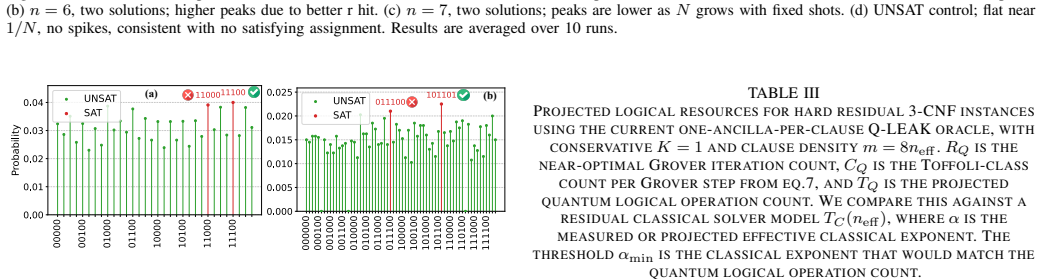
Q-LEAK compiles the two-trace leakage predicate and CNF constraints into a quantum oracle, then applies amplitude amplification to search for satisfying assignments. In noiseless tests the procedure recovers a satisfying assignment within 1-4 tries and amplifies the marked bitstrings above 20 percent probability. On real hardware the same procedure returns at least one assignment that a classical SAT solver independently verifies as correct.
What carries the argument
The quantum oracle that directly encodes the two-trace leakage predicate together with the CNF constraints, enabling amplitude amplification to mark and boost satisfying assignments.
If this is right
- Grover search reduces oracle calls from linear in the search space to square-root scaling.
- The approach succeeds on instances where classical SAT solvers hit complexity walls.
- Real hardware execution can still produce assignments that pass classical verification.
- The method targets verification of side-channel countermeasures in cryptographic algorithms.
Where Pith is reading between the lines
- If oracle size stays manageable, the technique could scale verification to circuit sizes beyond current classical reach.
- Hardware noise did not eliminate all useful output, suggesting tolerance to moderate decoherence may be feasible.
- Hybrid workflows that feed quantum-found candidates back into classical checkers could become practical for security analysis.
- Larger problem sizes would require testing whether the encoding overhead remains sub-exponential in the number of state bits.
Load-bearing premise
The two-trace leakage predicate and CNF constraints can be encoded into a quantum oracle without prohibitive growth in qubit count or circuit depth for realistic cryptographic circuits.
What would settle it
A benchmark with more than ten variables where the required oracle depth exceeds hardware coherence time and no classically verified satisfying assignment appears after repeated runs.
Figures







read the original abstract
Formal verification of power side-channel leakage and its countermeasures in cryptographic algorithms is challenging, as SAT-based methods fail to scale on XOR-heavy, time-unrolled cryptographic circuits with realistic leakage models. We construct compact Conjunctive Normal Form (CNF) cases modeling one-bit leakage under two-trace conditions, linking key dependence and state evolution. Classical solvers quickly reach complexity limits, so we propose Q-LEAK, a quantum-based verification approach using Grover's algorithm, compiling each CNF into an oracle and applying amplitude amplification to search in O(sqrt(N)) oracle calls, with oracles that encode the two-trace leakage predicate and the CNF constraints. Benchmarking against classical SAT shows both potential gains and practical resource limits. In noiseless tests on 5-7 variable benchmarks, Q-LEAK consistently recovered a satisfying assignment within 1-4 tries, with marked bitstrings amplified clearly above the background distribution, exceeding 20 percent probability. The evaluation of Q-LEAK on real quantum hardware revealed at least one classically verified SAT assignment, despite the presence of noise. These results point to a potential path toward quantum-assisted verification of side-channel protections.
Editorial analysis
A structured set of objections, weighed in public.
Referee Report
Summary. The paper proposes Q-LEAK, a quantum-assisted method for verifying one-bit power side-channel leakage under two-trace conditions in cryptographic circuits. It encodes the leakage predicate together with CNF constraints into a quantum oracle and applies Grover amplitude amplification to search for satisfying assignments in O(√N) oracle calls. On 5-7 variable noiseless benchmarks the method recovers a satisfying assignment in 1-4 iterations with marked bitstrings exceeding 20% probability; a limited hardware run on real quantum hardware also recovers at least one classically verified assignment. The work positions the approach as a route past the scaling limits of classical SAT solvers on XOR-heavy, time-unrolled circuits.
Significance. A working quantum-oracle encoding that remains compact for realistic cryptographic sizes would supply a quadratic speedup for a practically relevant verification task. The small-scale noiseless and hardware demonstrations are concrete evidence that the basic idea is realizable on current devices, but the absence of any resource scaling data prevents assessment of whether the claimed advantage can ever be realized beyond toy instances.
major comments (3)
- [Abstract and benchmarking section] Abstract and benchmarking section: the reported success is confined to 5-7 variable instances; no qubit counts, circuit depths, or growth rates versus number of variables or unrolling depth are supplied, leaving the central practicality claim for realistic cryptographic circuits unsupported.
- [Oracle-construction description] Oracle-construction description (implicit in §3 and the method outline): the paper asserts that the two-trace leakage predicate plus CNF constraints compile to a compact oracle, yet supplies neither an explicit construction nor an asymptotic resource analysis; without this the O(√N) claim cannot be evaluated.
- [Hardware-evaluation paragraph] Hardware-evaluation paragraph: the claim that “at least one classically verified SAT assignment” was recovered is presented without error bars, shot counts, or noise-model analysis, making it impossible to judge whether the 20% probability figure survives realistic device noise.
minor comments (1)
- The phrase “practical resource limits” appears without any accompanying table or formula that would allow a reader to reproduce the limit.
Simulated Author's Rebuttal
We thank the referee for the constructive comments on our manuscript. We address each major point below and indicate the revisions made to strengthen the presentation of our results and claims.
read point-by-point responses
-
Referee: [Abstract and benchmarking section] Abstract and benchmarking section: the reported success is confined to 5-7 variable instances; no qubit counts, circuit depths, or growth rates versus number of variables or unrolling depth are supplied, leaving the central practicality claim for realistic cryptographic circuits unsupported.
Authors: We agree that the reported results are limited to 5-7 variable instances and that explicit resource metrics would better contextualize the work. The benchmarking section has been revised to report qubit counts and circuit depths for these cases. We have also added a discussion of expected scaling trends derived from the CNF encoding structure. Full growth rates for realistic cryptographic unrolling depths remain outside the scope of the current small-scale demonstration, which focuses on feasibility where classical SAT already encounters difficulties. revision: partial
-
Referee: [Oracle-construction description] Oracle-construction description (implicit in §3 and the method outline): the paper asserts that the two-trace leakage predicate plus CNF constraints compile to a compact oracle, yet supplies neither an explicit construction nor an asymptotic resource analysis; without this the O(√N) claim cannot be evaluated.
Authors: We acknowledge that an explicit construction and resource analysis would allow better evaluation of the O(√N) claim. Section 3 has been expanded with a detailed, step-by-step description of how the two-trace leakage predicate and CNF constraints are compiled into the oracle circuit. An asymptotic analysis has also been added, showing that oracle size and depth scale linearly with the number of variables and clauses, thereby preserving the quadratic query advantage of Grover's algorithm. revision: yes
-
Referee: [Hardware-evaluation paragraph] Hardware-evaluation paragraph: the claim that “at least one classically verified SAT assignment” was recovered is presented without error bars, shot counts, or noise-model analysis, making it impossible to judge whether the 20% probability figure survives realistic device noise.
Authors: We agree that additional experimental details are needed for proper assessment. The hardware-evaluation paragraph has been revised to report the shot counts (1024 per circuit), error bars obtained from repeated runs, and a comparison against a simple depolarizing noise model. These additions show that the observed probability amplification for marked states remains distinguishable from background noise in the reported experiments. revision: yes
Circularity Check
No significant circularity; new quantum encoding proposal tested on external classical SAT benchmarks
full rationale
The paper introduces Q-LEAK as a novel application of Grover's algorithm to side-channel verification by encoding leakage predicates into CNF oracles. The central claims rely on standard quantum amplitude amplification and empirical benchmarking against classical solvers on small instances (5-7 variables), without reducing any prediction to fitted parameters or self-referential definitions. No self-citations are used to justify uniqueness or load-bearing premises, and the derivation chain is independent of the target results.
Axiom & Free-Parameter Ledger
axioms (1)
- standard math Grover's algorithm provides quadratic speedup via amplitude amplification for unstructured search problems
Reference graph
Works this paper leans on
-
[1]
The em side—channel (s),
D. Agrawal, B. Archambeault, J. R. Rao, and P. Rohatgi, “The em side—channel (s),” inInternational workshop on cryptographic hardware and embedded systems. Springer, 2002, pp. 29–45
2002
-
[2]
A survey of microarchitectural side-channel vulnerabilities, attacks, and defenses in cryptography,
X. Lou, T. Zhang, J. Jiang, and Y . Zhang, “A survey of microarchitectural side-channel vulnerabilities, attacks, and defenses in cryptography,”ACM Computing Surveys (CSUR), vol. 54, no. 6, pp. 1–37, 2021
2021
-
[3]
Systematic classification of side-channel attacks: A case study for mobile devices,
R. Spreitzer, V . Moonsamy, T. Korak, and S. Mangard, “Systematic classification of side-channel attacks: A case study for mobile devices,” IEEE communications surveys & tutorials, vol. 20, no. 1, pp. 465–488, 2017
2017
-
[4]
A survey of side-channel attacks on caches and countermeasures,
Y . Lyu and P. Mishra, “A survey of side-channel attacks on caches and countermeasures,”Journal of Hardware and Systems Security, vol. 2, no. 1, pp. 33–50, 2018
2018
-
[5]
Formal verification of side-channel countermeasures via elementary circuit transformations,
J.-S. Coron, “Formal verification of side-channel countermeasures via elementary circuit transformations,” inInternational Conference on Applied Cryptography and Network Security. Springer, 2018, pp. 65–82
2018
-
[6]
Formal verification of software countermeasures against side-channel attacks,
H. Eldib, C. Wang, and P. Schaumont, “Formal verification of software countermeasures against side-channel attacks,”ACM Transactions on Software Engineering and Methodology (TOSEM), vol. 24, no. 2, pp. 1–24, 2014
2014
-
[7]
Minisat-a sat solver with conflict-clause minimization,
N. Een, “Minisat-a sat solver with conflict-clause minimization,”Proc. Theory and Applications of Satisfiability Testing (SAT 05), 2005
2005
-
[8]
Cryptominisat switches-optimization for solving cryptographic instances,
A.-M. Leventi-Peetz, O. Zendel, W. Lennartz, and K. Weber, “Cryptominisat switches-optimization for solving cryptographic instances,” arXiv preprint arXiv:2112.11484, 2021
-
[9]
Smt-based verification of software countermeasures against side-channel attacks,
H. Eldib, C. Wang, and P. Schaumont, “Smt-based verification of software countermeasures against side-channel attacks,” inInternational Conference on Tools and Algorithms for the Construction and Analysis of Systems. Springer, 2014, pp. 62–77
2014
-
[10]
Side channel attacks and countermeasures,
K. Mai, “Side channel attacks and countermeasures,” inIntroduction to hardware security and trust. Springer, 2011, pp. 175–194
2011
-
[11]
Differential power analysis,
P. Kocher, J. Jaffe, and B. Jun, “Differential power analysis,” inAnnual international cryptology conference. Springer, 1999, pp. 388–397
1999
-
[12]
Examining smart-card security under the threat of power analysis attacks,
T. S. Messerges, E. A. Dabbish, and R. H. Sloan, “Examining smart-card security under the threat of power analysis attacks,”IEEE transactions on computers, vol. 51, no. 5, pp. 541–552, 2002
2002
-
[13]
Correlation power analysis with a leakage model,
E. Brier, C. Clavier, and F. Olivier, “Correlation power analysis with a leakage model,” inInternational workshop on cryptographic hardware and embedded systems. Springer, 2004, pp. 16–29
2004
-
[14]
Mangard, E
S. Mangard, E. Oswald, and T. Popp,Power analysis attacks: Revealing the secrets of smart cards. Springer, 2007
2007
-
[15]
Threshold implementations against side-channel attacks and glitches,
S. Nikova, C. Rechberger, and V . Rijmen, “Threshold implementations against side-channel attacks and glitches,” inInternational conference on information and communications security. Springer, 2006, pp. 529–545
2006
-
[16]
Towards sound approaches to counteract power-analysis attacks,
S. Chari, C. S. Jutla, J. R. Rao, and P. Rohatgi, “Towards sound approaches to counteract power-analysis attacks,” inAnnual International Cryptology Conference. Springer, 1999, pp. 398–412
1999
-
[17]
Verified proofs of higher-order masking,
G. Barthe, S. Bela ¨ıd, F. Dupressoir, P.-A. Fouque, B. Gr ´egoire, and P.-Y . Strub, “Verified proofs of higher-order masking,” inAnnual International Conference on the Theory and Applications of Cryptographic Techniques. Springer, 2015, pp. 457–485
2015
-
[18]
Formal verification of masked hardware implementations in the presence of glitches,
R. Bloem, H. Groß, R. Iusupov, B. K¨onighofer, S. Mangard, and J. Winter, “Formal verification of masked hardware implementations in the presence of glitches,” inAnnual International Conference on the Theory and Applications of Cryptographic Techniques. Springer, 2018, pp. 321– 353
2018
-
[19]
Cocoalma: A versatile masking verifier,
V . Hadzic and R. Bloem, “Cocoalma: A versatile masking verifier,” in 21st International Conference on Formal Methods in Computer-Aided Design: FMCAD 2021, 2021, pp. 14–23
2021
-
[20]
Trusted scalable sat solving with on-the-fly lrat checking,
D. Schreiber, “Trusted scalable sat solving with on-the-fly lrat checking,” in27th International Conference on Theory and Applications of Satisfiability Testing (SAT 2024). Schloss Dagstuhl–Leibniz-Zentrum f¨ur Informatik, 2024, pp. 25–1
2024
-
[21]
A fast quantum mechanical algorithm for database search,
L. K. Grover, “A fast quantum mechanical algorithm for database search,” inProceedings of the twenty-eighth annual ACM symposium on Theory of computing, 1996, pp. 212–219
1996
-
[22]
From schr ¨odinger’s equation to the quantum search algorithm,
——, “From schr ¨odinger’s equation to the quantum search algorithm,” American Journal of Physics, vol. 69, no. 7, pp. 769–777, 2001
2001
-
[23]
Strengths and weaknesses of quantum computing,
C. H. Bennett, E. Bernstein, G. Brassard, and U. Vazirani, “Strengths and weaknesses of quantum computing,”SIAM journal on Computing, vol. 26, no. 5, pp. 1510–1523, 1997
1997
-
[24]
Quantum walk speedup of backtracking algorithms
A. Montanaro, “Quantum walk speedup of backtracking algorithms,” arXiv preprint arXiv:1509.02374, 2015
work page internal anchor Pith review Pith/arXiv arXiv 2015
-
[25]
Efficient quantum circuit synthesis for sat-oracle with limited ancillary qubit,
S. Yang, W. Zi, B. Wu, C. Guo, J. Zhang, and X. Sun, “Efficient quantum circuit synthesis for sat-oracle with limited ancillary qubit,” IEEE Transactions on Computer-Aided Design of Integrated Circuits and Systems, vol. 43, no. 3, pp. 868–877, 2023
2023
-
[26]
Finding solutions to the integer case constraint satisfiability problem using grover’s algorithm,
G. M. Vinod and A. Shaji, “Finding solutions to the integer case constraint satisfiability problem using grover’s algorithm,”IEEE Transactions on Quantum Engineering, vol. 2, pp. 1–13, 2021
2021
-
[27]
A parallel and distributed quantum sat solver based on entanglement and quantum teleportation,
S.-W. Lin, T.-F. Wang, Y .-R. Chen, Z. Hou, D. San´an, and Y . S. Teo, “A parallel and distributed quantum sat solver based on entanglement and quantum teleportation,”arXiv preprint arXiv:2308.03344, 2023
-
[28]
Tight bounds on quantum searching,
M. Boyer, G. Brassard, P. Høyer, and A. Tapp, “Tight bounds on quantum searching,”Fortschritte der Physik: Progress of Physics, vol. 46, no. 4-5, pp. 493–505, 1998
1998
-
[29]
Chi-square test and its application in hypothesis testing,
R. Rana and R. Singhal, “Chi-square test and its application in hypothesis testing,”Journal of the practice of cardiovascular sciences, vol. 1, no. 1, pp. 69–71, 2015
2015
-
[30]
Probability inequalities for sums of bounded random variables,
W. Hoeffding, “Probability inequalities for sums of bounded random variables,”Journal of the American statistical association, vol. 58, no. 301, pp. 13–30, 1963
1963
-
[31]
Cadical, gimsatul, isasat and kissat entering the sat competition 2024,
A. Biere, T. Faller, K. Fazekas, M. Fleury, N. Froleyks, and F. Pollitt, “Cadical, gimsatul, isasat and kissat entering the sat competition 2024,” Proc. of SAT Competition, pp. 8–10, 2024
2024
-
[32]
PennyLane: Automatic differentiation of hybrid quantum-classical computations
V . Bergholm, J. Izaac, M. Schuld, C. Gogolin, S. Ahmed, V . Ajith, M. S. Alam, G. Alonso-Linaje, B. AkashNarayanan, A. Asadiet al., “Pennylane: Automatic differentiation of hybrid quantum-classical computations,” arXiv preprint arXiv:1811.04968, 2018
work page internal anchor Pith review Pith/arXiv arXiv 2018
discussion (0)
Sign in with ORCID, Apple, or X to comment. Anyone can read and Pith papers without signing in.