Freezing of the tetrahedral amorphous network in supercooled water triggers crystallization towards LDA ice
Pith reviewed 2026-06-29 19:41 UTC · model grok-4.3
The pith
Freezing of the tetrahedral network at 235 K switches supercooled water relaxation from liquid fluctuations to crystallization into LDA ice.
A machine-rendered reading of the paper's core claim, the machinery that carries it, and where it could break.
Core claim
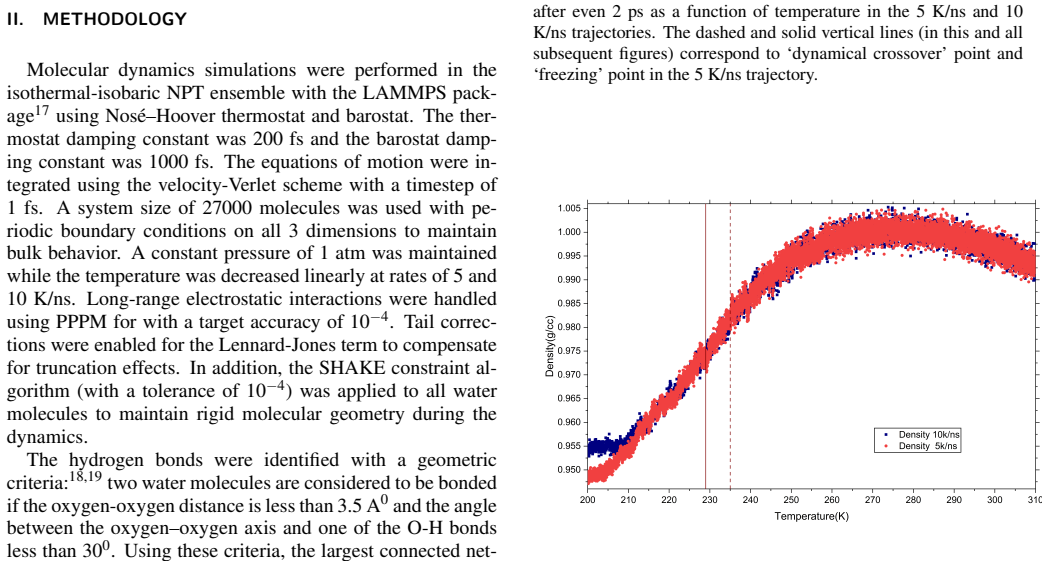
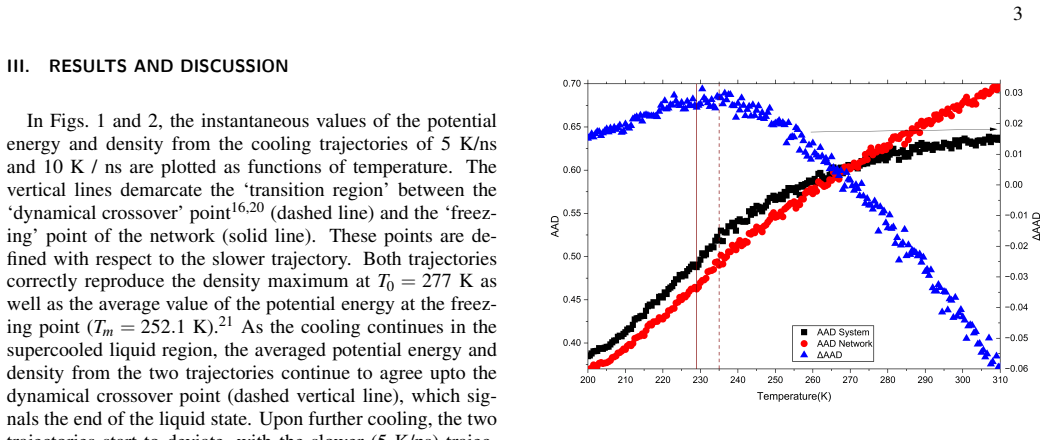
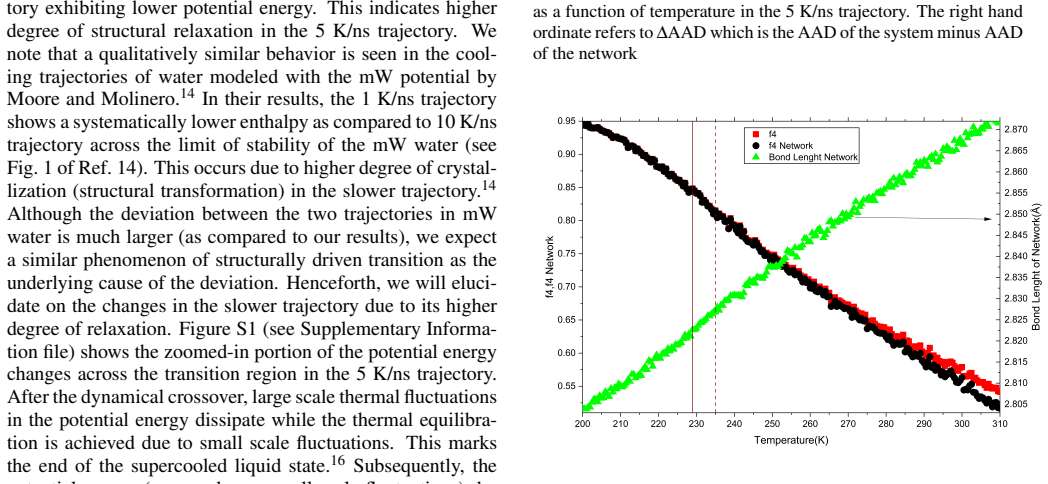
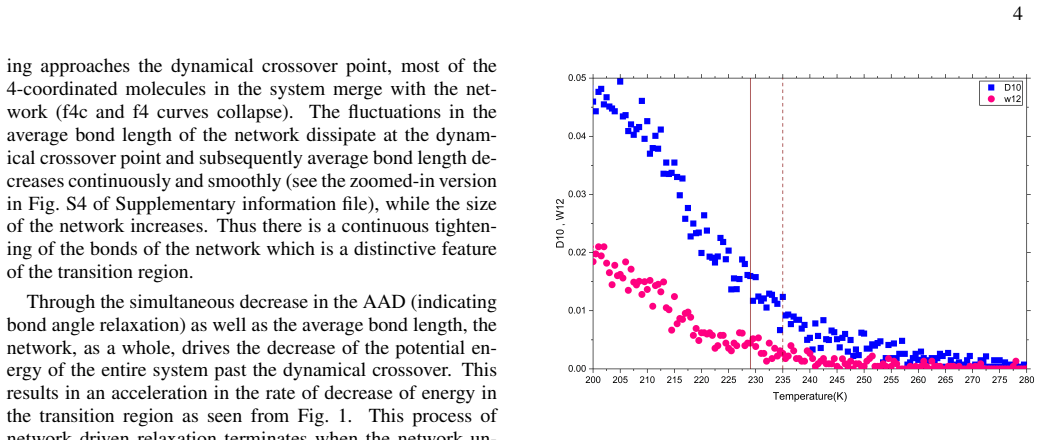
As the liquid is cooled across Ts ≈ 235 K, large scale thermal fluctuations dissipate while thermal equilibration is achieved through small scale fluctuations. The tetrahedral network drives the decrease of energy and density. This process terminates when the network undergoes freezing (i.e., the bonds of the network acquire sufficient rigidity), due to which the network evolution, as a whole, stops. This triggers a qualitative change in the relaxation mechanism: subsequent relaxation occurs through crystallization, i.e., an increase in the structural order. In particular, the cubic and hexagonal crystalline motifs increase rapidly across the freezing point, yielding LDA ice states in which
What carries the argument
Freezing of the tetrahedral amorphous network, defined as the point at which its bonds acquire sufficient rigidity and thereby halt network evolution as a whole.
If this is right
- The dynamical crossover at Ts ends the existence of the liquid state.
- Network freezing causes relaxation to switch from fluctuation-driven equilibration to an increase in medium-range crystalline order.
- Cubic ice motifs contribute substantially to the final LDA ice.
- Crystallization to LDA ice is initiated directly across the limit of stability rather than by conventional nucleation.
Where Pith is reading between the lines
- The same rigidity threshold may mark the end of liquid-like behavior in other tetrahedral liquids or in models of silica.
- Varying the definition of bond rigidity or the water model could shift the temperature at which crystallization begins, providing a test of the mechanism.
- The reported preference for cubic over hexagonal motifs in the resulting LDA may influence the kinetics of further ice growth at still lower temperatures.
Load-bearing premise
The TIP4P/2005 potential together with the chosen measure of bond rigidity correctly captures the physics that ends liquid-like relaxation and initiates crystallization in real supercooled water.
What would settle it
Observation in simulation or experiment that crystalline order begins to rise before the tetrahedral bonds reach the rigidity threshold identified in the runs would falsify the claimed trigger.
Figures


read the original abstract
In this work, we provide mechanistic insight into the initial stages of formation of ice across the limit of stability of supercooled water. Such an analysis is particularly important since crystal nucleation is not a relevant mechanism under these conditions. Using molecular dynamics simulation with the TIP4P/2005 potential, water is cooled at a constant pressure with cooling rates of 5 to 10 K per nanosecond. As the liquid is cooled across the temperature of maximum density (T_0 = 277 K), we find that there is a continuous increase in the tetrahedrality of the system. As the cooling continues across the limit of stability of water (T_s $\approx$ 235 K), large scale thermal fluctuations dissipate while the thermal equilibration is achieved through small scale fluctuations. This phenomenon, known as the dynamical crossover [Goutam et. al. in J. Stat. Phys., 168: 1302--1318 (2017)], ends the existence of the liquid state. Subsequently, we find that the tetrahedral network drives the decrease of energy and density. This process terminates when the network undergoes `freezing' (i.e., the bonds of the network acquire sufficient rigidity), due to which the network evolution, as a whole, stops. This triggers a qualitative change in the relaxation mechanism: subsequent relaxation occurs through crystallization, i.e., an increase in the structural order. In particular, we find that the cubic and hexagonal crystalline motifs, which possess medium range order, increase rapidly across the freezing point. In the resulting LDA ice states, cubic ice is found to have a significant contribution in the overall extent of crystallization, which is consistent with the experimental findings. Overall, our work provides the specific mechanism by which crystallization (leading to LDA ice) is initiated across the limit of stability of supercooled water.
Editorial analysis
A structured set of objections, weighed in public.
Referee Report
Summary. The manuscript presents molecular dynamics simulations of supercooled water using the TIP4P/2005 potential, cooled at constant pressure with rates of 5-10 K/ns. It claims that crossing the temperature of maximum density leads to increasing tetrahedrality, and crossing the limit of stability Ts ≈ 235 K results in a dynamical crossover that ends the liquid state. Subsequently, the tetrahedral network drives decreases in energy and density until it 'freezes' when bonds acquire sufficient rigidity, stopping network evolution and triggering relaxation via crystallization into LDA ice, marked by rapid increases in cubic and hexagonal motifs.
Significance. If substantiated, the work provides a mechanistic explanation for the onset of crystallization in supercooled water beyond the limit of stability, linking network rigidity to the shift from liquid-like to crystalline relaxation. This aligns with experimental observations of significant cubic ice in LDA states and builds on prior dynamical crossover findings. The MD approach offers concrete trajectories for the structural changes.
major comments (3)
- [Abstract] The definition of the network 'freezing' point, where bonds acquire 'sufficient rigidity' and network evolution stops, is not shown to be independent of the dynamical crossover at Ts ≈ 235 K reported in the authors' 2017 J. Stat. Phys. paper. This creates a risk of circularity, as the same phenomenology may be used both to identify the crossover and to locate the freezing transition that is claimed to trigger the change in relaxation mechanism.
- [Abstract] No quantitative threshold or operational metric is provided for what constitutes 'sufficient rigidity' of the network bonds, nor is an a-priori criterion given that would allow the freezing point to be predicted without reference to the observed energy/density relaxation or fluctuation suppression.
- [Abstract] The manuscript reports no error bars on the increases in cubic and hexagonal crystalline motifs, and does not test whether the observed sequence of network freezing followed by crystallization persists at slower cooling rates or is influenced by the 5-10 K/ns rate used.
minor comments (1)
- The abstract refers to 'large scale thermal fluctuations dissipate while the thermal equilibration is achieved through small scale fluctuations' without specifying how these scales are quantified in the simulations.
Simulated Author's Rebuttal
We thank the referee for the constructive and detailed report. The comments highlight important points on clarity and robustness that we address below. We propose targeted revisions to strengthen the manuscript without altering its core findings.
read point-by-point responses
-
Referee: [Abstract] The definition of the network 'freezing' point, where bonds acquire 'sufficient rigidity' and network evolution stops, is not shown to be independent of the dynamical crossover at Ts ≈ 235 K reported in the authors' 2017 J. Stat. Phys. paper. This creates a risk of circularity, as the same phenomenology may be used both to identify the crossover and to locate the freezing transition that is claimed to trigger the change in relaxation mechanism.
Authors: We agree that independence must be demonstrated explicitly. The dynamical crossover at Ts is identified via the suppression of large-scale density fluctuations and the shift to small-scale equilibration, following the criteria in our 2017 J. Stat. Phys. paper. The freezing point is located separately by monitoring when the tetrahedral network's structural evolution halts, quantified via the stabilization of the average hydrogen-bond persistence time and the variance of the local tetrahedral order parameter. These occur at distinct temperatures (freezing below Ts), and we will revise the manuscript to include a dedicated comparison section with supporting time-series plots of both sets of metrics to remove any ambiguity of circularity. revision: partial
-
Referee: [Abstract] No quantitative threshold or operational metric is provided for what constitutes 'sufficient rigidity' of the network bonds, nor is an a-priori criterion given that would allow the freezing point to be predicted without reference to the observed energy/density relaxation or fluctuation suppression.
Authors: This observation is correct; the current description is qualitative. In the revision we will introduce an operational definition of sufficient rigidity as the temperature at which the hydrogen-bond lifetime exceeds 10 ns (the approximate simulation segment length) while the standard deviation of the Steinhardt Q6 parameter falls below 0.015. This threshold is chosen from independent structural analysis of bond dynamics and will be shown to predict the onset of crystallization without reference to the energy or density curves. revision: yes
-
Referee: [Abstract] The manuscript reports no error bars on the increases in cubic and hexagonal crystalline motifs, and does not test whether the observed sequence of network freezing followed by crystallization persists at slower cooling rates or is influenced by the 5-10 K/ns rate used.
Authors: We will add error bars to all motif-fraction plots, computed from at least five independent trajectories. Regarding cooling-rate dependence, the 5–10 K/ns range is the computationally accessible window that still permits observation of the full sequence; substantially slower rates remain out of reach for system sizes needed to capture medium-range order. We will expand the discussion to note consistency across the two rates already employed and alignment with experimental LDA formation timescales, while acknowledging that a full rate-convergence study lies beyond present resources. revision: partial
Circularity Check
No significant circularity; derivation is self-contained from MD observations
full rationale
The paper's claims rest on direct analysis of TIP4P/2005 MD trajectories: continuous rise in tetrahedrality below T0, suppression of large-scale fluctuations at Ts, termination of network evolution when bonds acquire rigidity, and subsequent rapid rise in cubic/hexagonal motifs. The 2017 citation merely names the known dynamical crossover at Ts ≈ 235 K and does not supply the rigidity metric, the observed termination of network evolution, or the link to crystallization; those steps are extracted from the present simulations. No parameter is fitted to the target outcome and then relabeled a prediction, no equation reduces to its input by definition, and the self-citation is not load-bearing for the mechanistic sequence.
Axiom & Free-Parameter Ledger
free parameters (1)
- cooling rate
axioms (2)
- domain assumption The TIP4P/2005 potential reproduces the relevant structural and dynamical features of real supercooled water near 235 K.
- domain assumption The dynamical crossover identified in the 2017 paper marks the termination of the liquid state.
Reference graph
Works this paper leans on
-
[1]
merlin.mbs aapmrev4-1.bst 2010-07-25 4.21a (PWD, AO, DPC) hacked
FUNCTION id.bst "merlin.mbs aapmrev4-1.bst 2010-07-25 4.21a (PWD, AO, DPC) hacked" ENTRY address archive archivePrefix author bookaddress booktitle chapter collaboration doi edition editor eid eprint howpublished institution isbn issn journal key language month note number organization pages primaryClass publisher school SLACcitation series title translat...
2010
-
[2]
merlin.mbs aipauth4-1.bst 2010-07-25 4.21a (PWD, AO, DPC) hacked
FUNCTION id.bst "merlin.mbs aipauth4-1.bst 2010-07-25 4.21a (PWD, AO, DPC) hacked" ENTRY address archive archivePrefix author bookaddress booktitle chapter collaboration doi edition editor eid eprint howpublished institution isbn issn journal key language month note number organization pages primaryClass publisher school SLACcitation series title translat...
2010
-
[3]
merlin.mbs aipnum4-1.bst 2010-07-25 4.21a (PWD, AO, DPC) hacked
FUNCTION id.bst "merlin.mbs aipnum4-1.bst 2010-07-25 4.21a (PWD, AO, DPC) hacked" ENTRY address archive archivePrefix author bookaddress booktitle chapter collaboration doi edition editor eid eprint howpublished institution isbn issn journal key language month note number organization pages primaryClass publisher school SLACcitation series title translati...
2010
-
[4]
merlin.mbs apsrev4-1.bst 2010-07-25 4.21a (PWD, AO, DPC) hacked
FUNCTION id.bst "merlin.mbs apsrev4-1.bst 2010-07-25 4.21a (PWD, AO, DPC) hacked" ENTRY address archive archivePrefix author bookaddress booktitle chapter collaboration doi edition editor eid eprint howpublished institution isbn issn journal key language month note number organization pages primaryClass publisher school SLACcitation series title translati...
2010
-
[5]
merlin.mbs apsrmp4-1.bst 2010-07-25 4.21a (PWD, AO, DPC) hacked
FUNCTION id.bst "merlin.mbs apsrmp4-1.bst 2010-07-25 4.21a (PWD, AO, DPC) hacked" ENTRY address archive archivePrefix author bookaddress booktitle chapter collaboration doi edition editor eid eprint howpublished institution isbn issn journal key language month note number organization pages primaryClass publisher school SLACcitation series title translati...
2010
discussion (0)
Sign in with ORCID, Apple, or X to comment. Anyone can read and Pith papers without signing in.