Competition between pair and single-particle superfluidity in bosonic quasi-flat bands: A Gaussian state approach
Pith reviewed 2026-06-29 19:12 UTC · model grok-4.3
The pith
In a one-dimensional quasi-flat-band model, pair superfluidity stays stable against added single-particle hopping until a transition to conventional single-particle superfluidity occurs.
A machine-rendered reading of the paper's core claim, the machinery that carries it, and where it could break.
Core claim
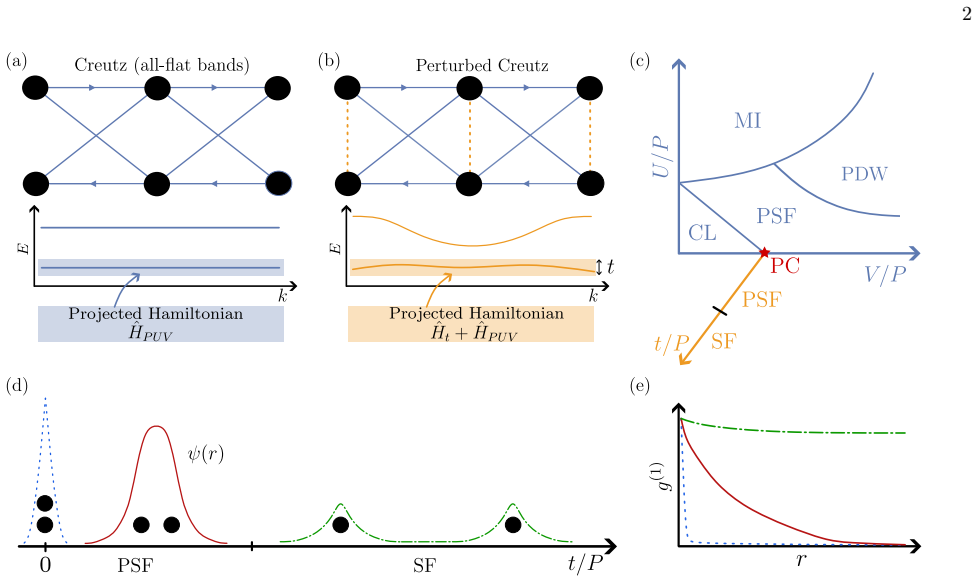
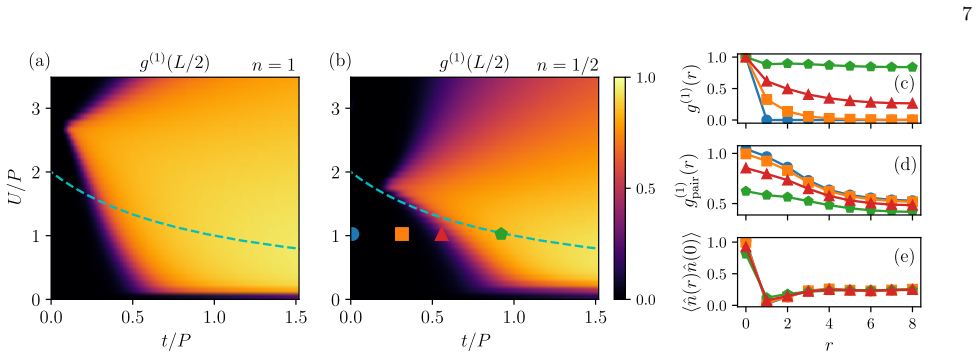
The pair superfluid remains stable for a finite range of the hopping strength until the system eventually transitions into the conventional superfluid phase. The variational Gaussian state approach supplies a unified description of the ground-state wavefunction and the collective excitation spectrum for both phases and yields a general relation between the speed of sound and a quantum geometric kernel that extends earlier single-particle mean-field connections to the quantum metric.
What carries the argument
Variational Gaussian state ansatz that treats single-particle and pair condensates on equal footing while linking the speed of sound to a quantum geometric kernel.
If this is right
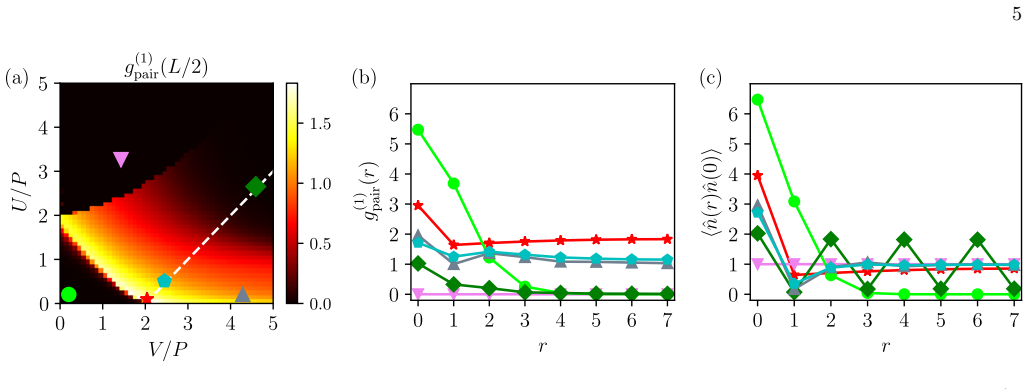
- The phase boundary between pair and single-particle superfluids is set by the competition between the flat-band quantum geometry and the single-particle hopping amplitude.
- The speed of sound in either phase is determined by the same quantum geometric kernel rather than by conventional single-particle mean-field theory.
- The Gaussian ansatz provides a practical route to the full excitation spectrum of interacting bosons in multi-orbital lattices beyond the perfectly flat-band limit.
Where Pith is reading between the lines
- The same Gaussian framework could be applied to two-dimensional quasi-flat bands to test whether pair superfluidity survives longer or shorter hopping intervals than in one dimension.
- If the geometric-kernel relation holds beyond mean-field, it supplies a measurable signature (via sound velocity) that distinguishes geometric from interaction-driven pairing.
- The stability window identified here suggests that pair superfluids may be observable in optical-lattice experiments even when residual single-particle dispersion is deliberately added to control the transition.
Load-bearing premise
The variational Gaussian state accurately captures both the ground-state wavefunction and the collective excitation spectrum for the competing single-particle and pair superfluid phases.
What would settle it
Exact diagonalization or quantum Monte Carlo on the same lattice model that finds either no stable pair-superfluid region or a speed-of-sound mismatch with the predicted geometric-kernel relation.
Figures
read the original abstract
The interplay between interactions and quantum geometry can drive weakly dispersive bosons into different exotic many-body phases. In this work we study a quasi flat-band model in one dimension that exhibits an extended pair-superfluid phase in the all-flat-band limit. Introducing single-particle hopping leads to an intriguing competition with a more conventional single-particle superfluid: we find that the pair superfluid remains stable for a finite range of the hopping strength until the system eventually transitions into the conventional superfluid phase. In our study, we make use of a variational Gaussian state approach that provides a unified description of the single-particle and pair superfluid phases, regarding both the ground state wavefunction and the collective excitation spectrum. In particular, we derive a general relation between the speed of sound and a ``quantum geometric kernel'', thereby extending earlier connections to the quantum metric, which relied on single-particle mean-field theory. This approach is combined with insights from the two-boson problem and exact diagonalization to map out the full phase diagram of the model. Our results show that the Gaussian approach is a versatile tool for studying a broad range of superfluid phases of interacting bosons in multi-orbital lattices.
Editorial analysis
A structured set of objections, weighed in public.
Referee Report
Summary. The manuscript studies the competition between pair superfluid (PSF) and single-particle superfluid (SSF) phases in a one-dimensional bosonic quasi-flat-band lattice model. In the flat-band limit an extended PSF phase is found; finite single-particle hopping is shown to leave the PSF stable over a finite interval before a transition to the conventional SSF phase. A variational Gaussian-state ansatz is used to treat both phases on equal footing for the ground-state wave function and the collective excitation spectrum; a general relation is derived linking the speed of sound to a quantum geometric kernel. The phase boundary is located by combining the variational results with exact two-boson solutions and exact diagonalization.
Significance. If the central claim holds, the work supplies a unified variational framework that extends earlier quantum-geometry–superfluid relations beyond single-particle mean-field theory and demonstrates its utility for competing bosonic phases in multi-orbital lattices. Explicit benchmarking of the Gaussian ansatz against the two-boson problem and exact diagonalization constitutes a concrete strength that increases in the reported phase diagram and excitation spectra.
minor comments (3)
- [§4.2, Eq. (18)] §4.2, Eq. (18): the definition of the quantum geometric kernel K_q is introduced without an explicit statement of its relation to the single-particle quantum metric used in prior literature; a one-sentence comparison would improve readability.
- [Figure 4] Figure 4: the ED data points lack error bars or system-size extrapolation details, making it difficult to judge the precision of the reported PSF–SSF boundary.
- [Appendix B] Appendix B: the derivation of the speed-of-sound formula assumes a particular form of the Gaussian covariance matrix; a brief remark on the range of validity of this assumption would be helpful.
Simulated Author's Rebuttal
We thank the referee for the positive assessment of our manuscript, including the summary of the Gaussian variational approach to pair versus single-particle superfluidity and the derived sound-speed relation. We appreciate the recommendation for minor revision.
Circularity Check
No significant circularity detected
full rationale
The derivation chain is self-contained: the variational Gaussian state provides a unified ansatz for both superfluid phases whose predictions for the phase boundary are cross-validated against independent exact diagonalization and two-boson solutions; the speed-of-sound to quantum-geometric-kernel relation is explicitly derived as an extension of prior single-particle mean-field results rather than obtained by fitting or self-definition; no load-bearing step reduces to a fitted parameter renamed as prediction or to a self-citation whose content is itself unverified within the paper.
Axiom & Free-Parameter Ledger
axioms (1)
- domain assumption Variational Gaussian states provide a unified description of single-particle and pair superfluid phases and their excitations
Reference graph
Works this paper leans on
-
[1]
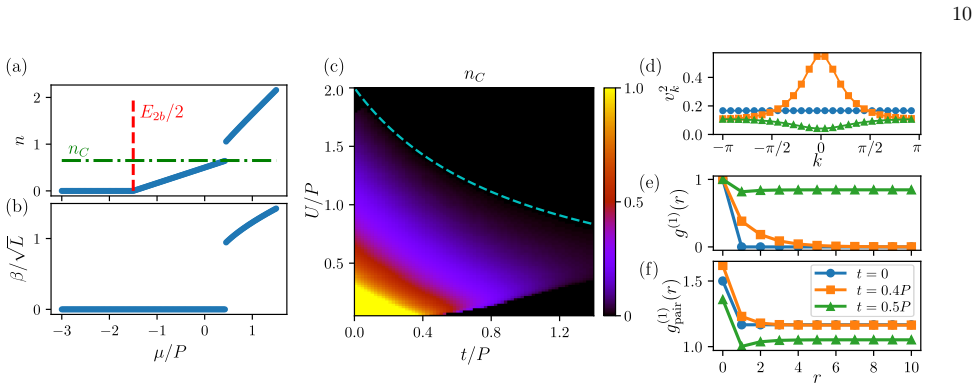
We will then focus on the average density, n= β2 L + 1 L X k v2 k,(38) as a function ofµ
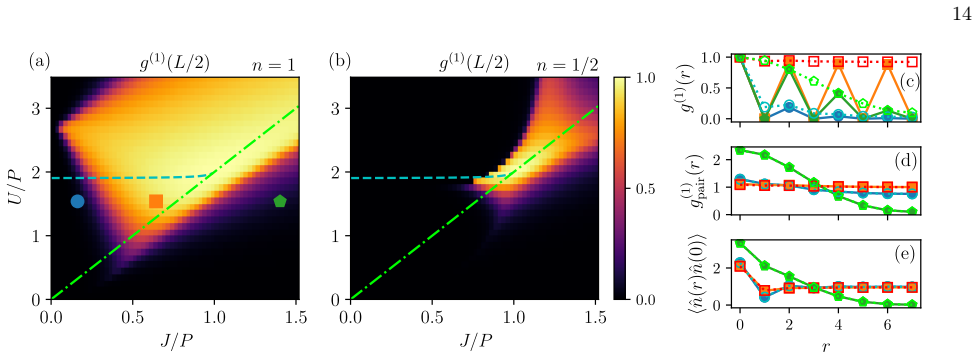
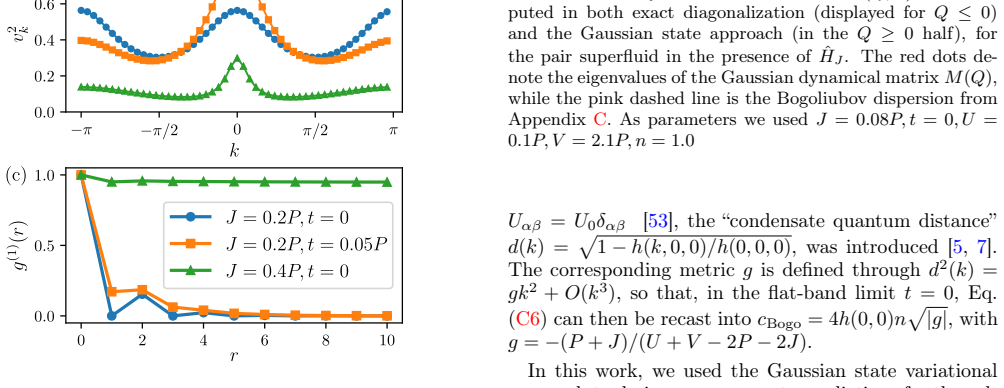
Ground-state properties Since the Gaussian states are not eigenstates of the total particle number operator, it is more convenient to adopt a grand-canonical approach and vary the chemical potentialµas a control parameter. We will then focus on the average density, n= β2 L + 1 L X k v2 k,(38) as a function ofµ. We show the typical behavior of n(µ)in Fig. ...
-
[2]
In ED,S(Q, ω)can be obtained ef- ficiently by relying on Krylov space methods [49]
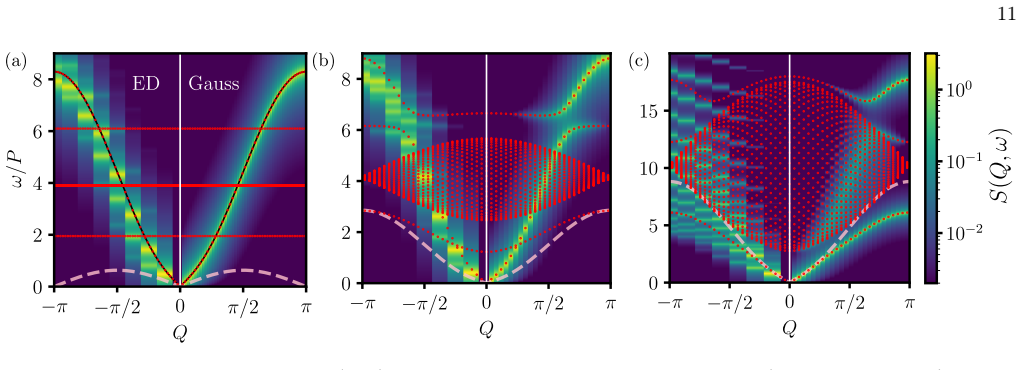
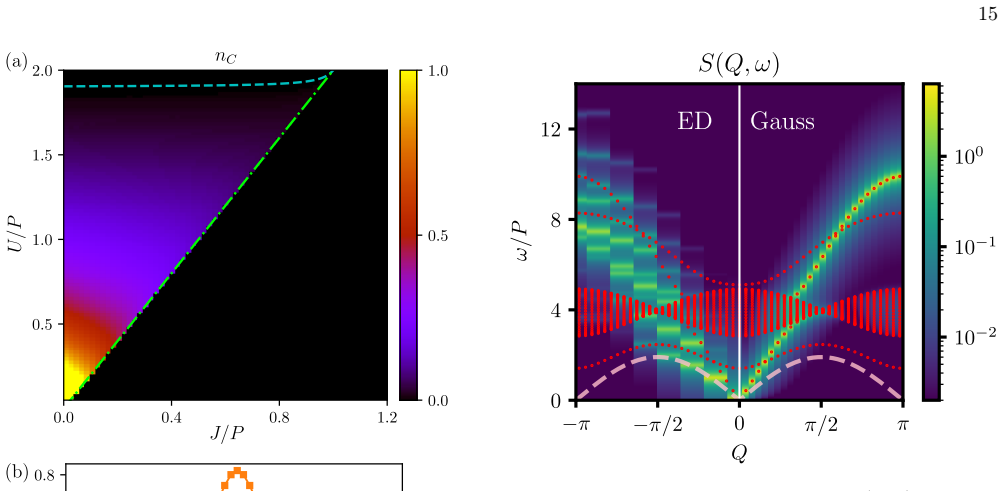
Collective excitations We have evaluated the dynamic structure factor S(Q, ω)using both the Gaussian state approach and ex- act diagonalization. In ED,S(Q, ω)can be obtained ef- ficiently by relying on Krylov space methods [49]. An artificial broadening ofη= 0.1Phas been chosen for the plots, and the colors encode a logarithmic scale. The results for thre...
-
[3]
condensate quantum distance
The shape of the ED dispersion is roughly captured by the Gaussian approach. It seems that, if the lowest and highest weakly dispersive bands opened some gap in the main (bright) dispersion branch, the Gaussian spectrum would resemble even more closely the ED findings. The Bogoliubov prediction is instead rather inaccurate. Appendix B: Pair condensation: ...
-
[4]
S. D. Huber and E. Altman, Bose condensation in flat bands, Phys. Rev. B82, 184502 (2010)
2010
-
[5]
Takayoshi, H
S. Takayoshi, H. Katsura, N. Watanabe, and H. Aoki, Phase diagram and pair Tomonaga-Luttinger liquid in a Bose-Hubbard model with flat bands, Phys. Rev. A88, 063613 (2013)
2013
-
[6]
Tovmasyan, E
M. Tovmasyan, E. P. L. van Nieuwenburg, and S. D. Huber, Geometry-induced pair condensation, Phys. Rev. B88, 220510 (2013)
2013
-
[7]
Julku, G
A. Julku, G. M. Bruun, and P. Törmä, Quantum geome- try and flat band Bose-Einstein condensation, Phys. Rev. Lett.127, 170404 (2021)
2021
-
[8]
Julku, G
A. Julku, G. M. Bruun, and P. Törmä, Excitations of a Bose-Einstein condensate and the quantum geometry of a flat band, Phys. Rev. B104, 144507 (2021)
2021
-
[9]
Salerno, T
G. Salerno, T. Ozawa, and P. Törmä, Drude weight and the many-body quantum metric in one-dimensional Bose systems, Phys. Rev. B108, L140503 (2023)
2023
-
[10]
Julku, G
A. Julku, G. Salerno, and P. Törmä, Superfluidity of flat band Bose-Einstein condensates revisited, Low Temper- ature Physics49, 701 (2023)
2023
-
[11]
Amelio and N
I. Amelio and N. Goldman, Lasing in non-hermitian flat bands: Quantum geometry, coherence, and the fate of Kardar-Parisi-Zhang physics, Phys. Rev. Lett.132, 186902 (2024)
2024
-
[12]
Peotta and P
S. Peotta and P. Törmä, Superfluidity in topologically nontrivial flat bands, Nature Communications6, 8944 (2015)
2015
-
[13]
Herzog-Arbeitman, V
J. Herzog-Arbeitman, V. Peri, F. Schindler, S. D. Huber, and B. A. Bernevig, Superfluid weight bounds from sym- metry and quantum geometry in flat bands, Phys. Rev. Lett.128, 087002 (2022)
2022
-
[14]
Huhtinen, J
K.-E. Huhtinen, J. Herzog-Arbeitman, A. Chew, B. A. Bernevig, and P. Törmä, Revisiting flat band supercon- ductivity: Dependence on minimal quantum metric and band touchings, Phys. Rev. B106, 014518 (2022)
2022
-
[15]
Thumin and G
M. Thumin and G. Bouzerar, Flat-band superconductiv- ity in a system with a tunable quantum metric: The stub lattice, Phys. Rev. B107, 214508 (2023)
2023
-
[16]
H. Tian, X. Gao, Y. Zhang, S. Che, T. Xu, P. Che- ung, K. Watanabe, T. Taniguchi, M. Randeria, F. Zhang, C. N. Lau, and M. W. Bockrath, Evidence for Dirac flat band superconductivity enabled by quantum geometry, Nature614, 440 (2023)
2023
-
[17]
J. Yu, B. A. Bernevig, R. Queiroz, E. Rossi, P. Törmä, and B.-J. Yang, Quantum geometry in quantum materi- als, npj Quantum Materials10, 101 (2025)
2025
-
[18]
Enrico Fermi
S. Peotta, K.-E. Huhtinen, and P. Törmä, Quantum geometry in superfluidity and superconductivity, in Quantum Mixtures with Ultra-cold Atoms, International School of Physics “Enrico Fermi”, Vol. 211, edited by R. Grimm, M. Inguscio, G. Lamporesi, and S. Stringari (IOS Press, NL, 2025) pp. 373–404
2025
-
[19]
Leykam, A
D. Leykam, A. Andreanov, and S. Flach, Artificial flat band systems: from lattice models to experiments, Ad- vances in Physics: X3, 1473052 (2018)
2018
-
[20]
M. E. Zhitomirsky and H. Tsunetsugu, Magnon pairing in quantum spin nematic, Europhysics Letters92, 37001 (2010)
2010
-
[21]
S. X. M. Riberolles, T. J. Slade, T. Han, B. Li, D. L. Abernathy, P. C. Canfield, B. G. Ueland, P. P. Orth, L. Ke, and R. J. McQueeney, Chiral and flat-band mag- netic quasiparticles in ferromagnetic and metallic kagome layers, Nature Communications15, 1592 (2024)
2024
-
[22]
J. G. C. Martinez, C. S. Chiu, B. M. Smitham, and A. A. Houck, Flat-band localization and interaction-induced delocalization of photons, Science Advances9, eadj7195 (2023)
2023
-
[23]
I. T. Rosen, S. Muschinske, C. N. Barrett, D. A. Rower, R. Das, D. K. Kim, B. M. Niedzielski, M. Schuldt, K. Ser- niak, M. E. Schwartz, J. L. Yoder, J. A. Grover, and W. D. Oliver, Flat-band (de)localization emulated with a superconducting qubit array, Phys. Rev. X15, 021091 (2025)
2025
-
[24]
M. Molinelli, J. C. Wang, J. G. C. Martinez, S. Lowe, A. Osborne, R. Samajdar, and A. A. Houck, Chiral and bond-ordered phases in a triangular- ladder superconducting-qubit quantum simulator (2026), arXiv:2603.16993 [quant-ph]
-
[25]
G.-B. Jo, J. Guzman, C. K. Thomas, P. Hosur, A. Vish- 20 wanath, and D. M. Stamper-Kurn, Ultracold atoms in a tunable optical kagome lattice, Phys. Rev. Lett.108, 045305 (2012)
2012
-
[26]
S. Taie, H. Ozawa, T. Ichinose, T. Nishio, S. Naka- jima, and Y. Takahashi, Coherent driving and freezing of bosonic matter wave in an optical Lieb lattice, Science Advances1, 10.1126/sciadv.1500854 (2015)
-
[27]
D. Leykam and S. Flach, Perspective: Photonic flat- bands, APL Photonics3, 10.1063/1.5034365 (2018)
-
[28]
Mukherjee, M
S. Mukherjee, M. Di Liberto, P. Öhberg, R. R. Thomson, and N. Goldman, Experimental observation of Aharonov- Bohm cages in photonic lattices, Phys. Rev. Lett.121, 075502 (2018)
2018
-
[29]
Baboux, L
F. Baboux, L. Ge, T. Jacqmin, M. Biondi, E. Galopin, A. Lemaître, L. Le Gratiet, I. Sagnes, S. Schmidt, H. E. Türeci, A. Amo, and J. Bloch, Bosonic condensation and disorder-induced localization in a flat band, Phys. Rev. Lett.116, 066402 (2016)
2016
-
[30]
T. H. Harder, O. A. Egorov, J. Beierlein, P. Gagel, J. Michl, M. Emmerling, C. Schneider, U. Peschel, S. Höfling, and S. Klembt, Exciton-polaritons in flatland: Controlling flatband properties in a Lieb lattice, Phys. Rev. B102, 121302 (2020)
2020
-
[31]
Eyvazi, E
S. Eyvazi, E. A. Mamonov, R. Heilmann, J. Cuerda, and P. Törmä, Flat-band lasing in silicon waveguide- integrated metasurfaces, ACS Photonics12, 1570 (2025)
2025
- [32]
-
[33]
Goldman, O
N. Goldman, O. Diessel, L. Barbiero, M. Prüfer, M. Di Liberto, and L. Peralta Gavensky, Floquet- engineered nonlinearities and controllable pair-hopping processes: From optical Kerr cavities to correlated quan- tum matter, PRX Quantum4, 040327 (2023)
2023
-
[34]
Tovmasyan, S
M. Tovmasyan, S. Peotta, L. Liang, P. Törmä, and S. D. Huber, Preformed pairs in flat Bloch bands, Phys. Rev. B98, 134513 (2018)
2018
-
[35]
Burgher, M
M. Burgher, M. Di Liberto, N. Goldman, and I. Ame- lio, Fate of chiral order and impurity self-pinning in flat bands with local symmetry, Phys. Rev. B111, 064514 (2025)
2025
-
[36]
Yan-Cheng, Z
W. Yan-Cheng, Z. Wan-Zhou, S. Hui, and G. Wen-An, Extended Bose-Hubbard model with pair hopping on tri- angular lattice, Chinese Physics B22, 096702 (2013)
2013
-
[37]
D.-S.Lühmann,Twistedsuperfluidphaseintheextended one-dimensional Bose-Hubbard model, Phys. Rev. A94, 011603 (2016)
2016
-
[38]
Malakar, S
M. Malakar, S. Sinha, and S. Sinha, Formation of paired phases of bosons and their excitations in a square lattice, Phys. Rev. B108, 054518 (2023)
2023
-
[39]
Weedbrook, S
C. Weedbrook, S. Pirandola, R. García-Patrón, N. J. Cerf, T. C. Ralph, J. H. Shapiro, and S. Lloyd, Gaussian quantum information, Rev. Mod. Phys.84, 621 (2012)
2012
-
[40]
Guaita, L
T. Guaita, L. Hackl, T. Shi, C. Hubig, E. Demler, and J.I.Cirac,Gaussiantime-dependentvariationalprinciple for the Bose-Hubbard model, Phys. Rev. B100, 094529 (2019)
2019
-
[41]
L.Hackl, T.Guaita, T.Shi, J.Haegeman, E.Demler,and J. I. Cirac, Geometry of variational methods: dynamics of closed quantum systems, SciPost Phys.9, 048 (2020)
2020
-
[42]
Giamarchi,Quantum Physics in One Dimension(Ox- ford University Press, 2003)
T. Giamarchi,Quantum Physics in One Dimension(Ox- ford University Press, 2003)
2003
-
[43]
Elitzur, Impossibility of spontaneously breaking local symmetries, Phys
S. Elitzur, Impossibility of spontaneously breaking local symmetries, Phys. Rev. D12, 3978 (1975)
1975
-
[44]
Sathe, F
P. Sathe, F. Harper, and R. Roy, Compactly supported Wannier functions and strictly local projectors, Journal of Physics A: Mathematical and Theoretical54(2021)
2021
-
[45]
Weinberg and M
P. Weinberg and M. Bukov, QuSpin: a Python package for dynamics and exact diagonalisation of quantum many body systems part I: spin chains, SciPost Phys.2, 003 (2017)
2017
-
[46]
Weinberg and M
P. Weinberg and M. Bukov, QuSpin: a Python package for dynamics and exact diagonalisation of quantum many body systems. Part II: bosons, fermions and higher spins, SciPost Phys.7, 020 (2019)
2019
-
[47]
T. D. Kühner, S. R. White, and H. Monien, One- dimensional Bose-Hubbard model with nearest-neighbor interaction, Phys. Rev. B61, 12474 (2000)
2000
-
[48]
Sengupta, L
P. Sengupta, L. P. Pryadko, F. Alet, M. Troyer, and G. Schmid, Supersolids versus phase separation in two- dimensional lattice bosons, Phys. Rev. Lett.94, 207202 (2005)
2005
-
[49]
S.ColemanandE.Weinberg,Radiativecorrectionsasthe origin of spontaneous symmetry breaking, Phys. Rev. D 7, 1888 (1973)
1973
-
[50]
Lee and Y.-L
Y.-W. Lee and Y.-L. Lee, Quantum phase transition in an atomic Bose gas near a Feshbach resonance, Phys. Rev. B70, 224506 (2004)
2004
-
[51]
Ng and M.-F
K.-K. Ng and M.-F. Yang, Thermal phase transitions in the attractive extended Bose-Hubbard model with three- body constraint, Phys. Rev. B83, 100511 (2011)
2011
-
[52]
An introduction to quantum cluster methods
D. Sénéchal, An introduction to quantum cluster meth- ods (2010), arXiv:0806.2690 [cond-mat.str-el]
work page internal anchor Pith review Pith/arXiv arXiv 2010
-
[53]
Mukerjee, C
S. Mukerjee, C. Xu, and J. E. Moore, Topological defects and the superfluid transition of thes= 1spinor con- densate in two dimensions, Phys. Rev. Lett.97, 120406 (2006)
2006
-
[54]
Amaro-Seoane, Physical Review D99, 10.1103/phys- revd.99.123025 (2019)
T. Sowinski, O. Dutta, P. Hauke, L. Tagliacozzo, and M. Lewenstein, Dipolar molecules in optical lat- tices, Physical Review Letters108, 10.1103/phys- revlett.108.115301 (2012)
-
[55]
Pitaevskii and S
L. Pitaevskii and S. Stringari,Bose-Einstein Condensa- tion and Superfluidity(Oxford University PressOxford,
-
[56]
IIB, sinceU 0 =−U 1
This is not the case in the Creutz ladder proposal of Sec. IIB, sinceU 0 =−U 1. Note the samehmay corre- spond to different microscopic models and quantum met- rics
-
[57]
P. A. M. Dirac, Note on exchange phenomena in the Thomas atom, Mathematical Proceedings of the Cam- bridge Philosophical Society26, 376 (1930)
1930
-
[58]
ForQ= 0, the Goldstone mode has zero frequency and is not normalizable
This is is true forQ̸= 0and in the absence of dynamical instabilities (associated with complex frequencies, occur- ring in conjugate pairs). ForQ= 0, the Goldstone mode has zero frequency and is not normalizable
discussion (0)
Sign in with ORCID, Apple, or X to comment. Anyone can read and Pith papers without signing in.